Inspiration
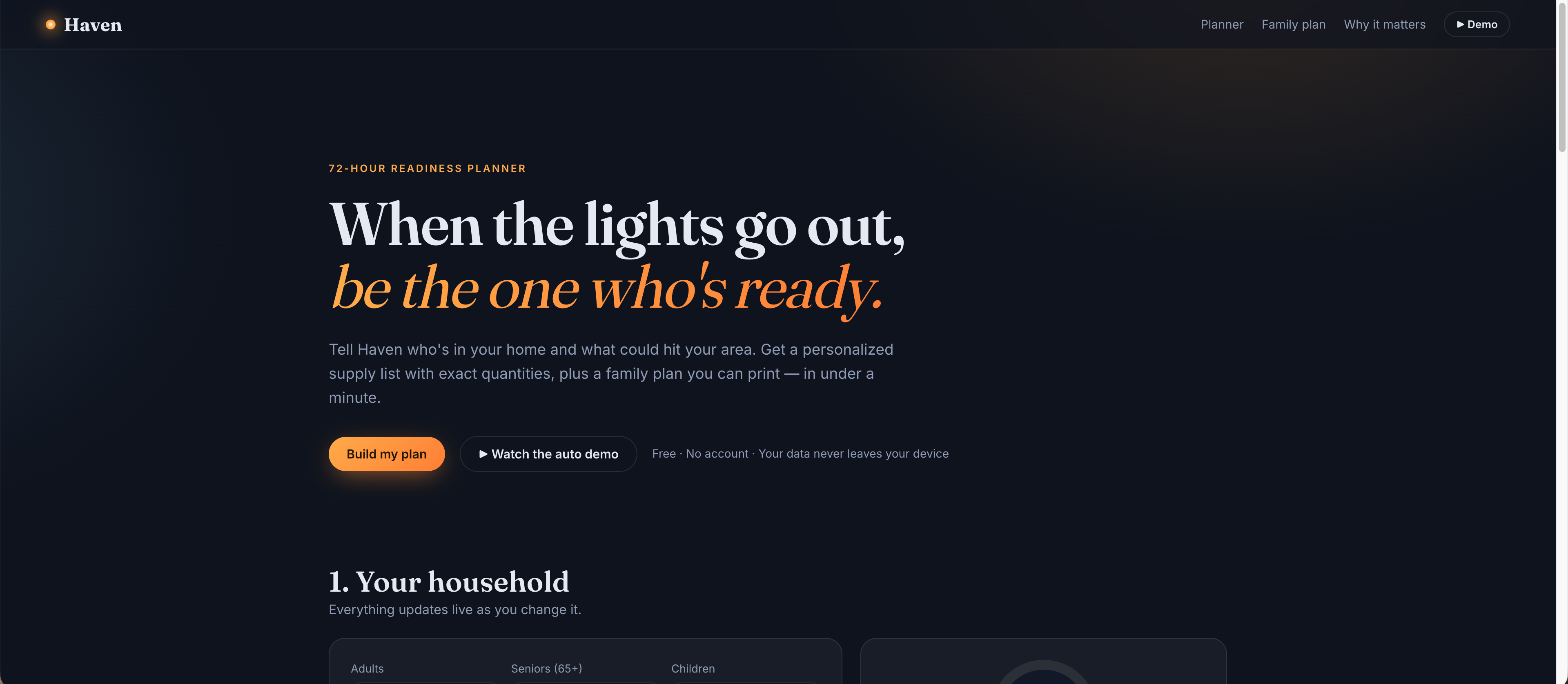
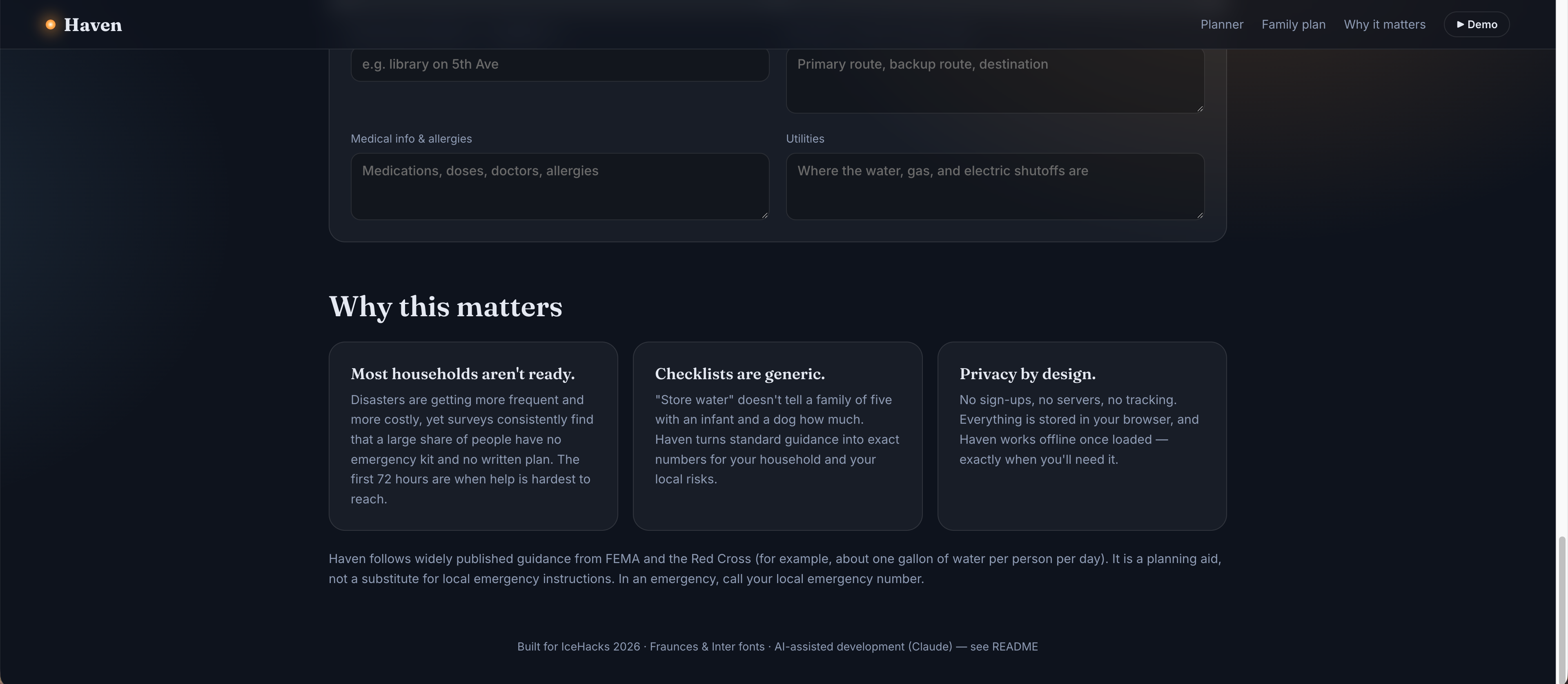
Most households have no emergency kit and no written plan, and the first 72 hours of a disaster are when help is hardest to reach. Existing checklists say "store water" without telling a family of five with an infant and a dog how much, and they rarely adapt to the hazards where you actually live. I wanted something that gives you exact numbers for your own household, works when the internet is down, and doesn't ask for an account or your data.
What it does
Haven builds a personalized 72-hour (up to 14-day) readiness plan:
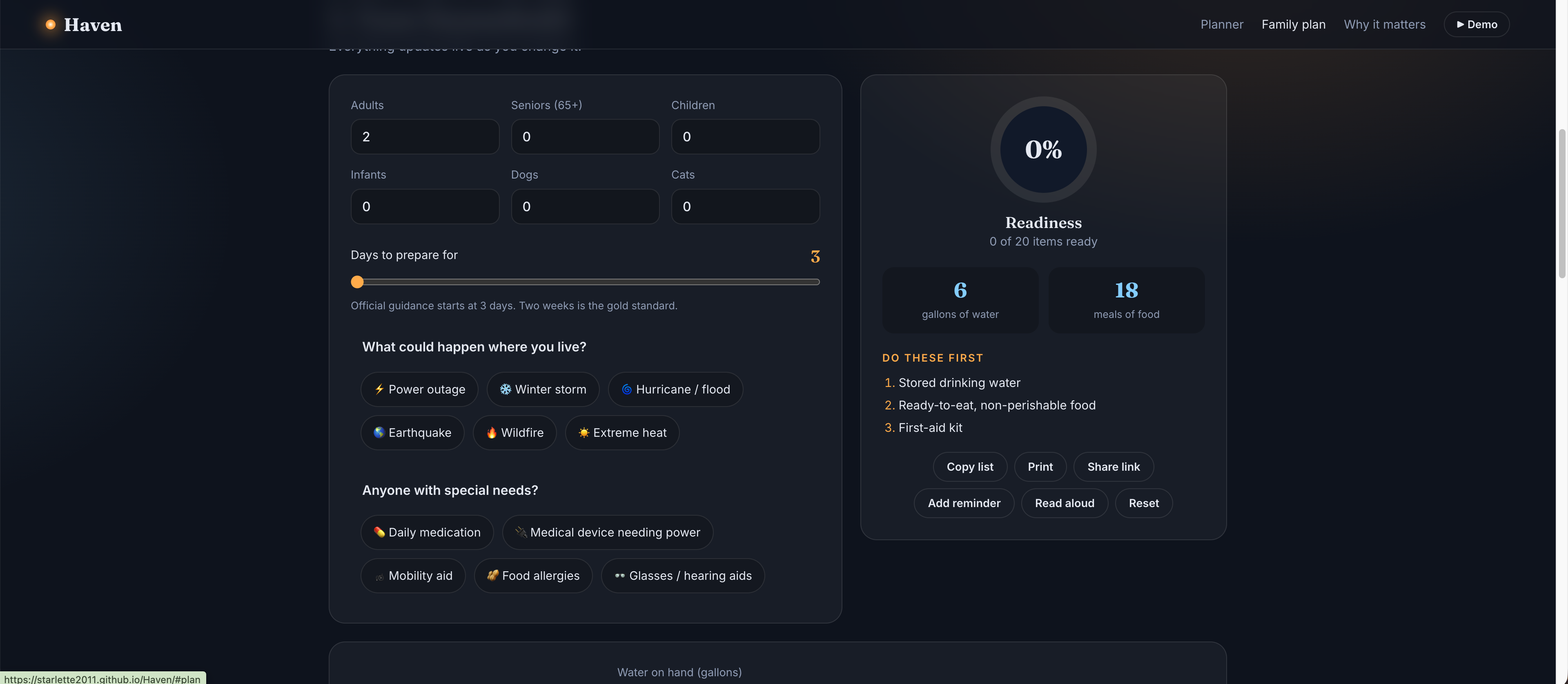
- Household-aware quantities: adults, seniors, children, infants, dogs and cats go in, and exact amounts of water, meals, formula, diapers, batteries and masks come out, based on widely published FEMA and Red Cross guidance (about one gallon of water per person per day).
- Hazard-specific items: power outage, winter storm, hurricane/flood, earthquake, wildfire and extreme heat each add the right gear (CO detectors, N95 masks, go-bags, cooling supplies and more).
- Special needs: daily medication, powered medical devices, mobility aids, allergies, glasses and hearing aids.
- Runway calculator: enter what you already own and see how many days you could last and exactly what you're short.
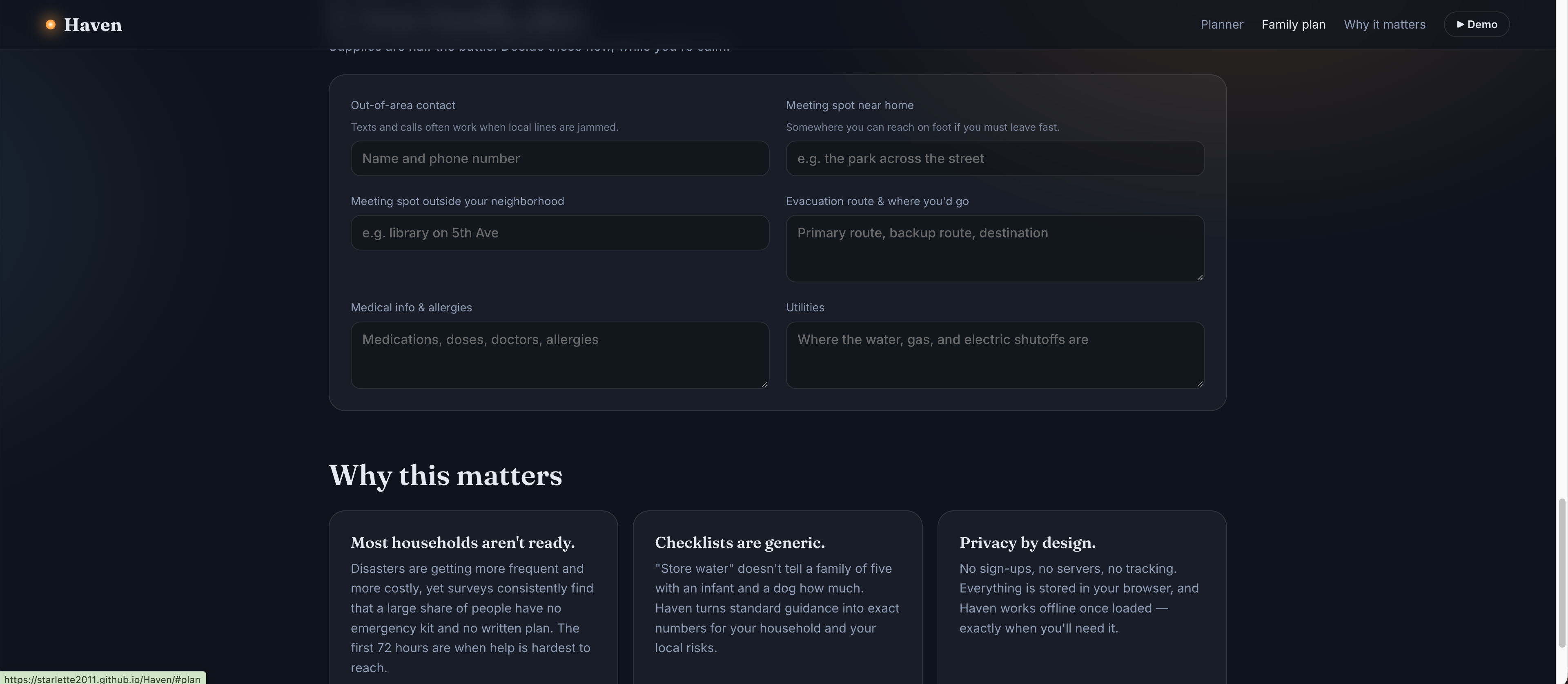
- Readiness score and "do these first" list, plus a printable family plan (out-of-area contact, meeting spots, evacuation route, medical info, utility shutoffs).
- Share link, 6-month calendar reminder, copy/print, and read-aloud for accessibility.
- Auto demo: one click plays a fully captioned walkthrough.
- Private and offline: no accounts, servers or tracking. Everything stays in the browser, and the site works offline as an installable PWA.
How I built it
Haven is a dependency-free static site: HTML, CSS and vanilla JavaScript, deployed on GitHub Pages. A small rules engine in JavaScript turns the household profile into categorized checklist items with computed quantities. State lives in localStorage, the share link encodes the household in the URL hash, and a service worker plus a web app manifest make it installable and offline-capable. The design uses Fraunces and Inter on a dark navy and amber theme, with print styles and a reduced-motion mode. I built it with AI assistance (Claude) during the hacking period and reviewed and tested the result myself.
Challenges I ran into
- Keeping quantities sensible and simple across many household combinations, such as infants who need formula but not regular meals, or pets that add water and food.
- Making the captioned demo safe: it runs on a temporary copy of the state so it never overwrites a user's saved plan.
- A service-worker caching bug that kept serving old files after updates. I fixed it by switching to a network-first strategy with an offline fallback.
Accomplishments that I'm proud of
A tool that is useful in under a minute, needs no signup, works with no internet, and is built around privacy from the start.
What I learned
Planning tools only help if people finish using them, so every step has to be fast, concrete and low-friction. I also learned how service workers, offline-first design and accessibility choices (keyboard focus, reduced motion, read-aloud) shape a real product.
What's next for Haven
Localized hazard data by ZIP code, multi-language support, shareable plans for neighbors and older relatives, nearby shelter and cooling-center lookup, and more region-specific guidance.
Disclaimer: Haven is a planning aid, not a substitute for local emergency instructions.
Built With
- claude
- css3
- github
- google-fonts
- html5
- javascript
- localstorage
- pwa
- service-worker
- web-app-manifest
- web-speech-api

