-
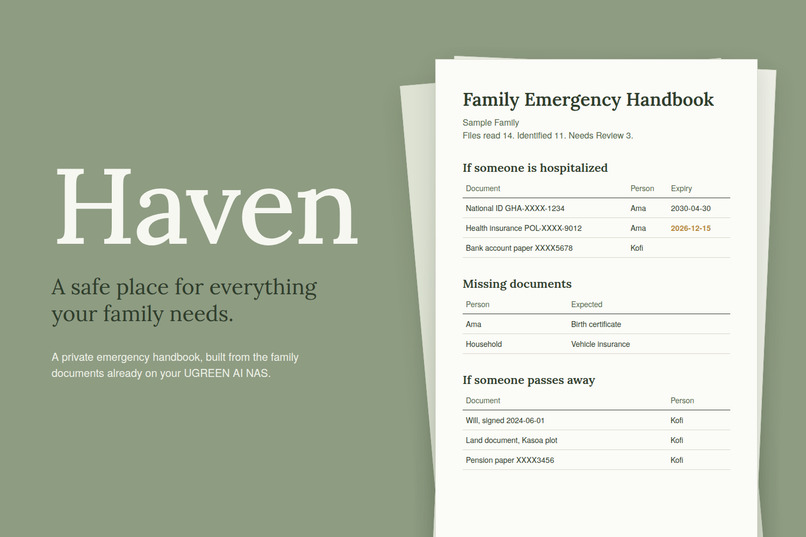
Haven turns a family's important documents on the NAS into one private emergency handbook.
-
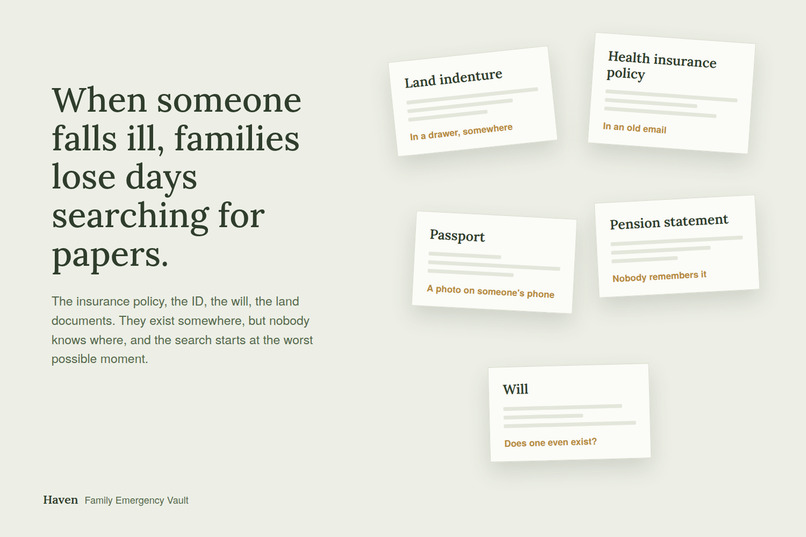
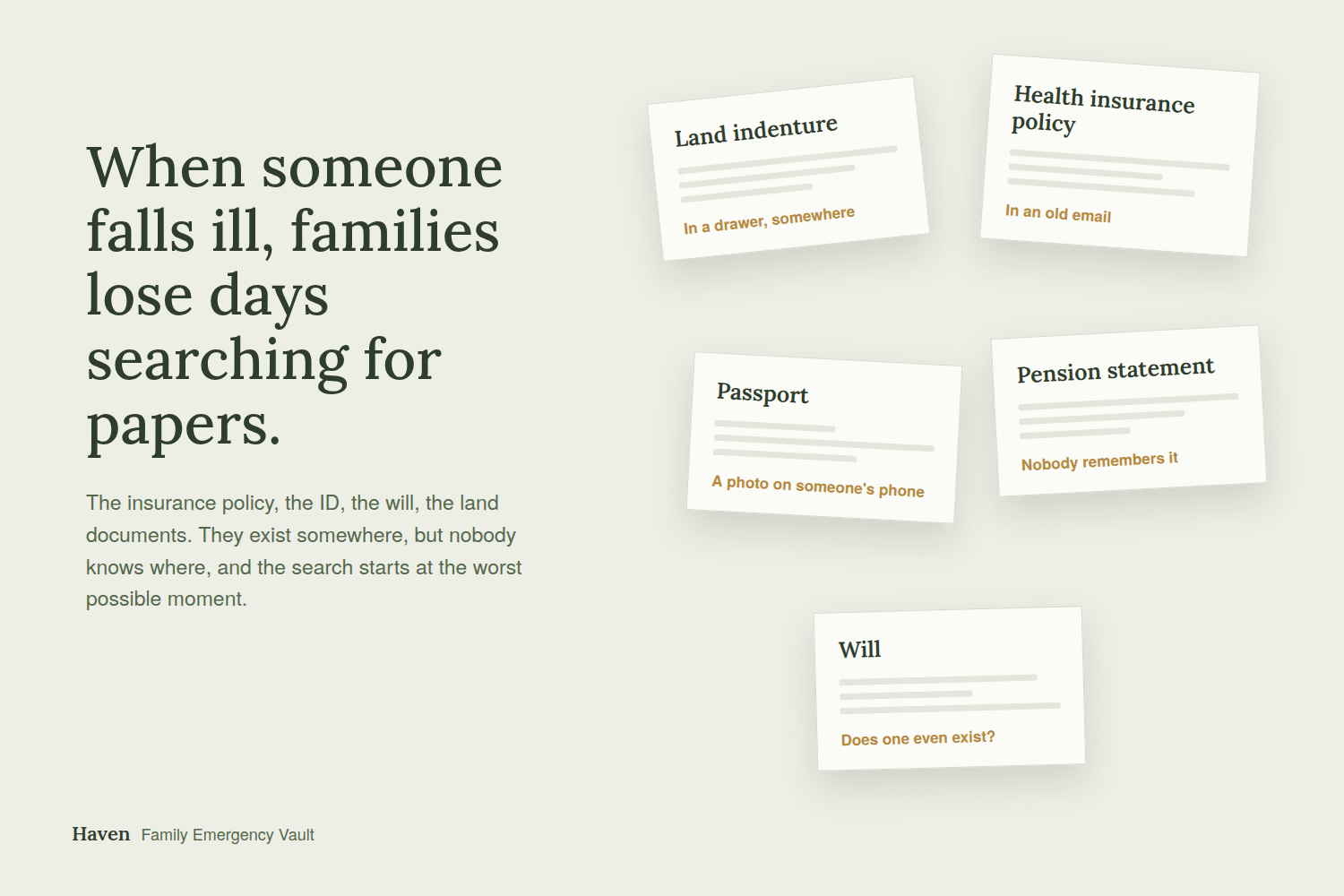
The problem: when someone falls ill or passes away, families lose days searching for scattered papers.
-
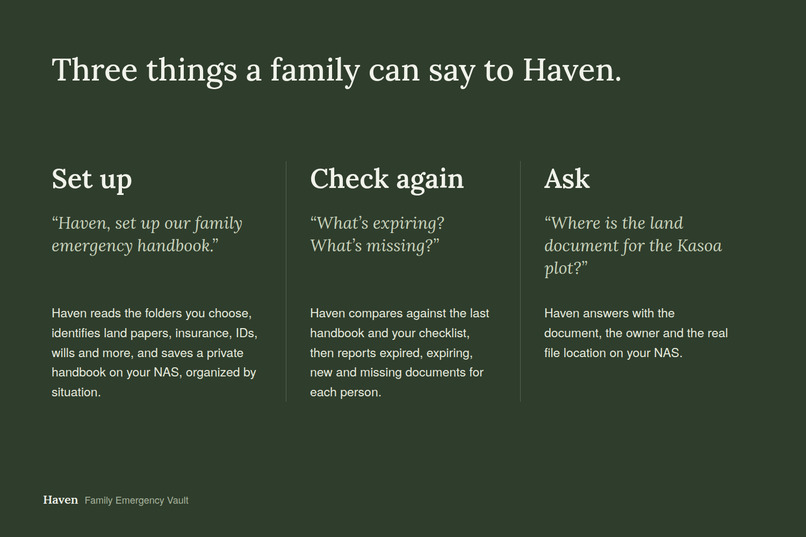
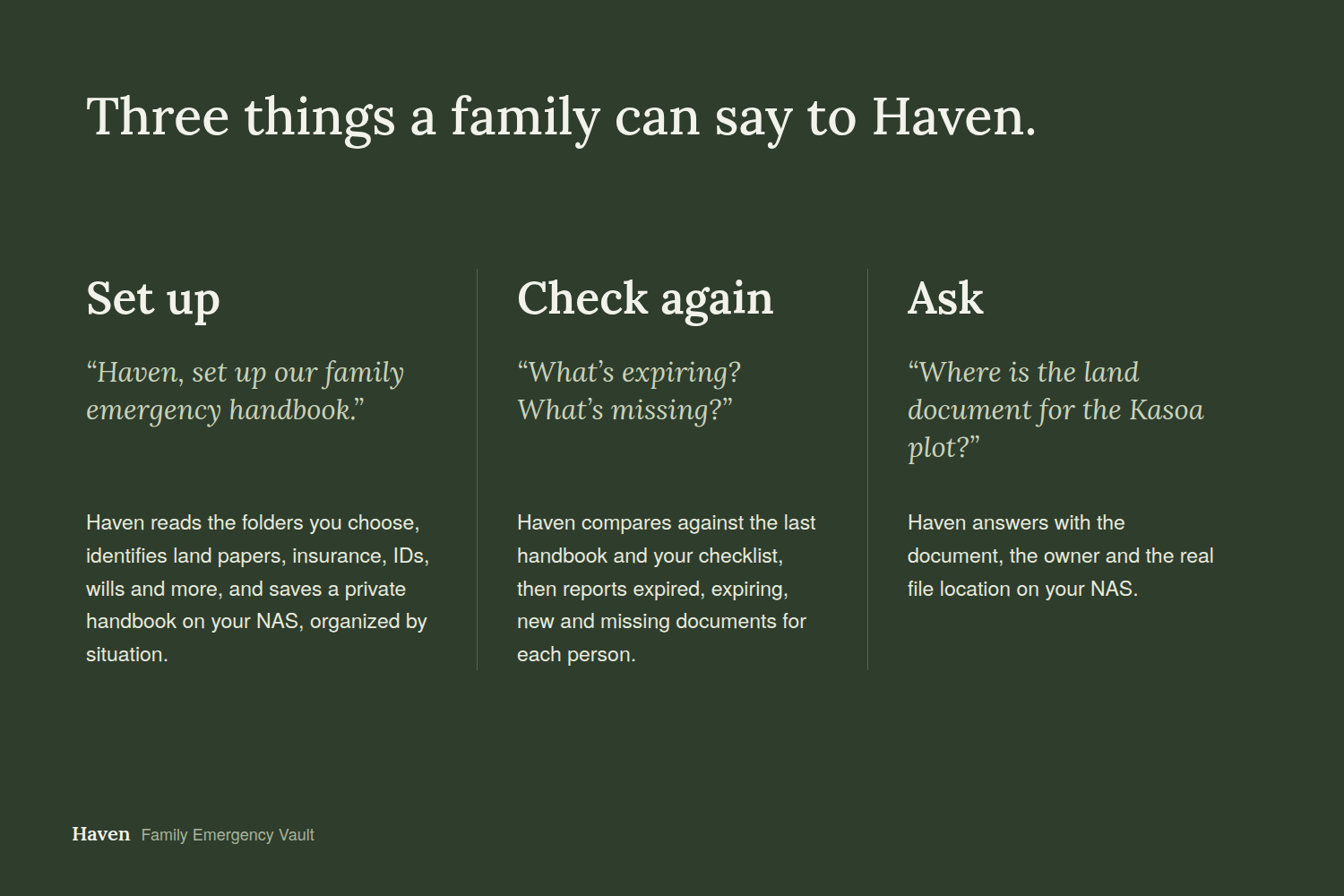
Three modes, triggered by plain language: Set up, Check again and Ask.
-
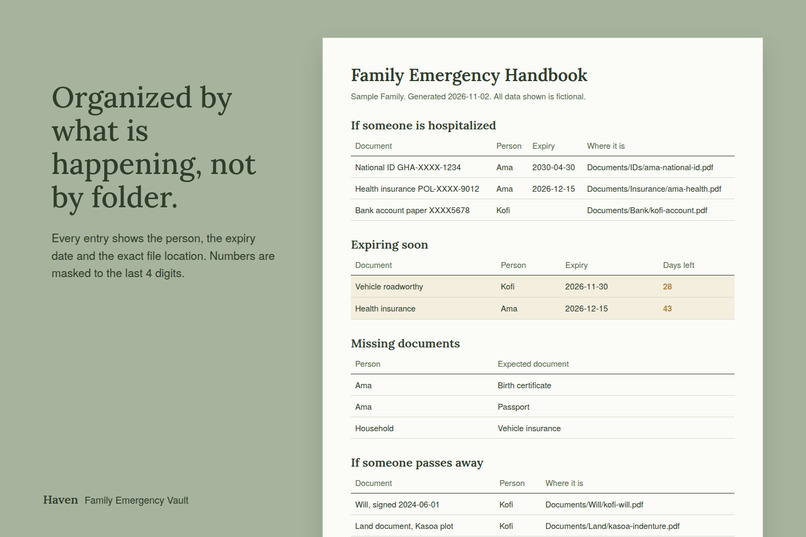
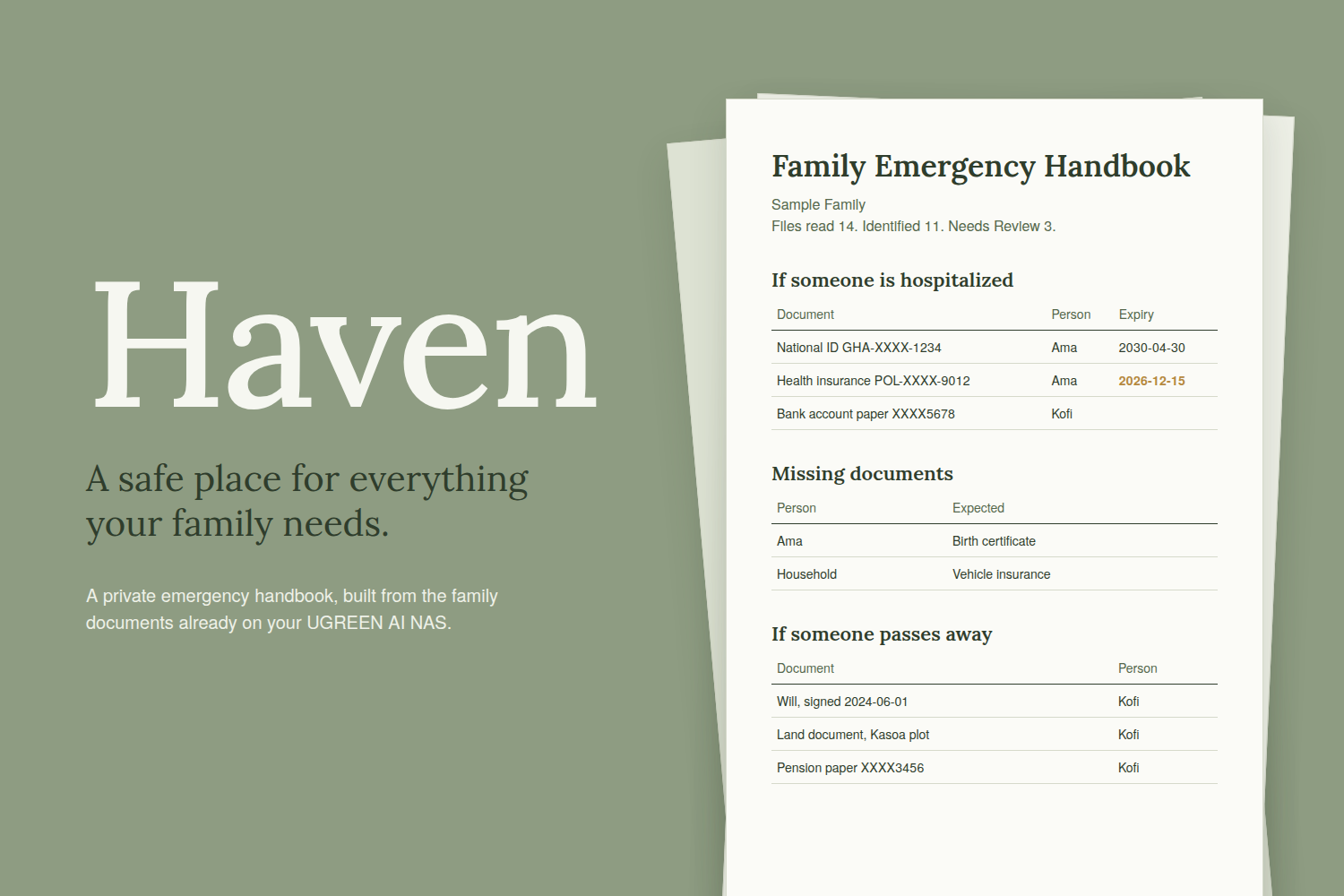
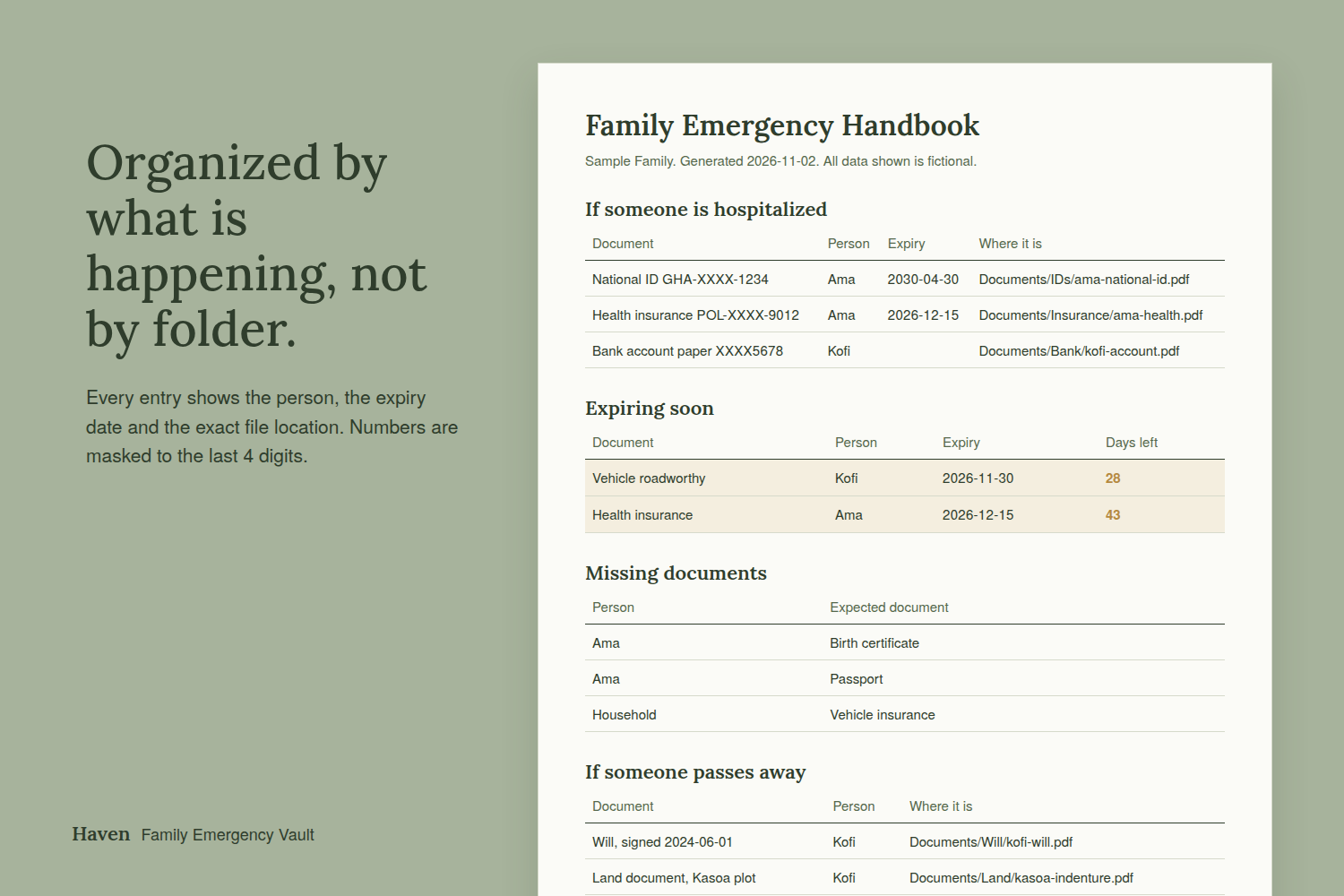
The handbook is organized by situation, with expiry dates, file locations and missing documents. All data shown is fictional.
-
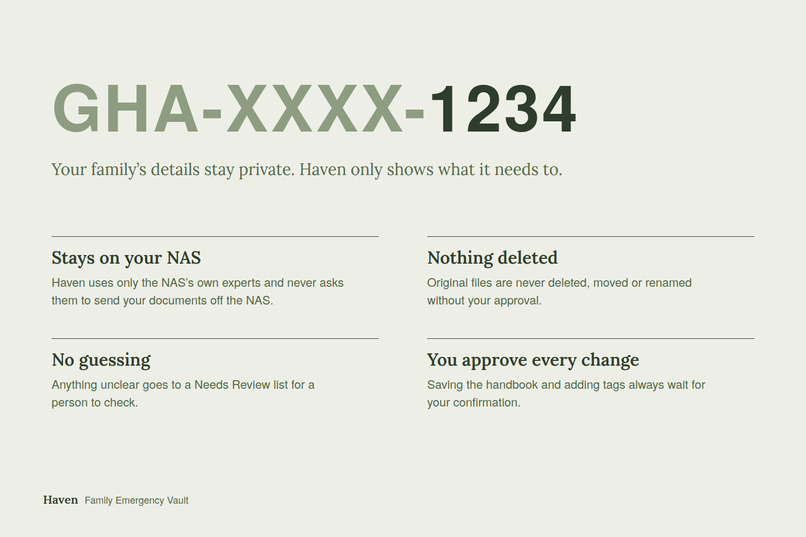
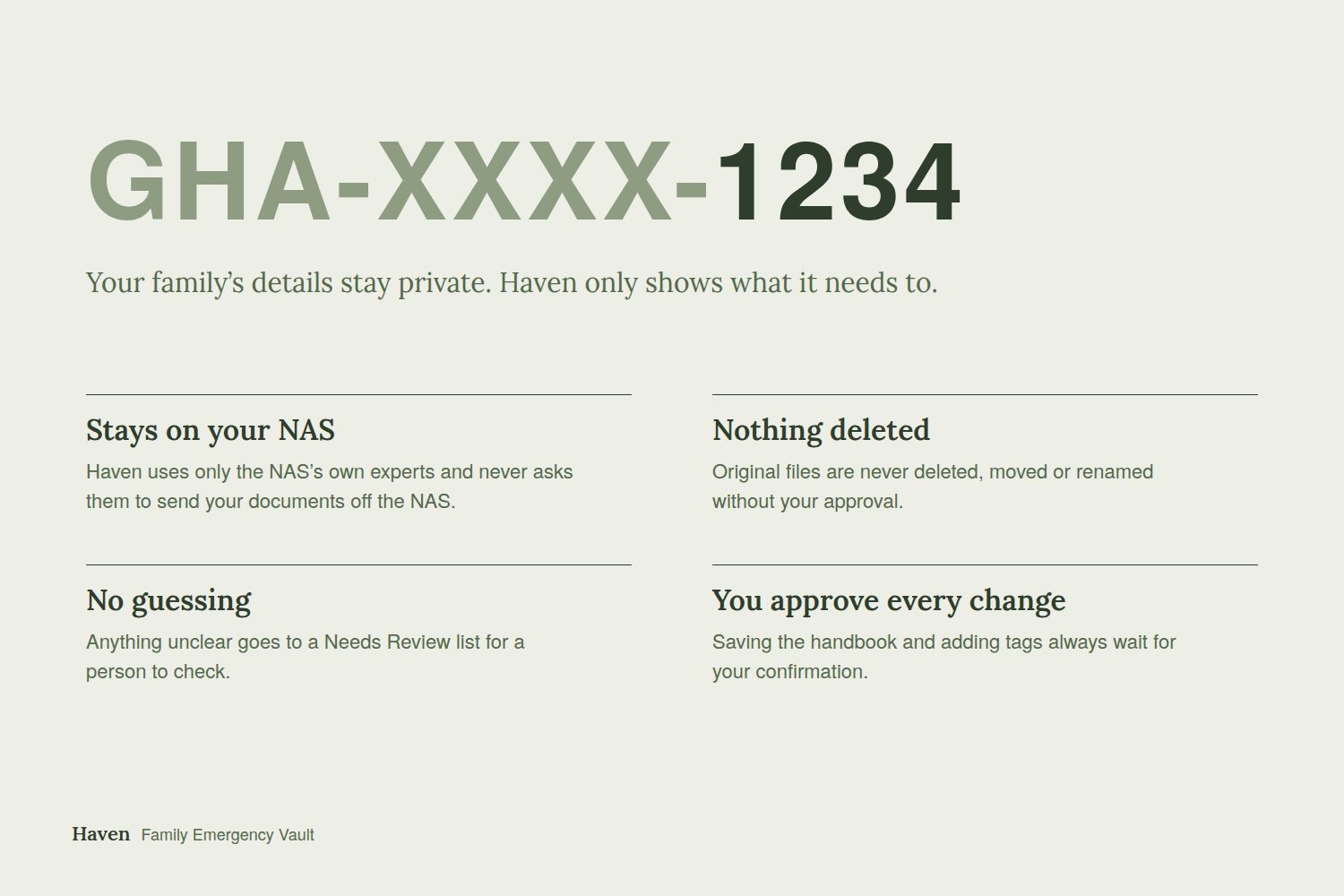
Built for privacy: numbers masked to the last 4 digits, nothing deleted, every change approved, and unclear files sent for review.
Inspiration
In many families, important papers are scattered everywhere: a land indenture in a drawer, an insurance policy in an old email, a passport photo on someone's phone, a pension statement nobody remembers receiving. Everything is fine until something goes wrong. When a parent is suddenly hospitalized or passes away, the family has to find the health insurance, the ID, the will, the land documents and the bank papers at the worst possible moment, often while grieving.
In Ghana, where I live, this is a very real problem. Families lose days searching, and sometimes documents are never found at all. I wanted to build something that does the searching before the emergency, privately, on storage the family already owns.
What it does
Haven is an AI Skill for UGREEN AI NAS that turns a family's documents into a private Family Emergency Handbook, saved on the NAS. It works in three modes:
- Set up: the user picks the family document folders, names the family members, and confirms a checklist of documents each person should have. Haven reads every document and photo, identifies land documents, insurance policies, IDs and passports, bank and pension papers, certificates, wills and vehicle papers, and records the owner, issuer and dates.
- Check again: Haven compares the folders against the last handbook and reports what has expired, what is expiring soon, what is new, and which expected documents are missing for each person.
- Ask: family members can ask questions like "Where is the land document for the Kasoa plot?" and get the answer with the real file location.
The handbook is organized by situation, not by folder: what you need if someone is hospitalized, if someone passes away, when travelling, or when an ID is lost. Every entry points back to the original file.
Safety is built in. ID and account numbers are masked to the last 4 digits, original files are never deleted, nothing is moved or renamed without explicit approval, and anything unclear goes to a Needs Review list instead of being guessed.
How we built it
Haven is a pure orchestration Skill written in Markdown, following the Uliya Skill Development Standard. I used the official UGOS Skill Creation Tool (uliya-skill-kit) with Claude Code to read the capability catalog and confirm every step maps to a real NAS capability before writing anything:
ug-filesystemandug-filemgrvia file-agent to list folders, find the latest handbook and optionally tag filesug-documentvia document-agent to identify documents, extract details and answer questionsug-photovision-ocrvia photo-agent to read text from photos and scansug-knowledgesave-textvia knowledge-agent to save each dated handbook
The handbook ends with Setup, Checklist and Inventory sections in a fixed format, so later runs can read them back and only re-read files that are new or changed. The package passes the kit's checker with zero errors and zero warnings.
Challenges we ran into
- No "classify" action. The catalog has no built-in document classifier, so Haven defines its own document types, identification hints and review rules, and routes uncertain results to Needs Review.
- Scanned documents. The document expert has no OCR option, so photos and scans go through the photo expert's OCR, and Haven identifies them from the recognized text with lower confidence.
- No diff action. There is no built-in way to compare two runs, so I designed the handbook format itself to carry the data needed for comparison.
- Knowing what is missing. A system cannot know a document is missing unless it knows what should exist, which led to the per-person checklist.
- Privacy without guarantees. The catalog does not state where each capability processes data, so Haven enforces a local-only rule itself by avoiding capabilities that may process data elsewhere, and says so honestly.
Accomplishments that we're proud of
- A complete workflow from trigger to result, with every failure, empty result and approval state handled.
- The situation-based handbook, which turns a pile of files into something a stressed family member can use in minutes.
- Gap detection: Haven tells you what is missing before you need it.
- Passing the official checker with zero errors and zero warnings on the first full build.
What we learned
I learned how to design an AI Skill as an orchestration of expert agents rather than as code, how important it is to only promise what the platform actually supports, and how much careful wording matters when an AI is handling a family's most sensitive documents.
What's next for Haven: Family Emergency Vault
- Testing on a real UGREEN AI NAS with real-world scans and photos, and tuning the identification hints.
- Scheduled checks and reminders before documents expire, if UGOS adds scheduling.
- Support for more local document types and languages.
- A shared, read-only view so trusted family members can open the handbook easily in an emergency.
Built With
- ai-agents
- claude
- claude-code
- markdown
- ocr
- ugos
- ugreen-ai-nas
- uliya-skill-kit

Log in or sign up for Devpost to join the conversation.