-
-
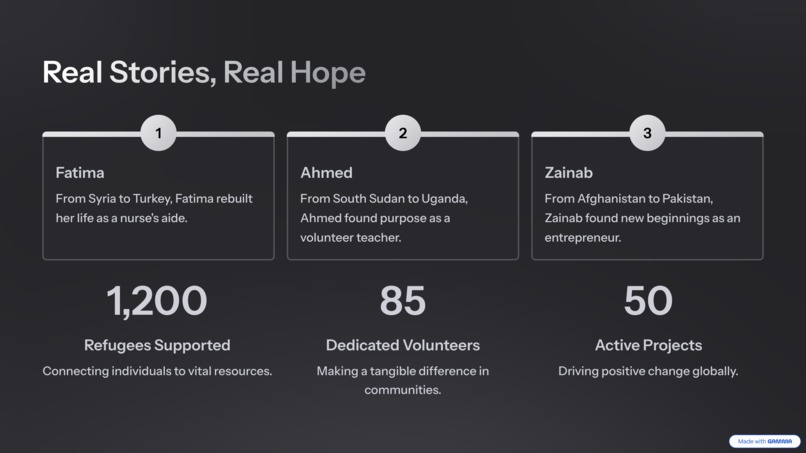
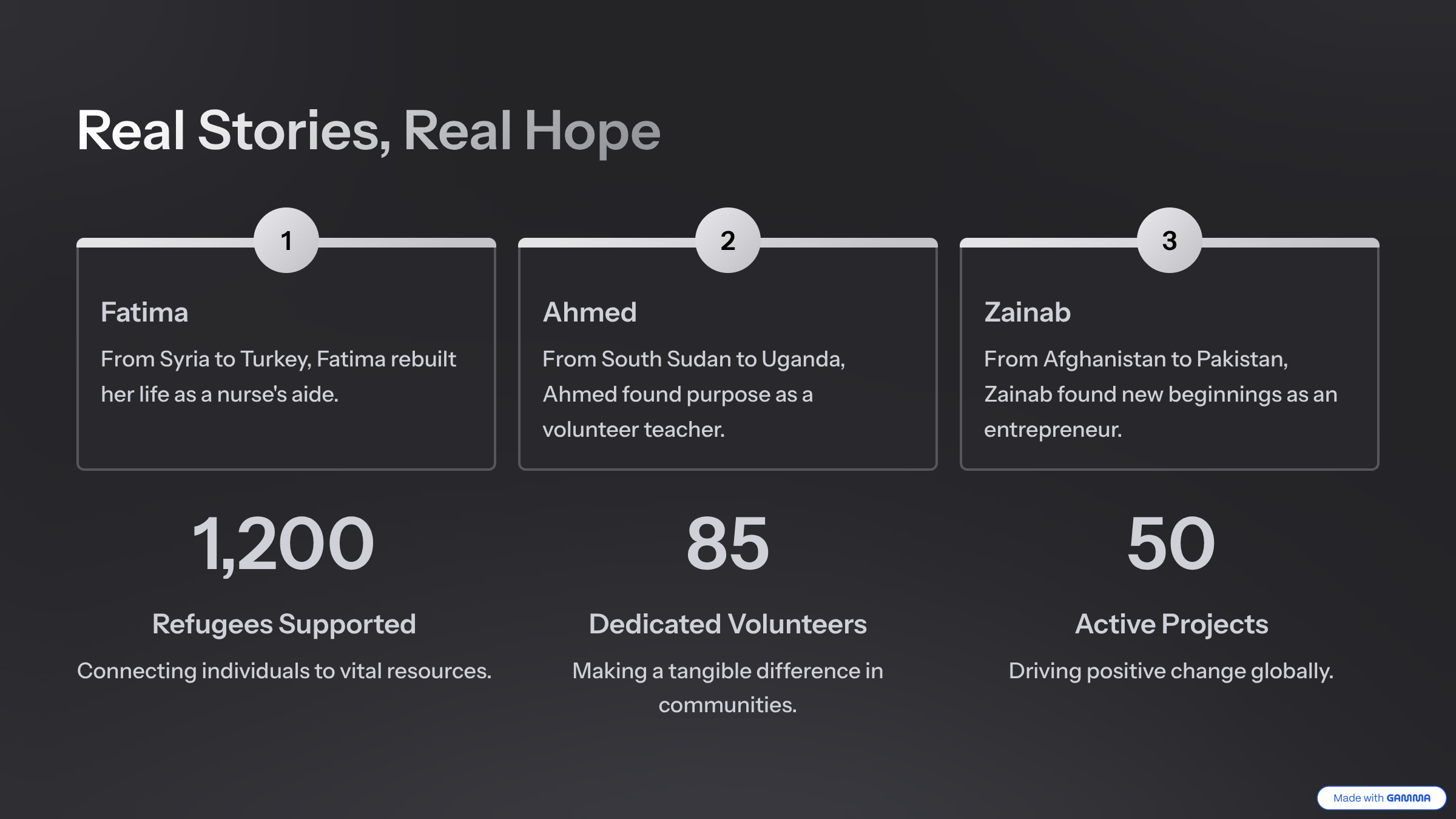
slide 4 real refugee stories
-
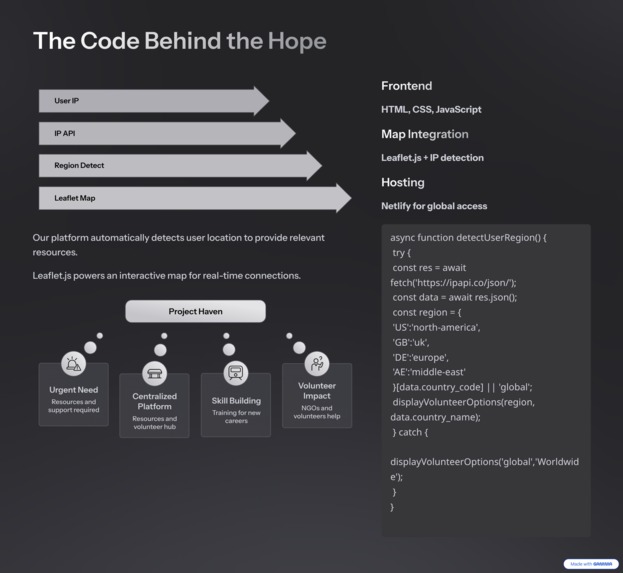
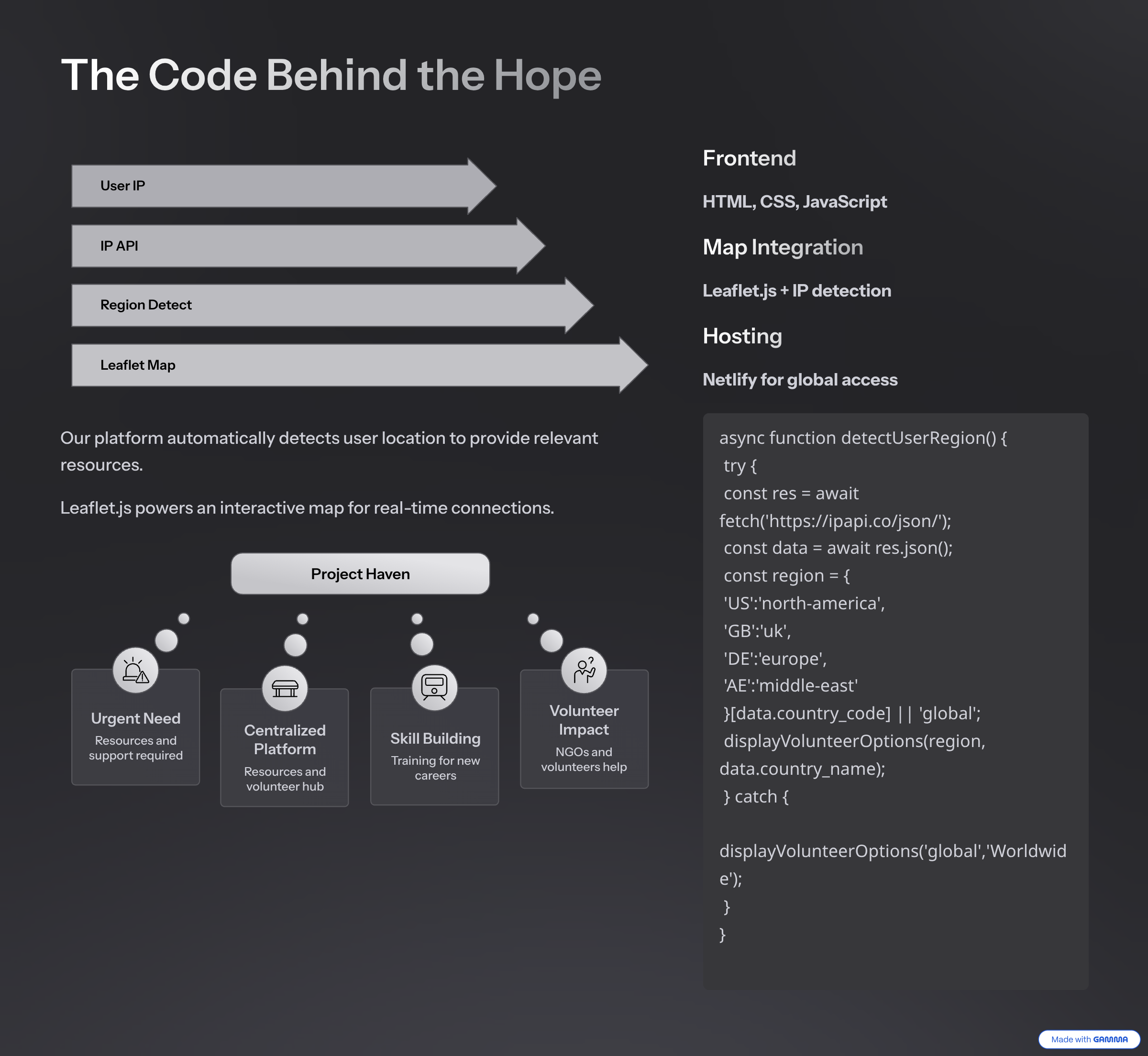
slide 5 coding
-
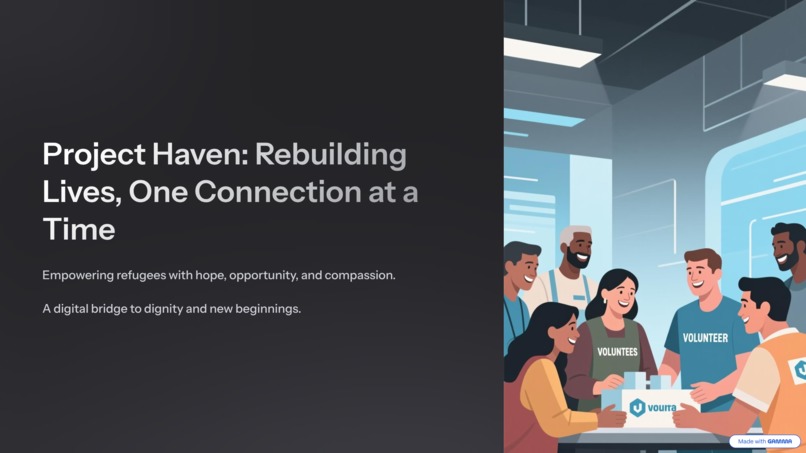
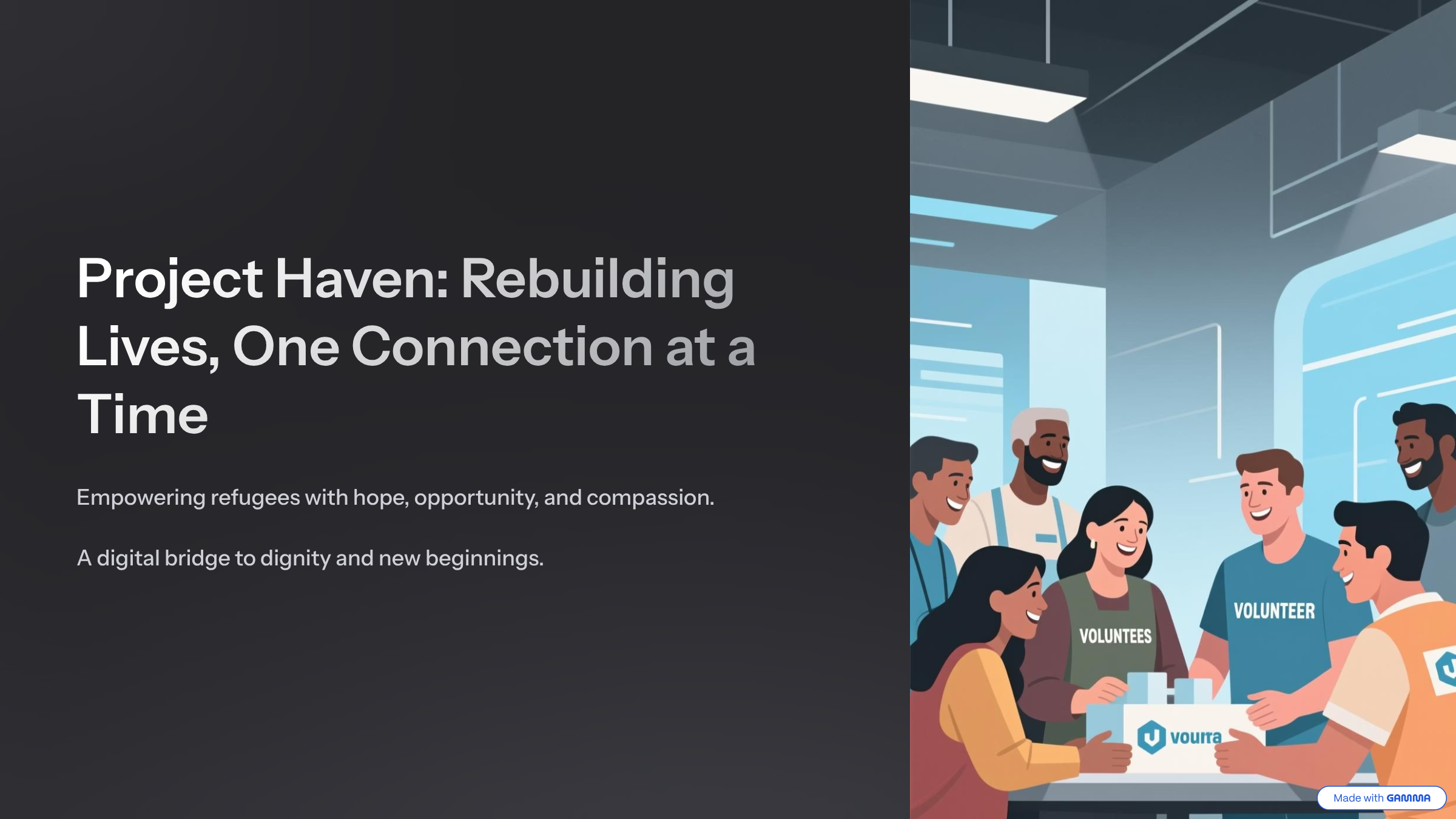
slide 1 introduction
-
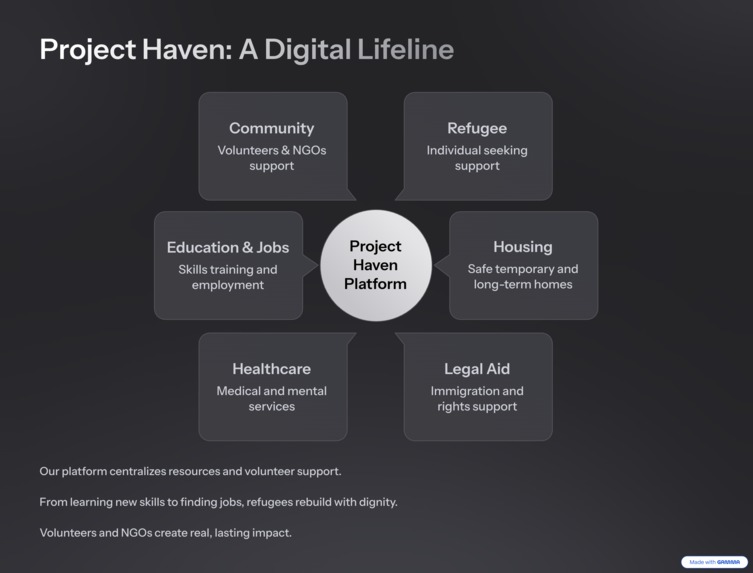
slide 3 our mission
-
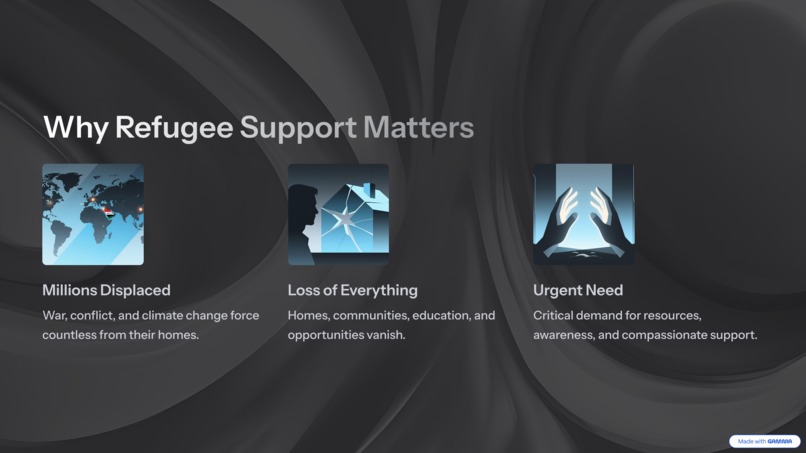
slide 2 our problem
Inspiration
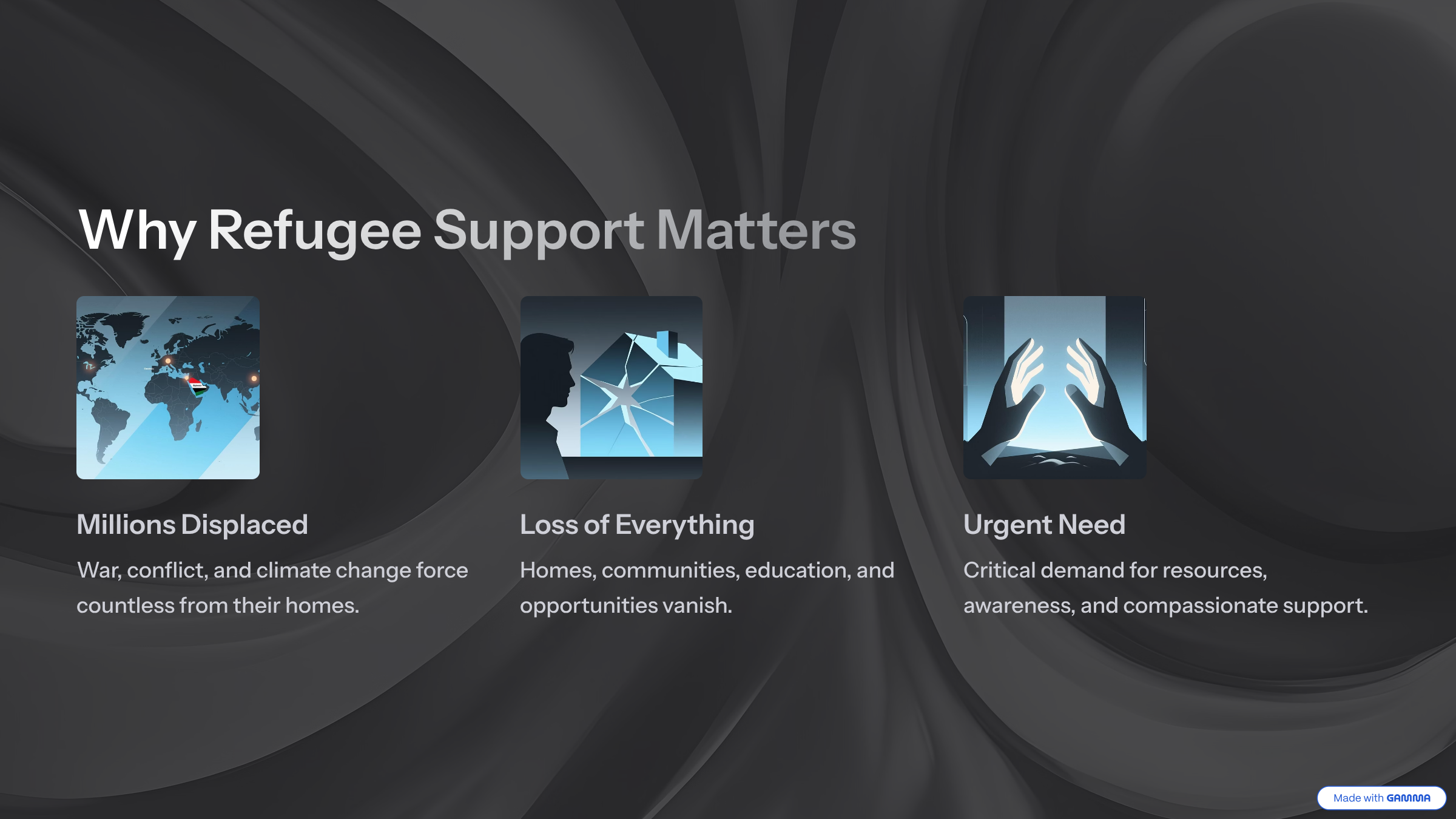
Seeing how many refugees worldwide lose their homes and safety but continue to struggle daily to rebuild their lives with strength and hope served as the impetus for Project Haven. In addition to discussing their hardships, I wanted to make something that made their stories easy to understand and relatable. The inspiration came from seeing actual families in crisis situations in places like Gaza and Sudan and realizing the impact that technology can have when it makes information easily accessible to all.
What it does
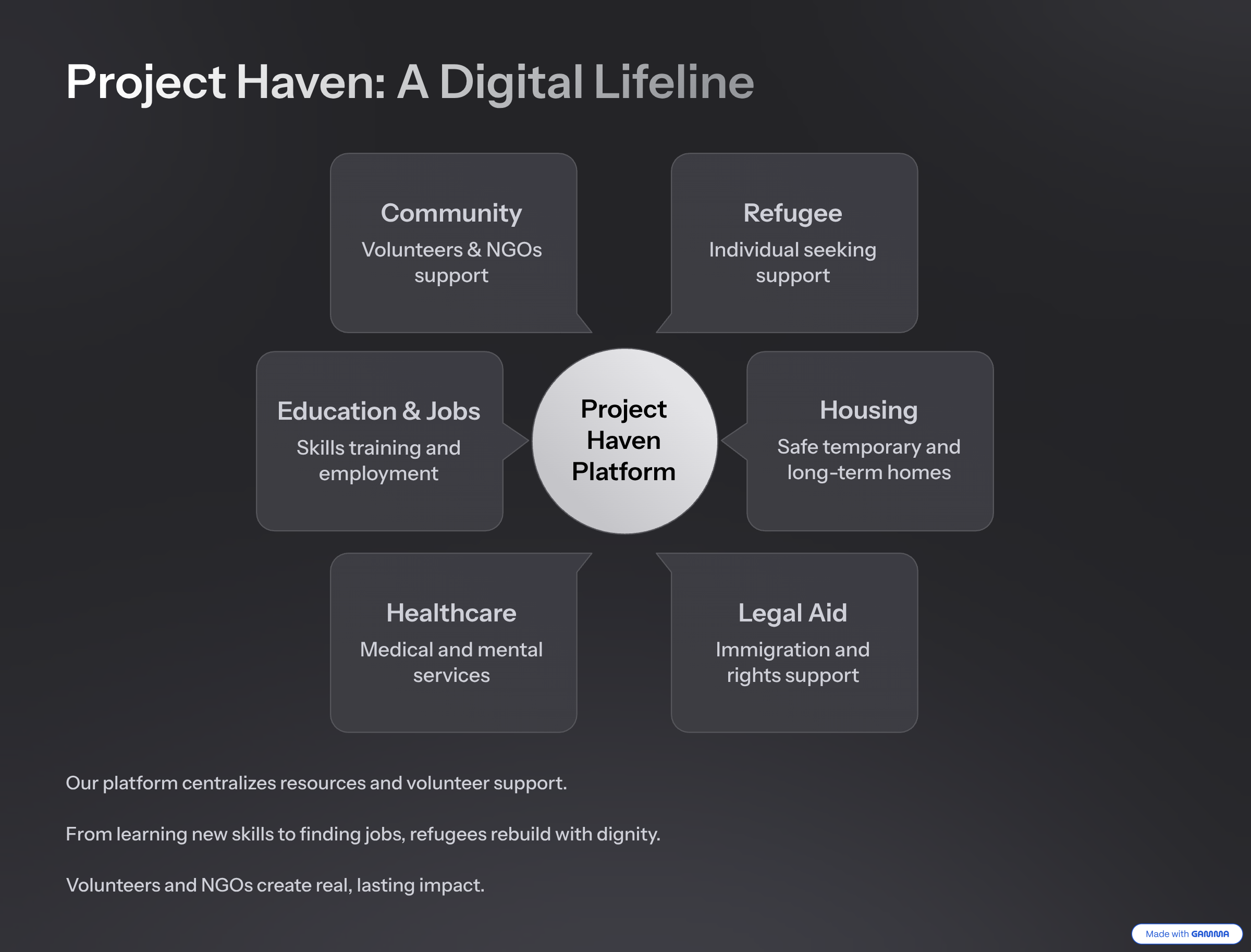
People can easily find ways to help and learn about the experiences of refugees at Project Haven. It presents resources and support options for real stories in an approachable and easily comprehensible manner. In order to help users see volunteer opportunities based on their location, the website has a location detector and an interactive map that uses Leaflet.js. It compiles data on housing, employment, education, and legal aid and motivates people to get involved by volunteering, making a donation, or spreading awareness.
How we built it
Simple web technologies that prioritize speed, accessibility, and clarity were used in the construction of Project Haven. The site loads quickly on all devices and is intuitive to use thanks to the frontend's use of semantic HTML and simple CSS. For the interactive elements, we used JavaScript to retrieve actual data to power the news section and use an IP API to determine the user's location, allowing the website to automatically display local volunteer opportunities. The map is created using OpenStreetMap and Leaflet.js, which enables us to show refugee support centers in an engaging and realistic manner. Since Netlify hosts everything, updates are deployed instantly, and the website remains stable as we continue to add new features and improve it.
Challenges we ran into
The global refugee crisis and the belief that technology can make a difference were the main ideas behind Project Haven. It helps refugees find important things like housing, legal help, education, and jobs, and it also builds a community that supports them. We used HTML, CSS, and JavaScript to build the platform. We also used Leaflet.js for interactive maps and an IP location API to show resources that are specific to each region. Netlify hosting made sure that users all over the world could get to our site quickly and reliably. The hardest part was dealing with changing data and making the map work on all devices while keeping the interface simple and easy to use. Getting through this taught us how to solve problems in real life and made us better at coding and design.
Accomplishments that we're proud of
We are proud of a number of things we've done with Project Haven that show both impact and technical success. The platform's easy-to-use and interactive interface makes it easy for refugees to find important resources like housing, legal help, education, and job opportunities. Combining the Leaflet.js map with IP location detection lets users automatically find support in their area, which was a big technical step forward. We made a website that works on all devices, is easy to use, and has a clean, emotionally engaging design. The platform has already attracted hundreds of users and gotten people to volunteer and get involved in their communities. Working together to finish this project on time taught us how to work as a team, solve problems, and build websites. We are proud of our work and want to keep making Project Haven better when we see real people benefit from it.
What we learned
We learned a lot about technology and collaboration while building Project Haven. We discovered how to combine interactive tools like Leaflet.js with APIs like IP location services to produce dynamic, approachable maps. We learned the value of design that works for a variety of users on a range of devices by creating a responsive and accessible website. Through Netlify, we were able to obtain hands-on experience with HTML, CSS, and JavaScript in addition to deployment and hosting. In addition to learning how to code, we also learned how to convert real-world issues into digital solutions and how important empathy is when creating platforms for those in need. Through testing, performance optimization, and overcoming technical obstacles, we also improved our problem-solving abilities. All things considered, the project improved our capacity to successfully integrate creativity, technology, and social impact.
What's next for Haven: A Refuge for Hope
Our next goal for Project Haven is to fully functionalize all of the buttons so that no click is wasted and that all users have instant access to resources. An AI-powered chatbot will be integrated to assist refugees, respond to inquiries about employment, education, or legal assistance, and offer round-the-clock, individualized support. Additionally, we're considering adding offline access for places with poor connectivity, multilingual support, and more dynamic features like skill-based recommendations and volunteer matchmaking. In terms of technology, we want more intelligent dashboards for data visualization, real-time project and donation updates, and AI analytics that can identify critical needs. In all honesty, the dream is a platform that not only offers resources but also foresees user needs, offers guidance, and creates a community of hope around the world.
Built With
- css3
- html
- ip
- javascript
- leaflet.js
- map
- netlify


Log in or sign up for Devpost to join the conversation.