Inspiration
Hatch Haven was born from two frustrations with modern mobile games: the predatory gacha that turns collecting into spending, and the time-sink design that turns casual play into a second job. We wanted to prove you could ship a creature-raiser where the gacha is the proud centerpiece (visible odds, visible pity counter, earn-only currency) and where no system requires more than 90 seconds of attention. The cozy aesthetic pulls from Ghibli meadows and Sky: Children of the Light; the multiplayer-by-default setting pulls from Horizon Worlds Mobile's always-online social fabric. The result is a creature-raiser designed to be played in 5-15 minute bursts — for commuters, lunch-break scrollers, and anyone who's been burned by a gacha that wanted their rent.
What it does
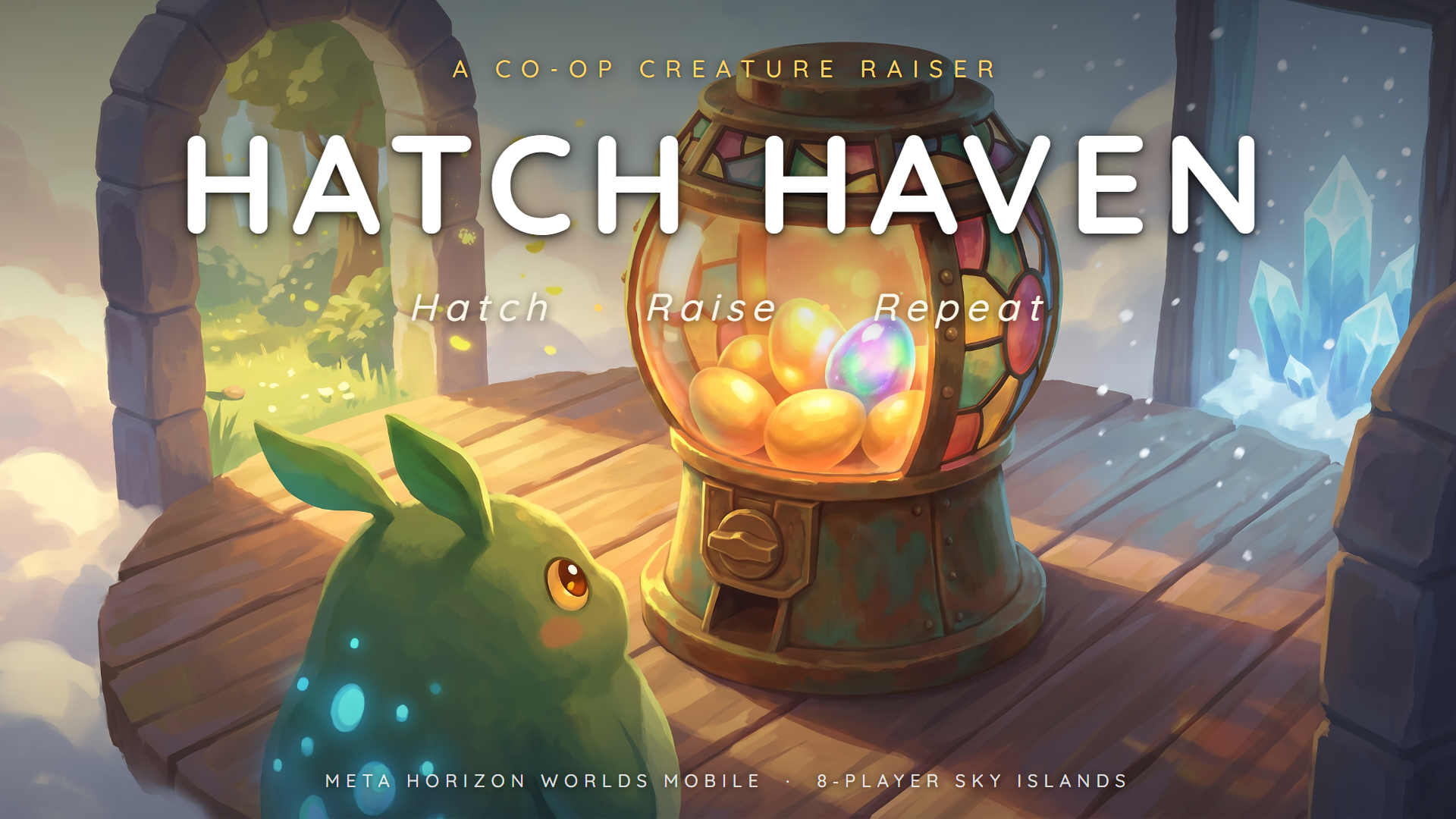
Hatch Haven is a pocket-sized, co-op creature garden for Meta Horizon Worlds Mobile. You and seven other players share a floating sky-island with three elemental biomes (Mosswild / Frostspire / Tideglass). The loop is a 3-beat ritual: earn Sparks in 60-second arcade minigames (Tap-Rhythm, Sumo-Smash) → roll a visible-odds Egg Gachapon → raise whatever elemental Ember hatches, watching it evolve over 48 hours based on how you fed it. Three pillars hold the experience together: cozy before clever (no dark modes, no gritty textures), honest spectacle (the gachapon is the loudest, proudest, most-photographed object in the world), and readability first (every creature is a silhouette before it's a texture). Three minigame prototypes are scope-locked; the rest is open.
How we built it
This submission is a pre-production package — no playable build, just the four design artifacts that prove the team is ready to ship:
- A Game Design Document covering concept, target player, core loop, mechanics, monetization, technical choices, art direction, and risk hypotheses.
- A Player Journey Map with a full 36-beat record of the first 15-minute session, an emotional arc chart, and the two load-bearing decision points (2:00 and 11:00).
- A Visual Concept Package with the three pillars, three silhouette rules, a full palette, five character/world renders, one UI wireframe, and the gachapon design philosophy.
- A Production Plan with an 8-week sprint, named risks, four falsifiable hypotheses, and five milestone tests (T1 paper playtest → T5 50-player soft launch).
The build itself is scoped for a solo creator + 3D artist (contract, weeks 1-4) + audio designer (contract, weeks 4-7). Pipeline is TypeScript-only on Horizon's in-world API, server-authoritative Ember/inventory state with client-predicted minigames, 150MB in-world asset memory ceiling, and the three Embers sharing a base sphere mesh so only textures differ.
Challenges we ran into
- Compressing a 36-beat first session into a Journey Map. The full record is dense — every screen, action, emotion, difficulty, and decision for 15 minutes — but the map has to be skimmable in 30 seconds. We solved this by encoding the vocabulary in column-header glyphs (⏱ 🖥 🎮 ❓ 💓 📈) so the legend lives inside the table, not in a separate key.
- Making the gachapon feel honest. The default assumption players bring to any gacha is "they're hiding the odds." Rebuilding that trust meant putting visible odds, a visible pity counter, and the earn-only Spark economy in the first 5 minutes — and making the gachapon itself the most-photographed object in the world, not a menu the player has to dig for.
- Designing nine distinct Embers with consistent readability. Three elements × three size variants = 9 forms, every one a recognizable silhouette at arm's length on a 6-inch phone. The silhouette rule (each Ember is identifiable by shape alone, with color/element as a secondary cue) was the constraint that made the renders cohere.
- The 90-Second Promise as a forcing function. Saying "no system can require more than 90 seconds of attention" sounds clean on paper but breaks against almost every modern progression system. The Daily Wanderer, the Harvest loop, and the 48h evolution timer all had to be redesigned to fit. Systems that couldn't were cut.
Accomplishments that we're proud of
- The 90-Second Promise as a binding design rule (no system requires more than 90 seconds of attention; no reward is hidden behind a multi-day gate on the first Ember).
- The honest-gachapon framing as a defensive moat — earn-only Sparks, cosmetic-only Bloom, visible odds, visible pity counter, no FOMO pressure. This dodges the post-Apple/Google lootbox regulation red flags that have hurt Western gacha.
- The Player Journey Map's 36-beat table showing exactly what the player sees, does, feels, and decides in the first 15 minutes — including the two load-bearing decision points that anchor the session.
- The visual identity built on three pillars (cozy before clever, honest spectacle, readability first) and a single palette rule (creature-identity lives in the body, mechanical-readout lives in the arc).
- The Production Plan with named risks, four falsifiable hypotheses, and five milestone tests — each test scoped to answer exactly one design question.
What we learned
- A 90-second ceiling is a feature, not a bug. Once you commit to "no system requires more than 90 seconds of attention," every system has to earn its place. Daily quests that take 5 minutes get cut. Harvest loops that gate progress on a 24-hour timer get redesigned. The constraint forces clarity.
- Visible odds change the entire feeling of a gacha. When the player can see "1 in 500 for a Prismatic," they're making an informed choice, not gambling blind. The pity counter compounds this — the player trusts the system because they can see when the guarantee kicks in.
- Silhouette rules scale. Designing 9 Embers with a single "what shape is this from across the room?" rule produced a coherent set without a hundred style-guide pages. The same rule scaled to biome layouts (sky-island, three portals, central spawn) and to the gachapon (round viewing chamber, ornate gears, stained-glass top).
- A Player Journey Map is a forcing function. Mapping the first 36 beats forced us to specify the difficulty curve, the emotion curve, and the decision moments — all of which were hand-waved in earlier drafts. Once the map exists, "I'll figure out the feel later" stops being an option.
- Pre-production is a deliverable. The four design artifacts aren't paperwork — they're the spec that de-risks the build. The 8-week sprint is a direct consequence of the choices made in the GDD, PJM, and VCP.
What's next for Hatch Haven
If selected, the 8-week build begins immediately. The plan:
- Wk 1-2: Tap-Rhythm and Sumo-Smash prototypes + Ember models (3D artist). T1 paper playtest.
- Wk 3: Gachapon SFX (chunk-chunk-chunk / kathunk-thunk-whirr) AND 5-second hatch VFX (crack → light-shaft → hatch) ship in-house, before the gachapon itself.
- Wk 4: Hand-off to contract audio + 3D artist with fully-spec'd bibles.
- Wk 5: T2 vertical-slice playtest with all three biomes and the gachapon loop.
- Wk 6: Polish + Horizon integration.
- Wk 7: T3 (replay rate) + T4 (lean-forward) tests.
- Wk 8: T5 soft launch with 50 invited players over 7 days. Targets: D1 40% / D3 20% / D7 10% / minigame replay 3+/session / gachapon pulls 2+/session.
Post-launch, the design doc outlines three expansion paths: a Live 8-player Co-op Raid (the "Lumina" event, weekend-only), Ember Stories (30-second animated vignettes when an Ember first evolves), and Creator Tooling for community worlds (letting players build their own biomes and trade them as visitable codes).


Log in or sign up for Devpost to join the conversation.