-
-
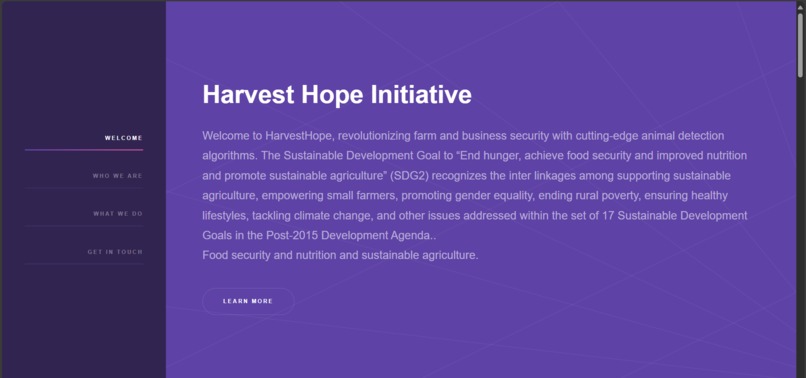
Project web based system
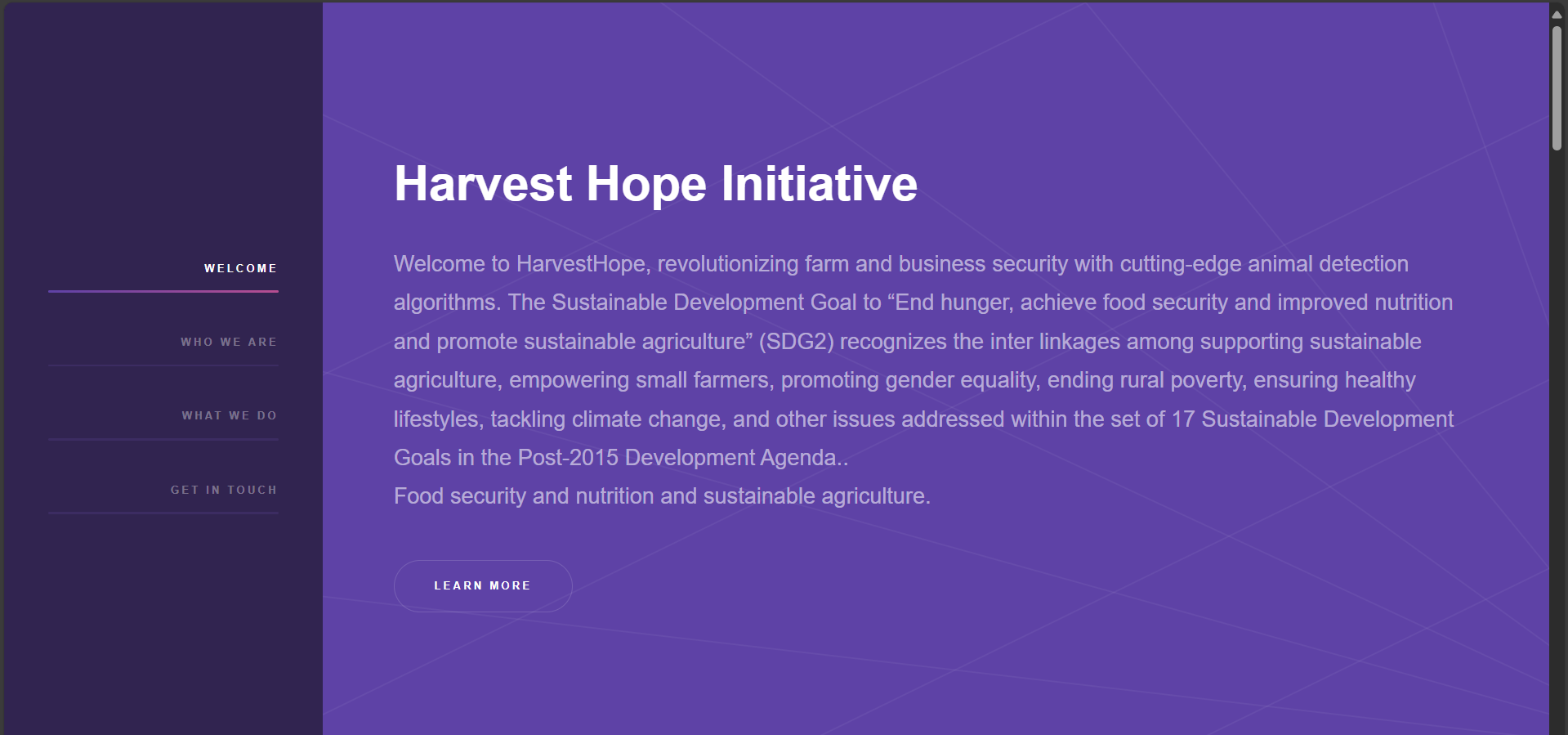
Inspiration
What it does
About HarvestHope Initiative
Inspiration: Growing up in a rural community in a peasant setup, I continually witnessed the devastating impact that birds, among other wildlife, have on crops, often characterizing great losses among farmers and plunging communities into further food insecurity and poverty. Inspired by SDG 2-to end hunger, achieve food security and improved nutrition, and promote sustainable agriculture-I envisioned a solution that would help protect crops and support farmers in achieving better yields.
What I Learned:
Throughout the development of HarvestHope, I came to understand that the integration of technology with traditional farming practices is indeed key. Further, solving problems related to agriculture-which have persisted through the ages-requires little less than state-of-the-art AI and machine learning. Solutions tailored for different regions and their specific challenges also became imperative.
Building the Project: HarvestHope was designed with state-of-the-art AI algorithms to detect and identify the presence of birds in crop fields. The system will trigger alarms to scare birds away, hence saving the crops from being destroyed. I used Python in developing the detection algorithms and integrated IoT devices for real-time monitoring and alertness. In testing the effectiveness and adaptability of the system in various environments, I collaborated with the local farmers.
Challenges Faced:
The main challenge was that in an environment characterized by the outdoors with immense variations, dynamic changes, the detection system must be fast and accurate. The other tricky parts are the weather conditions, the identification of several species of birds, and keeping the costs extremely low. This solution must be able to assure very user-friendly handling even for farmers who have little experience in this field. I was, therefore, able to surmount these difficulties after a series repetition and feedback, with the construction of a robust and reliable solution.
This will always be a work in progress, as more and more farmers' feedback is integrated into the tool, with new technologies leveraged to further enhance its capabilities. This project reflects the commitment toward the use of AI for social good, especially toward food supplies and enhanced capacity of agricultural communities.
How We Built It
HarvestHope was developed as a web application, wherein HTML and CSS were utilized in developing the frontend to ensure ease of use for farmers and other stakeholders. Object detection pre-trained models were used on the back-end, which had the ability to spot birds and other potential threats to crops with high accuracy. To monitor the fields in real time and trigger alarms, or provide actionable insights to farmers, it was decided to integrate these models into the system.
Accomplishments We Are Proud Of:
• Successful deployment of a functional prototype that is in place and accurately detects birds to protect crops, minimizing loss to small-scale farmers. • Creating an accessible, user-friendly platform that enables even less-experienced farmers to harness its potential. • Positive feedback from local farmers who have witnessed practical enhancement in crop protection and yields.
What We Learned
The role of User Centered Design in crafting technology solutions that are useable and pragmatic for non-technical users. The integration of the AI and IoT technologies into realistic applications, ensuring their working is adaptable to various environmental conditions. The importance of continuous testing and iteration-especially in a dynamic, usually quite unpredictable field environment like agriculture.
Upcoming Actions for HarvestHope
We further plan to scale up HarvestHope by integrating advanced AI algorithms to identify a wider number of wildlife threats. We also intend to provide support for mobile applications so as to make the system more accessible and user-friendly for farmers. We will be looking for more partnerships with agricultural organizations so that, through scaling up, many farming communities across Africa can be reached out to and contributed toward food security on the continent.

Log in or sign up for Devpost to join the conversation.