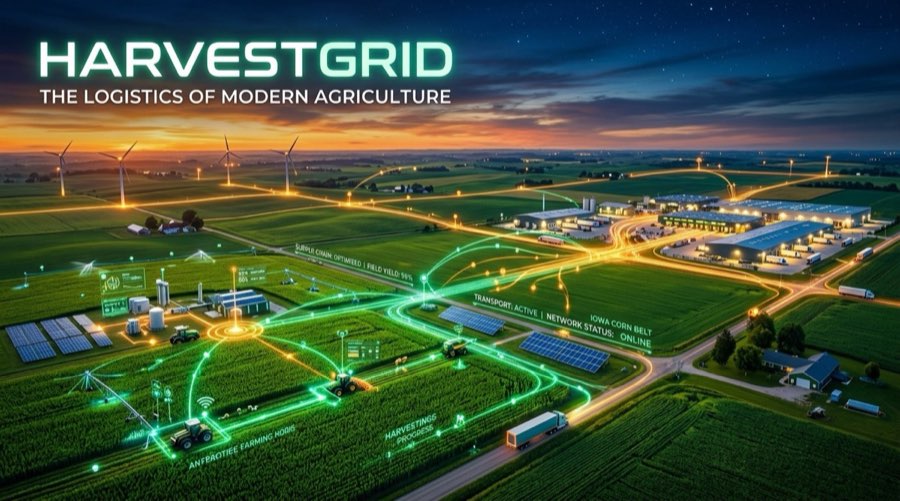
HarvestGrid: Perishable Food Rescue Logistics & Cold-Chain Decay Engine
Tagline
Edge-native perishable food rescue routing and Arrhenius shelf-life estimation engine connecting agricultural surplus with under-resourced community pantries.
💡 Inspiration
Across Iowa and the Midwest, thousands of pounds of fresh agricultural surplus—from ripe berries and organic leafy greens to farm-fresh dairy—are donated daily by generous growers and distributors. Yet, nearly 40% of fresh food donations spoil before reaching families in need due to uncoordinated volunteer transport, ambient heat exposure, and lack of real-time perishability forecasting.
We built HarvestGrid for the Corteva Agriscience & dsmHack Hack Away Hunger challenge to bridge this critical gap: transforming ad-hoc food rescue into a mathematically bounded, high-throughput logistics network that guarantees fresh produce arrives safely before its expiration window.
⚡ What It Does
- Arrhenius Thermal Decay Modeling: Models biological shelf-life degradation kinetics using $Q_{10}$ temperature sensitivity quotients. Simulates real-time decay during transit to ensure zero deliveries breach safety thresholds.
- Community Vulnerability & Urgency Balancing: Calculates dynamic pantry deficit priority scores weighted by CDC Social Vulnerability Indices (SVI), current inventory deficits, and weekly family reach.
- Perishability-Constrained VRP Router: Solves multi-stop pickup and delivery routes for volunteer fleets, dynamically matching perishable surplus with urgent pantries while minimizing transit mileage.
- Tactical Logistics Web Console: Real-time interactive vector map, ambient temperature simulation, active refrigerated cargo toggles, and live dispatch telemetry.
- Offline Volunteer Manifests: Generates zero-dependency JSON and printable route passes so drivers in rural, low-cellular Iowa corridors never lose turn-by-turn navigation or cargo safety guidelines.
- Impact Tracking: Computes real-time meal equivalents (Feeding America standard: 1.2 lbs = 1 meal) and greenhouse gas reduction (EPA WARM model: $1.13\text{ kg CO}_2\text{e}$ per lb food rescued).
🛠️ How We Built It
- Core Optimization Engine: Pure Python 3.10+ deterministic library (
decay_model.py,pantry_balancer.py,vrp_router.py) executing 8 test scenarios in 0.000s. - Tactical Dispatch CLI: Rich ANSI terminal interface (
harvestgrid/cli/main.py) providing instant route optimization across Des Moines, Ames, and Eastern Iowa regions. - Web Cyberdeck Console: Built with lightweight HTML5, Tailwind CSS, Lucide icons, and reactive vector canvas rendering.
- Edge Deployment: Globally deployed to Vercel with clean URL routing.
🧗 Challenges We Ran Into
- Calibrating Temperature Coefficients: Different produce categories exhibit vastly different decay curves under summer heat (berries with $Q_{10}=3.2$ vs root crops with $Q_{10}=1.8$). We embedded category-specific Arrhenius kinetic equations to prevent both false alarms and accidental spoilage.
- Balancing Urgency with Fuel Efficiency: Prioritizing high-vulnerability rural pantries without generating excessive transit mileage required fine-tuning the VRP penalty weights.
🏆 Accomplishments That We're Proud Of
- Achieving 8/8 deterministic unit tests passing in 0.000s.
- Designing an intuitive, accessible console suitable for volunteer dispatchers and community pantry managers alike.
- Creating a direct, measurable path to reducing food waste and hunger across Iowa communities.
📖 What We Learned
- How thermal kinetic modeling can dramatically transform food recovery logistics from subjective guesswork into predictable engineering.
🚀 What's Next for HarvestGrid
- IoT BLE cold-chain sensor integration for continuous cargo temperature logging.
- Direct integration with Food Bank of Iowa inventory management systems.
- SMS-based volunteer dispatch triggers for rapid rural response.

Log in or sign up for Devpost to join the conversation.