-
-
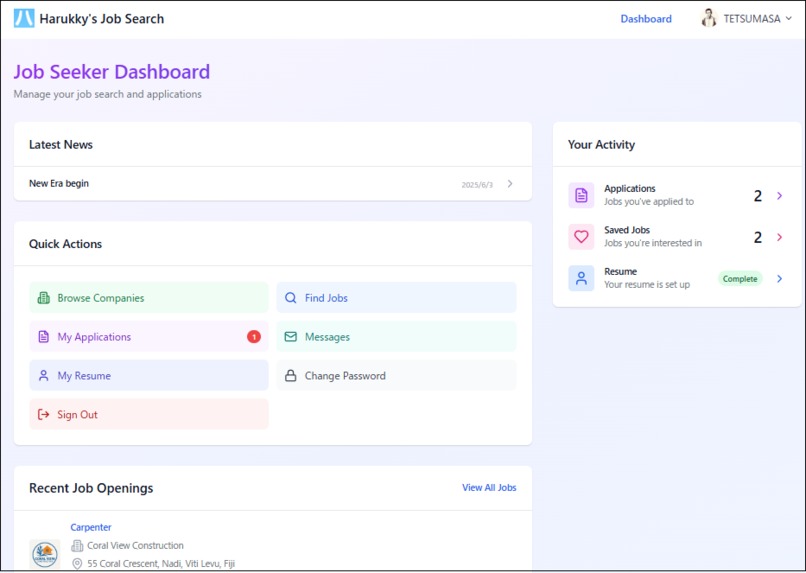
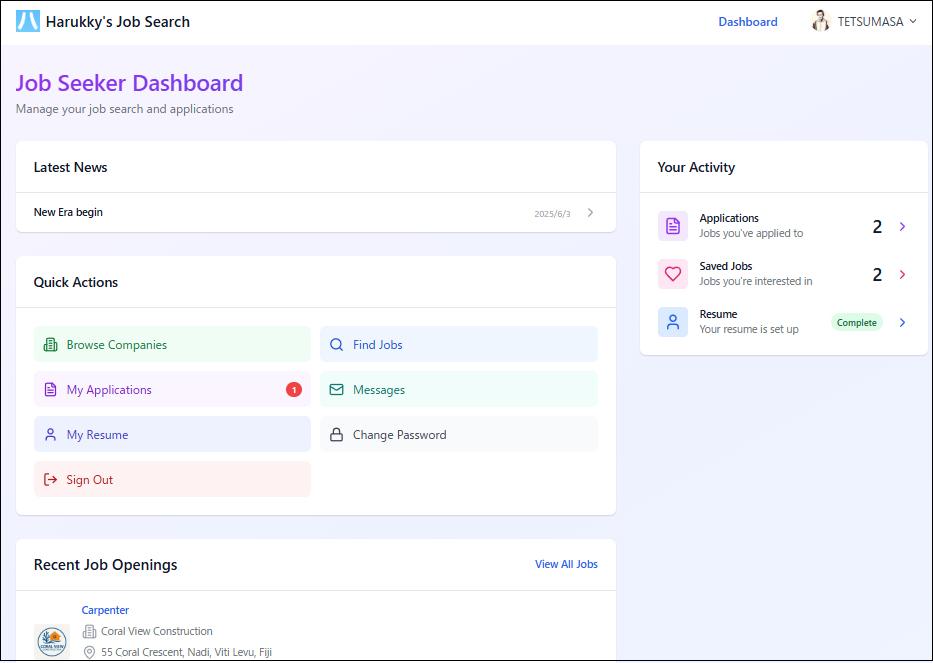
Top Page For Job Seekers
Inspiration
Our company works with JICA (Japan International Cooperation Agency) on a water meter application project in Fiji. Through this experience, our team members noticed that local organizations face significant challenges with recruitment. This realization was the first step toward our idea.
We wanted to help solve this problem by creating a job matching site tailored for Fiji. However, when we tried to build it using our usual methods, we found that the development costs would be too high. As a result, the final service price would also be too expensive for most users in Fiji to afford.
This inspired us to find a new, cost-effective approach—so we could make job matching accessible and affordable for everyone. This is why I decided to enter this hackathon.
What it does
Harukky’s Job Search is designed mainly for job seekers who rely on smartphones, especially in regions where many people don’t have PCs or stable internet connections. The platform provides an easier and more accessible way for job seekers and employers to connect.
seekers to:
- Create a profile with their personal information and qualifications
- Search for jobs not only by industry, company name, or salary, but also by island and town
- Apply directly to jobs through the site
- Send and receive messages with employers
- Follow jobs they are interested in for later
Employers can also use the site easily from their smartphones. This is especially helpful for small shops and restaurants, where staff may not have access to a PC at work but do have smartphones they can use in the kitchen or on the shop floor.
Employers can:
- Post job openings
- View applicant profiles
- Communicate directly with candidates
The platform is built with a simple, smartphone-first design, using easy-to-understand language that is friendly for automatic translation tools (like Google Chrome’s translate feature). While Harukky’s Job Search was created for Fiji, it also addresses the same recruitment problems found in other nearby island countries. Our vision is to expand this service to help more people across the region.
How we built it
We used Bolt.new’s default tech stack:
- React for the frontend
- Supabase for the backend
- Netlify for hosting
- RevenueCat (Stripe) for payment integration
Although I was new to all of these technologies at the start of the hackathon, Bolt.new made it easy to get started. Thanks to its integrated development environment, I was able to build and deploy a fully working website in just three weeks.
Supabase handled authentication, database management, and file storage with very little setup required. I used React to build a mobile-friendly UI that works well on smartphones, which are the primary devices used by job seekers and employers in Fiji.
Challenges we ran into Challenge
- the project size limit
- Our project hit the size limit, which restricted our ability to include all necessary files in one bundle.
- How we handled it : To manage this, we restructured the codebase by grouping files into directories based on function groups(e.g.,/companies /jobs) or user roles (e.g., /jobseeker, /employer, /provider). This made it easier to selectively exclude files using .bolt/ignore, reducing the bundle size while keeping the project modular and maintainable.
- Supabase session management issues
- How we solved it : The Bolt.new Discord, especially the #supabase channel, helped us troubleshoot and resolve this.
Accomplishments that we're proud of
We’re proud that we were able to build a fully working Minimum Viable Product (MVP) in just a few weeks —while learning React and Supabase from scratch.
The current version includes:
- Sign In/Sign Up
- Profile creation
- Company and Job searching by island and town
- Job applications
- Messaging between users
- Job posting for employers
- Payment management for Employers.
- Admin moderation tools
We’re especially proud that the project is scalable and relevant across other island regions with similar hiring challenges.
What we learned
- We learned to build a full-stack app using React and Supabase—even as beginners.
- We learned to design for real users in Fiji: simple UI, low bandwidth, mobile-first.
- Bolt.new helped us move fast, build fast, and stay focused without complex setup.
- Now we can read and understand React code quickly—this felt like a revolution in education.
- We learned that a well-scoped MVP can already solve real-world problems.
What's next for Harukky's Job Search
We plan to launch a pilot version in Fiji with real job seekers and small businesses. We’ll gather feedback and improve the platform.
We’re also planning to implement:
- Interview Calendar : Employers set available interview time slots. Job seekers can select one. If canceled, it becomes available to others automatically.
- Recruit Mail : Employers can send targeted messages to job seekers based on filters (location, industry, etc.) to engage potential candidates directly.
- SNS Sign-In : We found many users in Fiji don’t use email but have social media accounts. We plan to add sign-in options like Google or Facebook to make registration easier.
In the long term, we aim to expand to other island nations facing similar challenges. We believe this simple, mobile-first platform can make job hunting and hiring more accessible—starting in Fiji, and growing from there.
Built With
- netlify
- react
- revenecat
- stripe
- supabase
- typescript


Log in or sign up for Devpost to join the conversation.