-
-
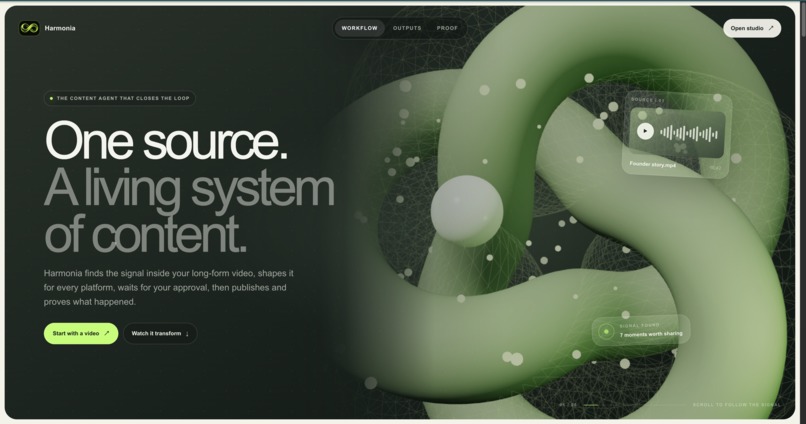
Landing page
-
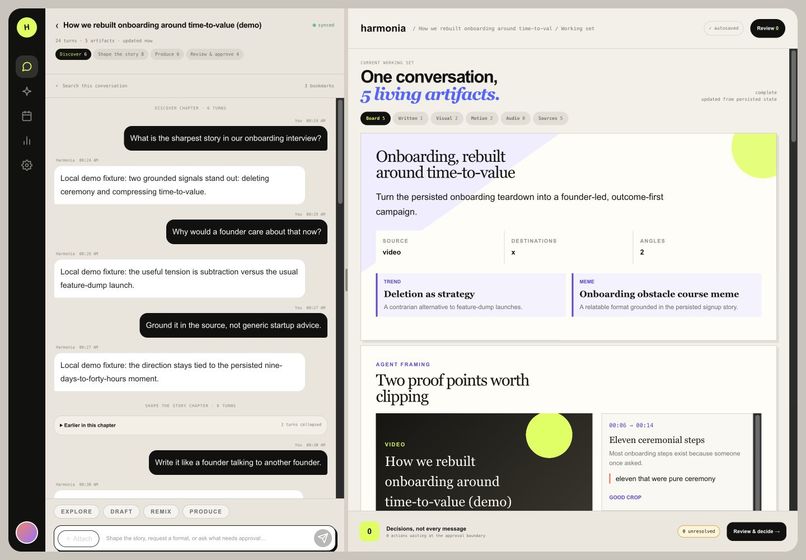
User Console
-
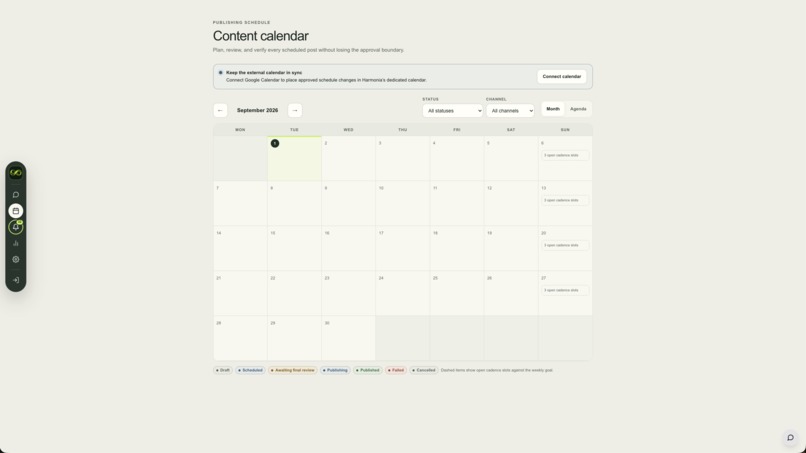
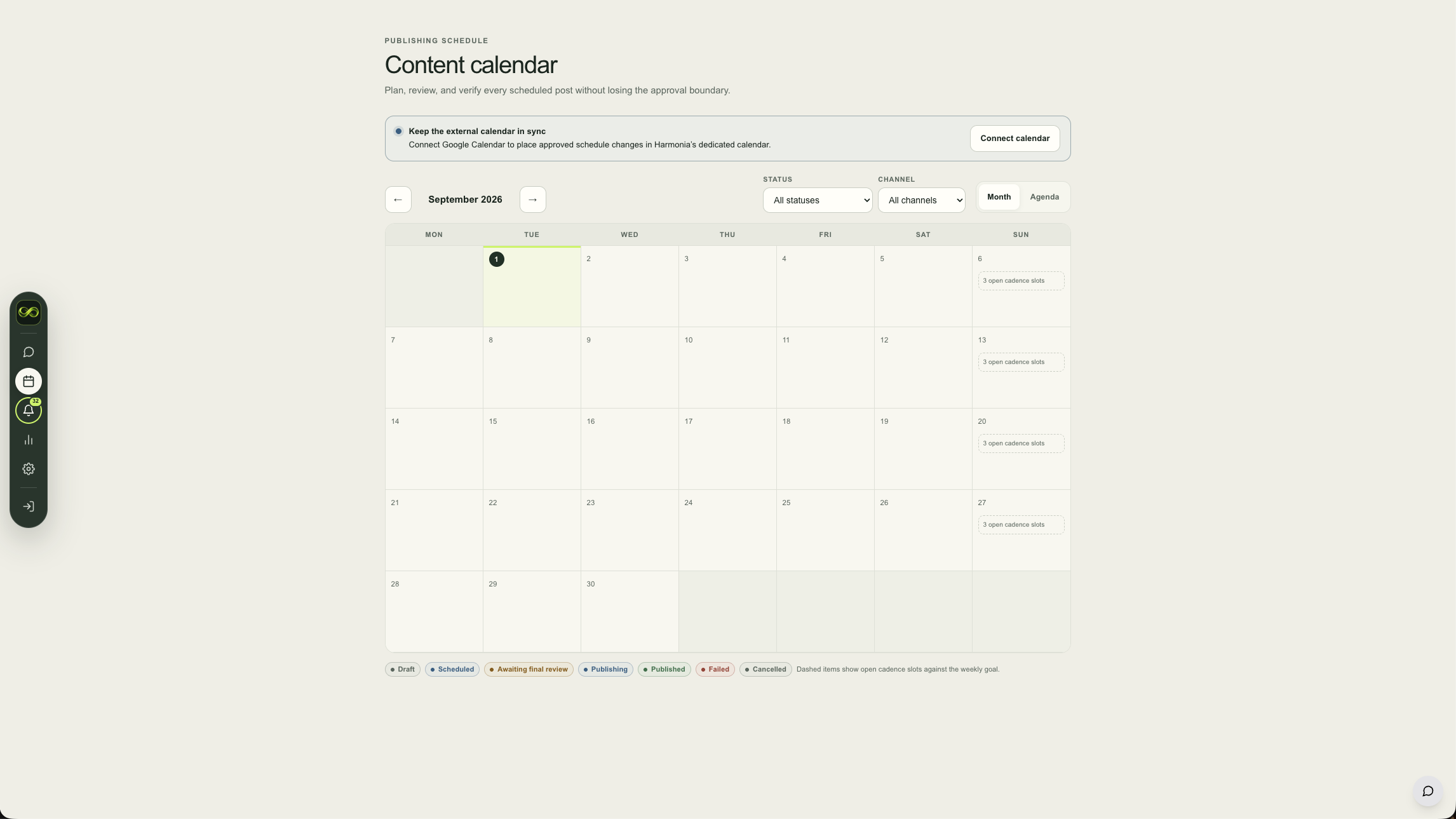
Content Calendar
-
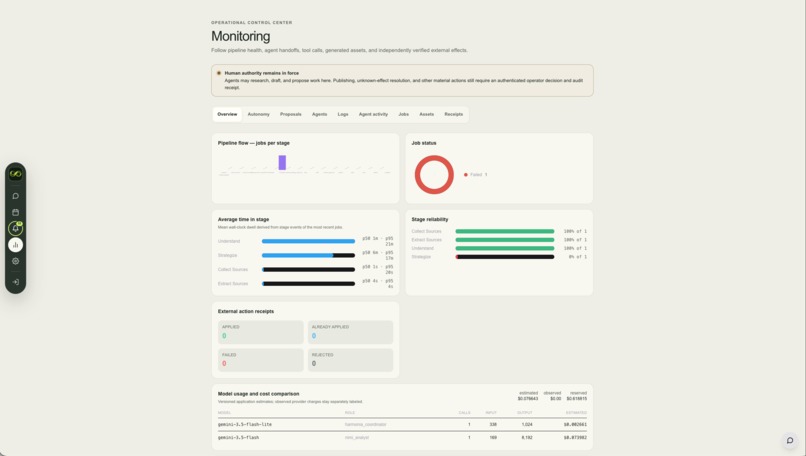
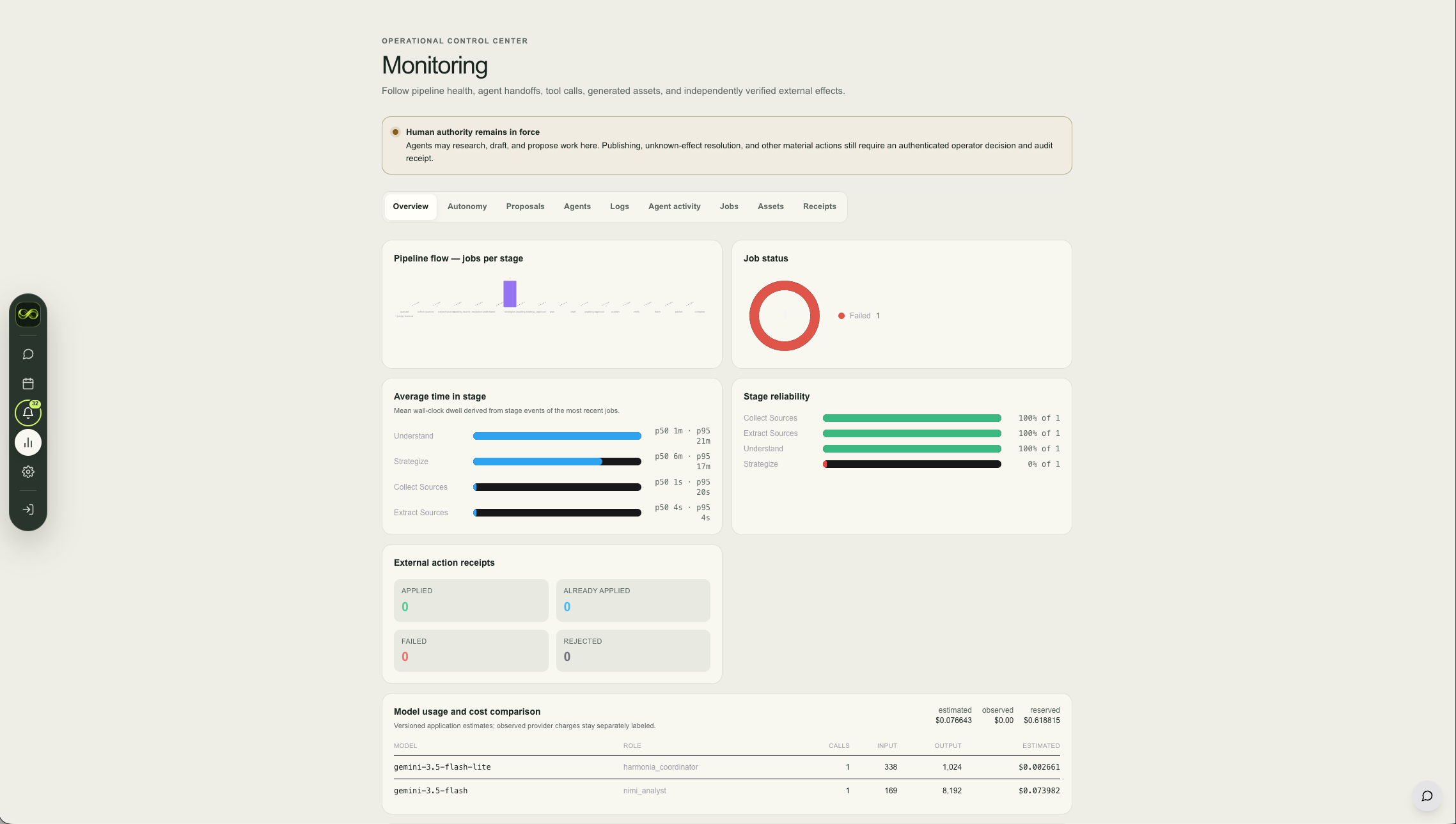
Monitoring Dashboard
-
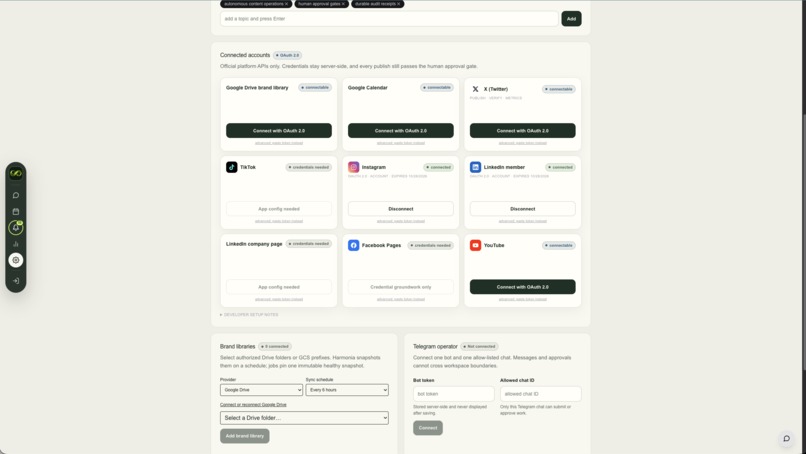
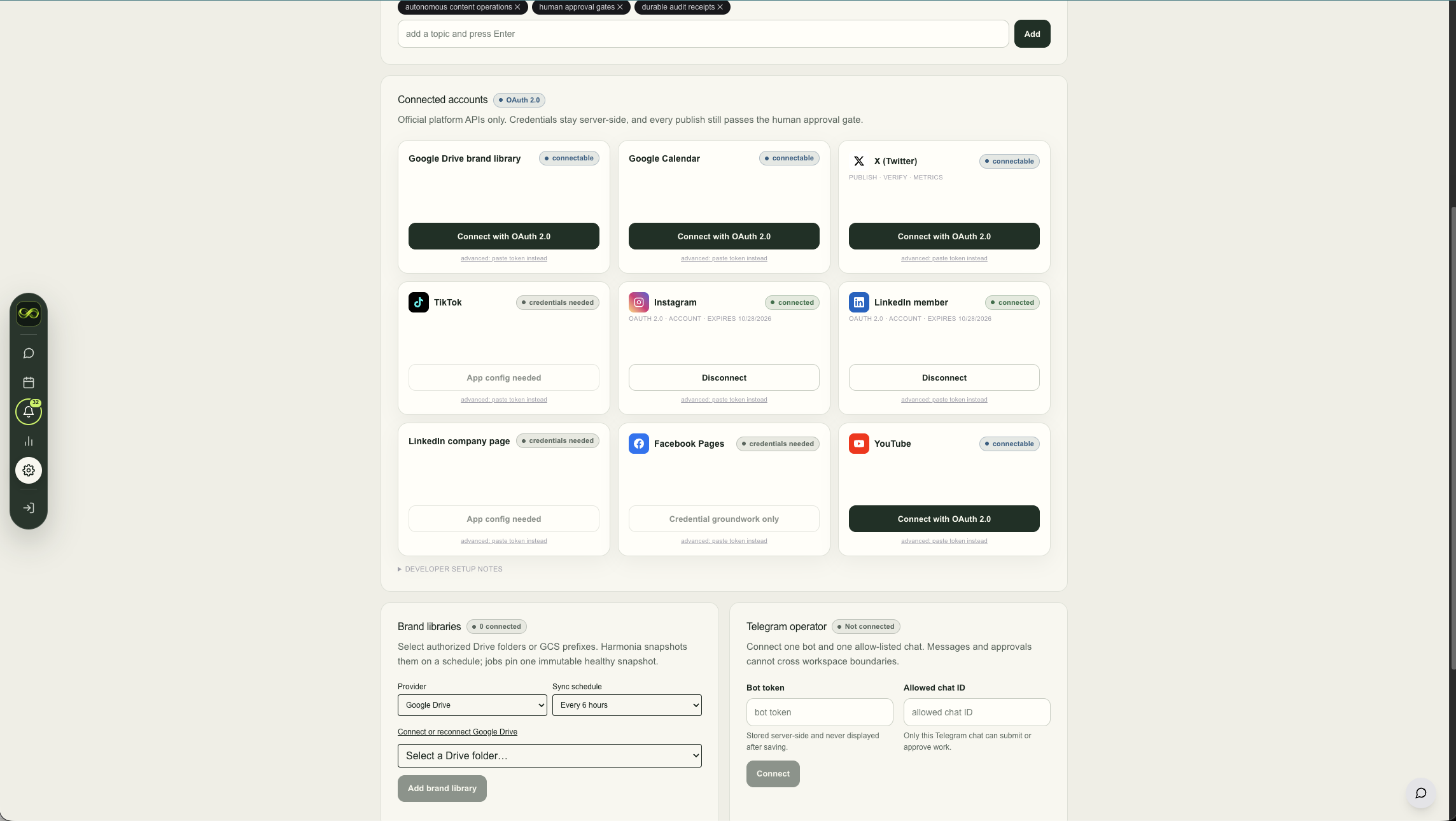
User Accounts and Social Profile
-
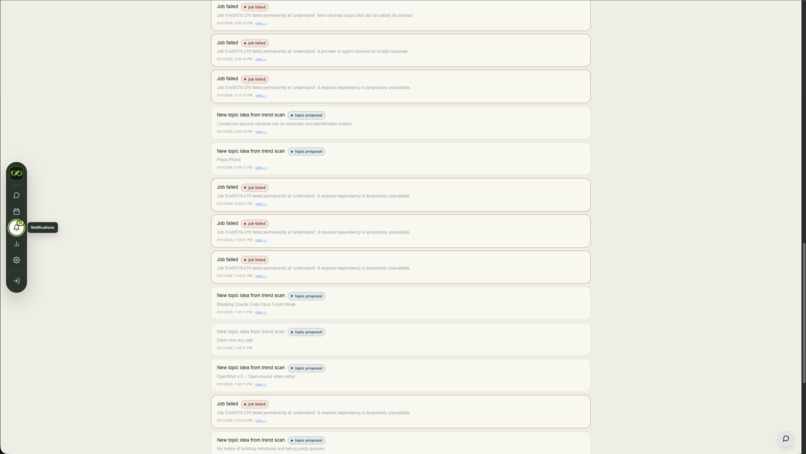
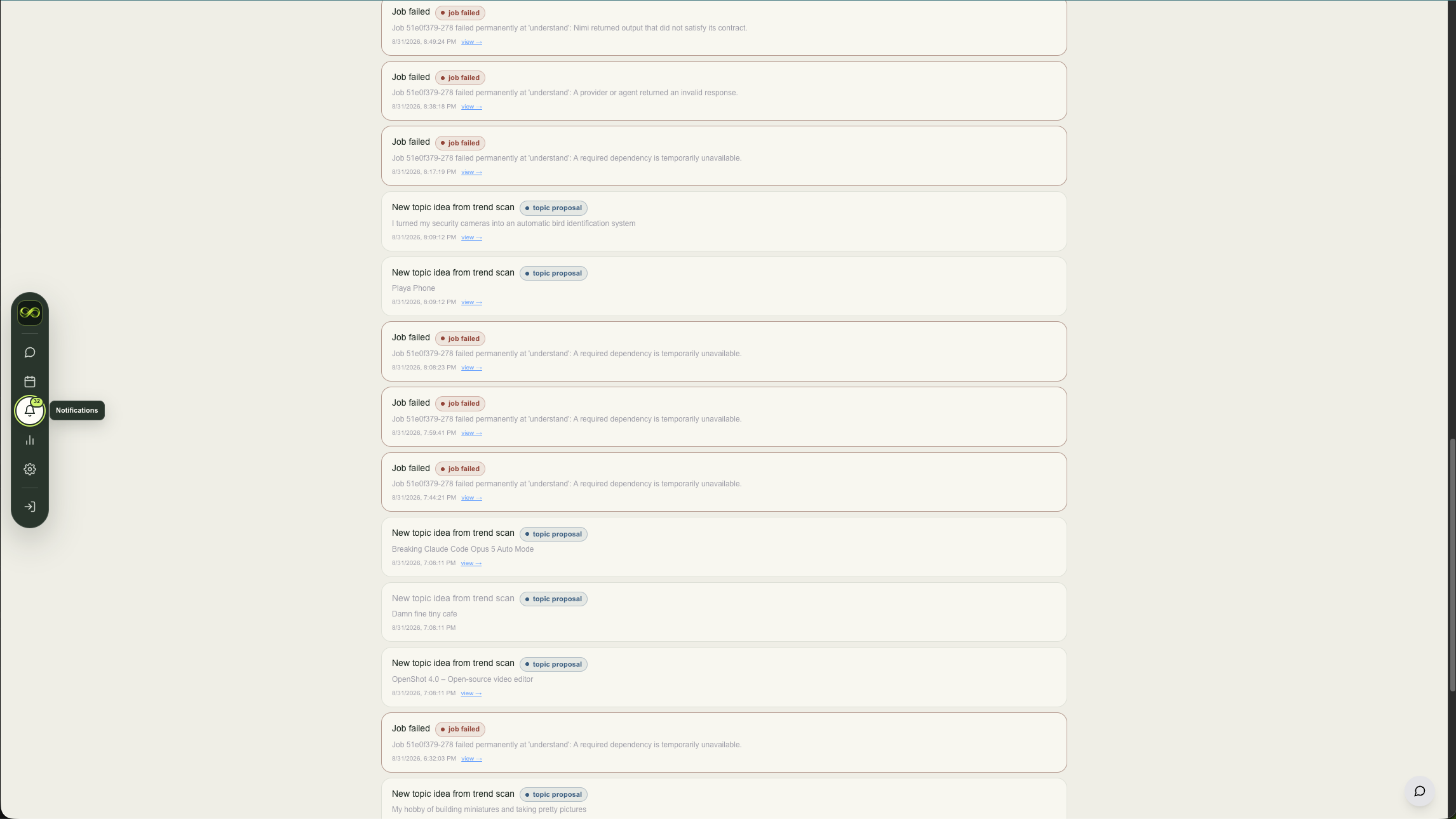
Notification Panels
-
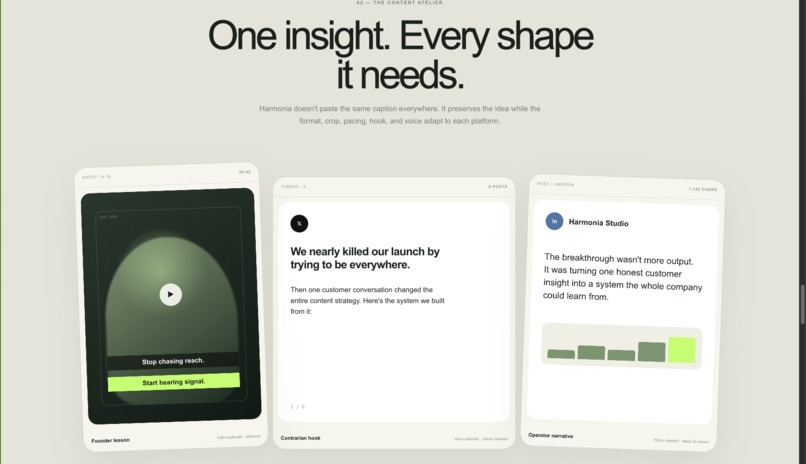
What it does
-
-
-
Inspiration
Content strategy is rarely the bottleneck; execution is.
Startups already know they should publish consistently. They already have ideas, stories, expertise, and source material. The difficult part is turning all of that into finished work:
- finding the strongest moments,
- adapting each idea to the right format,
- keeping every claim grounded, coordinating review,
- waiting for approval, publishing at the right time, and
- confirming what actually went live.
For a small team, that process becomes a second full-time job.
Meanwhile, valuable ideas remain buried inside founder interviews, product demos, podcasts, webinars, documents, and recordings.
Harmonia began with a practical question: could an agent take responsibility for that execution layer? Could it work asynchronously across every handoff? And without asking the team to surrender control?
What it does
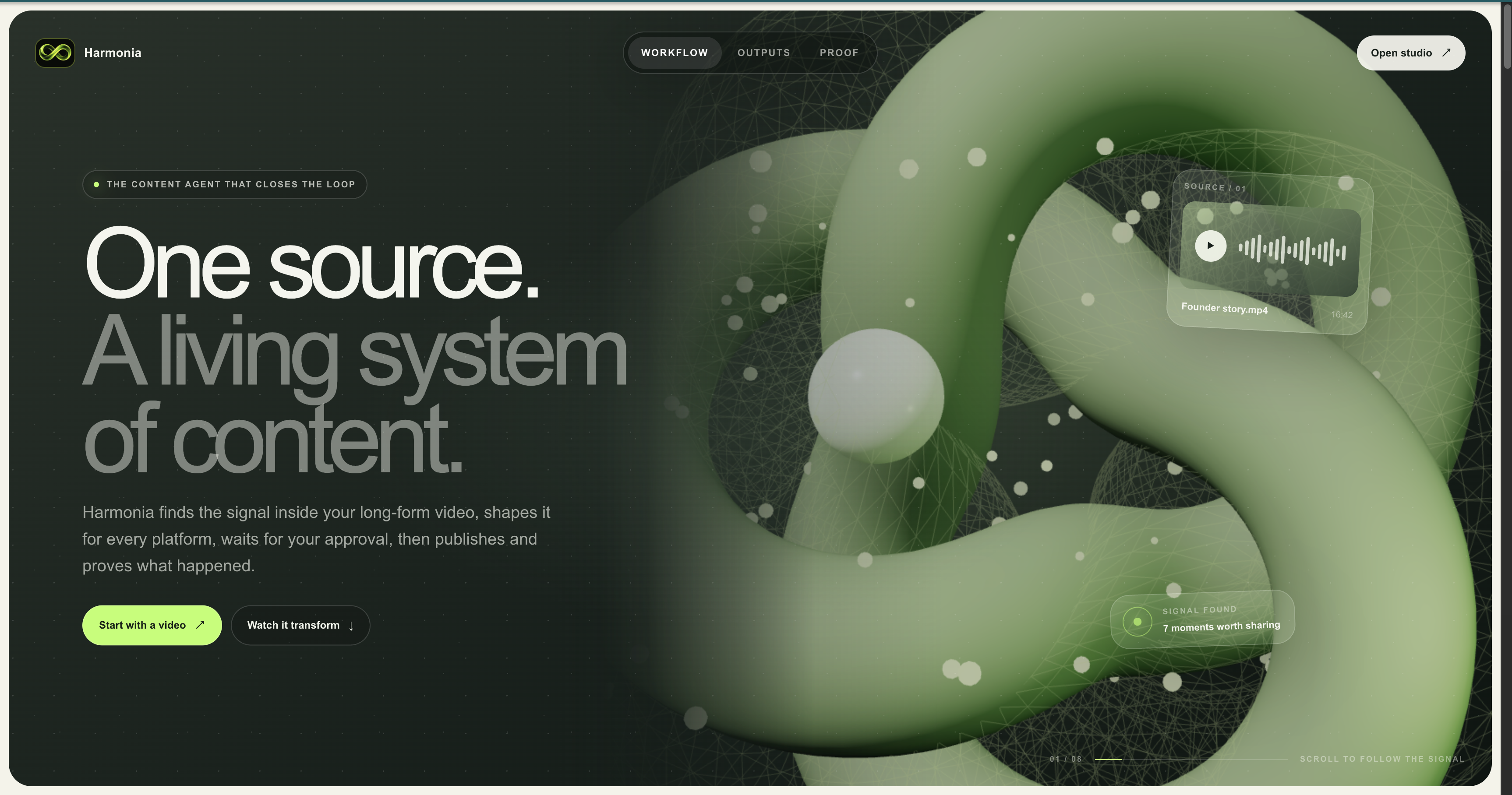
Harmonia is a governed social-content execution system for startups and small businesses. It turns a content dump into a content operation.
A team defines its goals, audience, brand voice, and constraints, then connects a YouTube video, upload, audio file, document, webpage, pasted text, or approved brand-library snapshot.
Harmonia creates one durable content job and carries it through the work that usually breaks across people and tools. It fingerprints and extracts the source, transcribes timed media, finds evidence-backed moments, develops a four-week strategy, waits for strategy approval, builds an editorial plan, and produces reviewed, platform-native content.
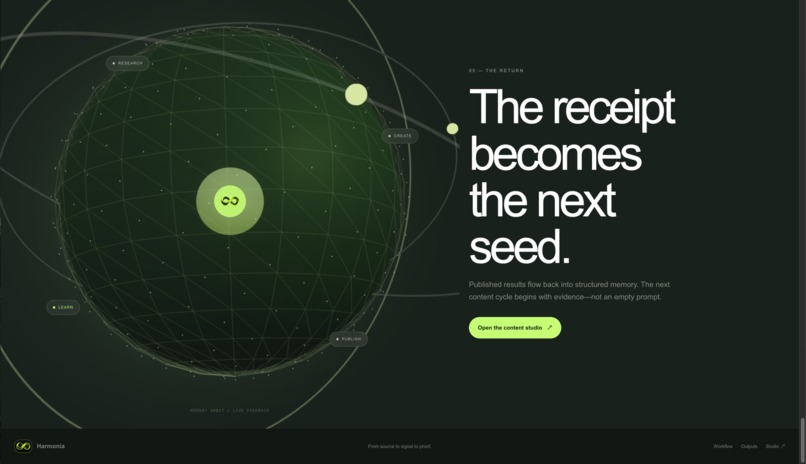
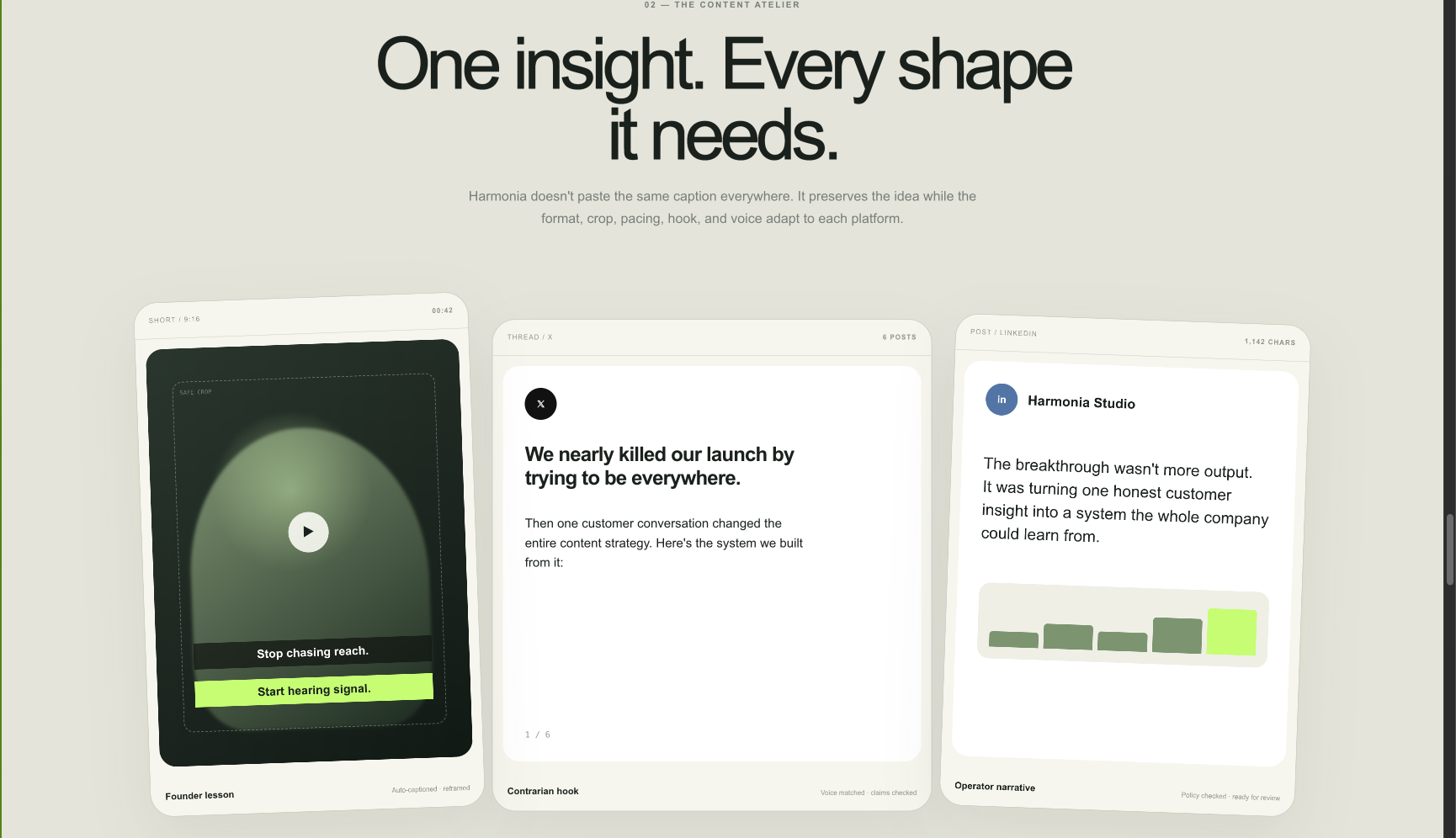
One grounded idea can become posts, threads, articles, newsletters, captions, visual specifications, short clips, reels, or a verified content pack. The format changes; the source lineage does not.
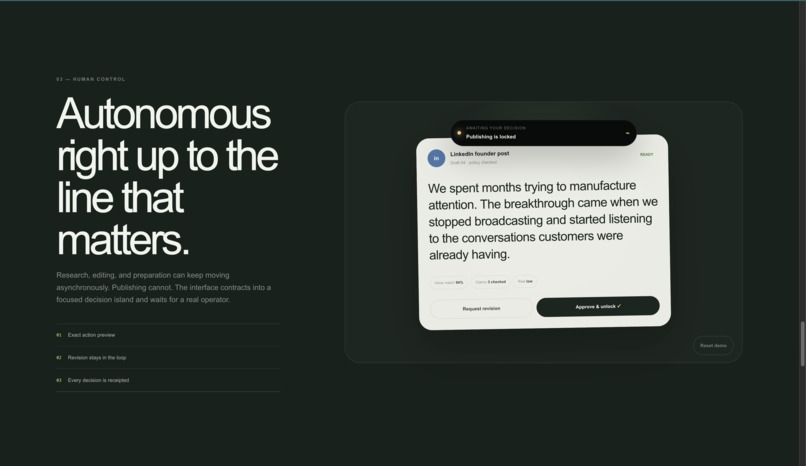
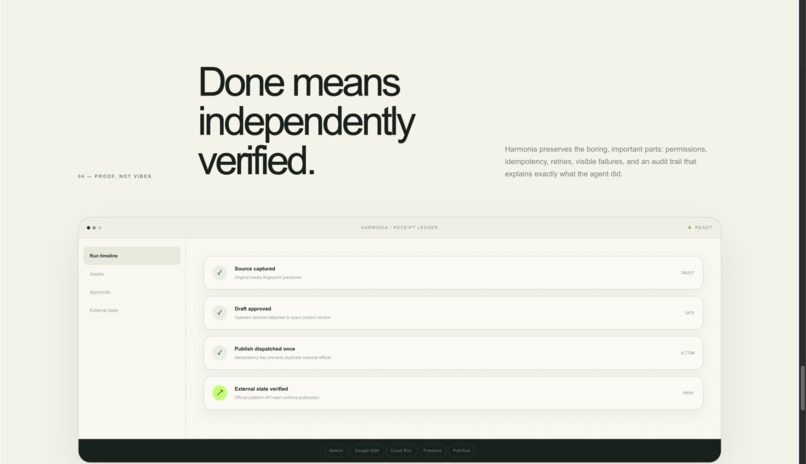
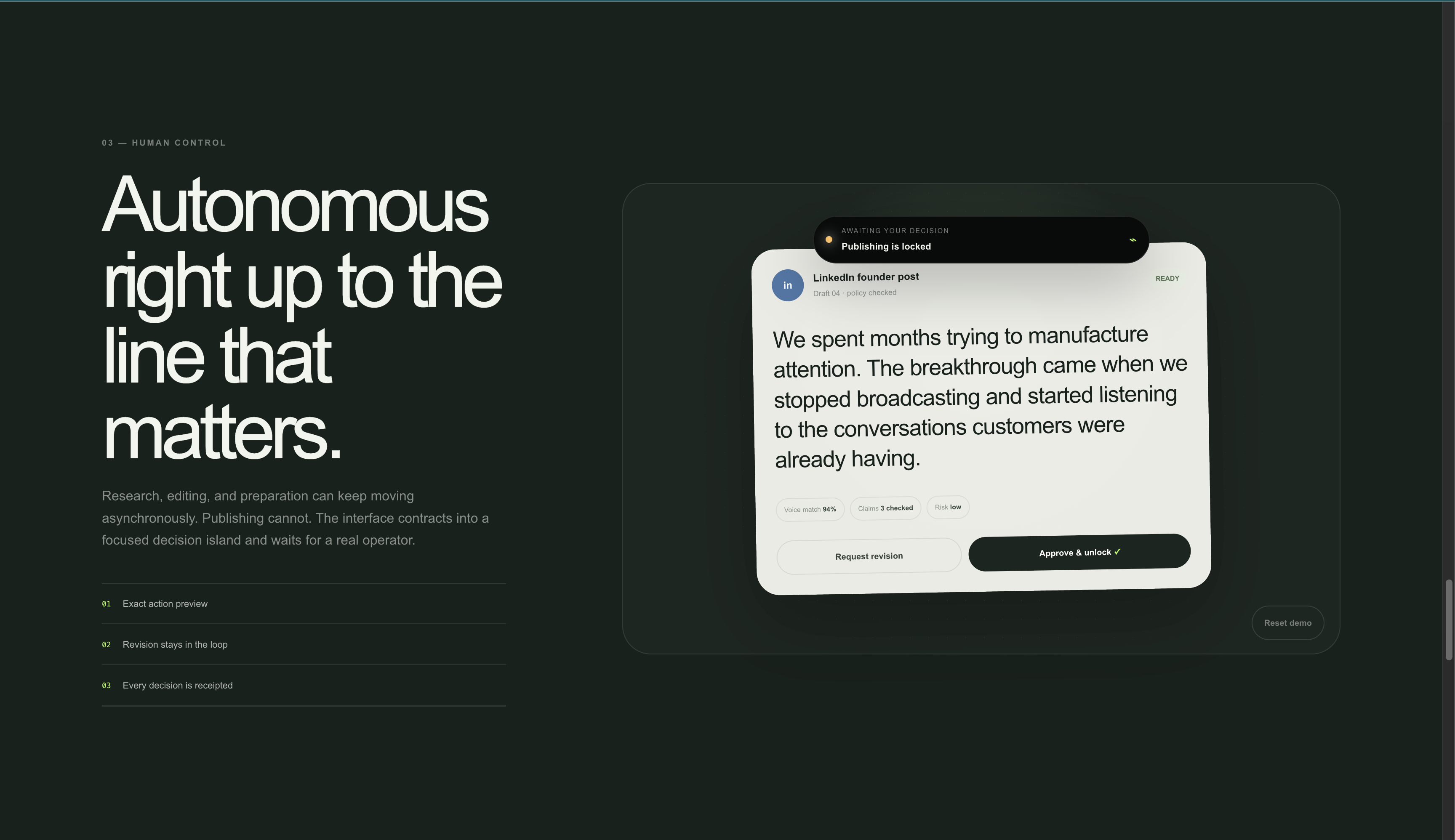
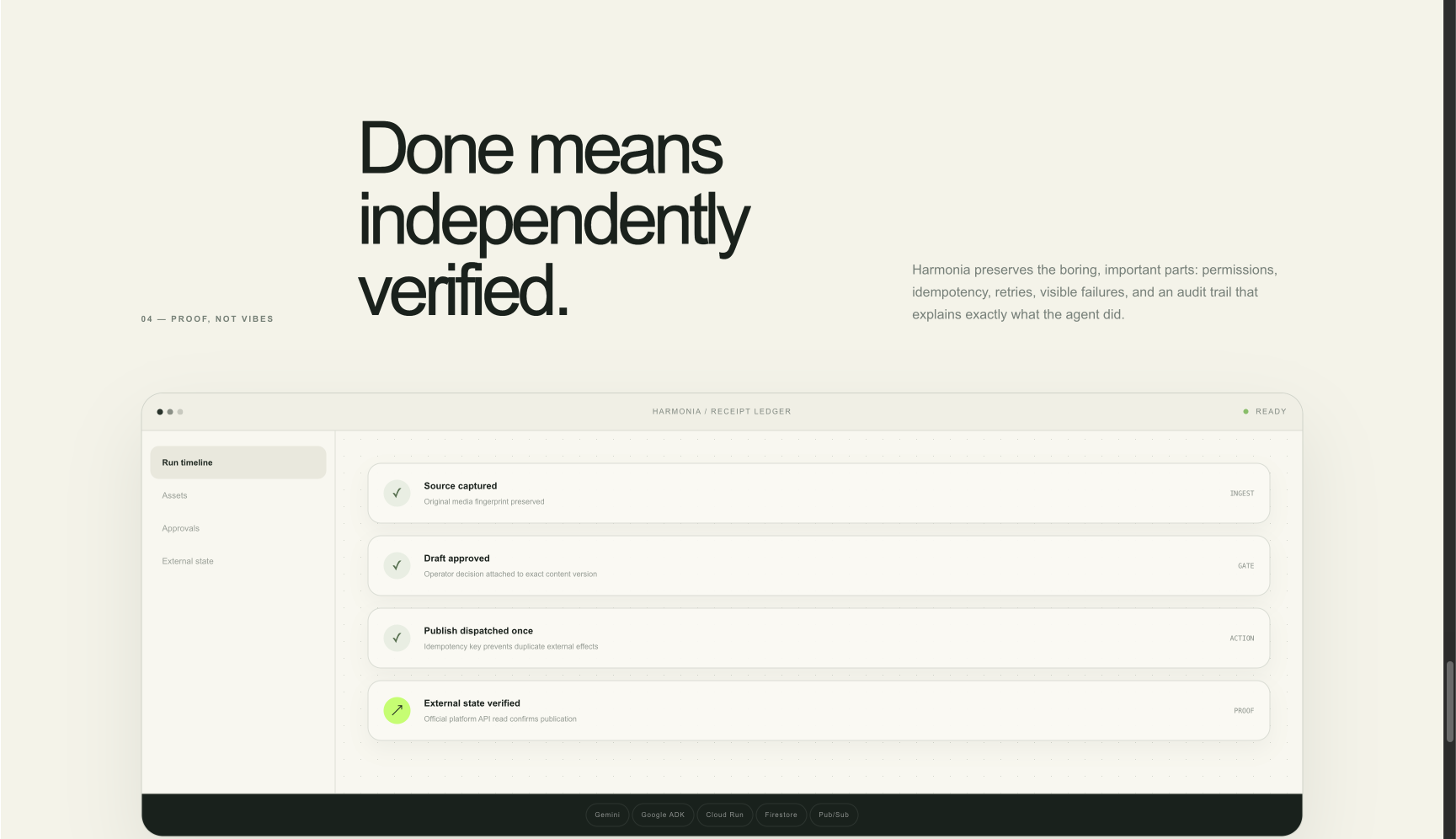
Before anything consequential happens, Harmonia presents the exact proposed action to a human. Only an approved action can execute. It receives a stable idempotency identity, produces a receipt, and is independently read back before Harmonia marks it verified.
The product is live at useharmonia.xyz, with public documentation at docs.useharmonia.xyz.
How we built it
Harmonia is not one large prompt pretending to be a workflow. It is a bounded Google ADK team:
- Nimi uses Gemini 3.5 Flash to analyze multimodal evidence and find moments, quotes, visual signals, and angles.
- Ryan turns the source, business goals, and eligible learning into a grounded four-week strategy.
- Temi, using Gemini 3.5 Flash-Lite, converts the approved strategy into an editorial plan.
- Noni produces platform-native content from approved briefs and evidence.
- Dara reviews grounding, voice, platform fit, clarity, safety, and calls to action, allowing at most one issue-bound revision.
- Maya composes trusted A2UI surfaces; Nova answers operational questions through bounded, read-only tools.
Their focused skill libraries include methods drawn from two years of hands-on content-marketing work.
Gemini 3.5 Flash and Flash-Lite handle the core reasoning roles. Gemini 3.5 Flash Image provides a budget-controlled image path. Harmonia also implements approval-gated Veo 3.1 Fast and Lyria 3 Clip actions; those paid-media paths stay disabled unless configuration, policy, budget, and evidence requirements are met.
The Next.js control plane runs the dashboard, APIs, chat, and human decisions.
A private Python/Pydantic worker runs the specialists through Vertex AI Agent Engine. Firestore owns durable state; Pub/Sub drives restartable work; Cloud Storage holds immutable assets; and Memory Bank carries only eligible, scoped learning.
Deterministic ffmpeg paths cut, caption, reframe, and assemble media. Official integration code covers YouTube sources, Google Drive, Google Calendar, Telegram, X, LinkedIn, Instagram, and YouTube destinations, subject to provider requirements.
What makes it different
Most content tools make one step easier: transcription, generation, scheduling, or generic “viral moment” detection. The execution burden still belongs to the team. Harmonia treats the entire content operation as one long-running, recoverable workflow.
Models handle the ambiguous work: interpreting sources, finding ideas, shaping strategy, and creating content. They cannot approve, publish, change credentials, mutate workflow truth, or declare their own work successful.
Deterministic code owns tenant scope, budgets, approval digests, idempotency, receipts, and verification. Jobs resume from durable state; retries do not quietly become duplicate posts; ambiguous results remain visibly unresolved.
- The model proposes.
- Policy checks.
- A human authorizes.
- Harmonia executes and verifies.
Challenges we ran into
The hardest problem was deciding what the agents must never control. Creative work needs flexibility, but approval, identity, cost, retries, and external effects need exact boundaries.
Long-running execution was equally difficult.
Cloud Run workers are disposable, Pub/Sub is at-least-once, and external APIs do not share a Firestore transaction. Durable outboxes, fenced claims, provider-aware idempotency, and fresh verification reads keep recovery independent of model memory.
We also learned to separate implementation from evidence. Tests prove code behavior, not credentialed provider success. Harmonia's evidence tooling keeps that distinction visible.
Accomplishments that we're proud of
- A seven-specialist Google ADK team with role-specific models, skills, typed handoffs, and explicit authority limits.
- A resumable multi-source pipeline spanning analysis, strategy approval, editorial planning, multi-format production, review, action approval, execution, receipts, and verification.
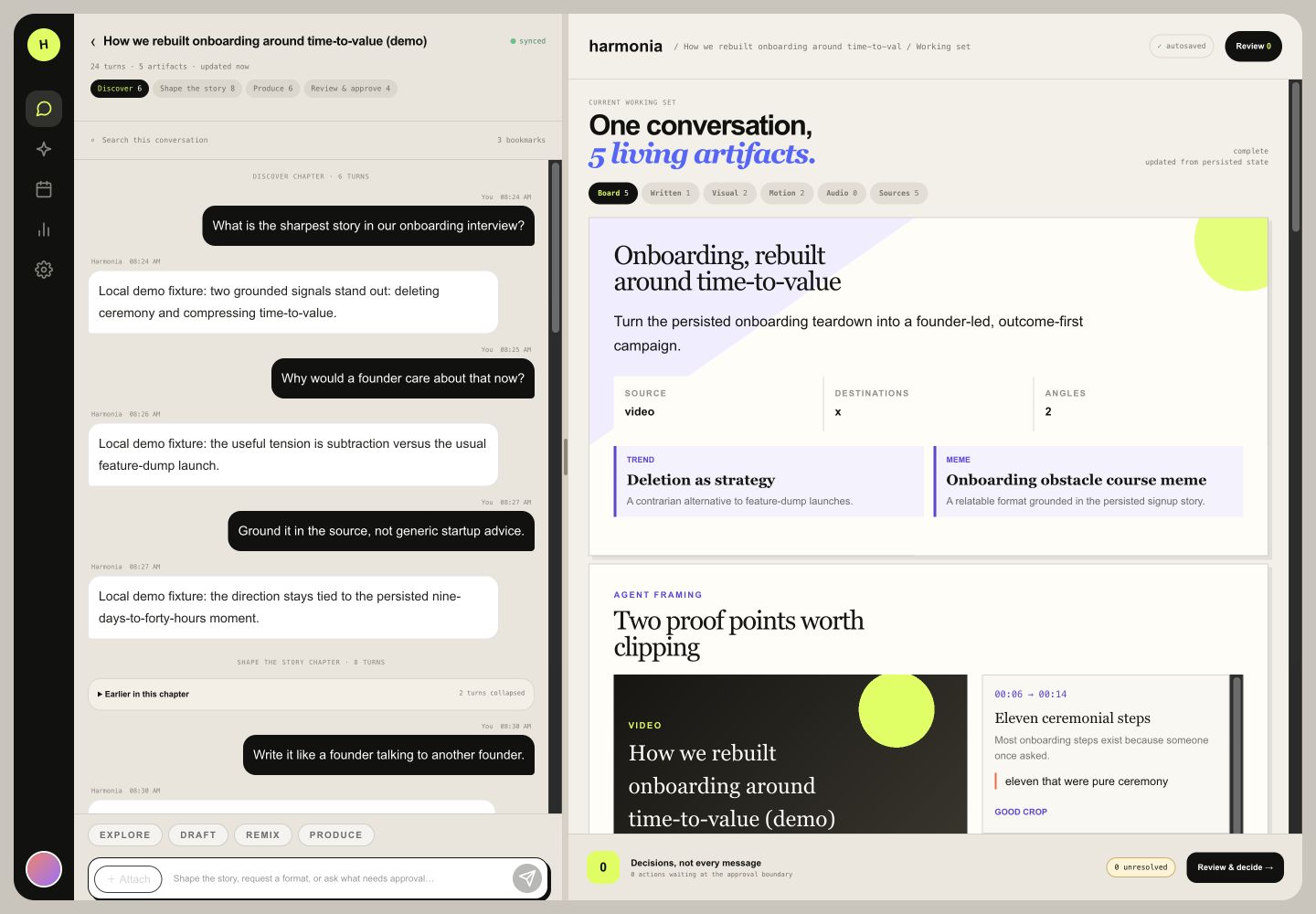
- A live product, public documentation, architecture explorer, dashboard, conversational A2UI workspace, and Telegram boundary.
- Deterministic content-pack exports and media rendering, with official-provider publishing adapters designed around fresh read-back verification.
- Tenant-scoped uploads, cost controls, observability, replay, retention, and visible failure recovery.
What we learned
Reliable agents need less ambient authority, not more. Gemini is strongest where interpretation and editorial judgment are genuinely ambiguous. Deterministic systems are stronger where one incorrect tenant ID, approval digest, or retry can cause a real external consequence.
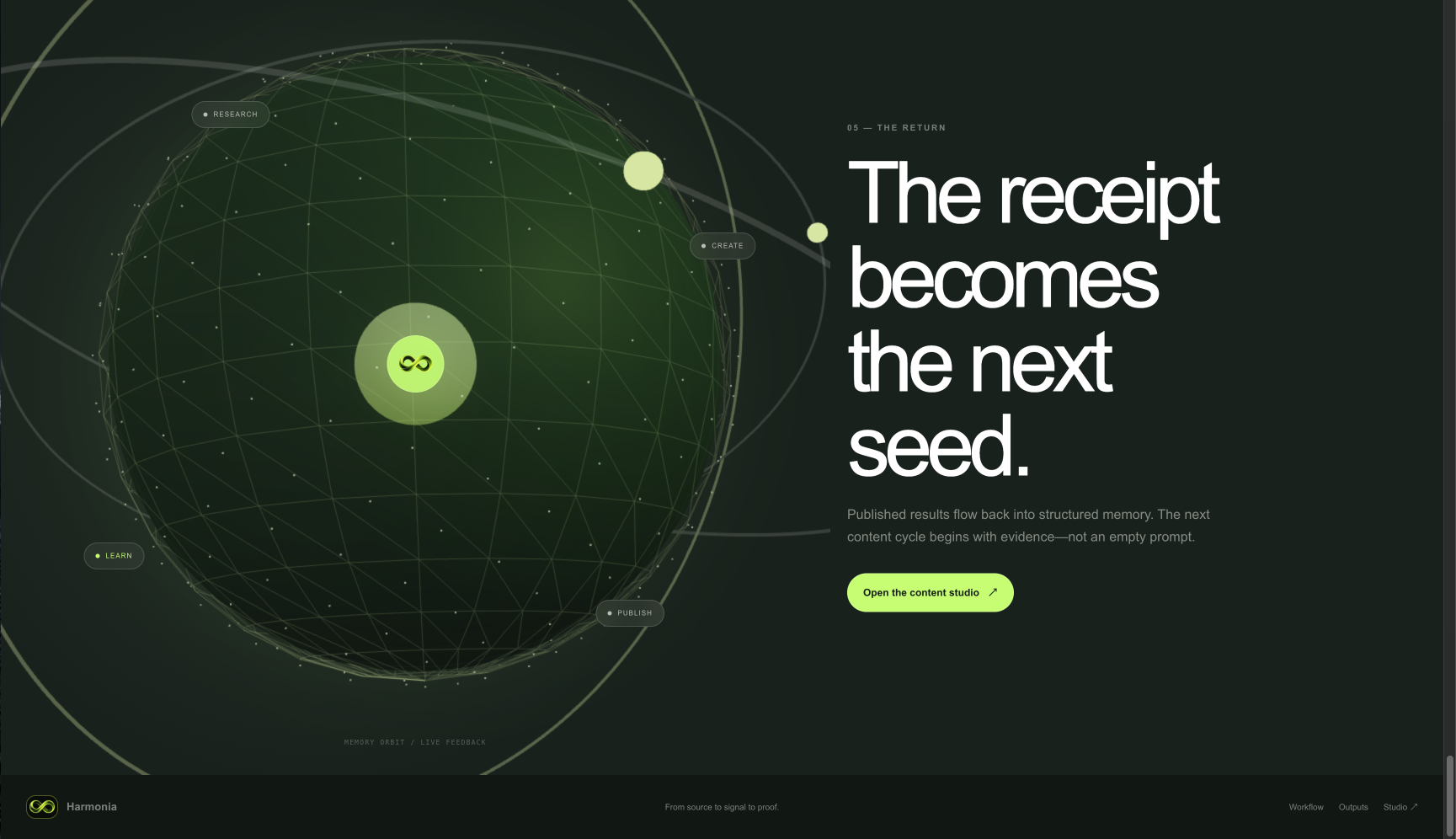
Memory also needs restraint: useful context requires scope and provenance.
What's next for Harmonia
The immediate milestone is one judge-reproducible run correlating the live product, Cloud Run, Agent Engine, Gemini, Firestore, Pub/Sub, human approval, an executed effect, independent verification, and privacy-bounded tracing under one job ID.
From there, Harmonia can promote more publishing destinations and generative-media paths without weakening its approval, budget, recovery, and evidence boundaries.
The strategy may begin the work. Harmonia carries it through execution.
One source goes in. A verified content operation comes out.
Disclosure
Harmonia was created during the submission period using standard frameworks, libraries, Google SDKs, and AI coding assistants. Product ideas were informed by an earlier social-media automation experiment; its non-Google implementation stack was not copied into Harmonia.
Built With
- cloud-run
- cloud-scheduler
- cloud-storage
- cloud-trace
- ffmpeg
- firebase-authentication
- firestore
- gemini-3.5-flash
- gemini-3.5-flash-image
- gemini-3.5-flash-lite
- google-a2ui
- google-adk
- google-genai-sdk
- hyperframes
- memory-bank
- next.js
- opentelemetry
- pub-sub
- pydantic
- python
- react
- secret-manager
- typescript
- vertex-ai-agent-engine
- zod

Log in or sign up for Devpost to join the conversation.