-
-
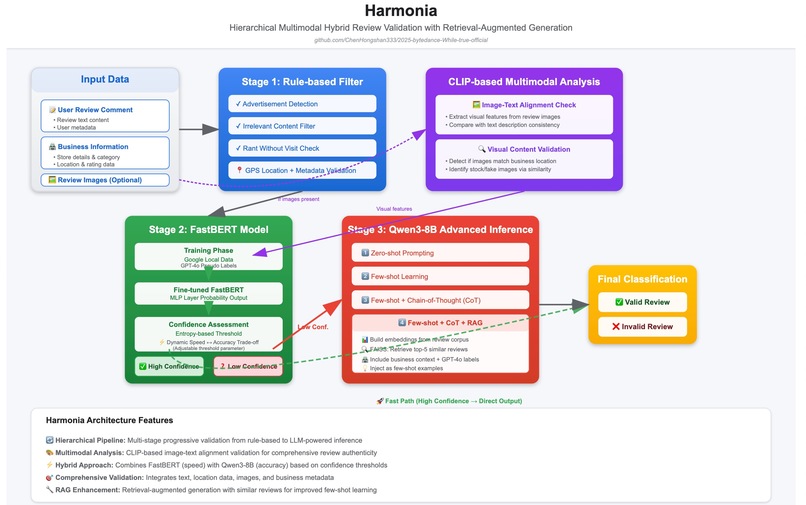
This is the main teaser for our project, including methods we use and solutions we provide.
-
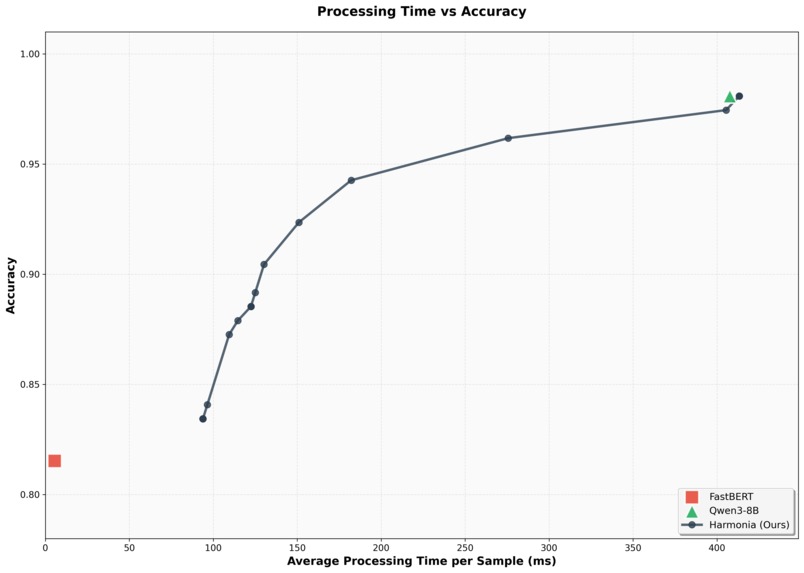
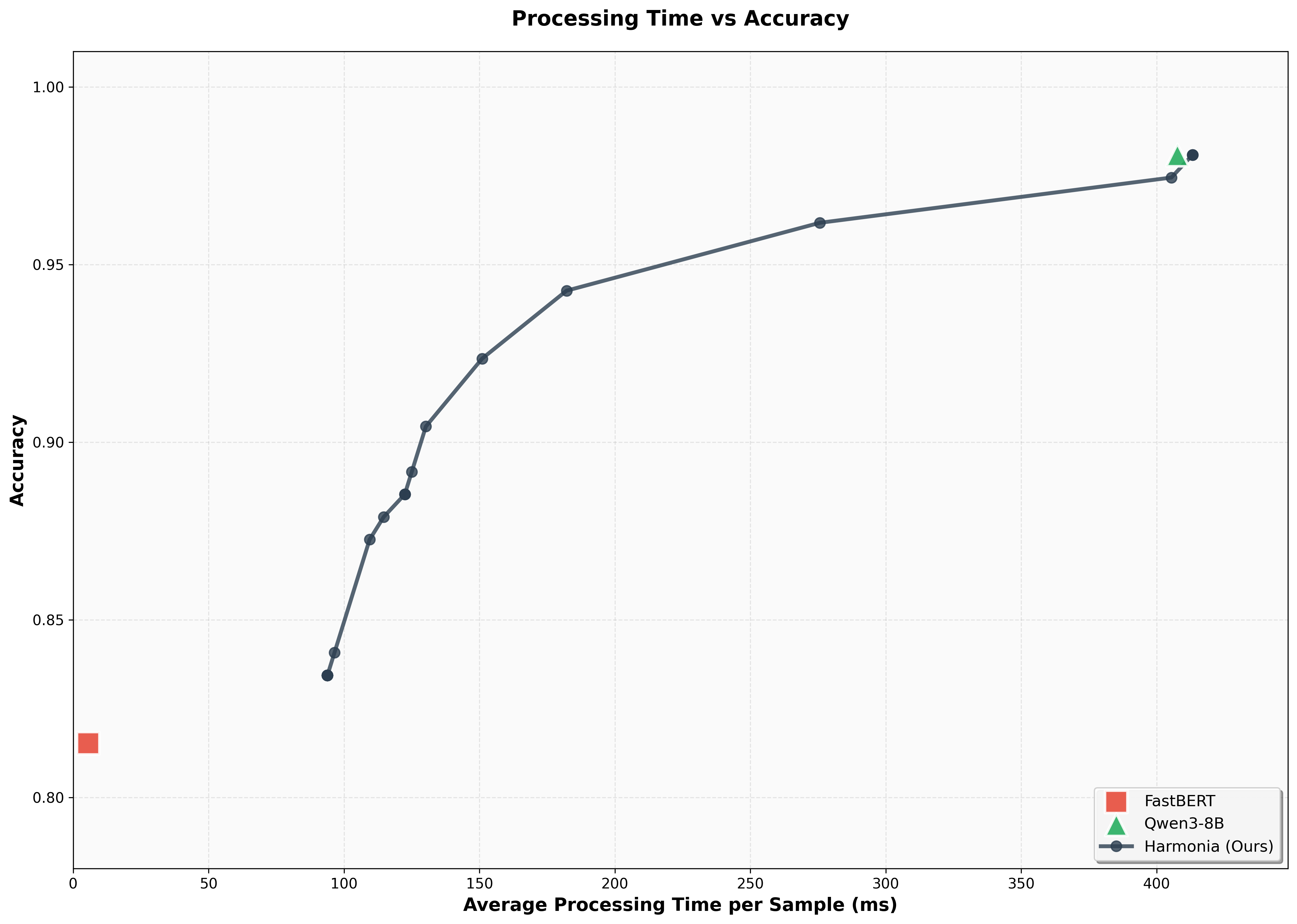
This is the accuracy VS time 2D graph, where we compare the performance of three different models: FastBERT, Qwen3-8B and Harmonia (Ours)
-
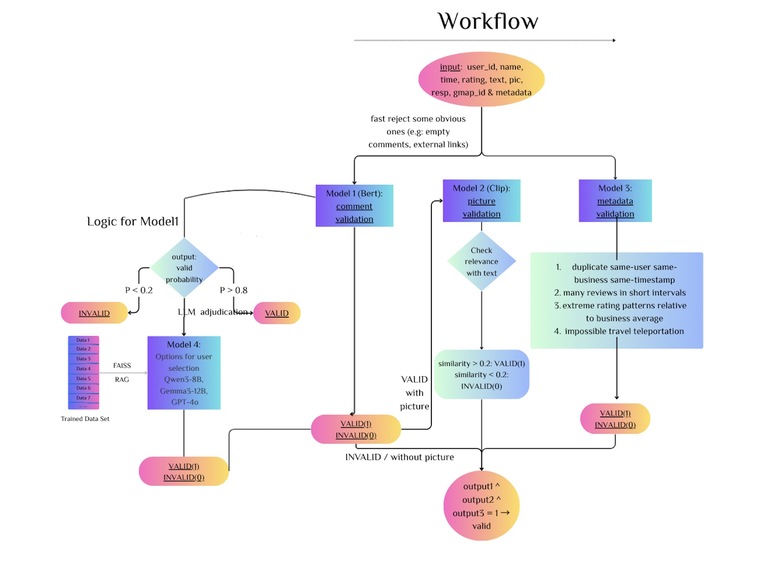
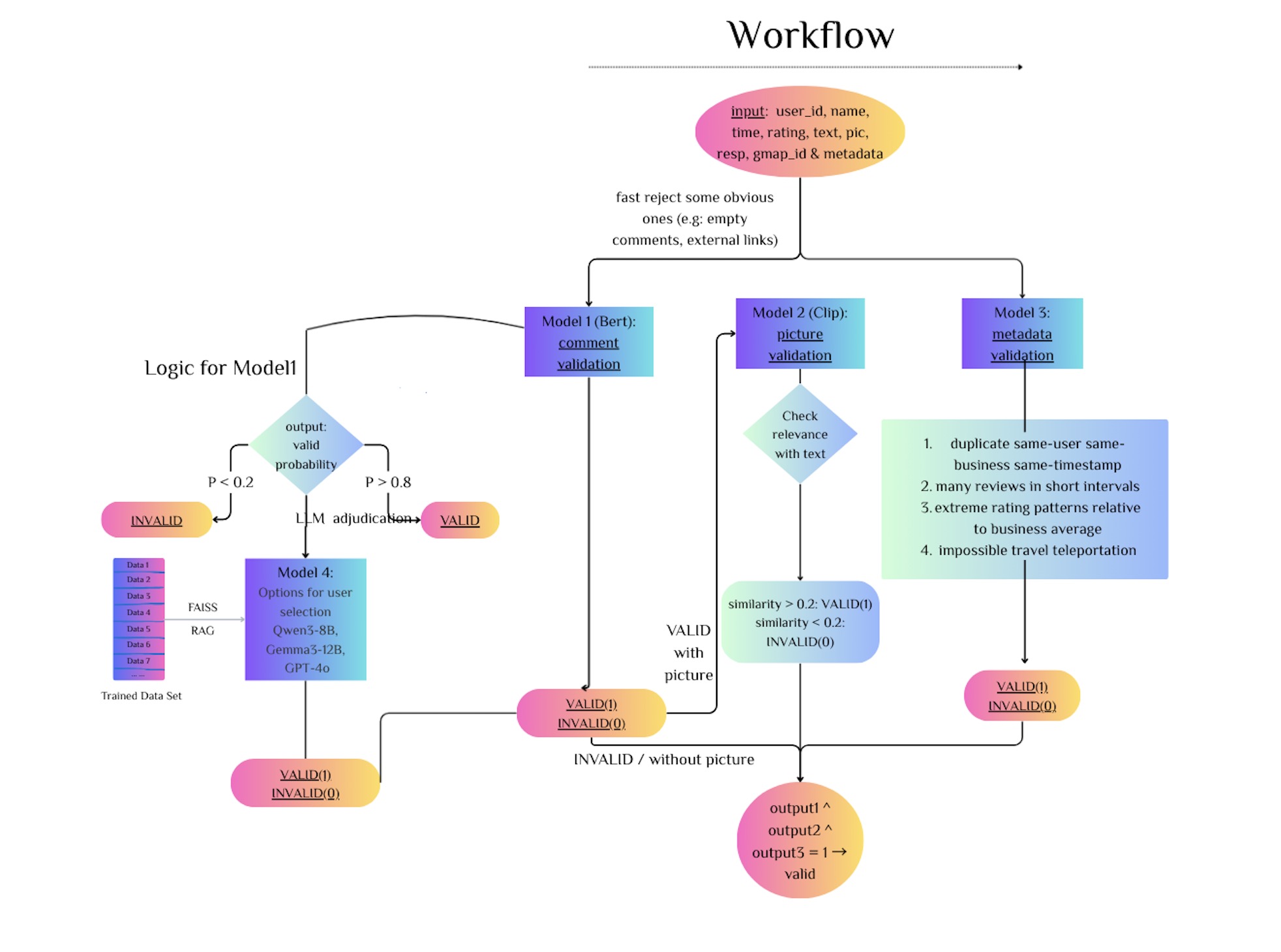
This is the flow chart describing our models
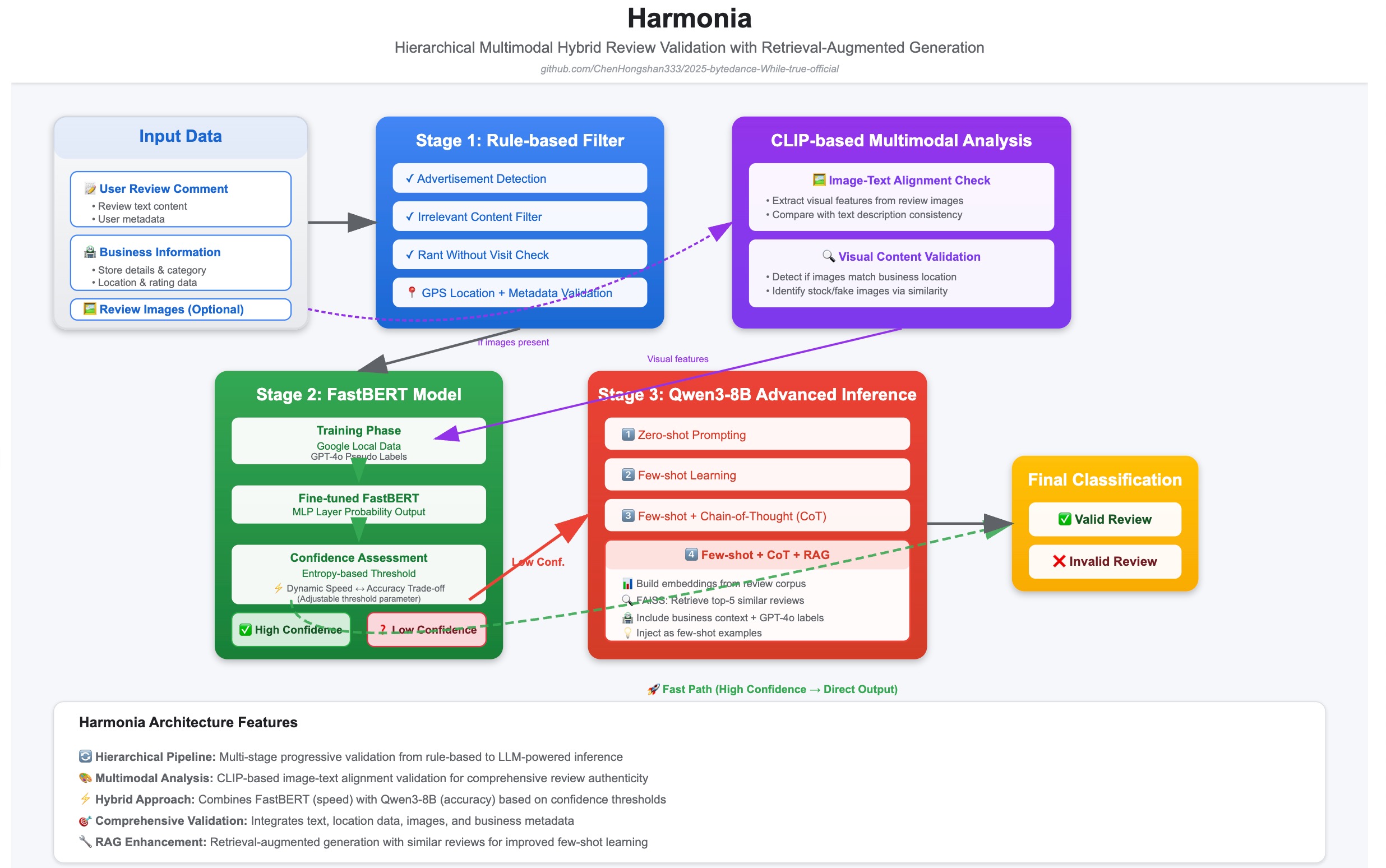
Project Journey: Building Harmonia
What Inspired Us
The inspiration for Harmonia emerged from witnessing a critical challenge in today's digital landscape: businesses drowning in millions of reviews where authentic customer voices are buried beneath spam, advertisements, and irrelevant noise. We observed that existing classification systems forced an impossible choice—either lightning-fast processing with mediocre accuracy, or near-perfect precision at glacial speeds unsuitable for real-time applications. Our vision crystallized: create an intelligent system capable of processing reviews at enterprise scale while maintaining human-level accuracy in distinguishing genuine feedback from digital clutter.
What We Learned
Through extensive experimentation, we uncovered a fundamental truth: no single AI approach could effectively solve this multifaceted problem. Traditional models like FastBERT delivered impressive speed (sub-50ms processing) but hit an accuracy ceiling at 81%—insufficient for business-critical decisions. Advanced models like Qwen3-8B achieved near-perfect accuracy (98%) but demanded 400ms per sample, rendering them impractical for real-time deployment. This revelation taught us that the future doesn't lie in choosing between speed and accuracy, but in intelligently orchestrating multiple approaches to transcend traditional tradeoffs.
How We Built Harmonia
Our breakthrough emerged through developing a hierarchical multimodal architecture that strategically leverages each model's unique strengths:
Layer 1 - Intelligent Preprocessing: We implemented rule-based filtering using regex matching to eliminate obvious spam patterns and process metadata efficiently.
Layer 2 - FastBERT with Entropy Confidence: We deployed a fine-tuned FastBERT model that makes predictions based on entropy confidence levels, handling clear-cut cases with blazing speed.
Layer 3 - Advanced Multimodal Processing: We enhanced the Qwen3-8B model with CLIP integration to process non-textual content, capturing nuances that text-only models miss.
Layer 4 - Harmonia Core: We developed our flagship innovation—a hybrid system featuring Hierarchical Multimodal Hybrid Review Validation with Retrieval-Augmented Generation, combining the best of all previous layers.
Challenges We Overcame
The Accuracy-Speed Paradox: Our greatest challenge was shattering the false dichotomy between accuracy and speed. Early iterations either sacrificed precision for velocity or became too sluggish for practical deployment. Each point on our performance graph represents weeks of rigorous experimentation with different architectures, hyperparameters, and ensemble methods—a testament to our iterative pursuit of excellence.
Real-World Data Complexity: Working with authentic review data meant confronting inconsistent formats, missing labels, and edge cases that defied neat categorization. We developed robust preprocessing pipelines and strategically augmented our training data to handle these real-world complexities.
Scalability Engineering: Implementing efficient multiprocessing and vector indexing while maintaining model consistency across parallel workers demanded meticulous architecture design and extensive stress testing.
Seamless Integration: Harmoniously combining FastBERT, OpenAI APIs, and FAISS indexing into a unified system capable of handling both individual reviews and batch processing of thousands of samples presented significant engineering challenges that pushed our technical boundaries.
The Impact
Our final achievement demonstrates that thoughtful system architecture can transcend traditional performance tradeoffs. Harmonia represents more than a technical solution—it's a production-ready platform that transforms how businesses understand their customers, proving that the future of AI lies not in singular models, but in intelligent orchestration of diverse technologies working in perfect harmony.
Built With
- clip
- faiss
- fastbert
- openai
- python
- qwen
- rag
- vllm


Log in or sign up for Devpost to join the conversation.