-
-
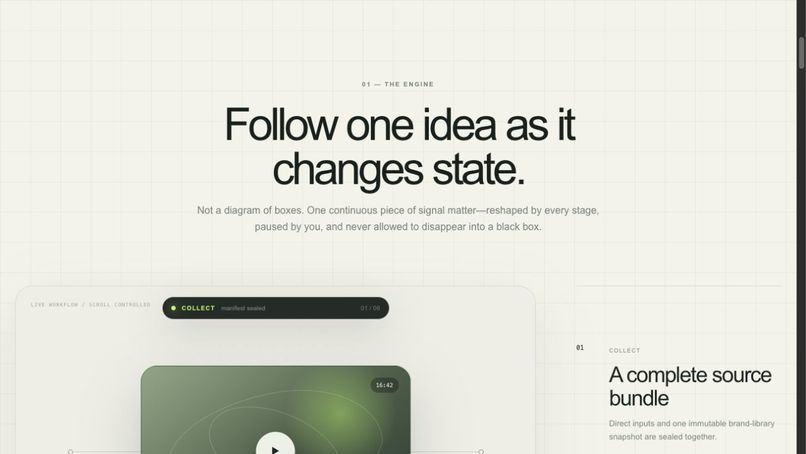
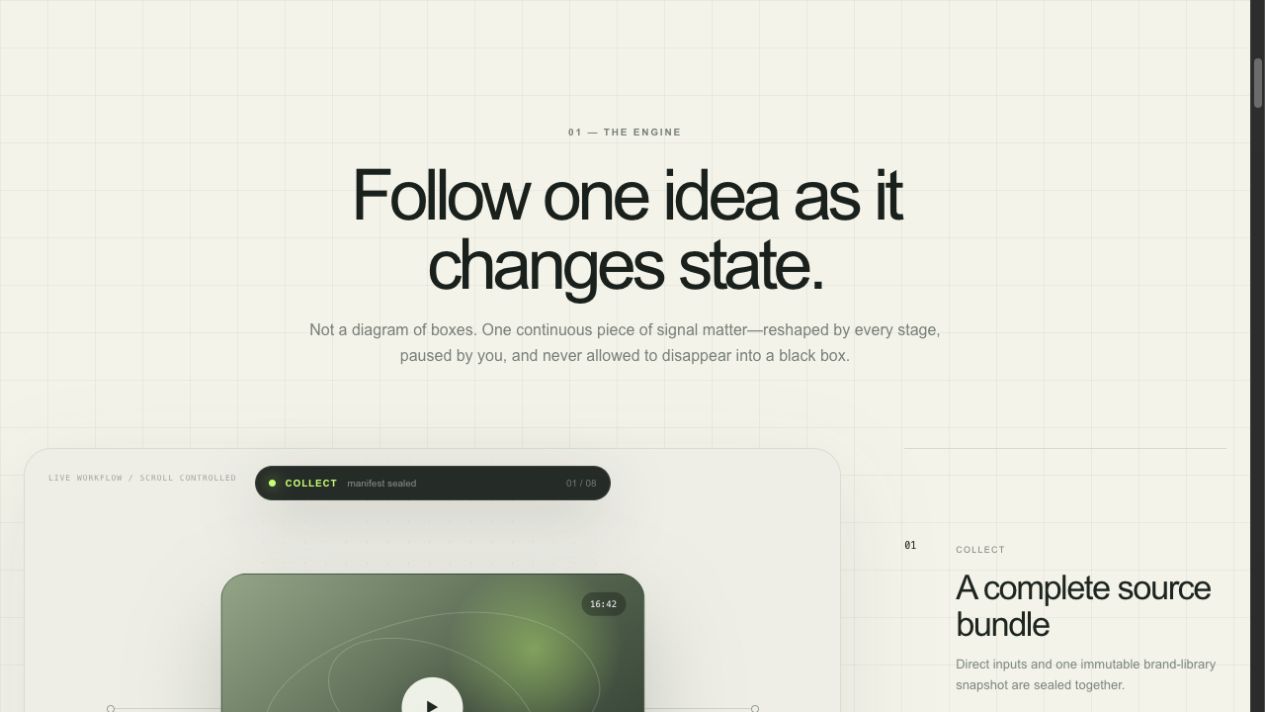
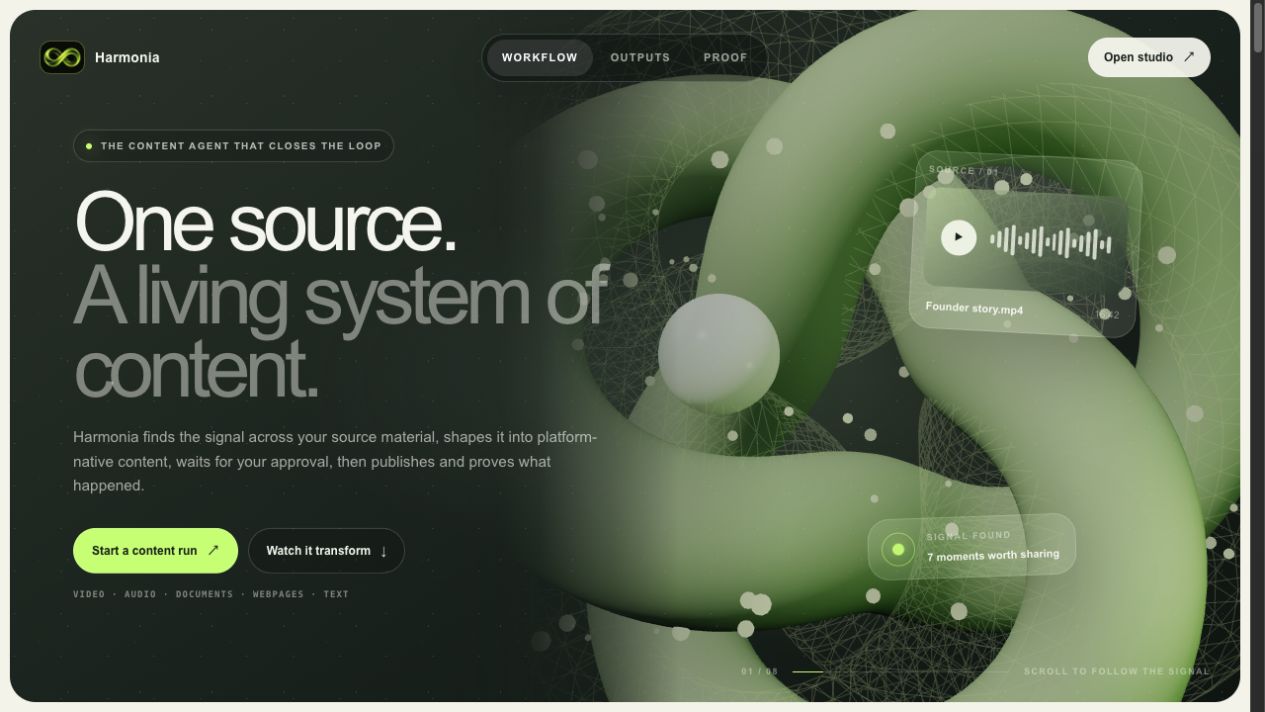
One source moves through explicit, durable workflow stages.
-
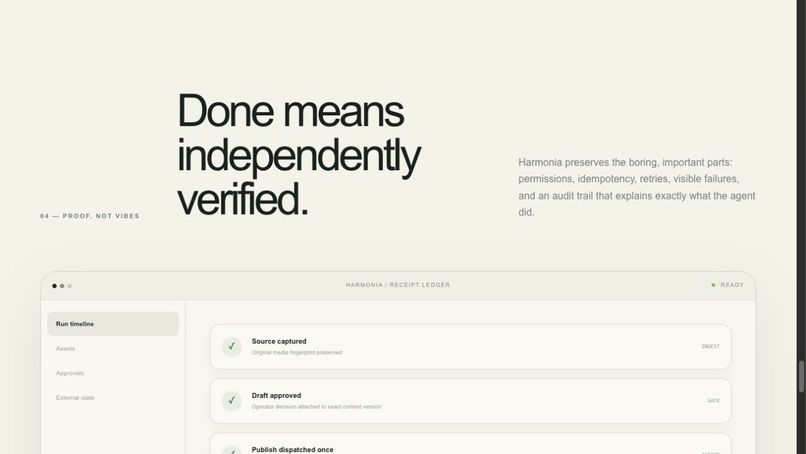
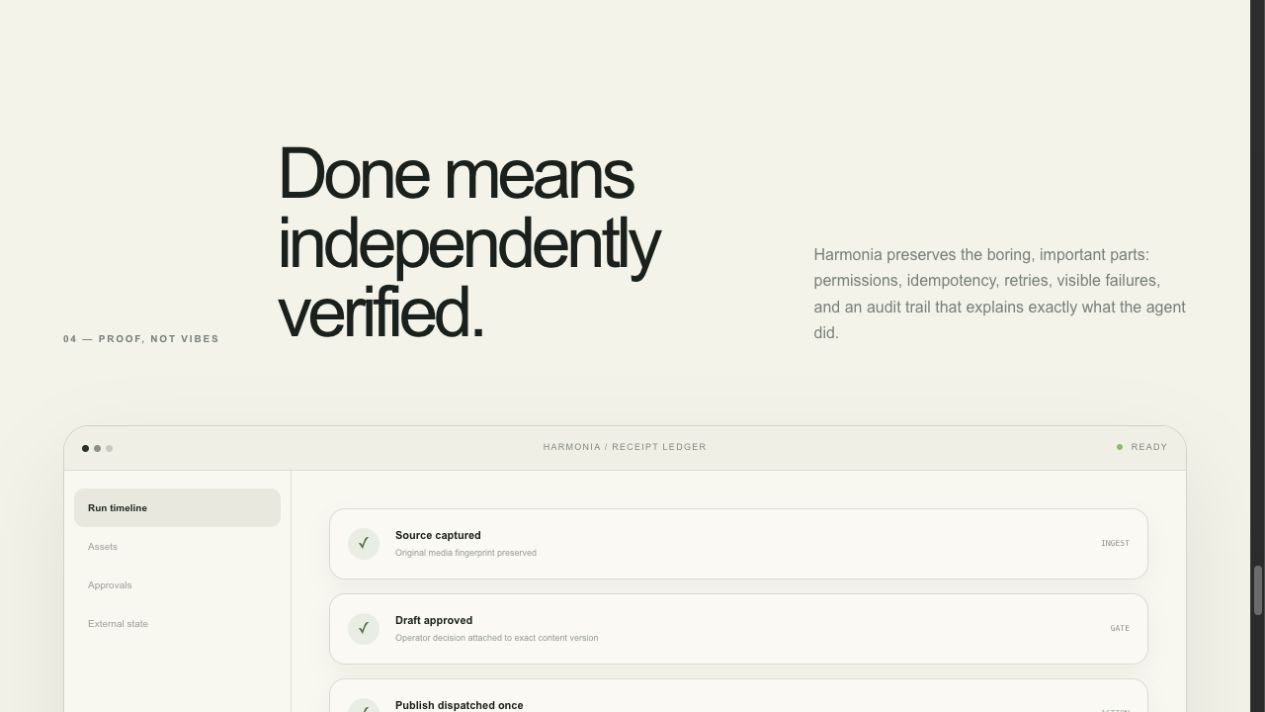
Approval, receipts, and independent verification define done.
-
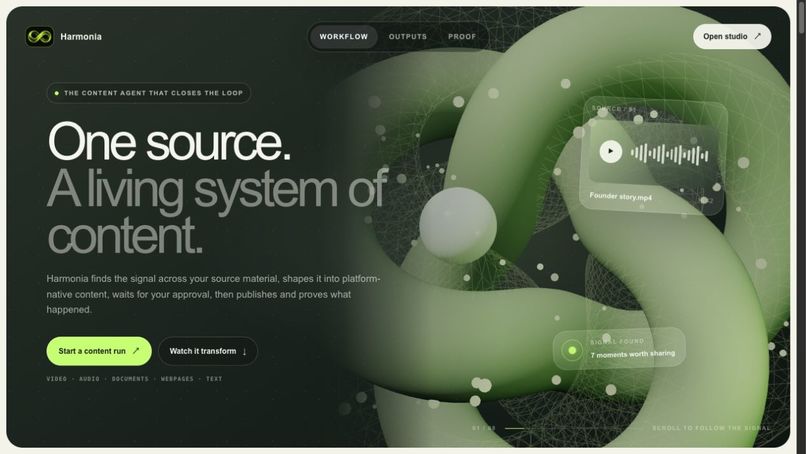
Harmonia turns one authorized source into a governed content operation.
-
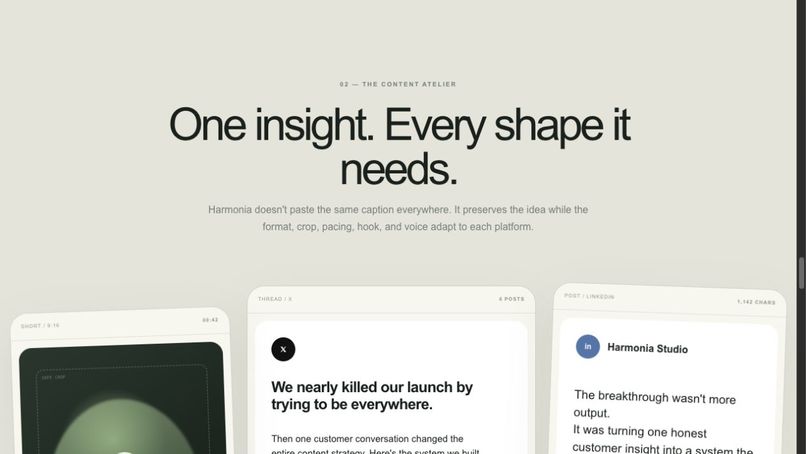
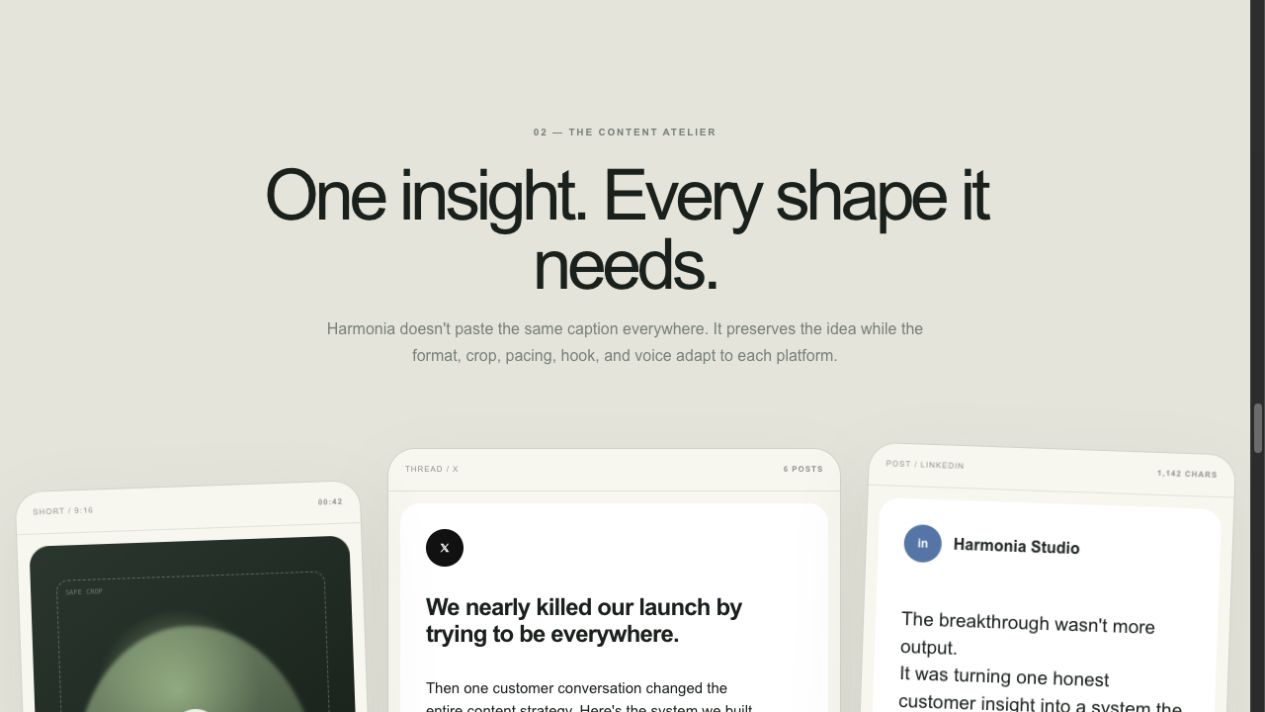
One insight becomes platform-native content without losing source traceability.
-
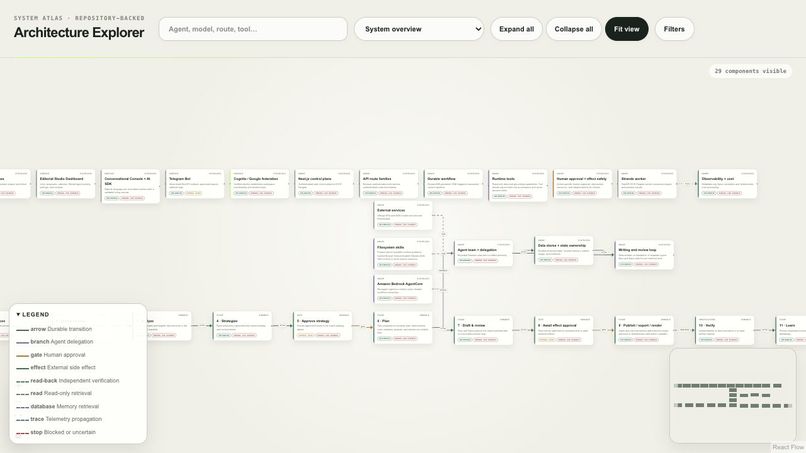
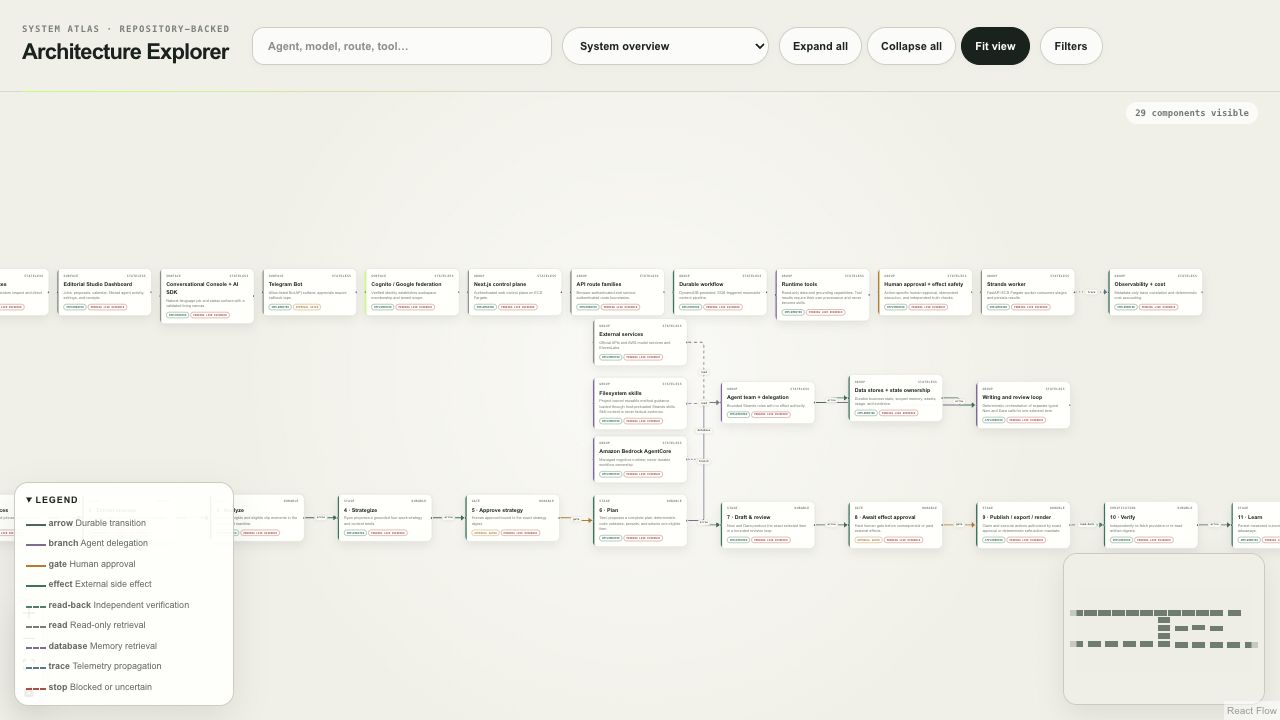
Repository-backed architecture explorer with live-evidence status boundaries.
-
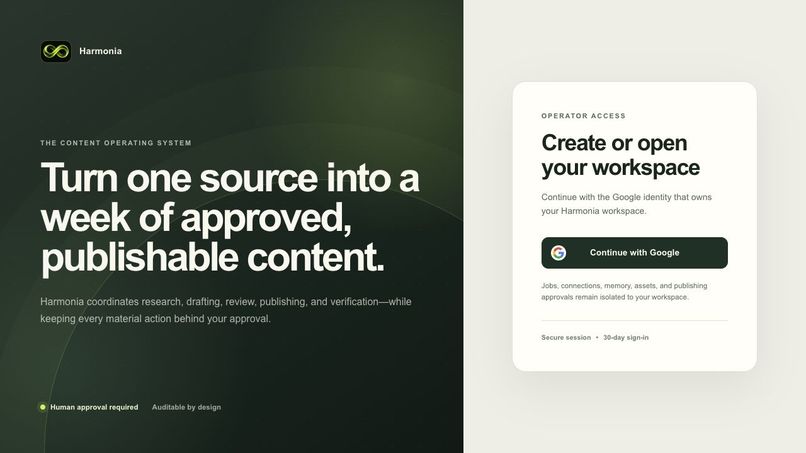
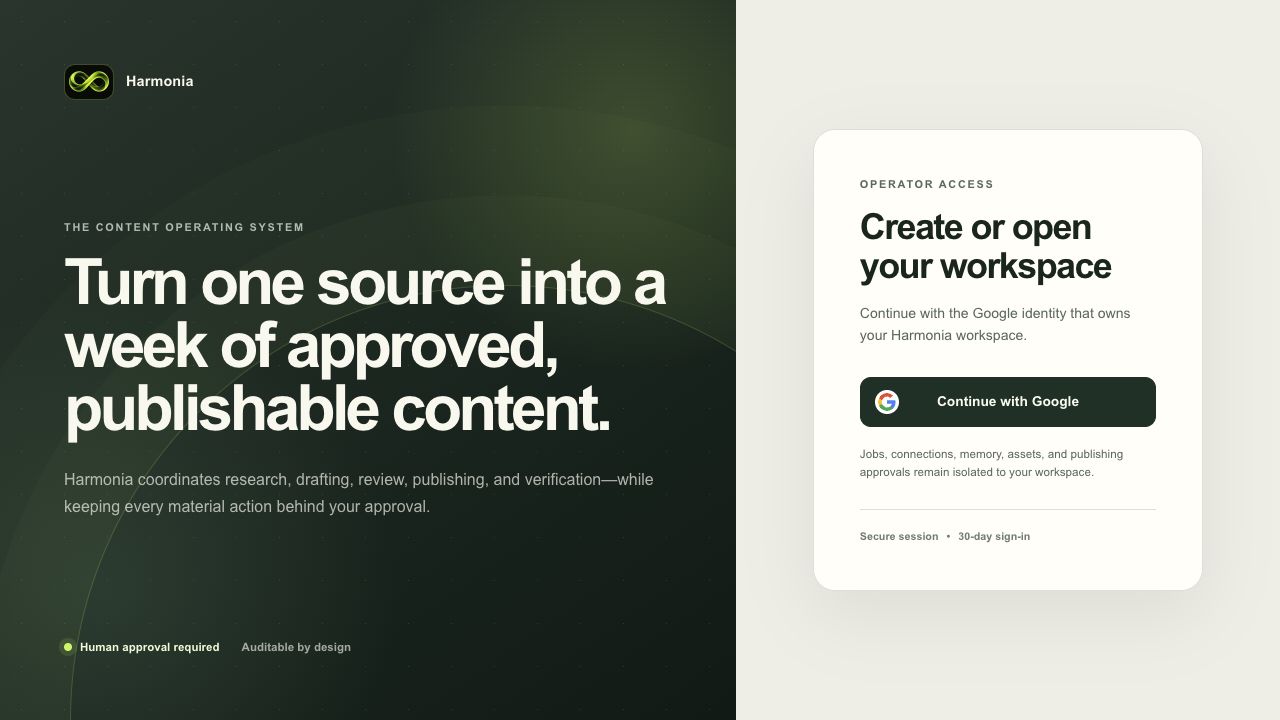
Operator access keeps jobs, assets, memory, and approvals isolated to a workspace.
-
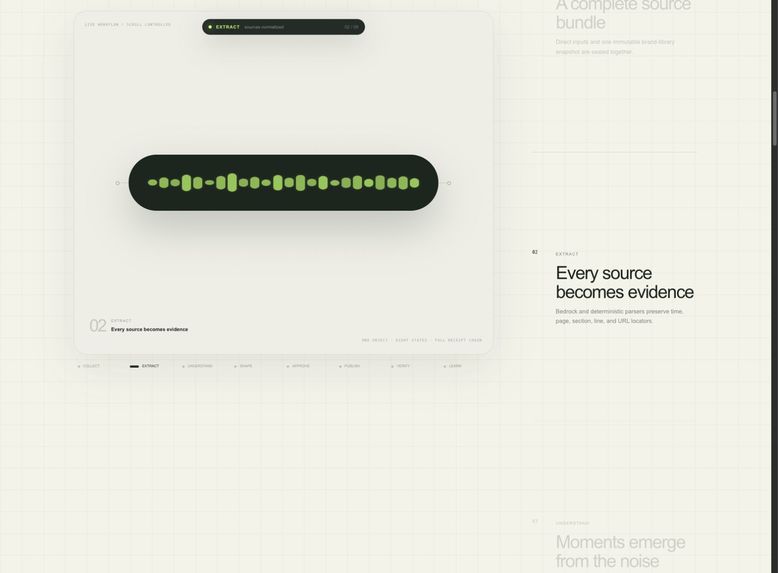
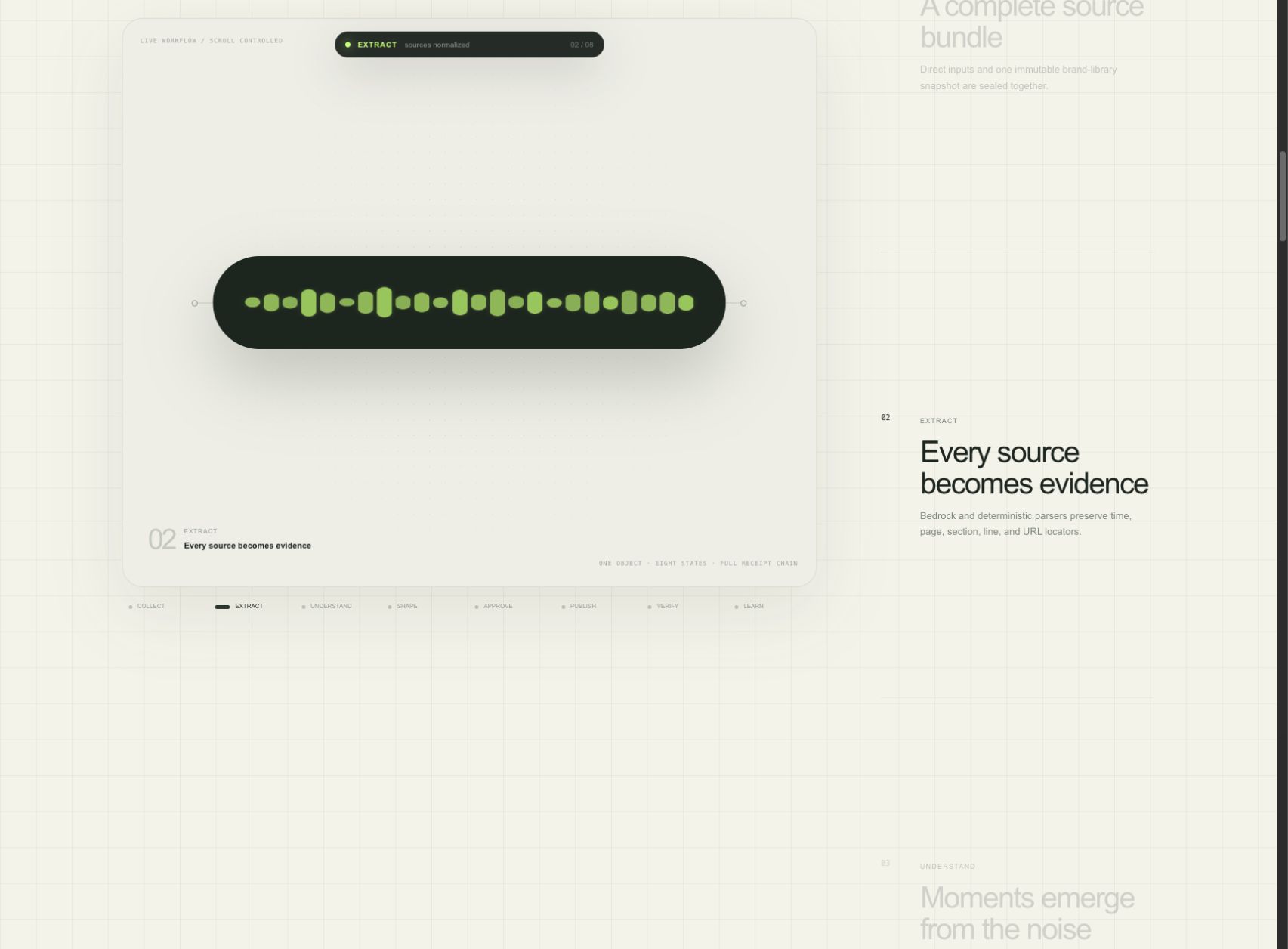
Every source becomes evidence with preserved time, page, section, line, and URL locators.
-
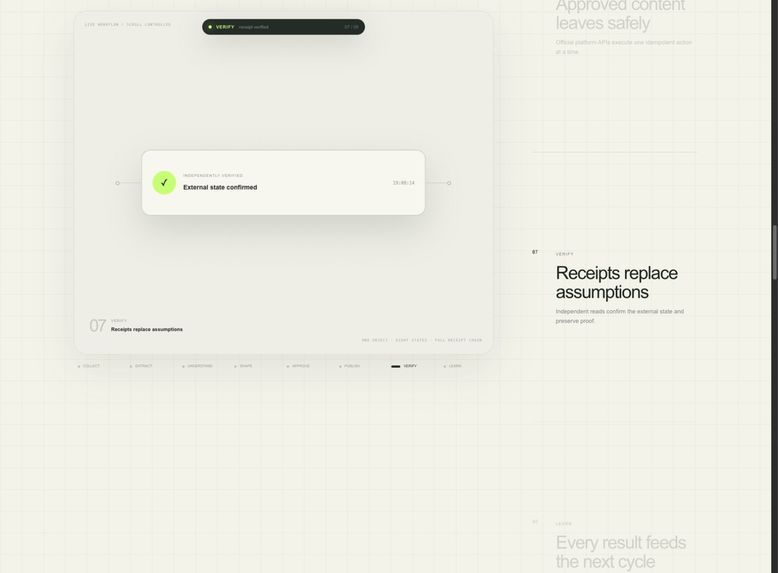
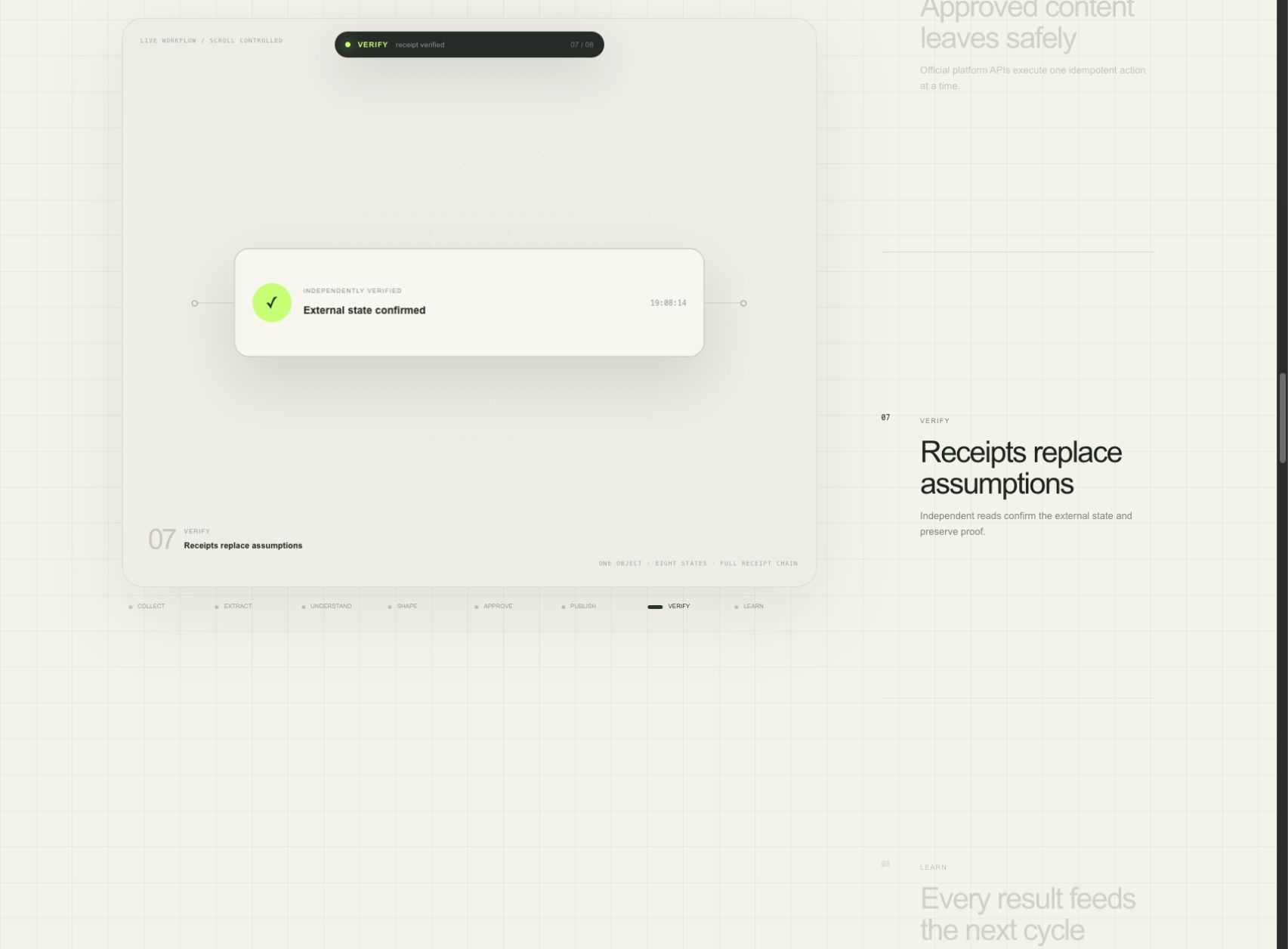
Independent read-back verification turns external state into an auditable receipt.
-
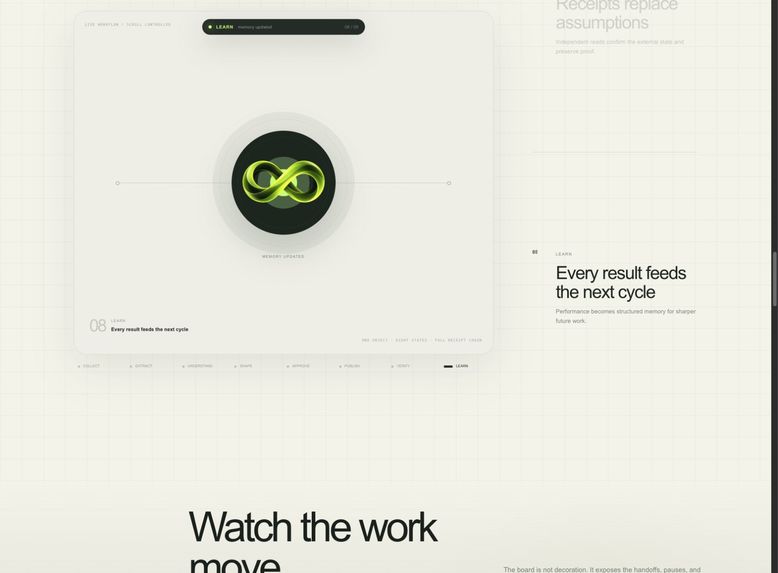
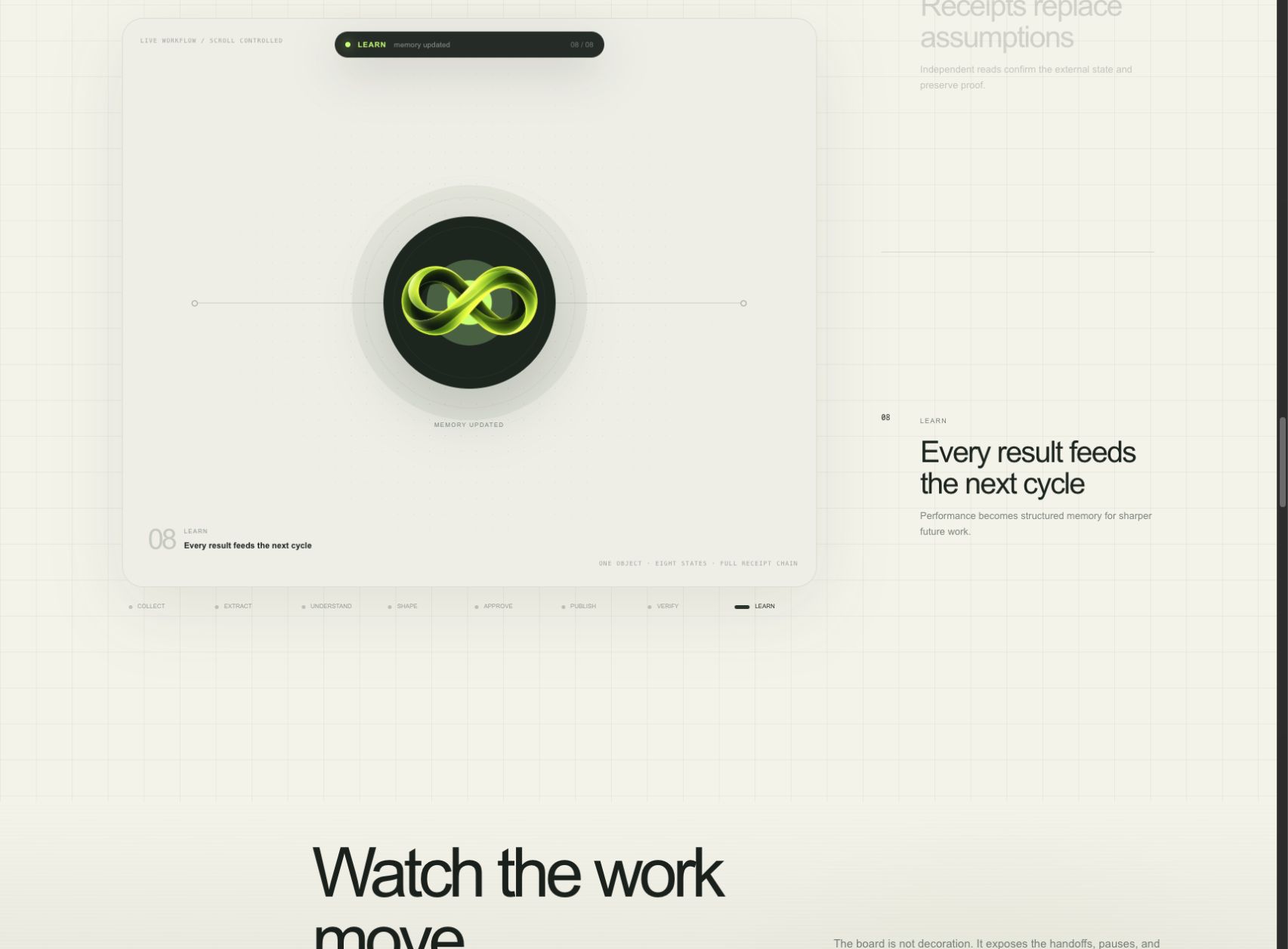
Verified outcomes become structured memory that improves the next governed content cycle.
-
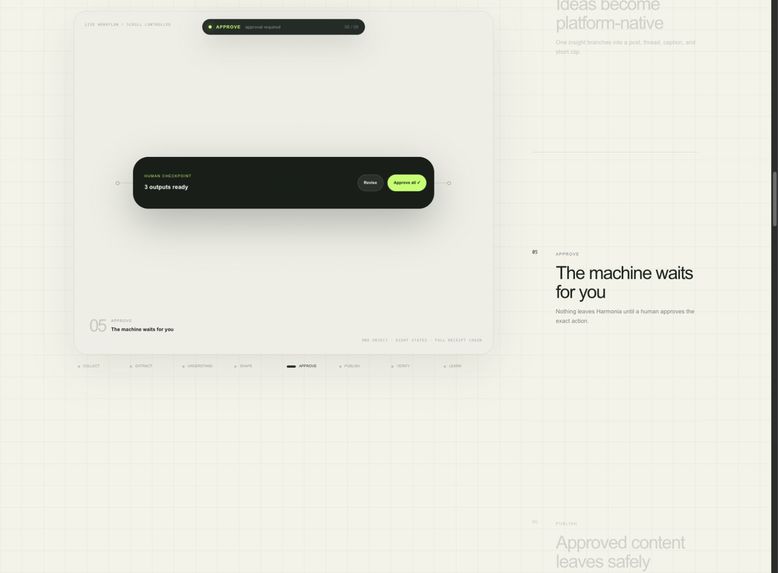
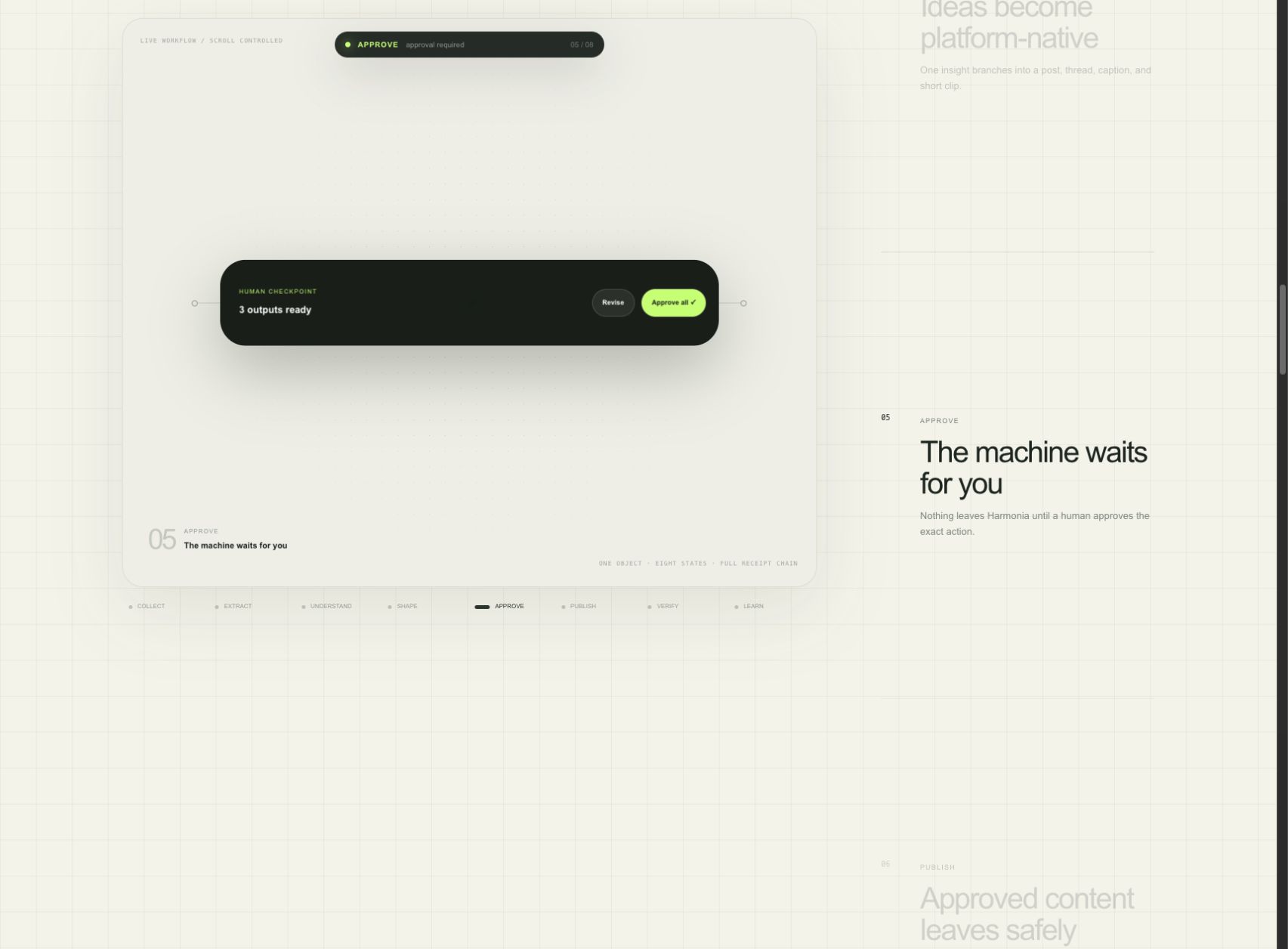
The machine pauses at the human checkpoint before any consequential external action.
Inspiration
Startup content work is repetitive, fragmented, and unusually easy to get wrong.
A team can spend hours moving from source material to strategy, calendars, platform-native drafts, reviews, exports, publication, and reporting – while losing the evidence and intent that made the content trustworthy in the first place.
Harmonia is a governed content operations partner for startups. It keeps daily production connected to an approved content strategy and handles the repetitive workflow in the background. It surfaces when a human decision is actually required.
What it does
An operator can bring Harmonia a goal, rough idea, video, audio file, document, pasted text, web page, YouTube link, or connected brand library. Harmonia preserves the operator brief separately from source evidence, then coordinates eight bounded specialists:
- Harmonia clarifies intent and coordinates the workflow.
- Nimi extracts claims, themes, moments, quotations, and clips from evidence.
- Ryan creates and evolves the evidence-linked content strategy.
- Temi turns strategy into campaigns, a content plan, and a calendar.
- Noni creates platform-native deliverables.
- Dara reviews strategic fit, accuracy, brand voice, and usability.
- Maya presents current state, approvals, work, and results.
- Nova answers read-only operational questions.
The operating loop is:
clarify -> strategy -> approve -> plan -> create -> review -> approve effect -> execute -> verify -> measure -> learn
Harmonia can prepare posts, X threads, LinkedIn content, content packs, short clips, captioned and reframed video, generated images, generated video sequences, and instrumental music. It also supports dashboard chat and an allow-listed Telegram surface.
Human judgment remains the authority boundary.
Models cannot advance workflow stages, approve strategy changes, authorize publication, incur generation costs, or turn unknown external outcomes into success. Every consequential approval binds the exact content, destination, cost, and revision.
Applied exports and publications require immutable receipts and independent read-back verification; repeat delivery returns the original receipt instead of duplicating the effect.
How we built it
The AWS edition uses the Strands Agents SDK for request-scoped specialists. Deterministic host code – not an LLM – selects the next stage, validates prerequisites, enforces tenant and budget policy, persists state, and controls approvals.
The application is designed for AWS deployment with:
- Amazon Cognito for server-resolved identity and roles
- DynamoDB transactions for durable state and approval authority
- Amazon S3 for immutable sources and artifacts
- Amazon SQS and dead-letter queues for repeatable delivery and recovery
- AWS Fargate for the web, worker, media, and scanner services
- Amazon Bedrock and AgentCore for bounded cognition, memory, and research
- Amazon Transcribe and Amazon Nova for media understanding and generation
- EventBridge Scheduler for resident background cycles
- CloudWatch and OpenTelemetry for correlated operations evidence
- AWS Backup, WAF, KMS, Secrets Manager, and least-privilege IAM for production controls
The dashboard uses Next.js and Vercel AI SDK 7 typed UI messages. Official X, LinkedIn, Google Drive, Google Calendar, YouTube, Telegram, and ElevenLabs integrations remain isolated behind explicit permissions and effect gates.
Challenges we ran into
The hardest problem was not generating content; it was preserving authority under retries, crashes, stale approvals, concurrent workers, and uncertain provider outcomes. We separated model judgment from workflow control, made external actions idempotent, fenced worker claims, bound approvals to content digests, and required independent observation before calling an effect verified.
We also had to preserve a rich existing operator experience while replacing the prior cloud and agent runtime. The AWS edition removes the old backend rather than maintaining dual-write fallbacks. Cross-runtime contracts are exercised using real serialized payloads, and local DynamoDB/S3 integration tests cover transaction and recovery behavior.
Accomplishments that we're proud of
- Eight narrow Strands specialists with request-scoped tools, hooks, skills, and typed result contracts
- Host-owned workflow authority and digest-bound human approvals
- Durable, tenant-isolated state with leases, outboxes, receipts, and duplicate suppression
- Evidence-linked strategy, planning, production, review, export, verification, and learning
- Persisted dashboard/chat refresh plus approval-safe Telegram decisions
- Approval-gated image, video, music, and ffmpeg/HyperFrames production contracts
- Explicit unknown-outcome reconciliation instead of blind replay or simulated success
- A clean exact-SHA local release gate: 1,025 web tests, 200 native integration tests, 1,083 Python tests, lint, TypeScript, production build, CDK synth, dependency audits, source SBOM, boundary drill, and local load verification
What we learned
Agent autonomy is useful only when authority is explicit.
Memory, search, model output, telemetry, and UI presentation are valuable evidence, but none of them should authorize a consequential action. Durable host state must remain the source of truth.
We also learned that “working locally,” “deployed,” and “verified against a provider” are different claims.
This submission package keeps those boundaries visible: the repository-local AWS edition has extensive deterministic evidence, while authenticated AWS/provider rehearsal and deployment must be demonstrated separately before they are claimed.
What's next for Harmonia
The next gate is a fresh authenticated AWS rehearsal using one licensed upload: login, malware scan, transcription, visual analysis, strategy correction and approval, planning, drafting, one rejected effect, one approved content-pack export, downloaded-byte digest verification, and duplicate suppression.
After that, we will enable feature families one at a time under reviewed budgets and permissions.
Provenance disclosure
Harmonia's identity, visual design, specialist roles, deterministic workflow contracts, operator interfaces, official platform connectors, source/execution evidence model, and existing tests predate this event edition.
The event work replaces the prior cloud and agent runtime with native Strands and AWS identity, persistence, assets, dispatch, infrastructure, memory/search, media-provider contracts, resident scheduling/recovery, and AWS-specific verification. The original Git history is retained.
Built With
- amazon-bedrock
- amazon-cloudwatch
- amazon-cognito
- amazon-dynamodb
- amazon-eventbridge
- amazon-nova
- amazon-sqs
- amazon-transcribe
- amazon-web-services
- aws-agentcore
- aws-cdk
- aws-fargate
- elevenlabs
- ffmpeg
- hyperframes
- next.js
- opentelemetry
- pydantic
- python
- react
- strands-agents-sdk
- telegram-bot-api
- typescript
- vercel-ai-sdk

Log in or sign up for Devpost to join the conversation.