-
-
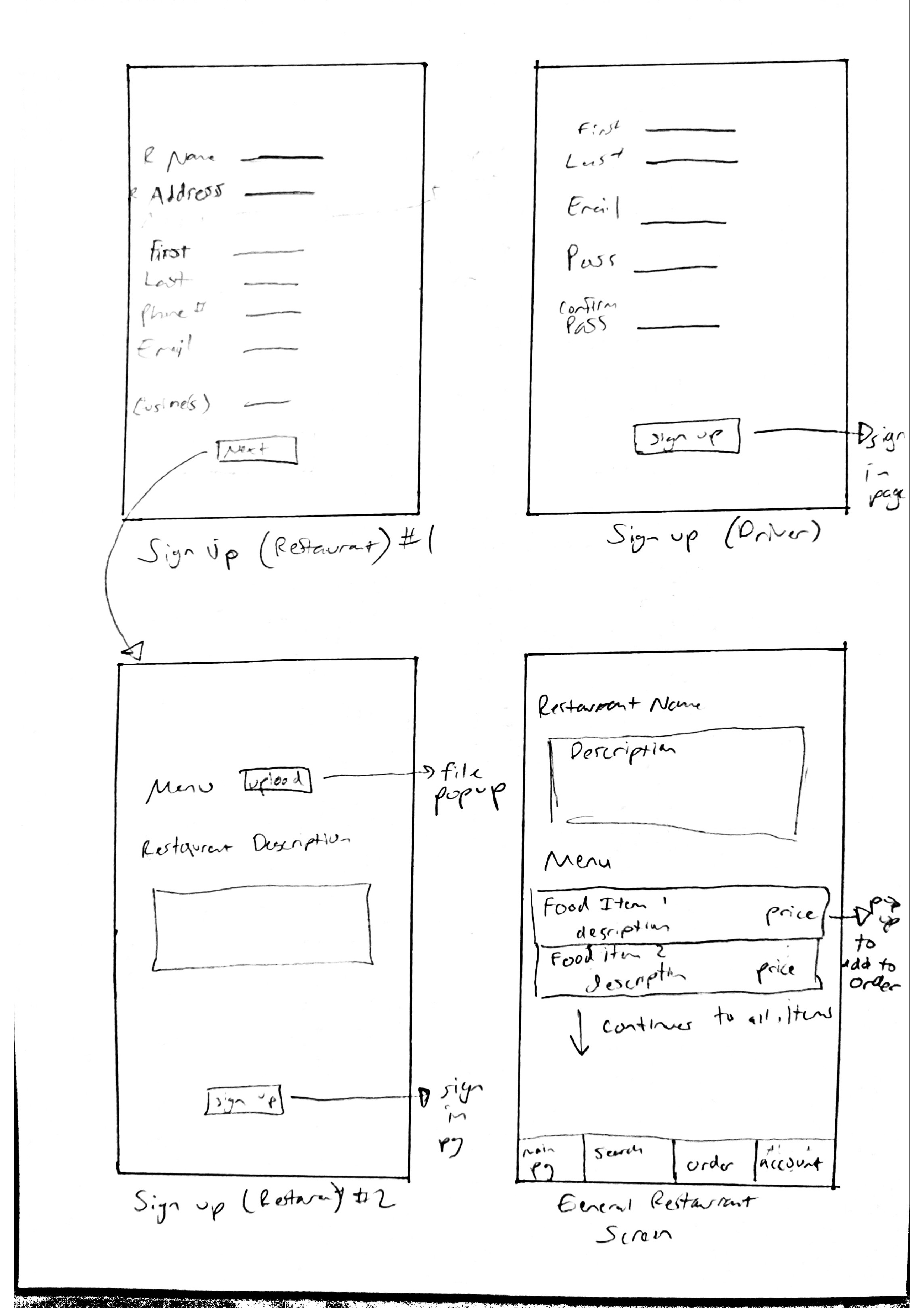
Lo-Fi Prototype Page One
-
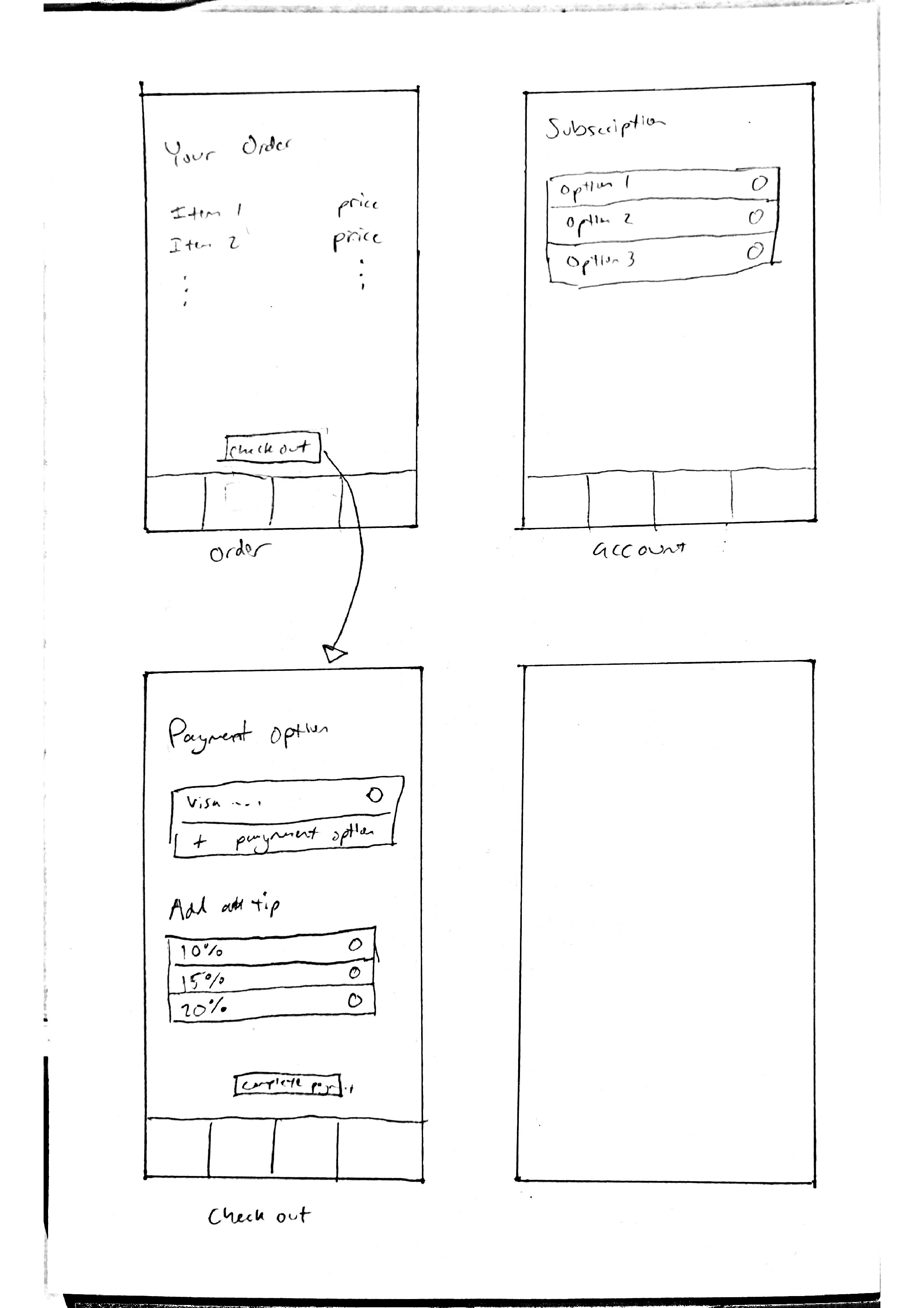
Lo-Fi Prototype Page Two
-
Lo-Fi Prototype Page Three
Overview
Covid-19 has affected the world in many different ways. Restaurants were completely closed for some time and now there are strict mask and social distancing guidelines. Restaurants are relying on delivery for their main source of income. Many of these delivery companies though, like Uber Eats and GrubHub, have a few major flaws.
The restaurants are losing money because of the 15-30% commission on each order, the drivers are not making consistent money due to inconsistency of tips and the customers are paying more for each meal because of delivery fees and tips.
Considering the shortcomings of these delivery services, we came up with a go-to-market strategy that removes tips, delivery fees and commission from the equation. See below for more detail.
Team Members
Jackson Hajer (Project Manager and Pro-Team Software Engineer, Chemical Engineering @ Rose-Hulman) Jackson was responsible with coordinating meeting times and running daily stand-up meetings. He created a Trello board to help the team coordinate which action items everyone was working on. He also worked on much of the UI and food ordering workflow in the product.
Carson Meyer (Pro-Team Software Engineer, Computer Engineering @ Rose-Hulman) Carson was responsible for user authentication, some UI implementation, and basic user security features. He filled in the gaps between the front and back ends of development.
Sathyan Venkatanaranyan (Pro-Team Software Engineer, MS Computer Science @ IU Bloomington) Sathyan was responsible for setting up Firebase and integrating each module in the back-end. He integrated all modules, fixed any merge conflict that occurred in GitHub, and carried out code reviews.
Nora Child (Go-Team Business Analyst & Data Science, Healthcare Management and Policy @ Indiana University Bloomington) Nora was responsible for allocating the tasks for the Go-Team every week to ensure that the deliverables were completed to meet the deadlines. Along with completing the weekly tasks (Value Proposition, Environmental Analysis, Business Model Canvas), she created a survey to collect real data from potential users to determine the needs/wants of the customers. She took the lead in the layout and design of the team's final powerpoint.
Spencer Wand (Go-Team Marketing, Marketing @ Butler University) Spencer was responsible for conducting market research that was germane to the product. This research is located throughout the Value Proposition, Environmental Analysis, Business Model Canvas, and Customer Personas.
Bradley Jones (Go-Team Sales and Business Analyst, Accounting @ Ball State University) Bradley was responsible for providing industry and environmental information for the product, which included work on the Value Proposition, Environmental Analysis, and Business Model Canvas.
How did you decide on this customer segment, problem, and solution?
We wanted a product that would support local restaurants and communities and we wanted to make that product make delivery as painless as possible for all parties. Delivery services are middle men. We wanted to minimize the impact that they had on everyone. We knew that commissions are hard for restaurants to deal with in the first place and replacing restaurant commissions, tips and delivery fees with a subscription-based service was the next logical step. With HarmonEats, we have accomplished that.
How did your team build and iterate on the solution?
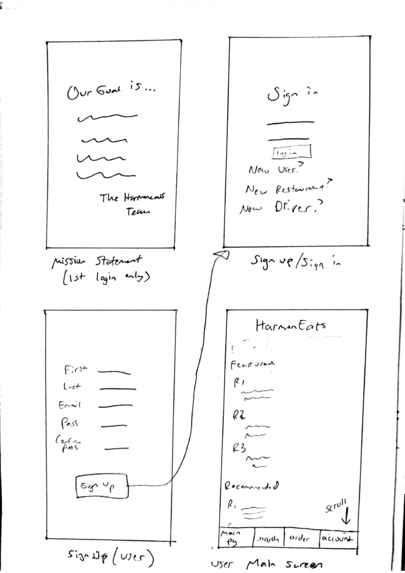
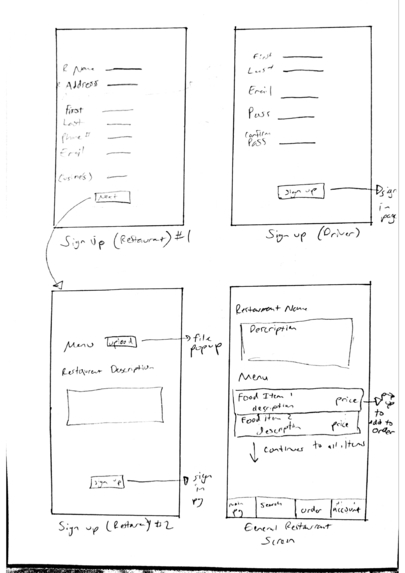
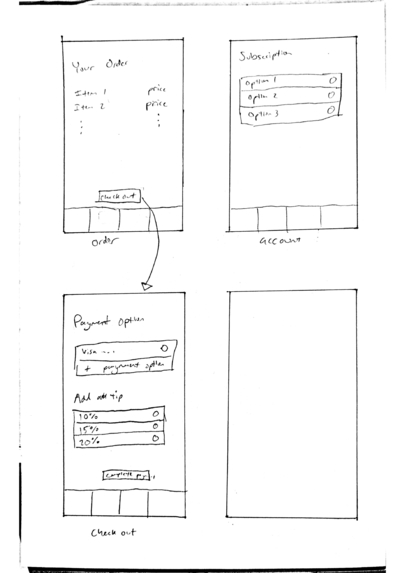
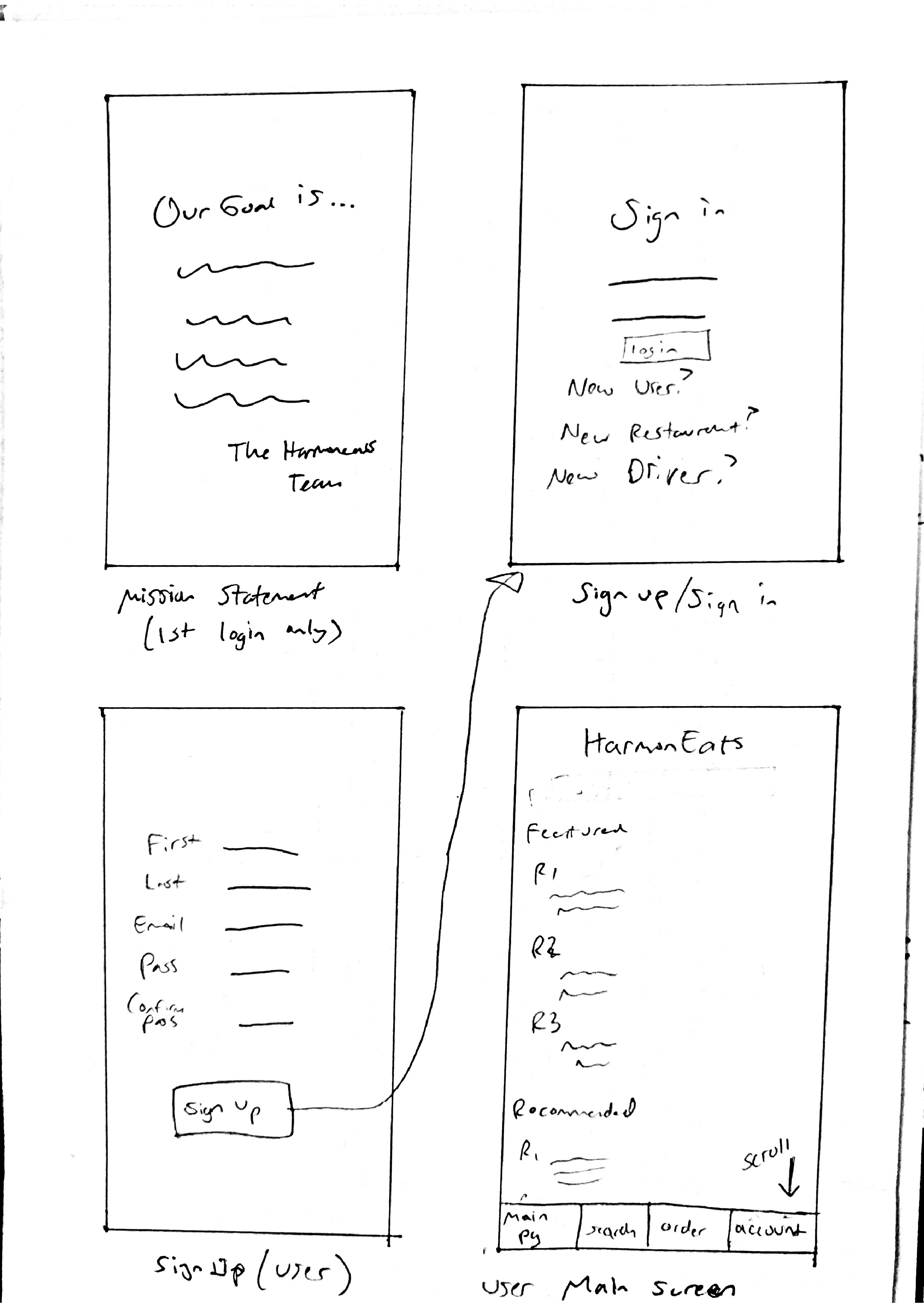
Trello was used to keep track of the project development and to assign tasks. Tasks related to programming were linked to their respective issues in GitHub. Issues were created and assigned to weekly milestones at the beginning of every week. At the inception of the project, we developed a Lo-Fi prototype with conceptualized features that helped us in visualizing how we wanted to design our product and implement certain functionalities. User testing began after Week 3 once we were certain that we had developed a minimum viable product. User testing was carried out by sharing the application's within closed circles and acquiring user reviews and inputs which were used to improve upon existing features and develop new ones.
Key Metrics
We created a survey that collected information regarding the public's opinion of food delivery apps. We had 16 responses, which allowed us to determine what features people like and dislike about current food delivery apps. Based on the feedback, we were able to tailor the application towards the needs of the public and include some ideas of our own.
Technical Architecture
Basic design layout can be viewed in the image gallery in the form of a Lo-Fi prototype. The GitHub repository is linked at the bottom of the page. The application was developed in Android Studio and uses Google Firebase at the back-end to support user authentication.
Key Tools, Libraries, and Frameworks
GitHub was used to let the Pro Squad collaborate on the same project using the same code base. The Pro Squad had already used GitHub and it integrated well with Android Studio.
Android Studio was the IDE that we used to develop the app. Android Studio was familiar to one of our team members, so we were able to pick it up quickly.
Firebase was used for our user authentication. Firebase is free and is easier to use than AWS.
Java was the coding language that we used to develop the app. This was a language that all of the Pro Squad members were all familiar with and made the most sense for us to use.
Google Drive was used to share and store files. This was a free and easy way for us to collaborate on the same files.
If you had another 5 weeks to work on this, what would you do next?
The application is currently not sending orders to restaurants. The steps to get to this point are quite extensive. We would like to begin working with drivers and restaurants first. This would require setting up driver payment and a whole slew of other features.
The application is not the most visually appealing. We would like to add our colors to the app and spruce up the app and make it much more welcoming.
The application was not beta-tested on a sample population. Factors such as costs and revenue were not analyzed to determine the cash flows related to the app. This would also have required a more in-depth study of customers' behavior.
Checklist of Completed Items
- Environmental Analysis - Completed
- Business Model Canvas - Completed
- Value Proposition Canvas - Completed
- Customer Persona(s) - Completed


Log in or sign up for Devpost to join the conversation.