-
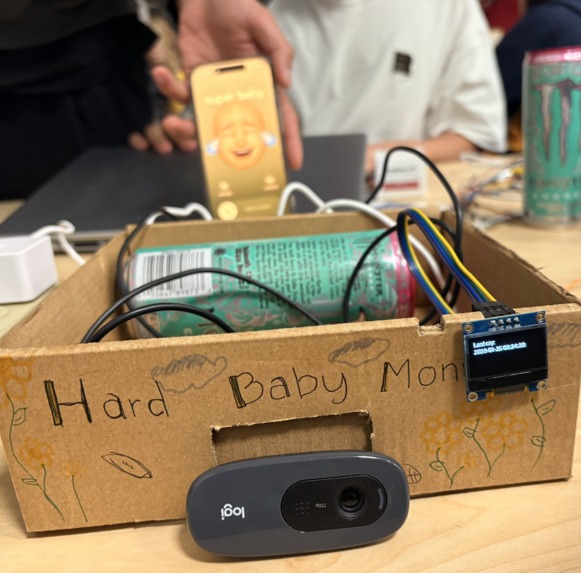
The monitor in action
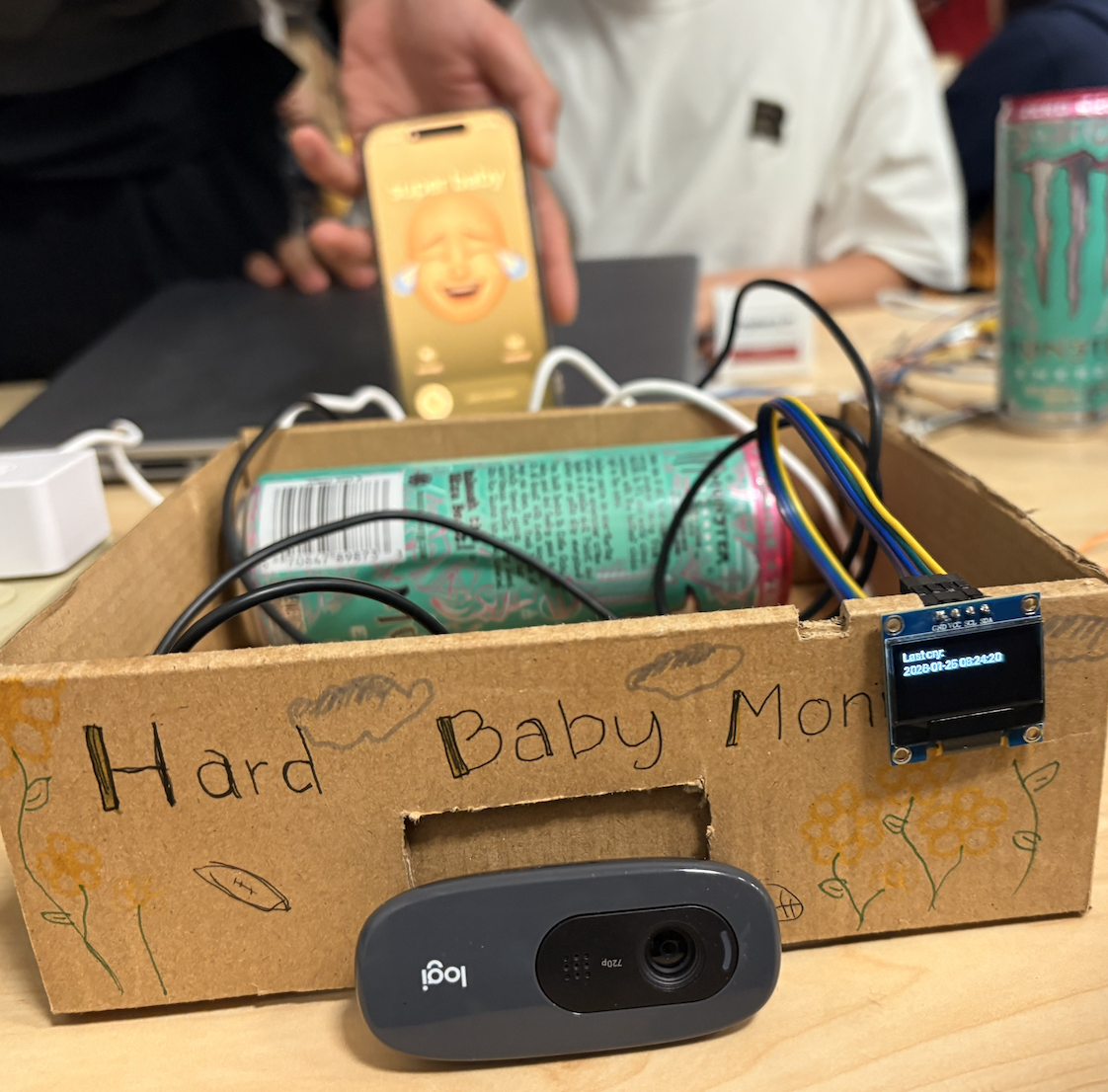
Inspiration:
Traditional baby monitors are inherently passive; they require a caregiver to remain within range of a receiver or constantly watch a video feed. The goal of this project was to bridge the gap between detection and notification by creating a proactive system. By utilizing cellular infrastructure, we ensured that a caregiver is alerted via a direct phone call, regardless of their immediate proximity to a dedicated monitor station.
What it does:
The monitor functions as an automated acoustic watchdog. It continuously samples ambient sound and processes the data to determine if the noise level warrants an alert.
*Detection Logic: * The system relies on calculating the Root Mean Square (RMS) of the audio signal to measure average power over a specific window. This allows the system to evaluate volume based on the energy of the wave rather than just peak values:
How we built it
The project was built using a combination of low-cost hardware and robust cloud services:
**Core Hardware: **A Raspberry Pi 3 serves as the central processing unit, connected to a USB microphone and an OLED status display (SSD1306).
Audio Processing: A Python engine using the pyaudio library captures real-time audio streams and performs mathematical analysis on the data chunks.
**Interface: **An integrated OLED display provides real-time status updates, while a physical toggle switch on GPIO 17 allows for manual enabling/disabling of the monitor.
**Cloud Telephony: **The Twilio Python SDK manages the transition from a local hardware trigger to a global telecommunications event.
**Software Development: **Coded entirely in Python, with architectural assistance from Google Gemini, ChatGPT, and Claude AI to optimize logic flows.
Challenges we ran into
The hardware-level interrupts for the physical button proved difficult. Initial library choices for GPIO management (like lgpio) were inconsistent, leading to a pivot toward native RPi.GPIO interrupt handling. This ensured the system remained responsive to user input without incurring high CPU overhead from constant polling.
Accomplishments that we're proud of
We are particularly proud of the refined filtering system. Through rigorous testing, we tuned the system so that ambient background noise is ignored, and primarily human-range audio activate the notification system, significantly reducing false positives.
What we learned
This project served as a deep dive into Digital Signal Processing (DSP) and asynchronous programming. Handling real-time audio buffers taught us the importance of efficient memory management and the nuances of hardware-software interfacing, specifically regarding the timing of I/O operations. We also learned that small algorithmic optimizations can contribute significantly to the stability of a resource-constrained device like the Raspberry Pi 3.
What's next for Hard Baby Monitor
The next phase involves moving beyond simple volume thresholds. Given a more powerful processor, we aim to implement Machine Learning models trained on infant vocalizations. By analyzing the spectral signature (via Fast Fourier Transform), the system could predict why a baby is crying—identifying patterns based on pitch, frequency, and time of day.
This would allow for a more nuanced caregiver alert system that adapts to the baby's personal routines, and allows the parents to adapt more quickly to the baby's needs.


Log in or sign up for Devpost to join the conversation.