Harbor
Evacuation cash, ready before landfall.
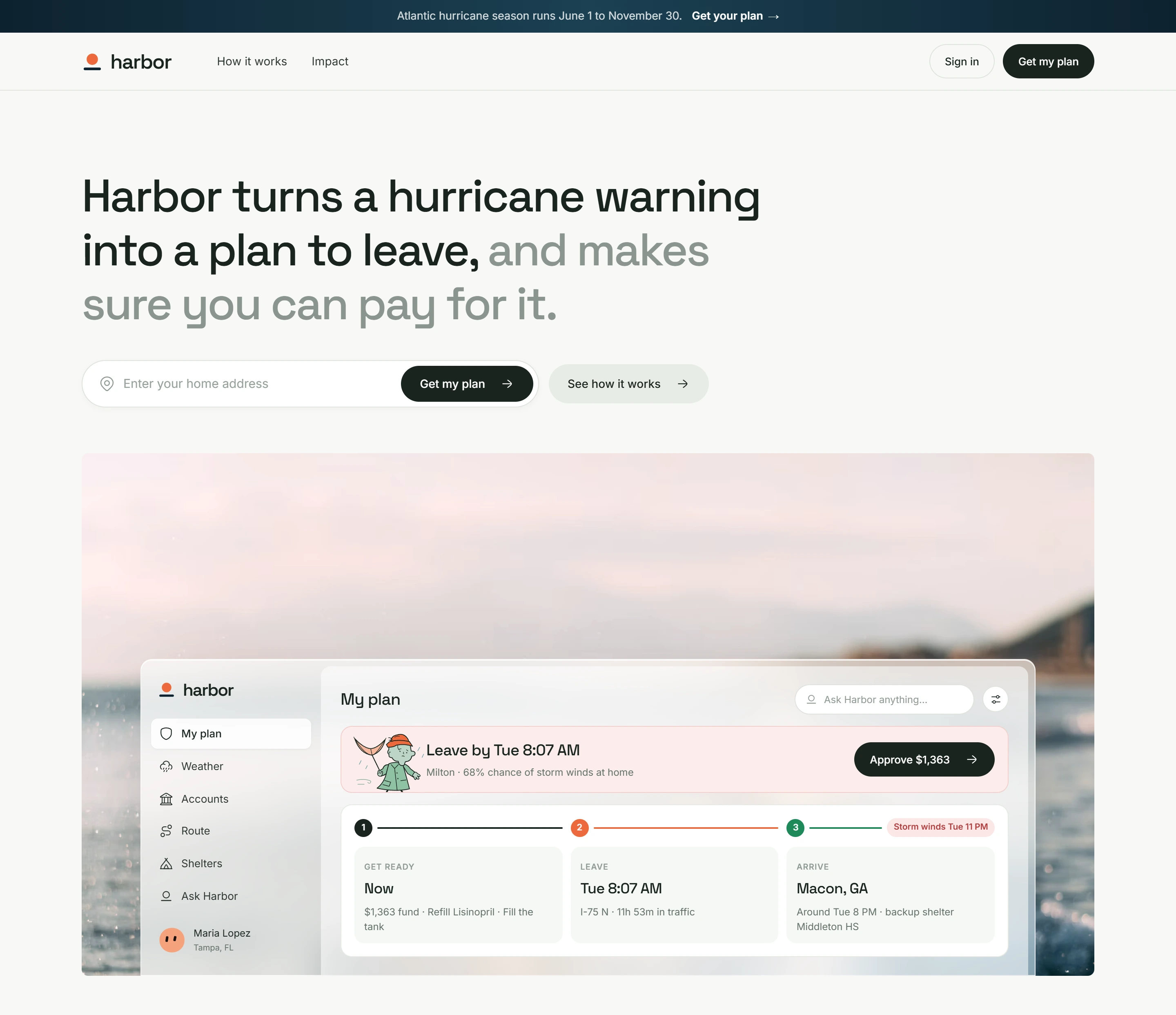
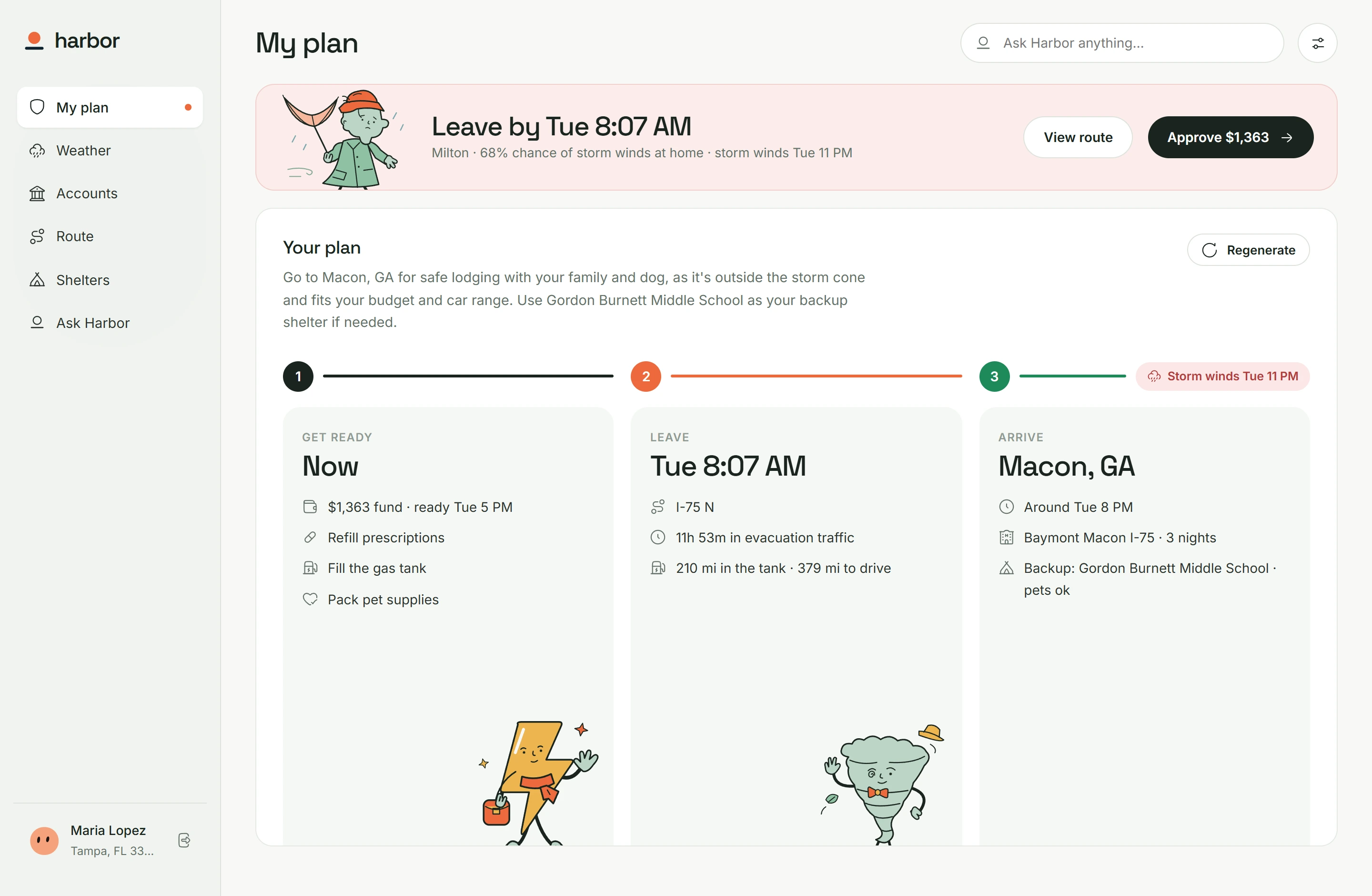
Harbor helps families afford to leave before a hurricane hits. It connects the storm forecast, an evacuation route, and a funding plan so households can prepare and approve the next step in one place.
Know the risk → Plan the trip → Arrange the money → Approve
Inspiration
Knowing you need to leave is not the same as being able to afford it.
| The problem | The number |
|---|---|
| U.S. adults who would not cover a $400 emergency entirely with cash or equivalent | 37% |
| U.S. adults who could not cover that expense by any means | 13% |
| Typical hurricane watch lead time before anticipated tropical-storm-force winds | 48 hours |
| Typical hurricane warning lead time before anticipated tropical-storm-force winds | 36 hours |
Families may need to pay for transportation, food, and a place to stay within a short window. Harbor helps turn that warning into a plan they can afford.
Sources: Federal Reserve, 2024 SHED; NOAA National Hurricane Center. The 13% is included in the 37%, not added to it. Cash equivalent includes a credit card paid off at the next statement. Alert timing refers to wind onset, not landfall.
What it does
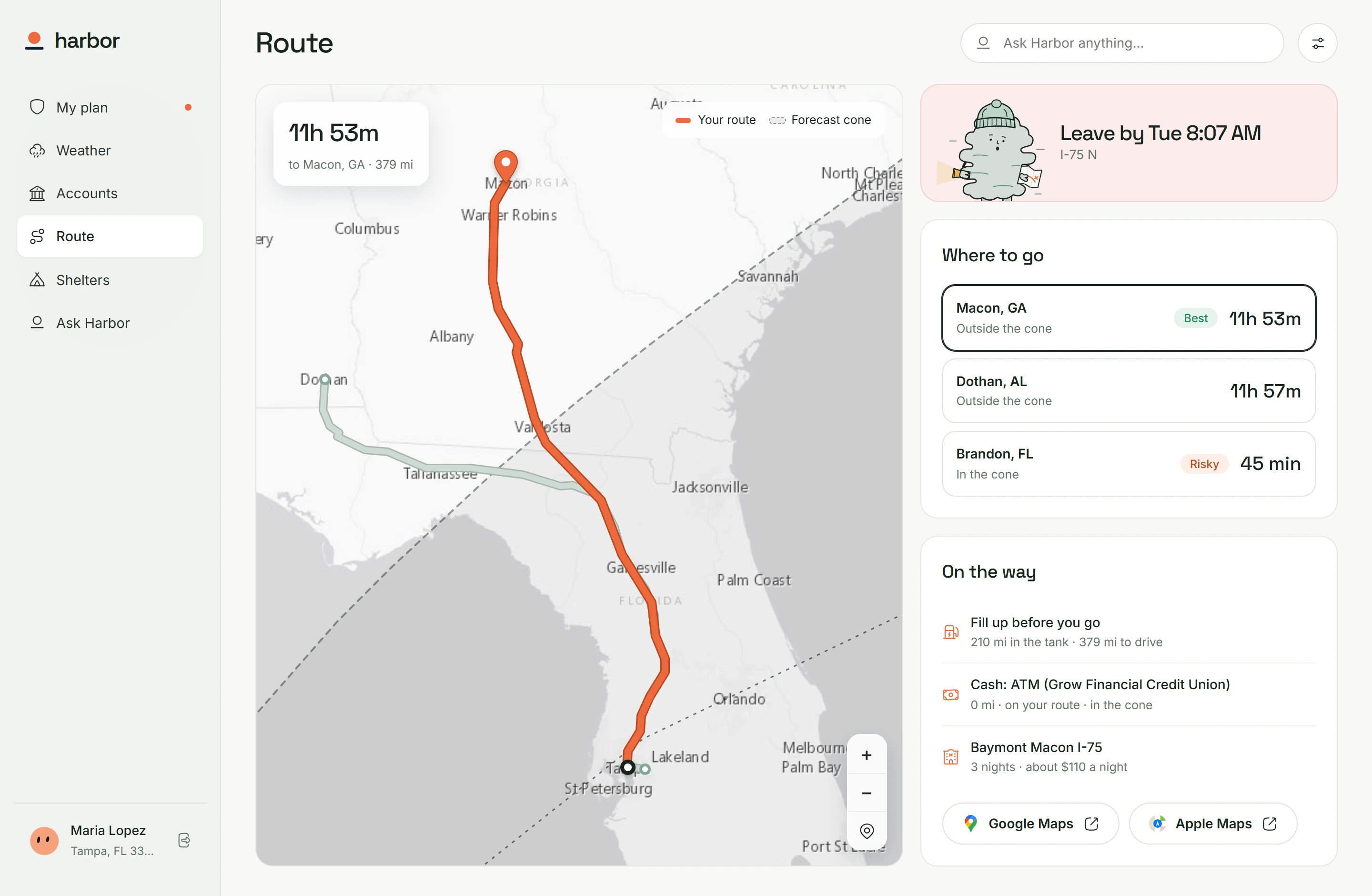
Harbor brings three questions together: When should I leave? Where should I go? How will I pay?
- Watch the storm. Track hurricane forecasts for the household's location.
- Plan the trip. Identify a route and estimate transportation, essentials, and shelter costs.
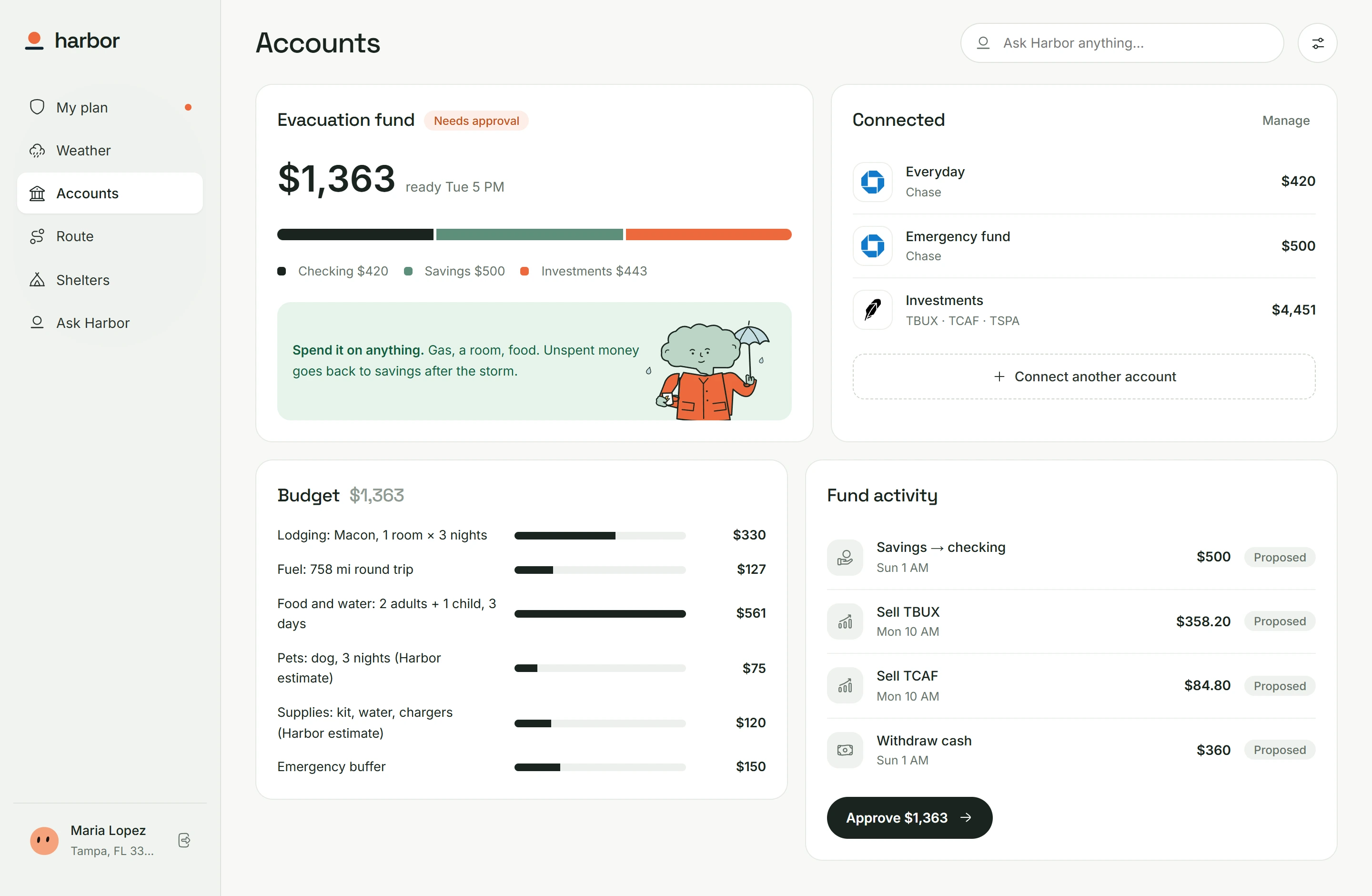
- Build a funding plan. Match costs with checking, savings, and eligible investment proceeds, subject to availability and timing.
- Ask for approval. The user approves the plan before money moves.
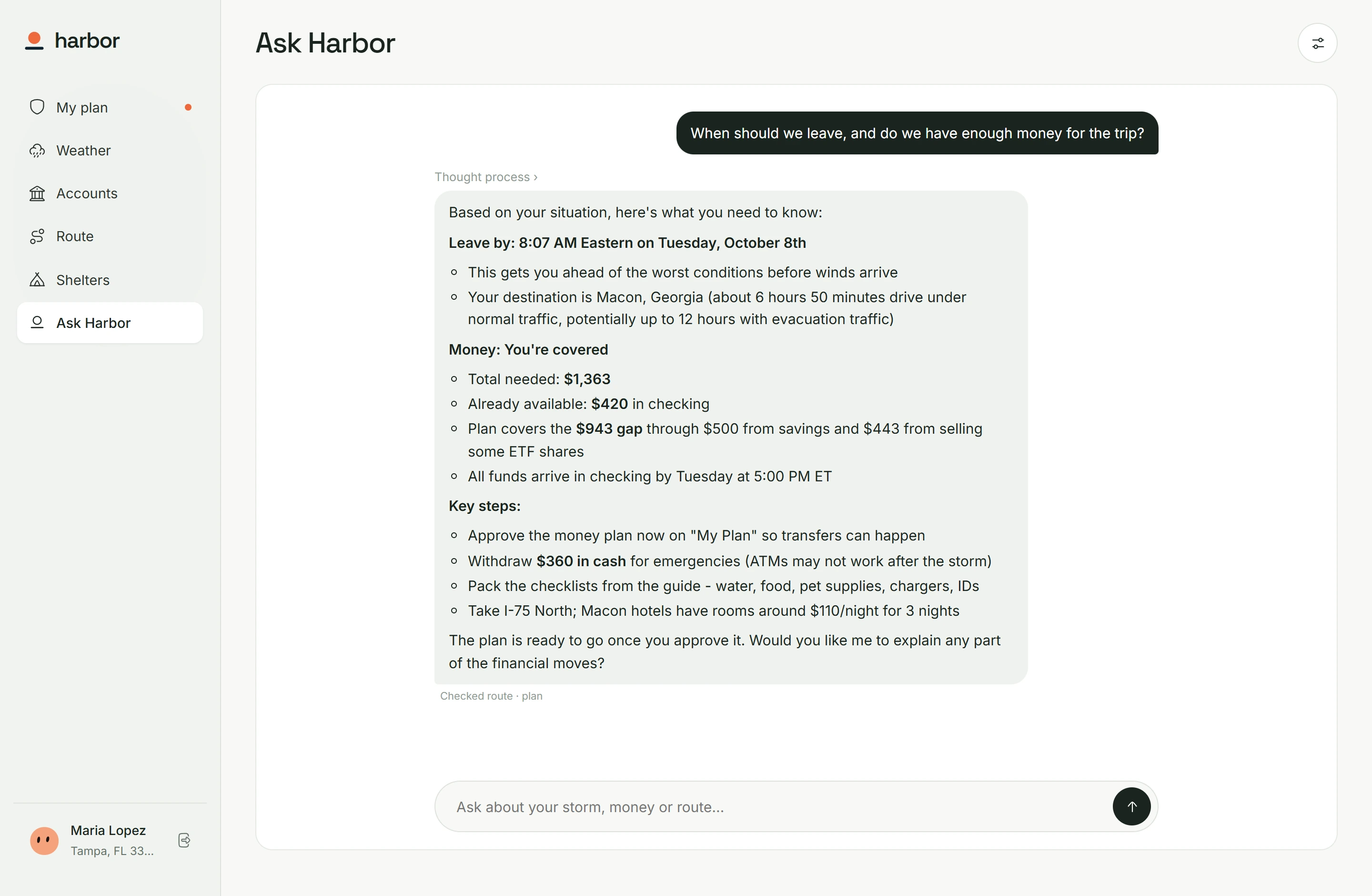
- Explain the plan. Ask Harbor provides AI assistance for questions about the storm and evacuation.
A simple example
$1,200 trip cost − $300 in checking = $900 still to arrange
Harbor proposes where the remaining money could come from. If available funds are insufficient, there is still a shortfall. Harbor does not create money or guarantee funding.
Illustrative example, not a real household or a quoted evacuation cost.
What works today: a Hurricane Milton replay using real NOAA data, fictional demo households, and simulated banking through Capital One's Nessie sandbox. Free evacuation transport matching is a planned extension, not a live guarantee.
How we built it
| Layer | What we used |
|---|---|
| Website and app | React, React Router, TypeScript, and Bun |
| Backend | Python, FastAPI, and SQLite, managed with uv |
| Storms and routes | NOAA hurricane data, Open-Meteo weather, and OSRM routing |
| Funding | A rules engine for planning and Capital One's Nessie sandbox for transfers |
| AI assistance | Gemini for evacuation advice and Ask Harbor, built with Pydantic AI |
| Quality checks | Python and frontend tests, linting, type checking, and CI |
The backend serves the app and API together. Docker provides a single-container setup.
Challenges we ran into
- Timing matters. Money needs to be available before departure, not just present in an account.
- The data must connect. Forecasts, routes, household needs, and travel costs must support the same plan.
- Users need control. Financial actions require approval, and advice must be clear about uncertainty.
Accomplishments that we're proud of
- Built an end-to-end demo connecting hurricane risk, evacuation planning, and funding.
- Used real NOAA records to replay Hurricane Milton.
- Connected funding plans to sandbox transfers without moving real household money.
- Added Ask Harbor and automated checks across the frontend and backend.
What we learned
- A warning is not a complete plan. People also need transportation, somewhere to go, and money they can access.
- Available funds matter more than account totals. Timing can determine whether a plan is usable.
- Clarity builds trust. Users need to understand the cost, the proposed action, and what still requires approval.
What's next for Harbor
- Support households without funds. Match free transport, pickup points, and shelters to household needs.
- Connect live availability. Improve transport and shelter information while following official evacuation guidance.
- Test with households. Validate whether people understand the plan and can act on it.
- Explore real bank integrations. Evaluate the security, permissions, and reliability needed beyond the sandbox.
- Validate a bank-funded model. Explore banks paying $1 per customer per month, rather than charging households.
The potential
At the README's illustrative budget:
10,000 households × $1,200 prepared per household = $12 million ready for evacuation
This describes a possible preparedness scenario, not money Harbor has provided, savings achieved, or proven impact.
Our goal: make the decision to leave less dependent on whether a family can access money in time.
Built With
- ai
- fintech
- python
- sensor
- ts
- weather
