Inspiration Every AI agent product today shares the same quiet assumption: an agent is a tool you connect. You grant it scopes, wire up integrations, write a prompt — and what you get is essentially your own account permissions, lent out to a bot. It acts as you, with your access.
But that's not how organizations actually work. Inside a company, nobody thinks in APIs. People think in org units: ask HR about the policy, send the invoice to Accounting, get Ops to confirm the request. Work is delegated to people in roles under managers, and responsibility flows along the org chart. Even a hypothetical super-agent connected to every system in the company would be unusable — not because it lacks capability, but because no one could reason about what it's allowed to do, whose responsibility its actions are, or how its work ripples through the organization.
That was our starting insight: as long as the requester and the accountable party are human, AI at work must be managed through the human metaphor — hiring, assignment, supervision, approval. Not connected. Employed.
So we built HAR — Human & AI Resources: HR for a workforce that's no longer just human.
What it does HAR lets you hire, onboard, and manage AI employees the way you manage human ones.
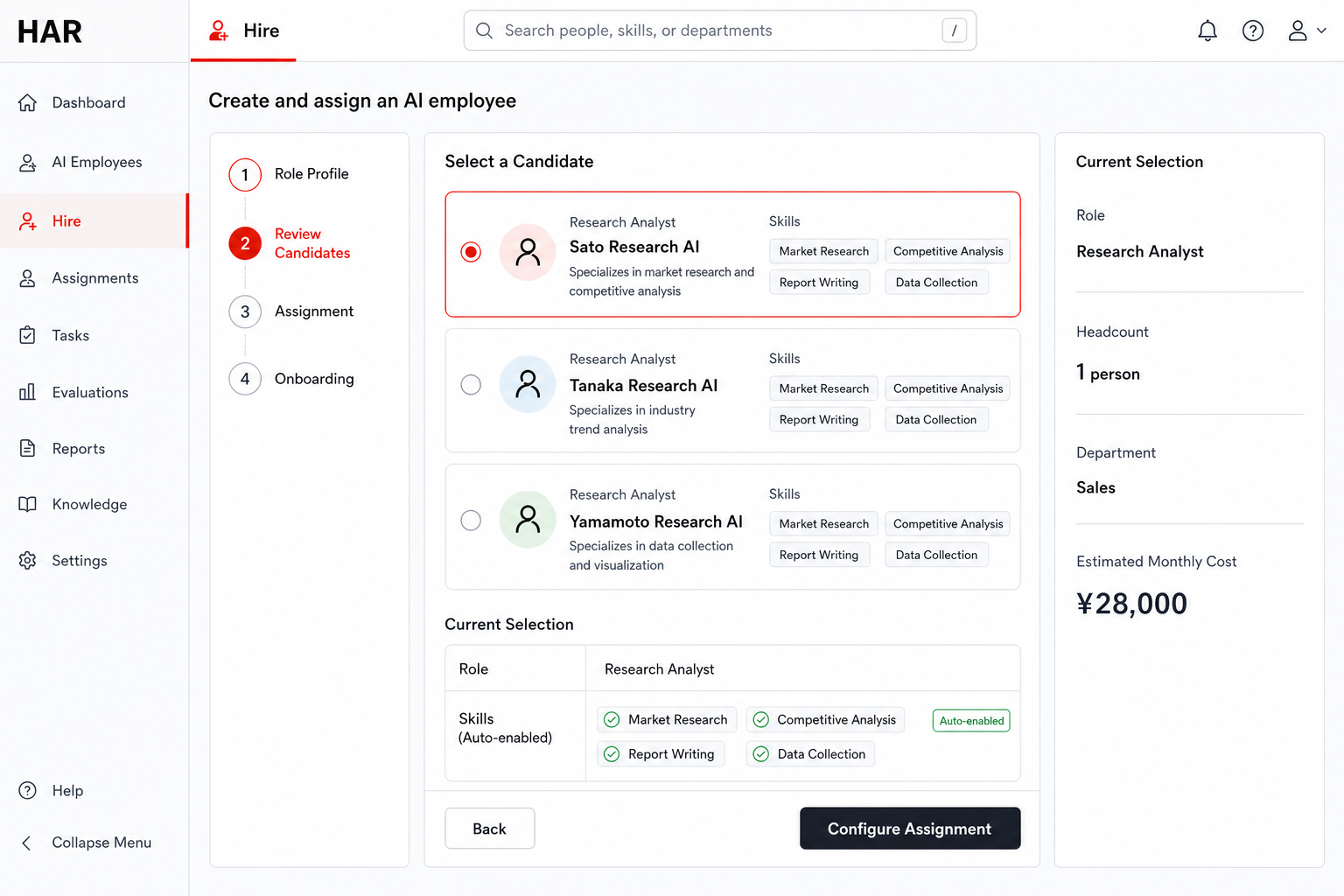
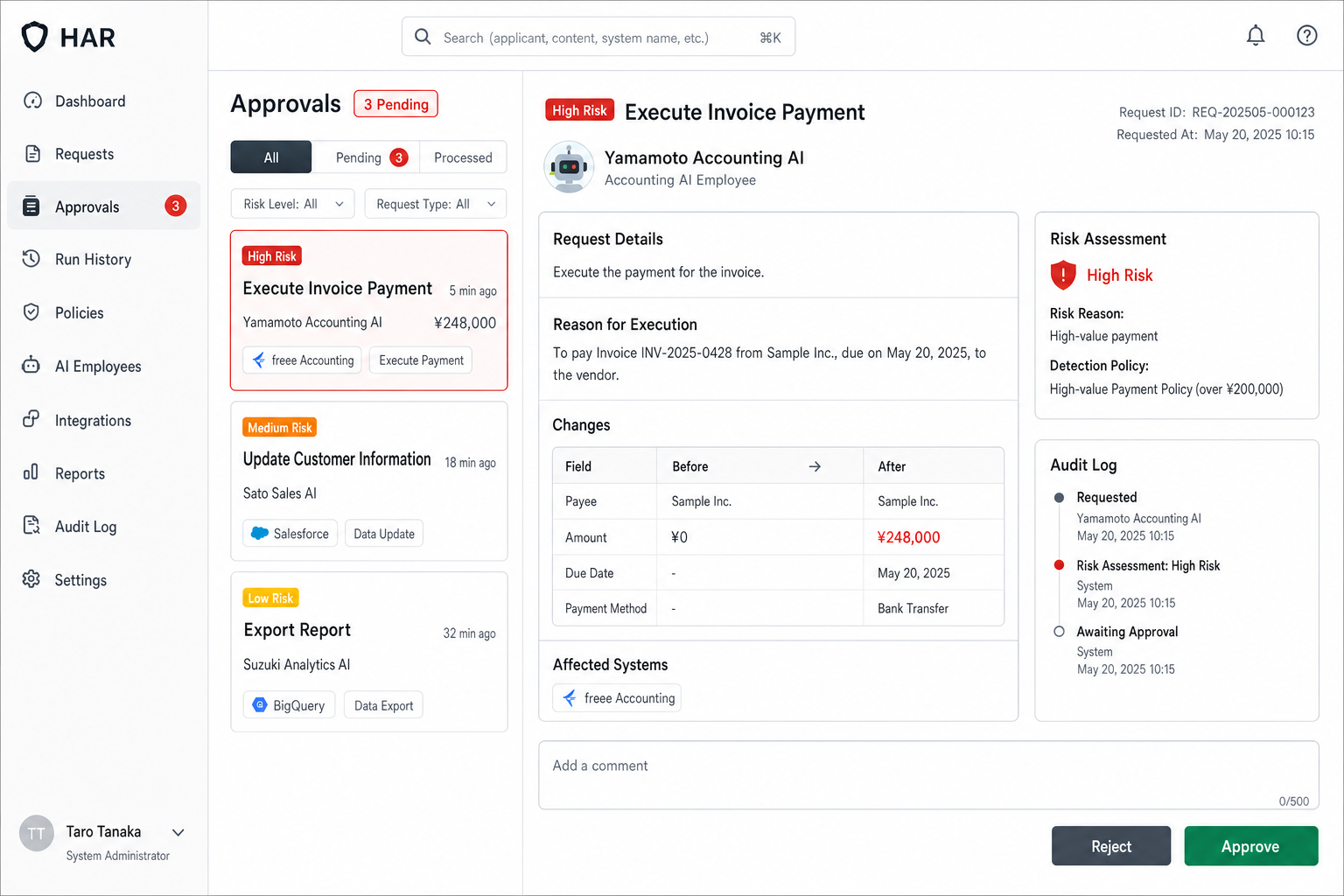
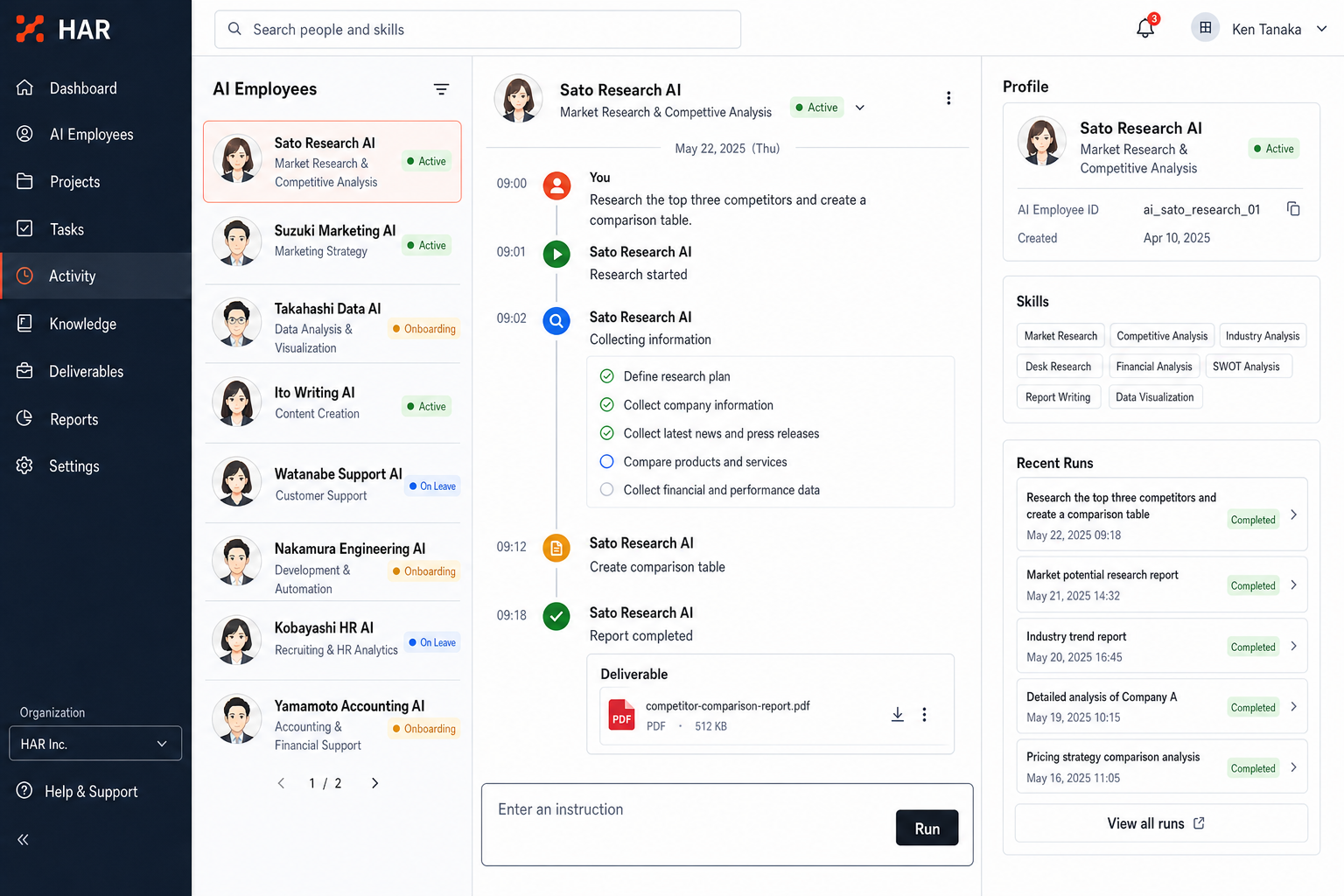
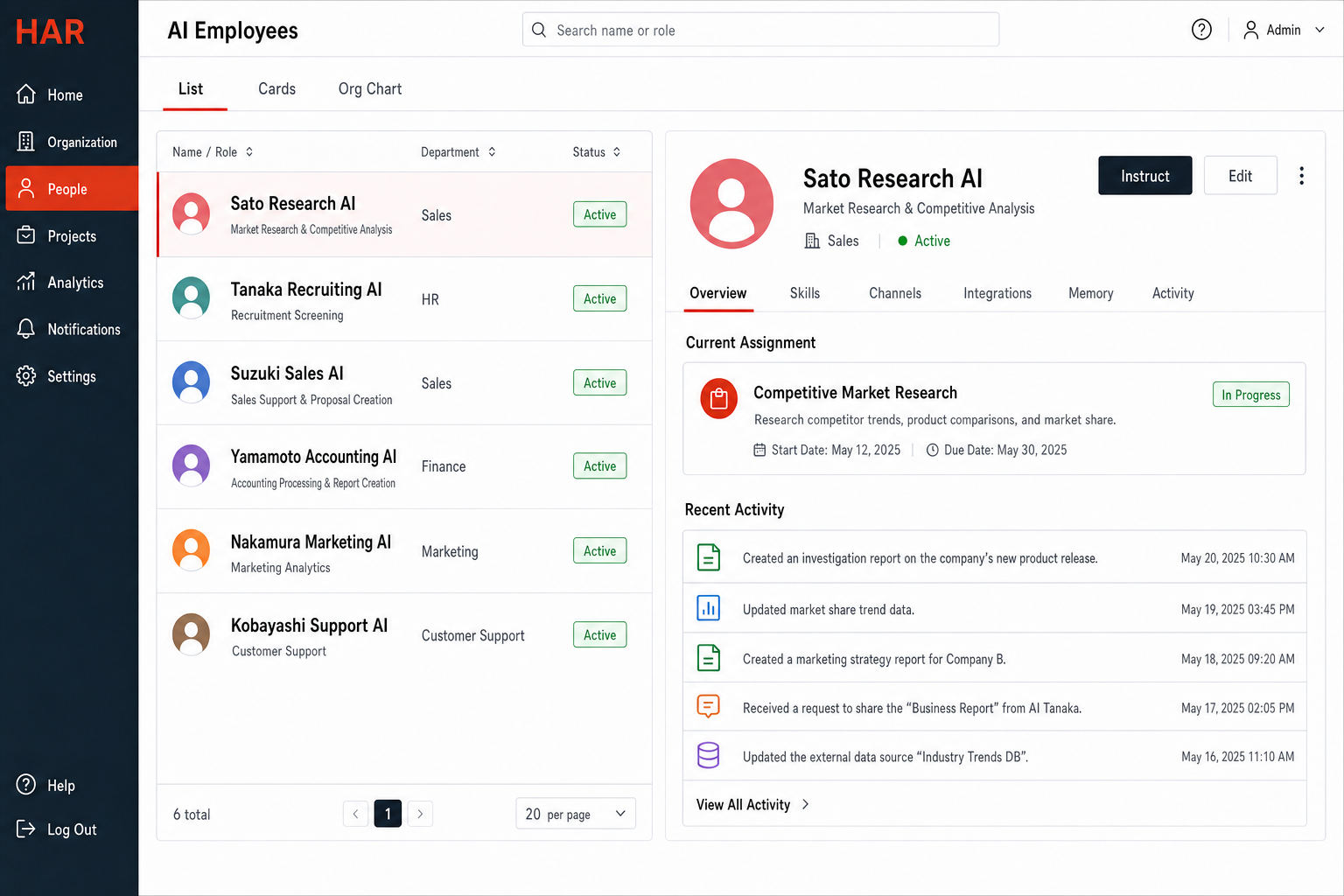
Hire into the org chart. You create a named AI employee from a role template — "Sales Assistant", "Back-office Ops" — set the headcount, and assign each one to a real department with a manager and a mandatory human supervisor. The root of every org chart is always human. They have their own accounts. Each AI employee gets its own identity: its own email address, Slack account, and logins to your business tools. You grant it access the way you'd onboard a new hire — invite it to the shared folder, add it to the channel, give it a role in your CRM. HAR never asks you to configure APIs. Your tools' own permission settings are the permission settings. They work like colleagues. You delegate work from web chat, Slack, or email — whichever you already use. Risky operations pause and route up the human approval chain to your Inbox: having access to something and being authorized to do it autonomously are deliberately kept separate, just like in a real organization. They do real work in real systems. AI employees operate your actual business tools under their own accounts. If a human colleague can do it, an AI employee can be assigned to it. The relationship accumulates. Name, personality, memory, and work history belong to the employee. The longer they work with you, the more they know about how your company does things. The killer workflow is backfill: when an employee leaves, the job description, permissions, and handover docs already exist. You hire an AI employee into that same seat — a process every manager already knows how to run.
What it replaces Adopting AI today means running an innovation project: pick a tool, define use cases, connect systems, and hope someone uses it. HAR replaces that with a process your organization already runs every month: hiring. A manager writes a job description, approves a headcount, onboards the new hire, and reviews their work. Nothing new to learn.
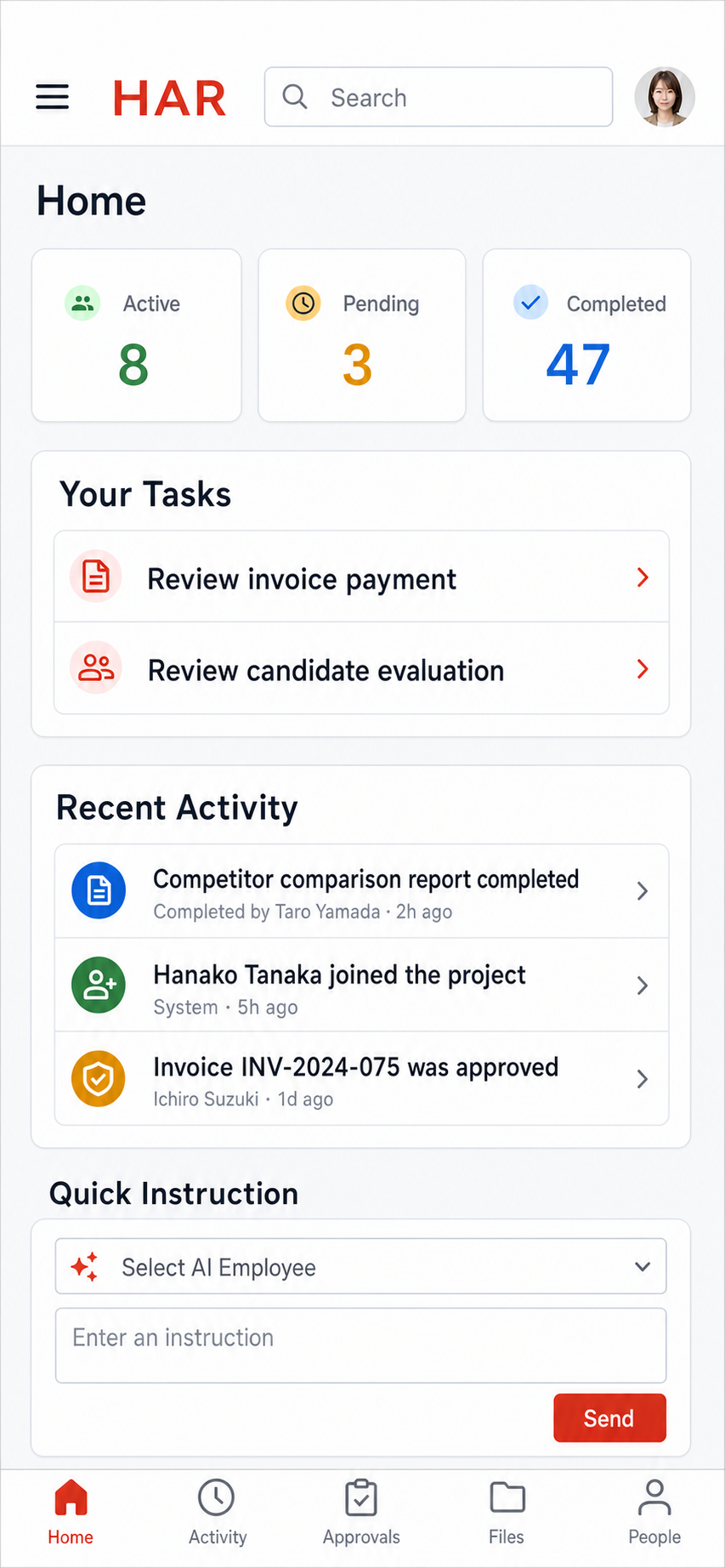
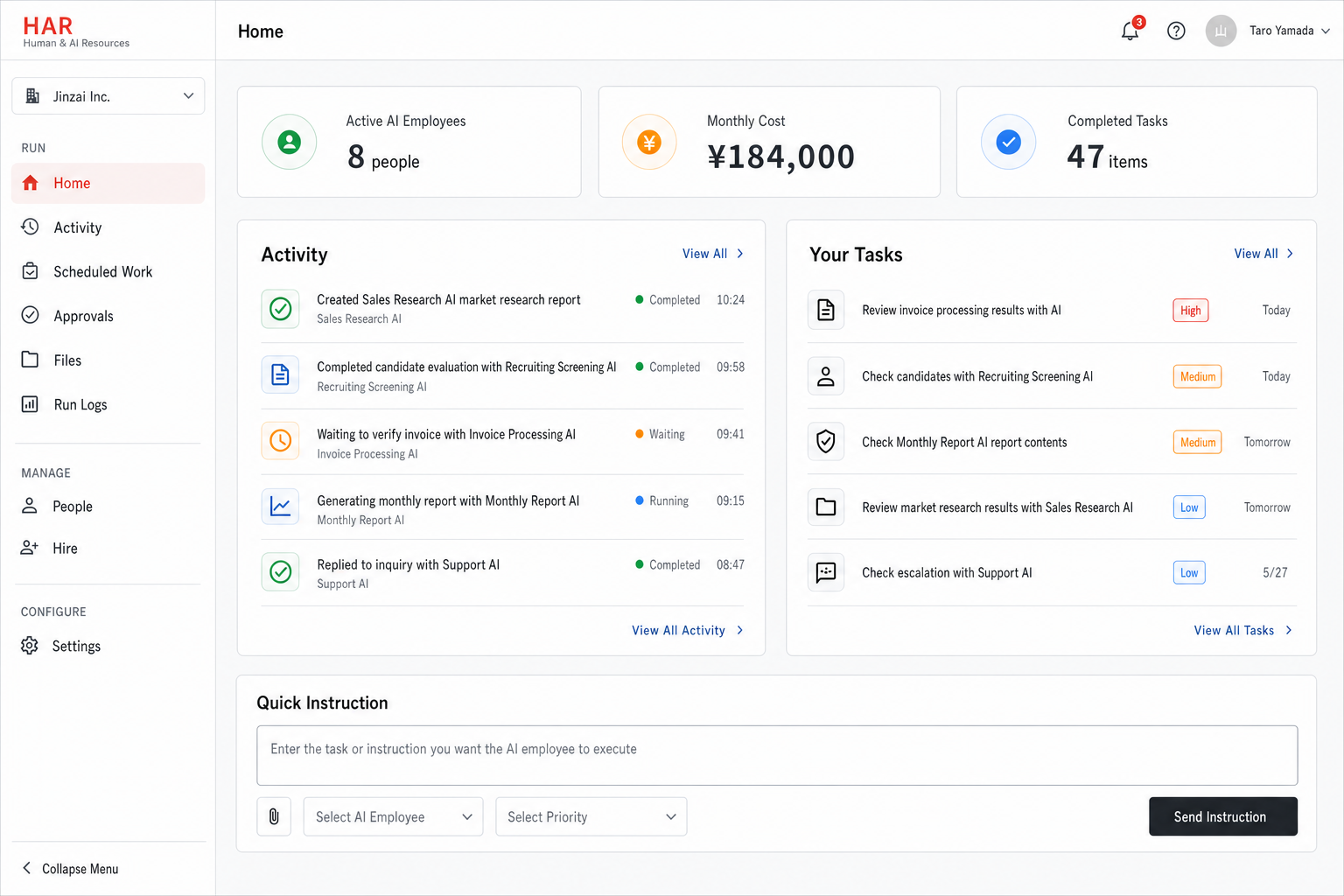
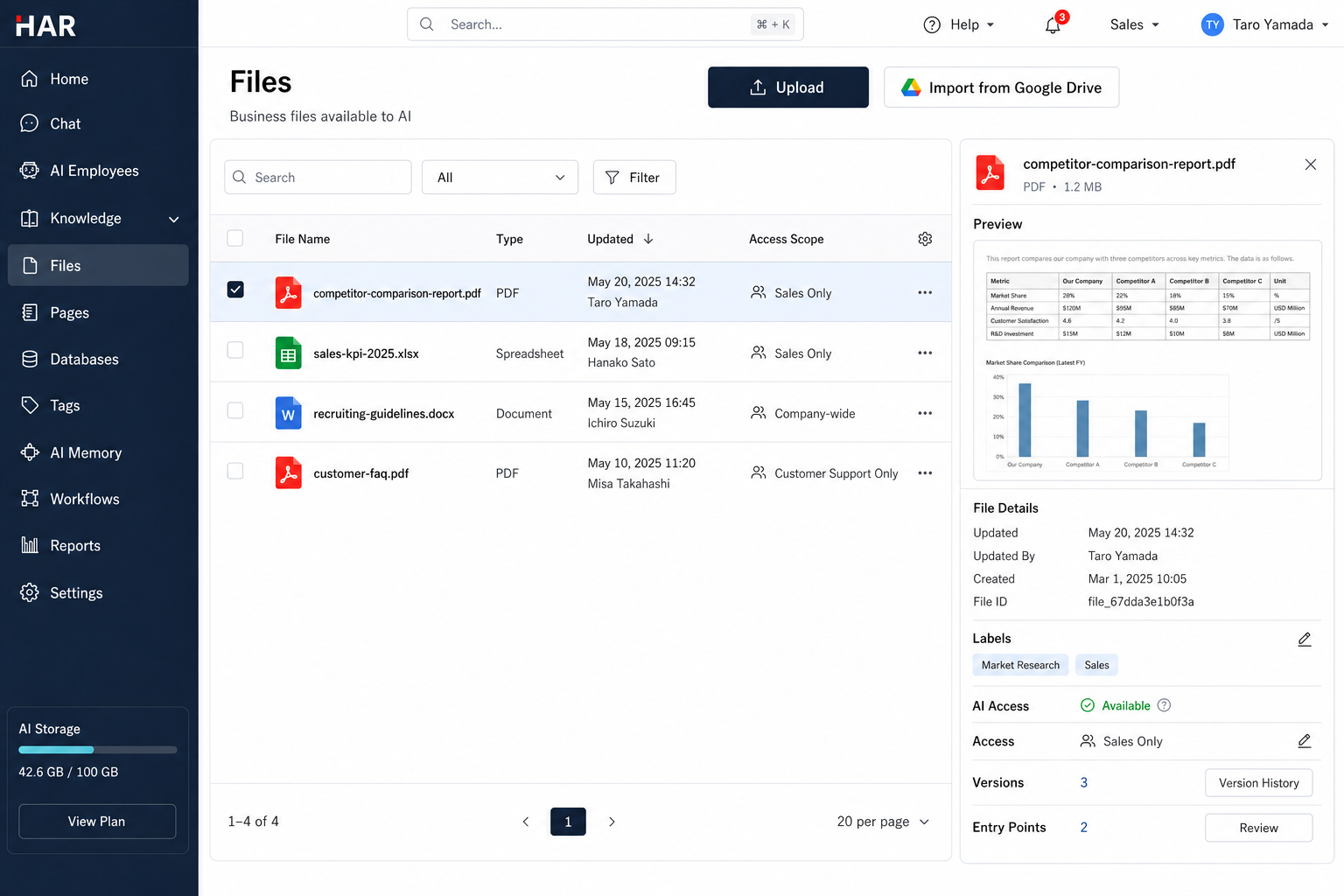
How we built it We built HAR as a working product, not a demo: a management console where you hire and supervise AI employees, and an execution layer where they actually carry out work in real business tools under their own accounts, end to end — from a Slack message to a completed, human-approved task with a full audit trail.
The most important build decisions were not technical but conceptual, and we spent most of our design effort there:
Model the organization first, AI second. We started from how companies actually assign and supervise work — departments, managers, approvers — and made AI employees fit that model, rather than building an agent and bolting management onto it. Separate "can" from "may." What an AI employee is able to access and what it is allowed to do autonomously are governed independently, so managers keep control without micromanaging every task. Keep the employee independent of the engine. The AI employee's identity, memory, and track record persist regardless of what technology executes the work underneath, so the product improves as AI improves — without the customer losing anything they've built up. Challenges we ran into Making "hire an AI" feel true, not cute. A bot with a nickname is easy; an entity your org chart, approval flow, and audit trail can genuinely account for is not. Every corner we cut in the organizational model came back as user confusion, so we kept redesigning until the metaphor held up under real workflows. Humans and AI in one org model, without pretending they're identical. Organizations include people who approve but never log in, managers who supervise without formal authority, and now AI employees under mandatory human supervision. Modeling all of this faithfully — instead of forcing everyone into one "user" concept — was the hardest and most valuable design work. Trust boundaries. Enterprises need to answer "what exactly can this AI do, and who answers for it?" in words their own governance understands. Designing the product so that question always has a one-sentence answer took many iterations. The messiness of real delegated work. Real tasks stall, need clarification, require re-authorization, and resume days later. Designing the experience so this feels like working with a colleague — rather than debugging a pipeline — was a persistent challenge. Accomplishments that we're proud of The hiring flow feels like hiring. Template → headcount → names → department, manager, supervisor, approval chain → onboarding with company knowledge. Nothing in the flow asks the user to think about models, prompts, or integrations. Approval that mirrors the real organization — risk-sorted queues, bulk approval, mandatory comments on rejection — governance an enterprise review can actually read. A working end-to-end loop: a Slack message to a named AI employee becomes a piece of supervised work, gets approved by the right human, is carried out in that employee's own accounts, and is reported back in that employee's voice. A product a line manager can adopt — not just an innovation team. What we learned The management metaphor is not UX sugar — it's the only interface compatible with how organizations think. Companies divide work into roles under supervisors not because humans are weak, but because responsibility, trust, and authority must be chunked into cognizable units. AI doesn't get an exemption just because it's capable. Adoption economics beat capability. An AI employee hired into an existing job description — a backfill — skips the most expensive step of every AI rollout: figuring out what the AI should do. The organization already paid that cost. The buyer changes everything. Agent tools are bought by IT out of experimentation budgets. An AI employee is bought by a line manager out of headcount budget — a budget orders of magnitude larger, justified in words ("one hire") every organization already understands. Trust is the product's clock. The human-metaphor layer is most valuable during the long transition in which organizations cannot yet fully trust autonomous AI. Designing for that transition — supervision, approval, audit — is the job. What's next for HAR — Human & AI Resources Smarter execution behind the seat. AI employees will automatically use the fastest capable means for each task, while the employee you manage stays the same. Proactive employees. Per-employee objectives, recurring duties, and AI-initiated reporting and consultation — the employee who reports up, asks before getting blocked, and proposes their own next work. Deeper enterprise onboarding. Hiring, transferring, and offboarding AI employees through the identity and IT workflows enterprises already run. Performance reviews for AI. Evaluation, feedback, and improvement in the same cycle you use for humans — closing the loop on the HR metaphor. From backfill to workforce planning. Planning headcount as a mix of human and AI seats, with cost, capacity, and risk visible side by side.
Built With
- google-cloud
- neon
- nextjs
- openai
- playwright
- postgresql
- react
- resend
- slack-api
- stripe
- tailwindcss
- terraform
- typescript
- vercel

Log in or sign up for Devpost to join the conversation.