-
-
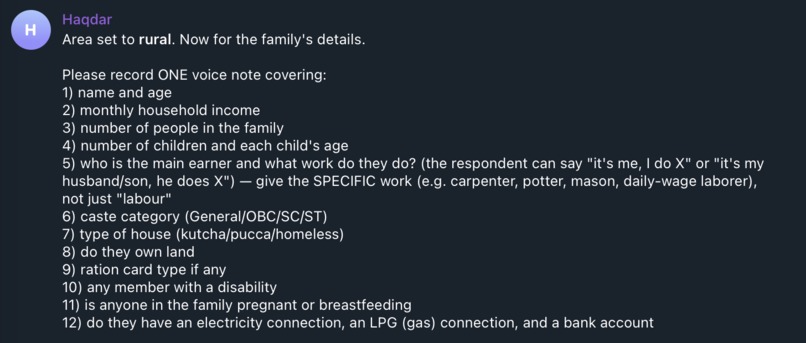
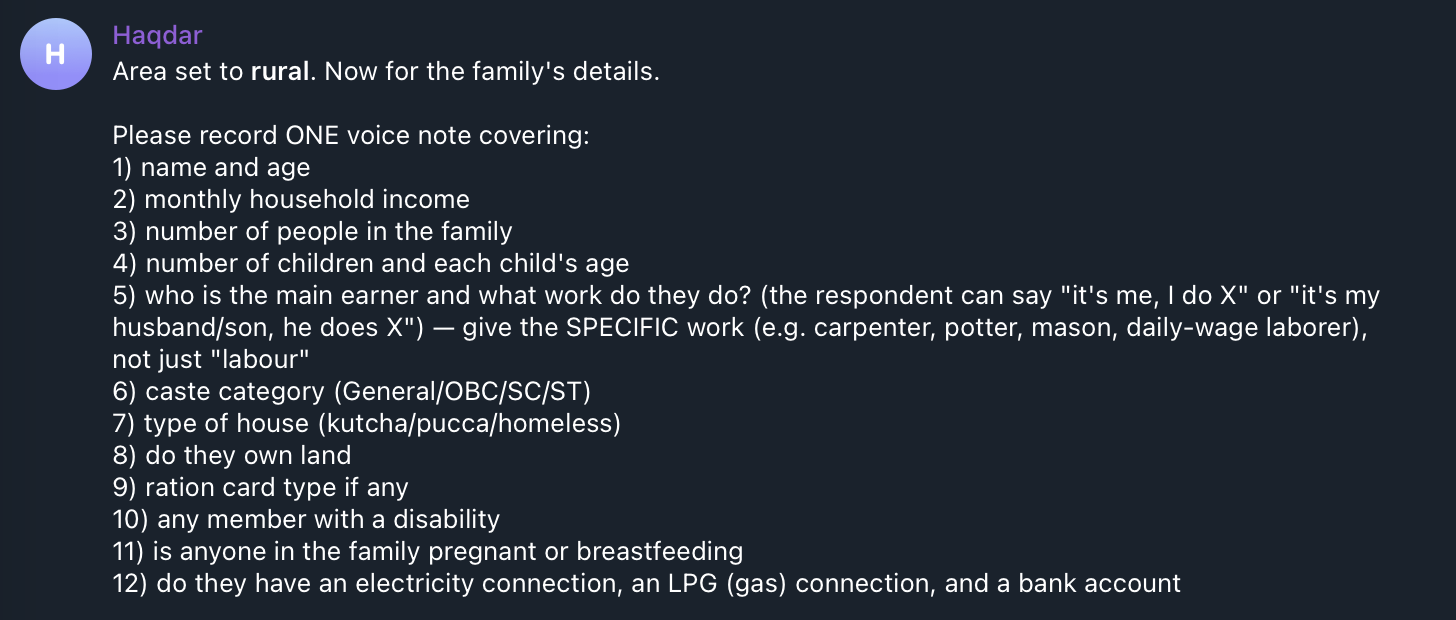
Questionnaire Provided by Haqdar for field workers
-
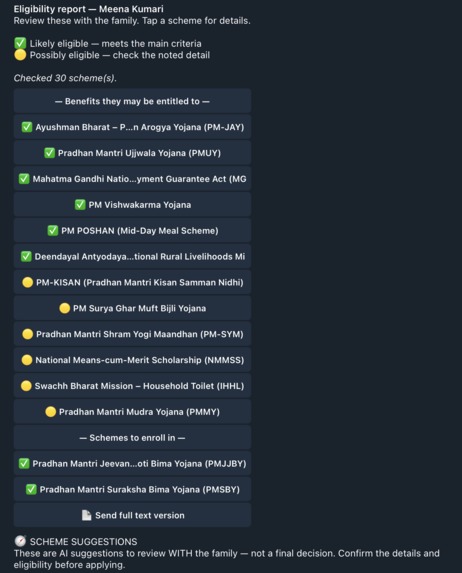
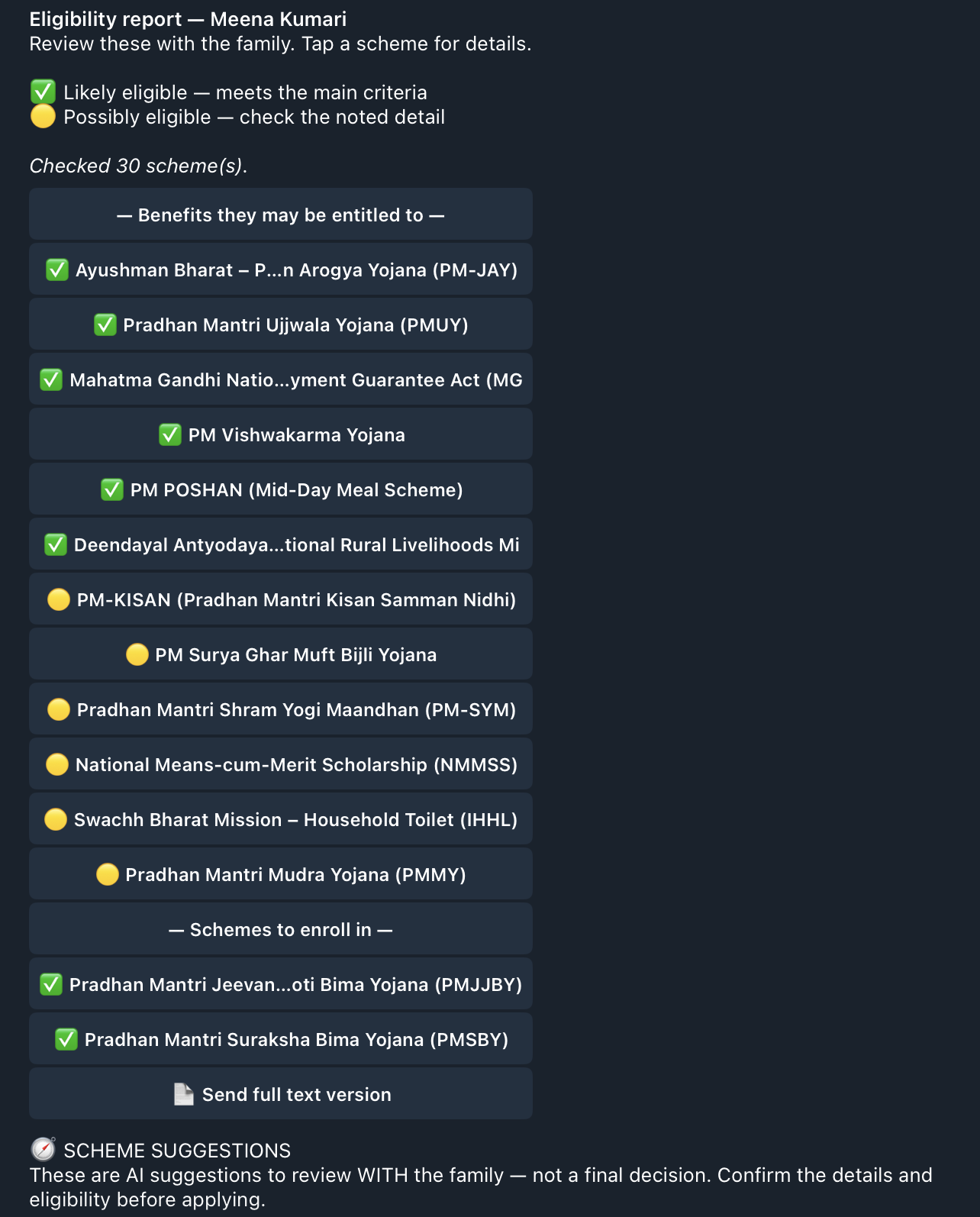
Eligibility Report (interactable)
Inspiration
Millions of low-income families in India qualify for government welfare schemes they never receive. Not because they don't want them, but because finding out what you qualify for is slow and confusing. The rules sit across dozens of portals, are written in dense language, and change often.
The people best placed to help are community field workers like ASHA and NGO staff, who do home visits and are often the first contact between a family and public services. But a worker who sees many families a day can't manually check each one against hundreds of schemes. The problem isn't that they don't know the schemes exist. It's that checking eligibility by hand, family by family, takes time they don't have.
Haqdar aims to remove that manual overhead so workers can connect more families to the support they're owed.
What it does
Haqdar turns a field worker's voice note into a welfare eligibility report, inside a chat app they already use.
The worker asks a family a short set of questions and records the answers as one voice note. Haqdar transcribes it, pulls out the answers, and builds a profile of the household. If something is missing, it asks the worker a couple of follow-up questions. Then it checks the profile against a database of government schemes and sends back a tappable report: which schemes the family is likely eligible for, which are worth a closer look, the reason for each, and an official link to verify.
The family doesn't need a smartphone, literacy, or internet. The worker handles the phone. That's the main idea: by helping the worker rather than the citizen directly, Haqdar reaches families who can't navigate these systems on their own.
The AI does four things, each visible in the output:
- It transcribes the voice note from Hindi or a regional language into English using Whisper.
- It separates the worker's questions from the family's answers in the transcript.
- It builds a structured profile and flags anything missing so the bot can ask for it.
- It checks the profile against each scheme's eligibility rules and returns the matches with a plain-language reason for each.
The report splits results into benefits the family may be entitled to and schemes they can choose to enroll in, each marked likely or possibly eligible with a reason and a source link.
Haqdar never says "you qualify." It says likely or possibly eligible, shows its reasoning, and links to the official page to confirm. It only flags a scheme when the profile actually meets the criteria, so it errs toward under-claiming. The field worker makes the final call, using things the system can't know, like a local waitlist or a past rejection, and decides with the family what to pursue.
How we built it
The bot runs on the Telegram Bot API with a Python backend. Voice notes are transcribed with Whisper. Profile extraction and eligibility matching run through an LLM via OpenRouter. Session state and the scheme database are stored in Supabase.
For this build we created a demo database of 30 schemes, each compiled from official Indian government scheme portals. Every scheme has its eligibility rules broken into structured fields and a source link, which is what lets the system explain its reasoning rather than return a black-box answer.
Challenges we ran into
Getting the matching to behave correctly took the most work. An early version returned a large number of schemes for a single family, including some that did not fit. We revised the matcher so that a scheme is only suggested when the profile clearly meets its criteria, and so that it states when a detail still needs to be confirmed. The result was a shorter, more reliable report.
Eligibility rules in practice are detailed and vary by state, and public sources do not always agree. Rather than present a definitive verdict, we designed the system to suggest likely matches, show its reasoning, and link to the official source for confirmation. This also shaped the decision to keep the field worker responsible for the final judgement.
The voice input raised a few practical issues. Terms such as kutcha and pucca, which affect housing eligibility, do not translate consistently, so the system reads the description of the house rather than depending on a single word. We also separated the person being interviewed from the household's main earner, so that an occupation is attributed to the correct individual.
Accomplishments that we're proud of
A complete voice-to-eligibility flow that runs inside a chat app, with nothing for the worker or the family to install.
A scheme database where every entry is sourced and linked, so any suggestion can be verified.
A report that shows its working: the answers the system heard, the profile it built, and the reasoning behind each match, including where it is uncertain.
An approach that reaches families who cannot navigate these systems themselves, by supporting the worker already visiting them.
What we learned
The core problem was not a lack of awareness among field workers. It was the manual effort of checking each family against scheme after scheme. Framing it that way shaped the whole design.
We also found that having the system acknowledge uncertainty, and point to official sources, made it more useful and more trustworthy than having it return a confident list.
What's next for Haqdar
A WhatsApp version through Twilio, so workers can use whichever app they prefer. A larger, verified scheme database beyond the current demo set. And state-level eligibility rules, so results align more closely with what each family faces locally.
Built With
- fastapi
- llm
- openrouter
- python
- supabase
- telegram-bot-api
- whisper

Log in or sign up for Devpost to join the conversation.