-

-

-

-
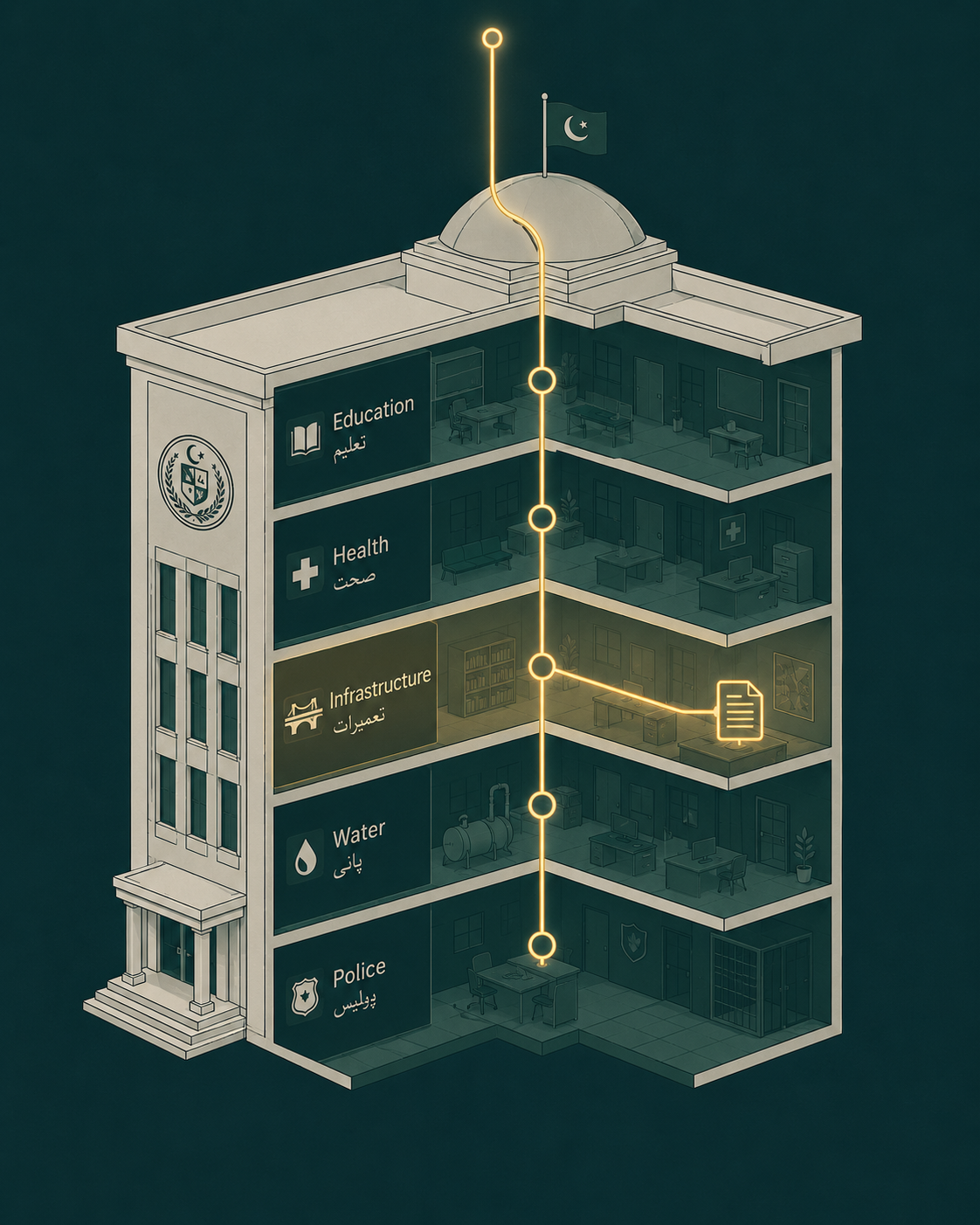
The routing map
-

-

-
-




Inspiration
KP passed the Right to Information Act in 2013 , one of the strongest RTI laws in South Asia at the time. Thirteen years later, it is rarely used. Not because citizens lack grievances, but because the path from grievance to formal RTI request is nearly invisible. Most KP citizens don't know which department holds the information they need, don't know the name or address of the relevant Public Information Officer, and wouldn't know how to write a request that cites the correct section of the Act without being dismissed on a technicality.
The tool makes the access to information accessible, exercising it as easy as typing a question.
There's a second layer. Party manifestos in KP like PTI, ANP, JUI-F contain hundreds of specific promises on education, health, infrastructure, and governance. Those promises are public and whether they were kept is not. RTI is the legal mechanism to demand that answer from government. Connecting the promise to the tool that can hold it accountable felt like the right thing to build.
What it does
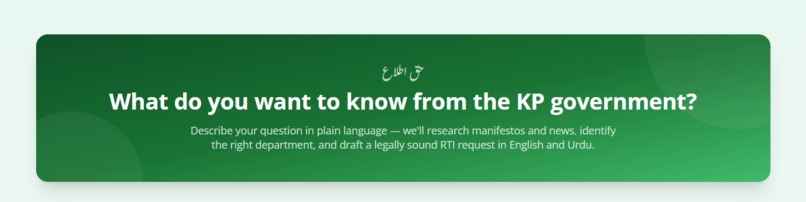
Haq Ittila is a five-step wizard that takes a citizen from a plain-language question to a submission-ready RTI request in minutes.
Step 1 : Query. The citizen describes what they want to know in their own words , in English or Urdu. No form, no legal language required. Sixteen example queries organised by department category (education, health, infrastructure, agriculture, energy, water, police, forestry, local government) give first-time users a clear starting point.
Step 2 : Research. The app runs two parallel searches: it scans curated KP party manifesto excerpts (PTI, ANP, JUI-F) for promises relevant to the query, then calls Claude with web search enabled to surface relevant news and government announcements. The result is a structured briefing with promises found, web findings, the accountability gap, and why this is a valid RTI subject. The citizen gets evidence before they file.
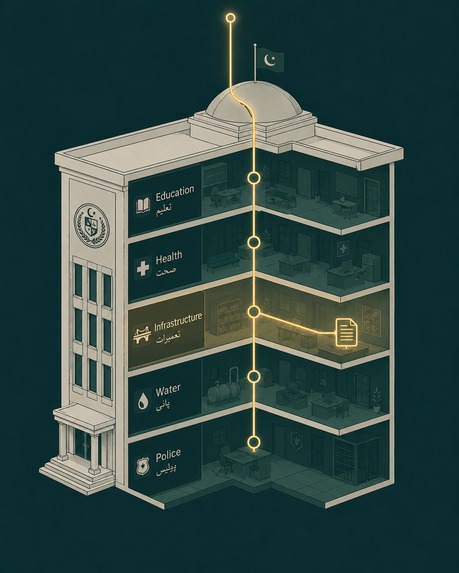
Step 3 : Route. Claude identifies the correct KP provincial department and explains its reasoning. The citizen reviews and confirms, with an override option. The app surfaces the department's full name, address, Public Information Officer title, official email, and the relevant section of the KP RTI Act 2013.
Step 4 : Draft. Claude generates a complete, editable RTI request in both formal English and Urdu (Nastaliq script, right-to-left), citing the correct Act sections, the 14-working-day statutory deadline, and the KP Information Commission as the escalation body if the government doesn't respond. The citizen can copy the draft or download it as a PDF.
Step 5 : Submission guide. Tailored filing instructions for that specific department, where to send it, what format, and what to expect next.
Importantly, the tool is a drafting assistant , not a filing system. It does not submit anything to government. This is a deliberate design choice: no liability exposure, no dependency on government cooperation, deployable immediately by any citizen or civil society organisation without institutional permission.
How we built it
React 18, Vite, Tailwind CSS v4, JavaScript, Anthropic Claude API, Claude web_search tool, Vercel
Manifesto content for three parties is embedded as curated, chunked text with a client-side keyword search with exact word matching with stopword filtering that is fast enough to run in the browser with no backend. State management uses React's useReducer with no external library. The app is entirely frontend-only, deployed to Vercel.
For the hackathon demo, 16 example queries are paired with pre-baked, fully authored responses . Each containing a complete research summary, routing decision, and bilingual RTI draft that is served with realistic delays so the full five-step experience runs without live API calls. The ideal production version replaces this with live Claude calls for every custom query, with the citizen's own prompt parsed against the manifesto data and web search in real time. The pre-baked layer is a pragmatic demo decision, not the target architecture.
Challenges we ran into
The API cost problem. The original design called for live Anthropic API calls on every query. That works , the integration is fully built in src/lib/claude.js and all three prompts are wired and tested. The problem is structural: each full run costs approximately $0.01–0.03. For a civic tool aimed at ordinary KP citizens, that cost scales linearly with civic engagement. A tool that empowers more citizens to file RTI requests should not become financially unsustainable precisely because it succeeds.
The solution was demo mode with pre-baked responses for all 16 example queries. Rather than degrading the experience with placeholder text or blocking API calls, each pre-baked entry is a complete, human-reviewed response , real research, real routing logic, real bilingual drafts that are served with artificial delays so the loading states behave identically to live calls. For production, the path is clear: a thin server-side proxy to hold the API key, query caching for common requests, and funding from a civic organisation or government IT budget. The cost per RTI drafted is lower than printing a form.
Then comes the sustainability and institutional adoption question. A working prototype raises an immediate question about who houses it after the hackathon, and who pays? The app is a static frontend. Vercel hosting for a low-traffic civic tool costs nothing. For wider deployment, the KP Right to Information Act 2013 already mandates that public bodies facilitate access to information. The KP Information Commission is the statutory body responsible for promoting RTI culture , hosting a tool like this on their domain would be an extension of their legal duty, not charity. In a government context, the API cost is well within the kind of technology spend that KP's IT Board already manages. The post-hackathon next step is a submission to the KP Information Commission with the working prototype.
Accomplishments that we're proud of
- Built a complete five-step bilingual RTI infromation commons civic tech tool as a solo builder. From a plain-language citizen query to a legally grounded, submission-ready request in English and Urdu, with correct KP department routing, accurate Act citations, statutory deadline language, and the KP Information Commission named as the escalation body. Every step functional, live on Vercel, usable by any KP citizen today.
-Solved the jurisdictional routing problem without government data access. The tool identifies the correct KP department, surfaces the Public Information Officer title and address, and cites the applicable section of the KP RTI Act 2013, all from embedded legal logic built into the prompt architecture. No backend. No government cooperation required. No institutional permission needed to deploy.
-Designed a demo architecture that makes the production cost problem visible rather than hiding it. Sixteen legally reviewed, human-authored RTI drafts cover the full range of KP department categories and serve as the demo layer, while the live Claude integration remains fully wired in the codebase. The gap between demo and production is documented, not papered over.
-Built the RTI flow as the foundation of an information commons. Every citizen who uses the tool to file an RTI generates a record. When RTI responses are logged back, government compliance or non-compliance becomes public data. The architecture is designed so that civic action compounds: each filing makes the next one more informed, and aggregated non-responses surface which KP departments are systematically evading their legal obligations. The tool is a drafting assistant today and an accountability commons in the direction it is heading.
What we learned
The API cost problem is structural, not technical. A single full run costs approximately $0.01 to $0.03. A tool that reaches ten thousand citizens costs hundreds of dollars in API fees. The more civic uptake it generates, the more unsustainable it becomes for an individual builder. The answer is institutional: a government technology budget, a civil society grant, or query caching at scale. Building the pre-baked demo mode made this visible early and forced clarity on what production sustainability actually requires.
Legal validity is a specific prompting problem. An RTI request can be dismissed on procedural grounds — wrong department, wrong Act citation, subject description vague enough that the department can respond to something other than what was asked. Getting the prompt right required understanding the failure modes in the KP RTI Act 2013 before touching the model. The design work was more about the law than about AI.
The line between drafting assistance and a filing system is not a compromise. It is the decision that makes the tool deployable now, without liability exposure, without government cooperation, and without maintaining integrations to any departmental system.
What's next for Haq Itilla - KP Information Commons Companion
Federal and provincial expansion. The routing logic and department data are architected to support additional jurisdictions as data files. The next expansion covers the Freedom of Information Ordinance 2002 for federal departments, followed by Punjab, Sindh, and Balochistan under their respective RTI acts — each with different deadlines, different escalation bodies, and different PIO structures. The goal is a single tool that routes correctly regardless of which tier of government holds the information.
RTI response tracker — the shared data commons. Citizens who file an RTI using the tool can return to log the outcome: upload the government's response if one arrives, or record a non-response if the 14-day deadline passes without reply. Both are published publicly on the live site. A response builds an open record of what government disclosed. A non-response is itself data. It is the legal trigger for escalation to the KP Information Commission, and aggregated across many citizens it becomes evidence of systemic evasion by department. This creates a crowd-sourced, open dataset of government RTI compliance rates by department, query type, and time period, growing with every citizen who uses the tool. It is the shared data commons mission of this hackathon, realised through the RTI flow: civic action generates public data, and that data compounds in value the more people contribute to it.
Pashto interface. Pashto is the dominant language across much of rural KP. Adding Pashto as a third output language for the RTI draft would substantially extend the tool's reach to districts where Pashto is the primary literacy language.
Partnership with a KP civil society organisation to deploy the tool inside a real accountability campaign , testing it with journalists, legal aid clinics, and community organisations who already work on RTI and accountability in the province.
Built With
- anthropic
- javascript
- react-18
- tailwind-css-v4
- vite


Log in or sign up for Devpost to join the conversation.