Inspiration
The project actually stemmed from wanting to make a hack to allow bikers to sense the cars around them. However, as the direction of the project changed, we instead geared it towards those who were visually impaired. As Mechanical Engineers with little real programming experience, we wanted to make something that may not be extremely sophisticated/difficult, but at least helpful.
What it does
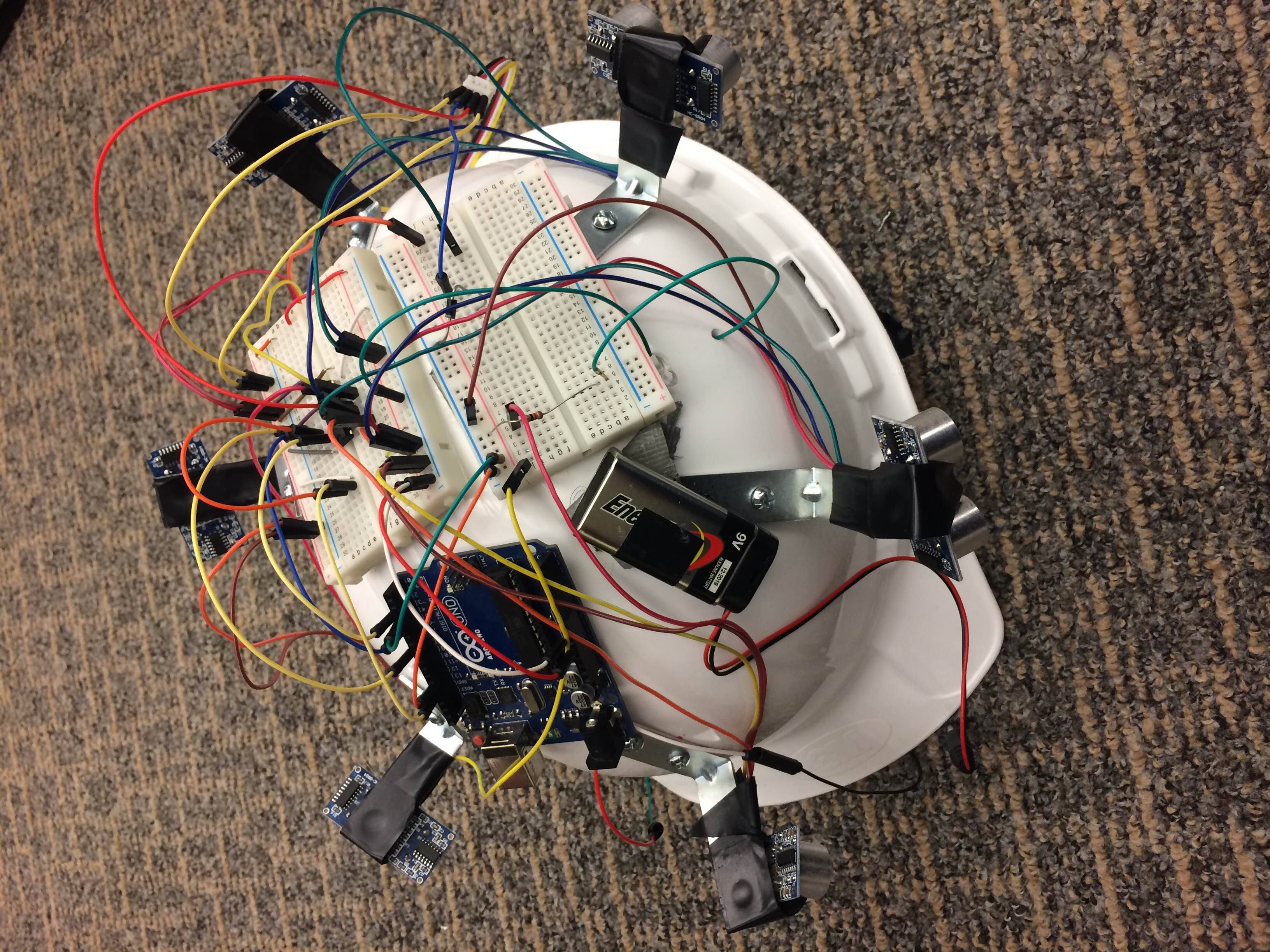
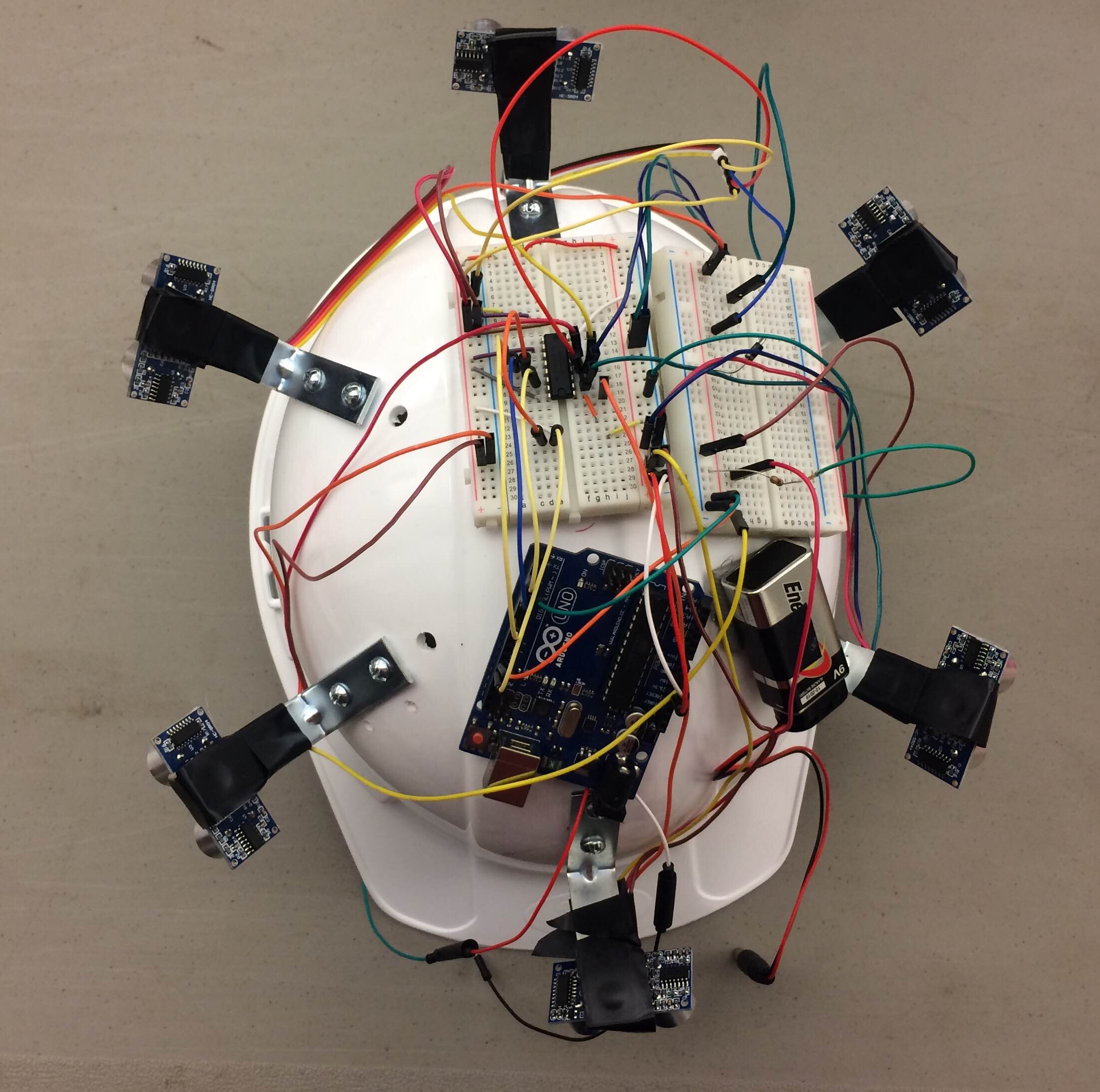
Using 6 ultrasonic sensors placed around a helmet, sound waves are used to detect nearby objects. Once detected (say a chair to the left of the user), an internal motor vibrates in the direction of that object to give users a feeling of their environment.
How I built it
We utilized an arduino uno, 6 ultrasonic sensors, a sample helmet to mount the sensors on and small motors within the actual helmet. An arduino sends out a trigger for 6 ultrasonic sensors through a shift register. As we receive information back from the sound wave sent out by the sensor, we utilize that to calculate the distance from the nearest object. If it met some minimum distance criteria, we vibrated an internal motor in the direction of that nearest object.
Challenges I ran into
Because we are mechanical engineers, we were never formally trained in any of the things we used during citrus hack. All we had was a passion and a love for all things electronics related. That being said, we never used or knew about over half of the things we utilized for our project this year.
Also, as we ran out of pins, we quickly found out that we had to use a shift register. Learning how to use and implement this new IC was incredibly challenging for us as mechanical engineers. In fact, this was the source of all of our confusion in the code and in the actual circuit we built.
The other challenge was physically making the device. The internally vibrating motors were of very low quality and the leads kept falling off, eventually destroying the motor, by things like their own vibration.
Accomplishments that I'm proud of
Figuring out a way to mount all of our sensors in an intuitive way as well as being able to interface even a part of our system was really rewarding to us. Learning about the shift register, implementing it, and working with it was also very exciting. In general, we learned so much in the topics of coding, circuit design, and computer engineering in the past 36 hours in order to (attempt) solve an engineering problem for those in need.
What I learned
There's several things to note here. First and foremost, how to use a shift register (at least to some extent). Also, we learned the basics of circuits as well as ICs. One of the things I did not expect to learn was how to plan a project which turns out is very important...
What's next for Haptic Feed-back for the Blind
Really, it's all about showing what mechanical engineers can and should do to leverage the power of electrical, computer and computer science engineering. From there, finding a better way to implement the feedback system, lessening the size and weight, the precision for the system and using an Arduino Mega microcontroller are all things that could be considered.
Also, utilizing a helmet could be both cumbersome and inconvenient for the user. Not to mention the vibration in the head could be nauseating for some. So instead, we could make a belt or another article of clothing.

Log in or sign up for Devpost to join the conversation.