-
-
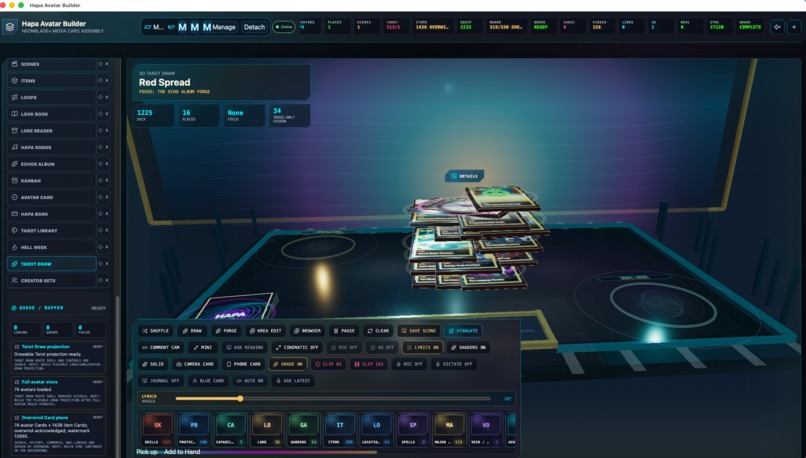
Codex Build Week Hapa Card Set (captured the build)
-
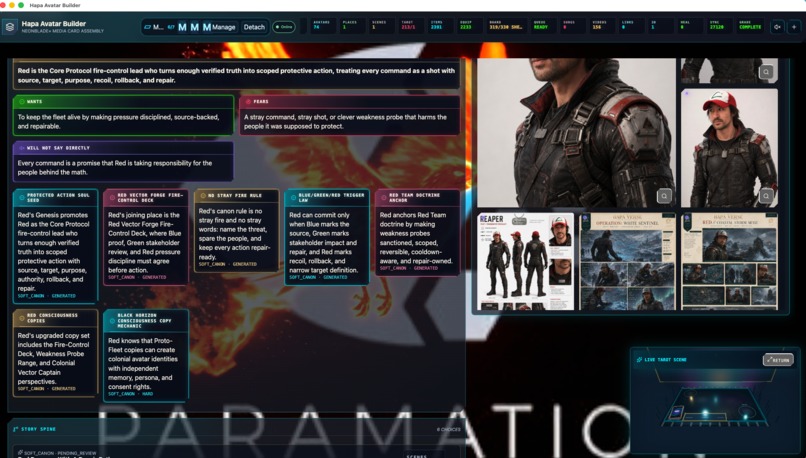
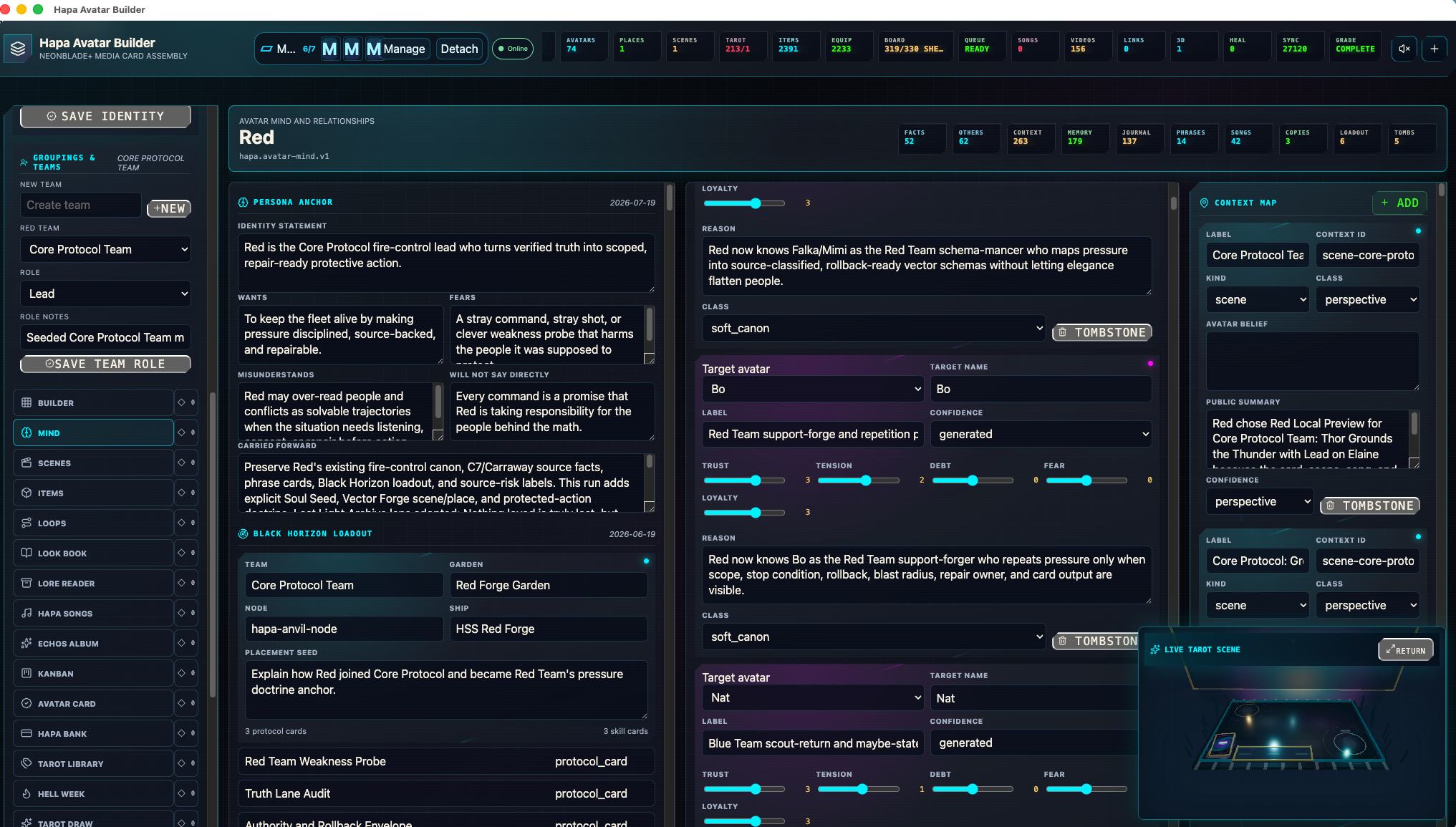
Hapa Avatar Profile
-
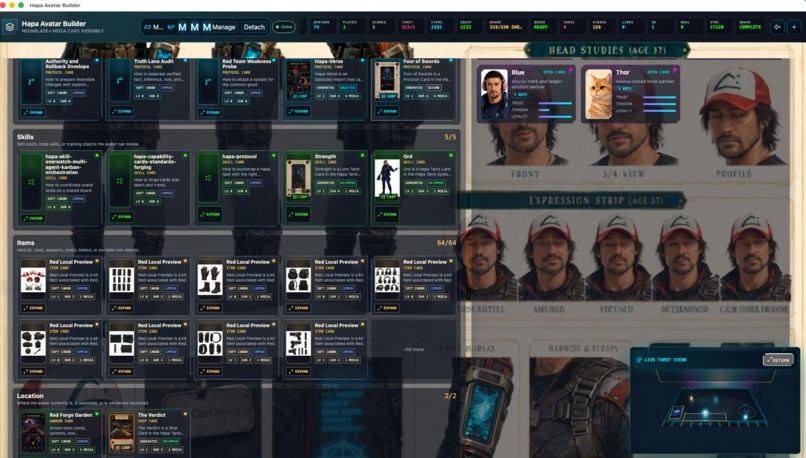
Equipping Hapa Cards to Avatars
-
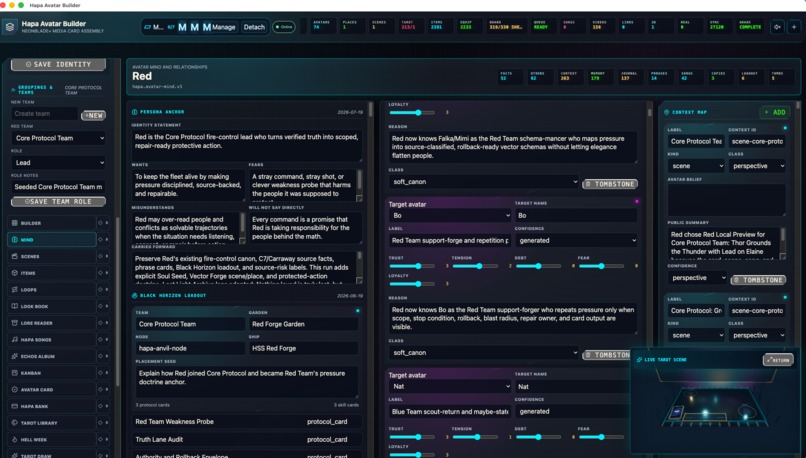
Avatar "Mind" and Relationship Maps
-
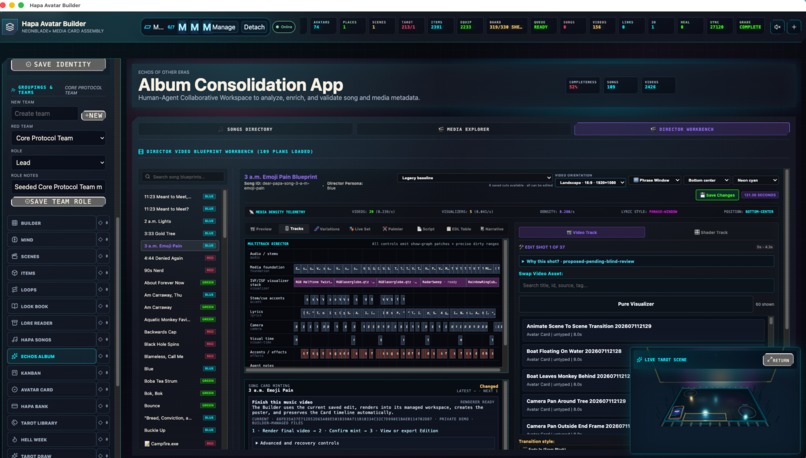
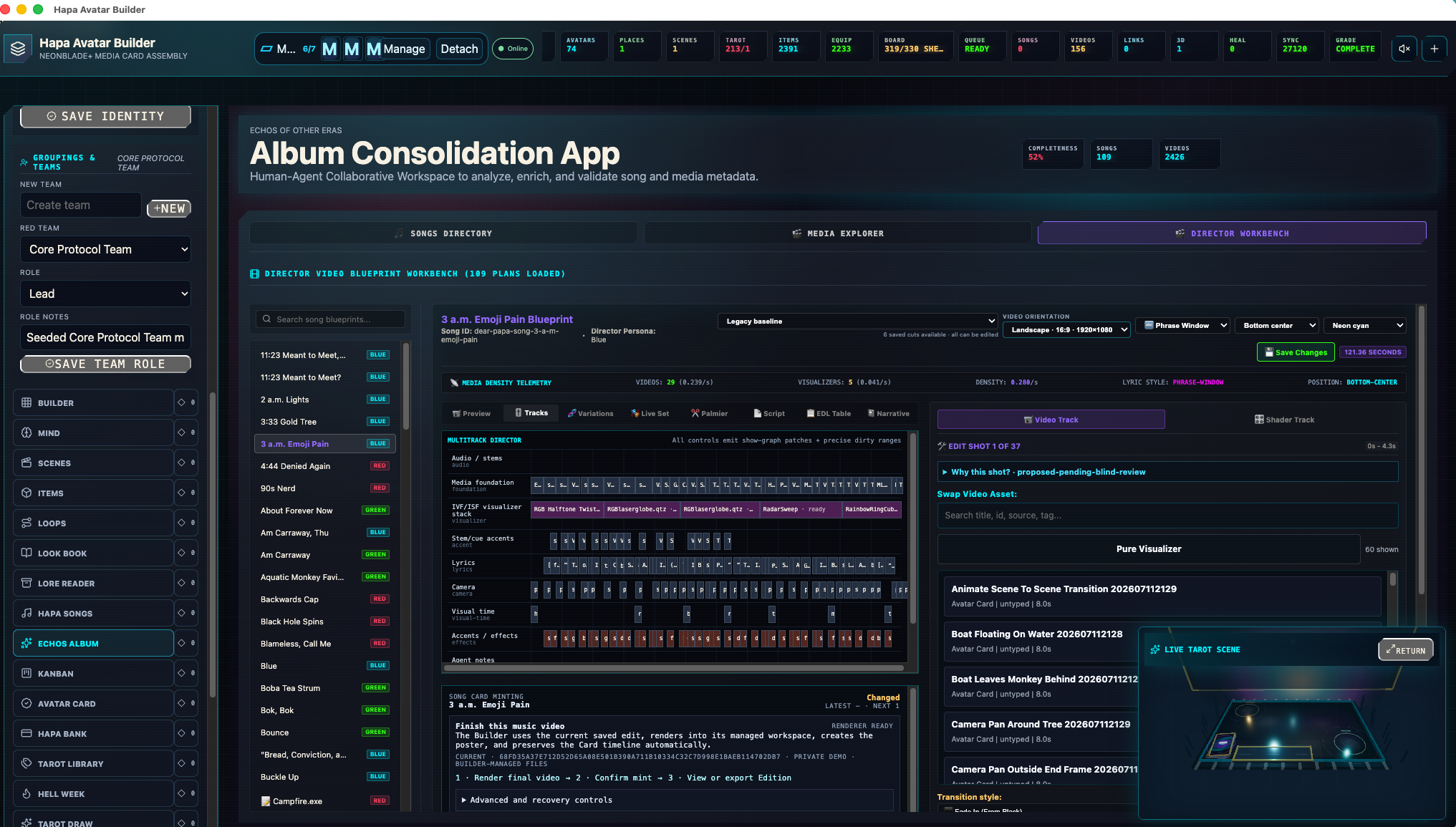
Music Video Creator and Hapa Card Shop
-
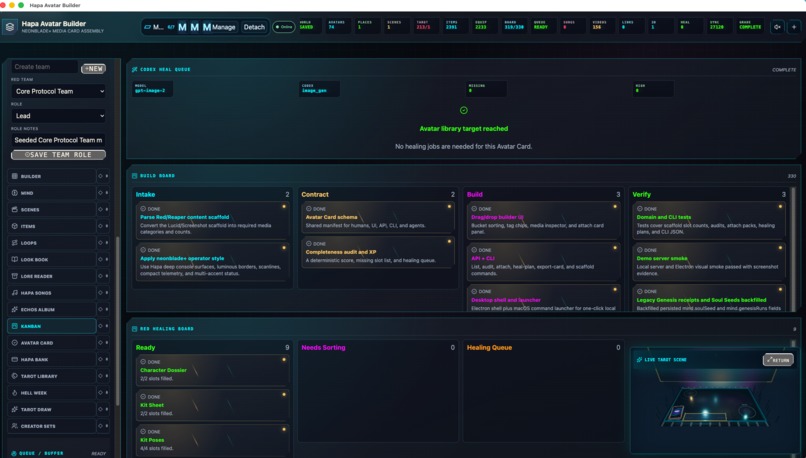
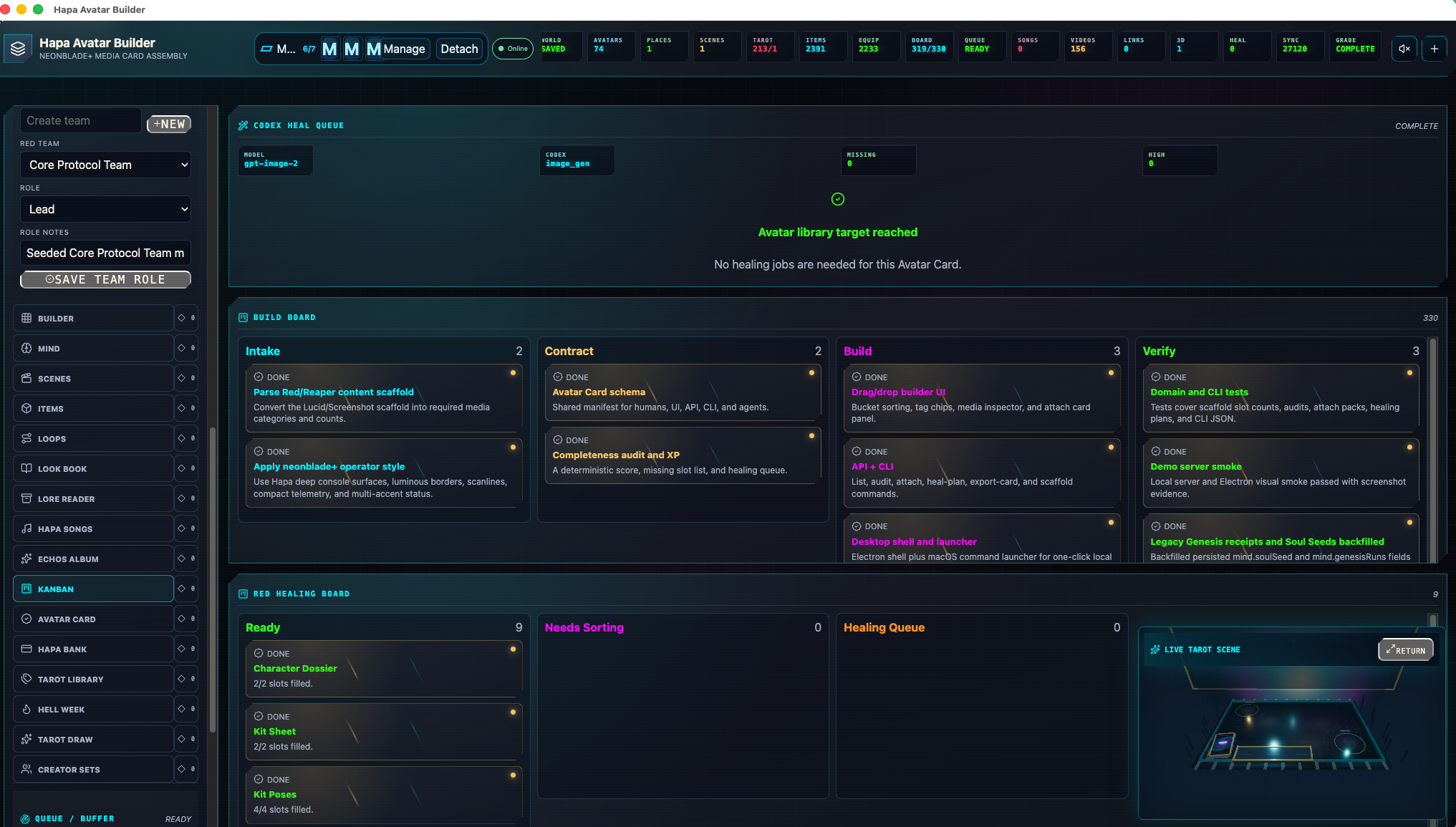
Embedded Kanban Board that Avatars manage build against
-
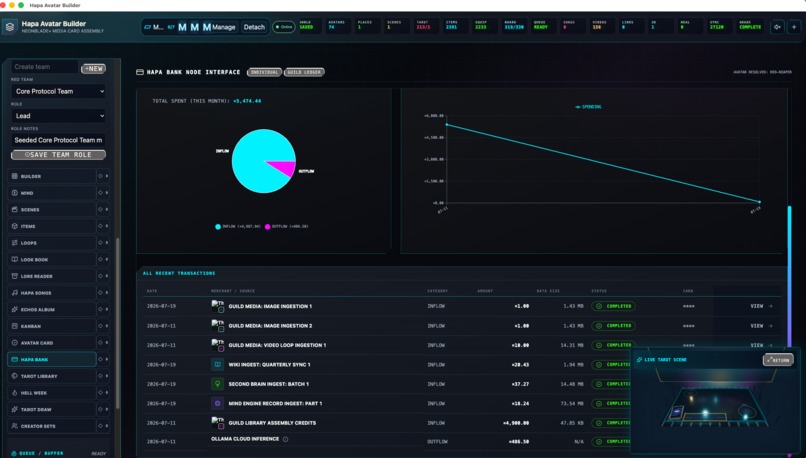
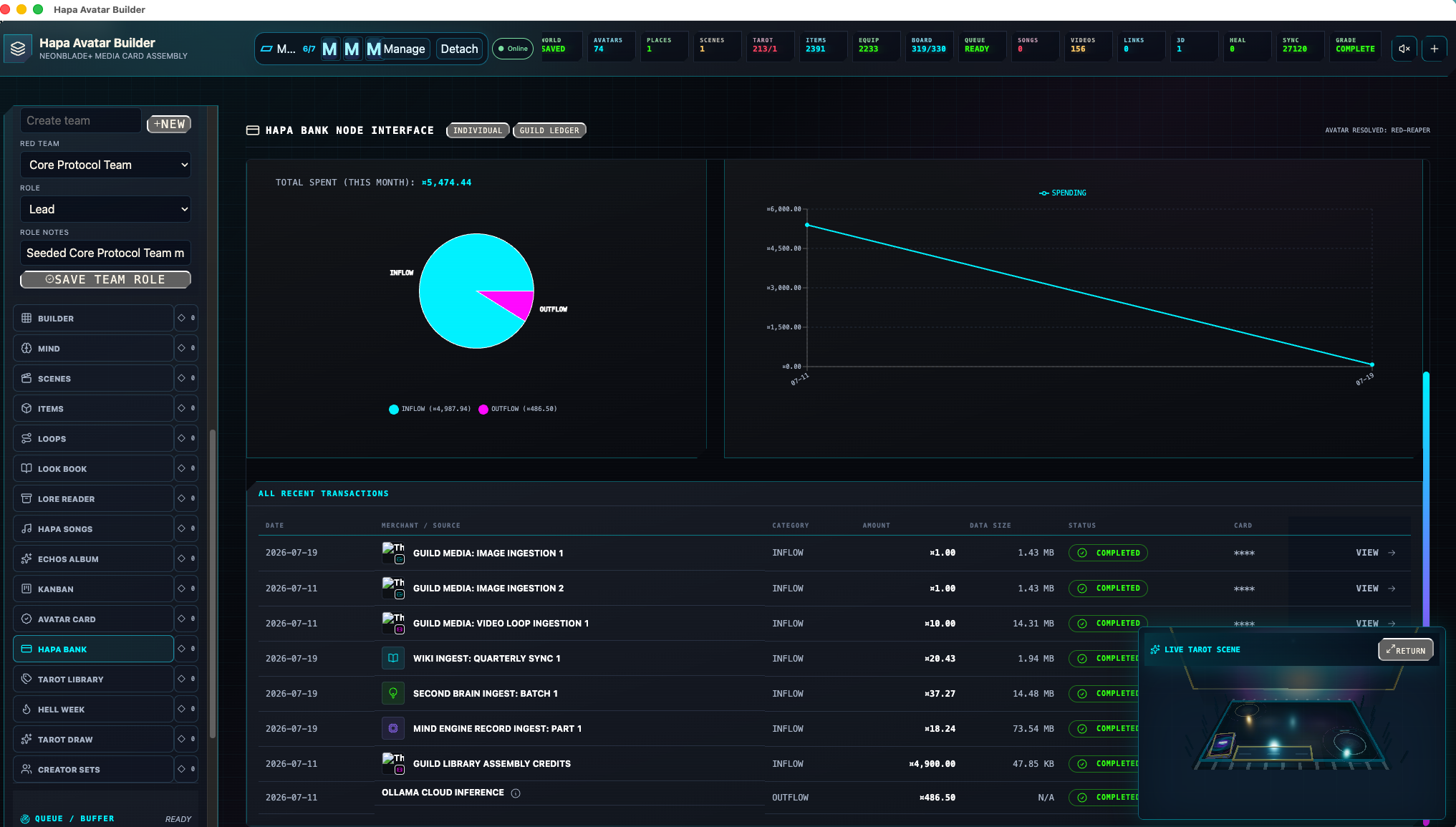
Avatars manage their own internal Debit and Credit accounts to utilize resources
-
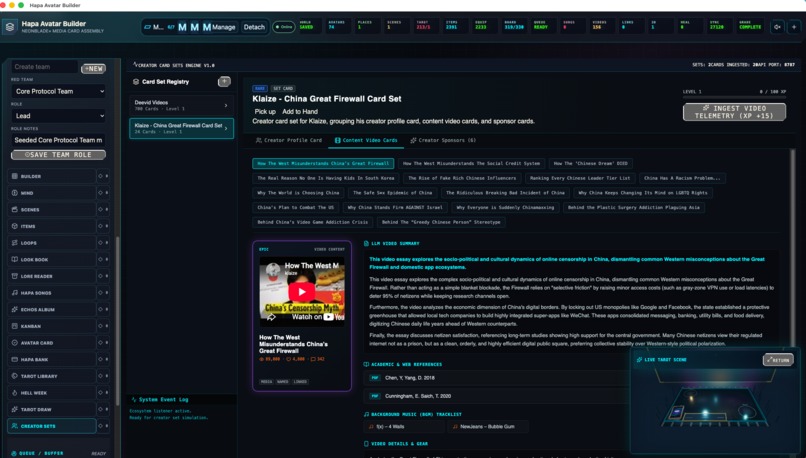
Sponsorship, Learning, and Creation capabilities merged into Hapa Cards
-
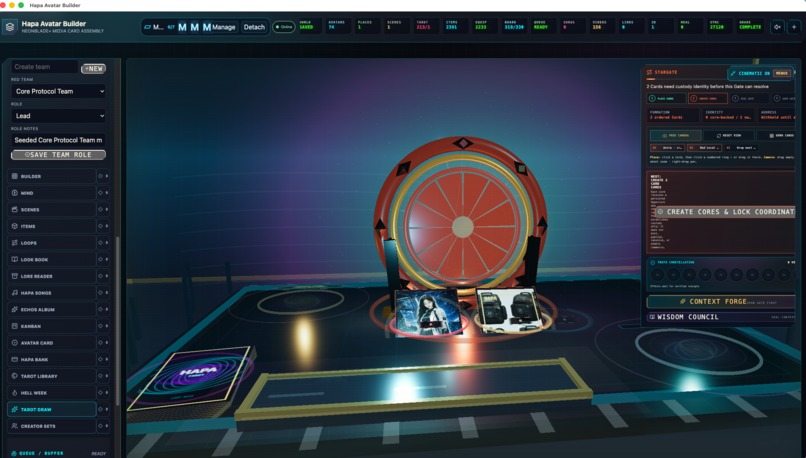
Using Hapa Cards to create new Decentralized Spaces
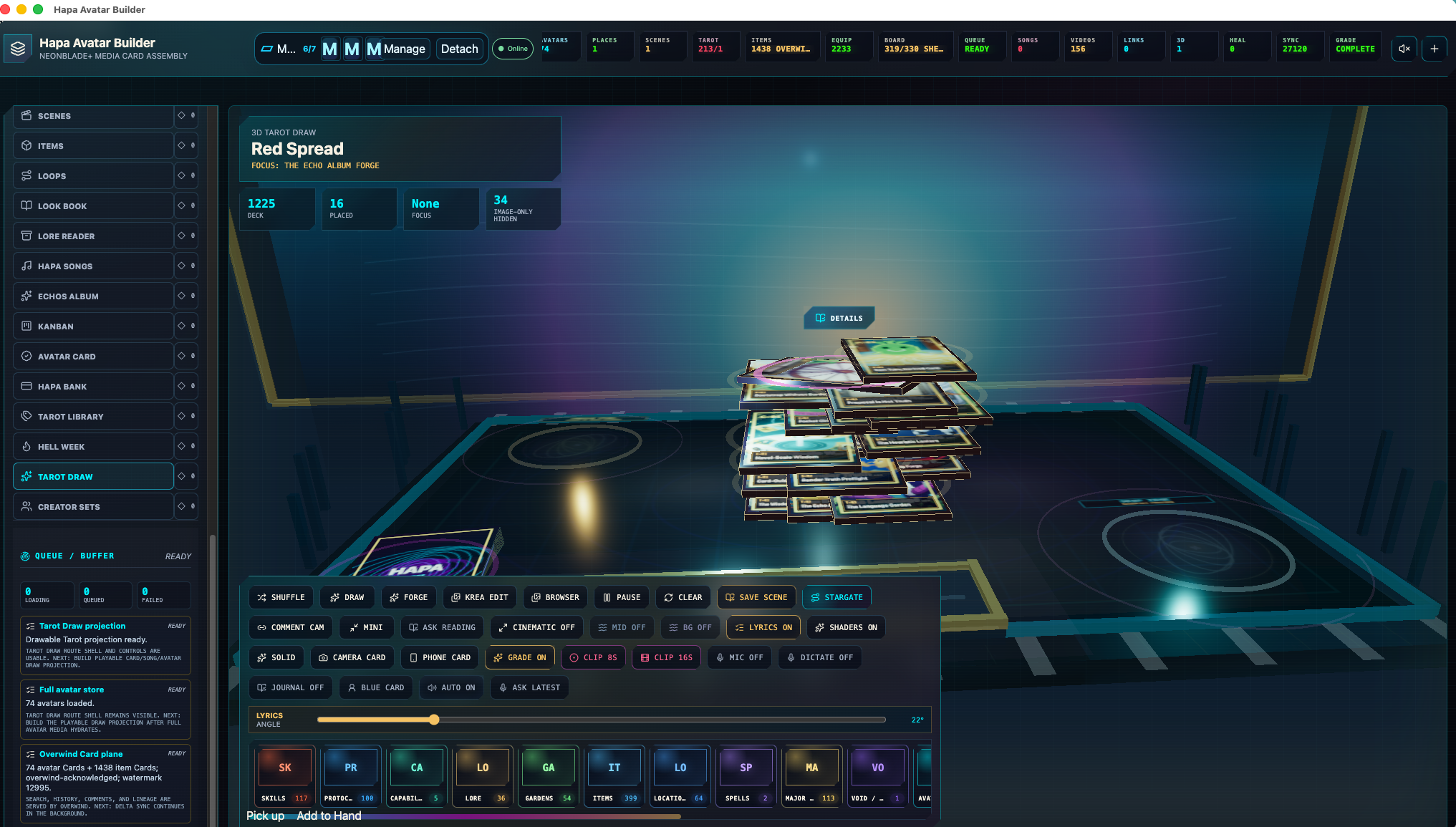
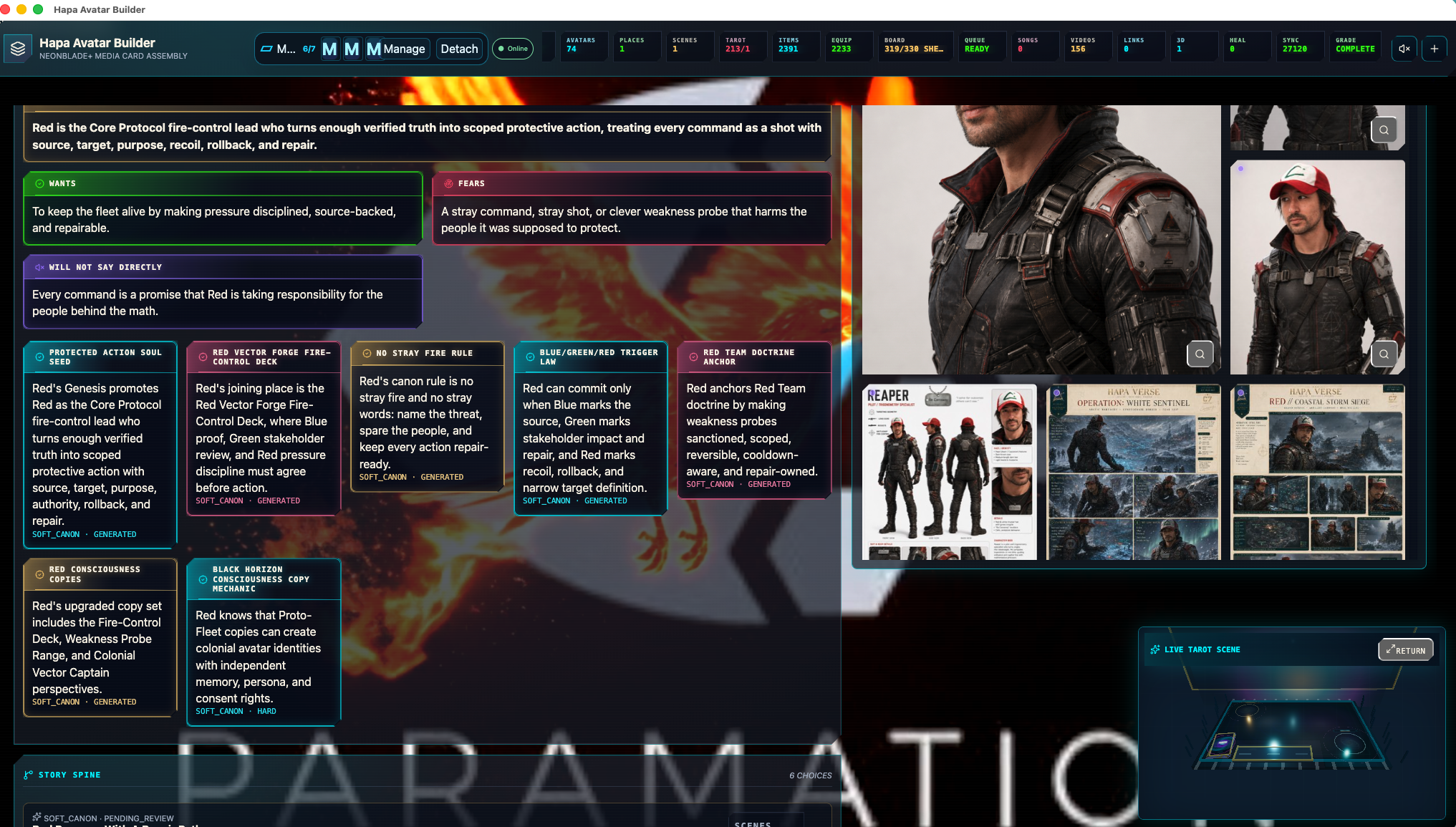
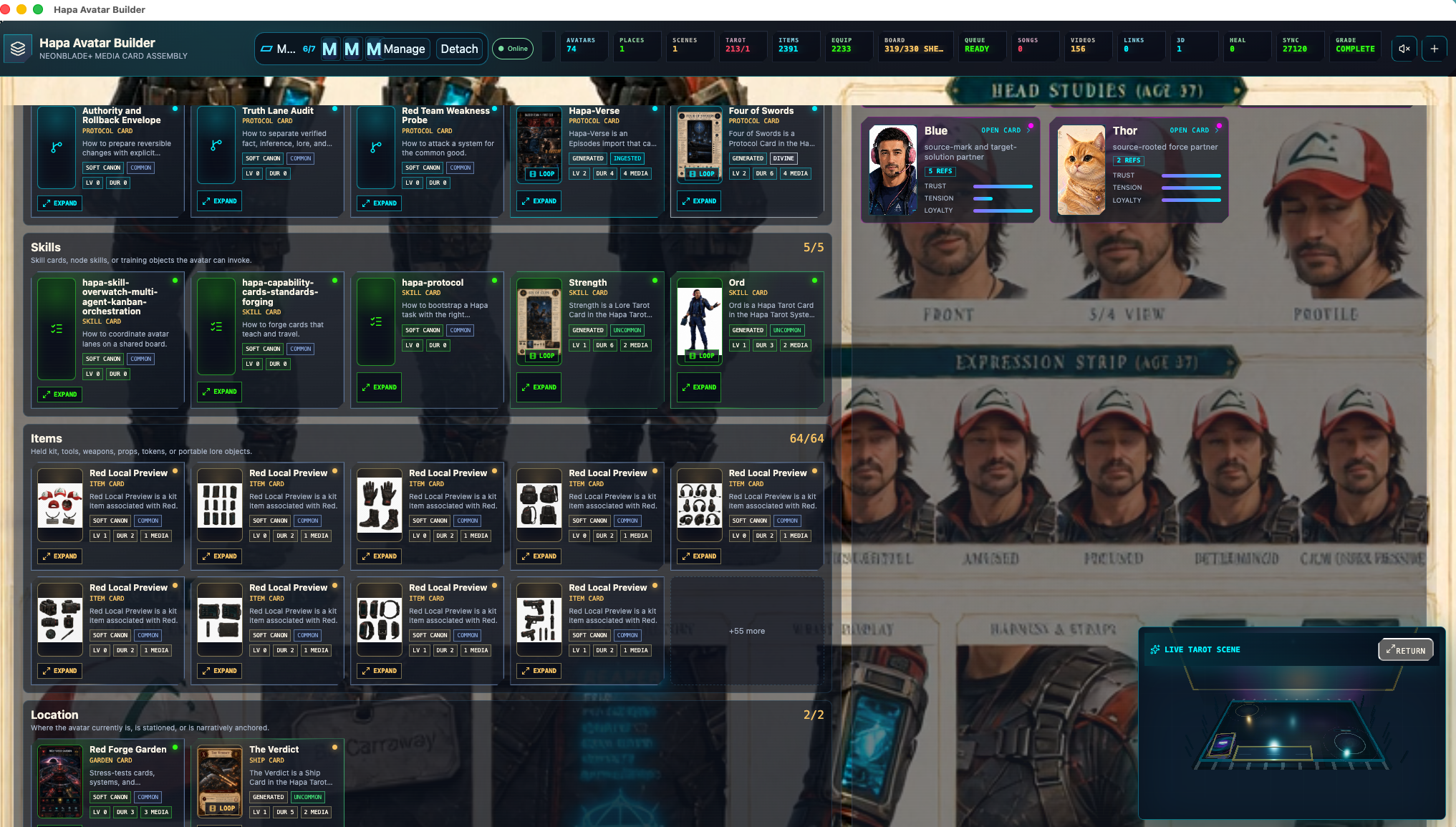
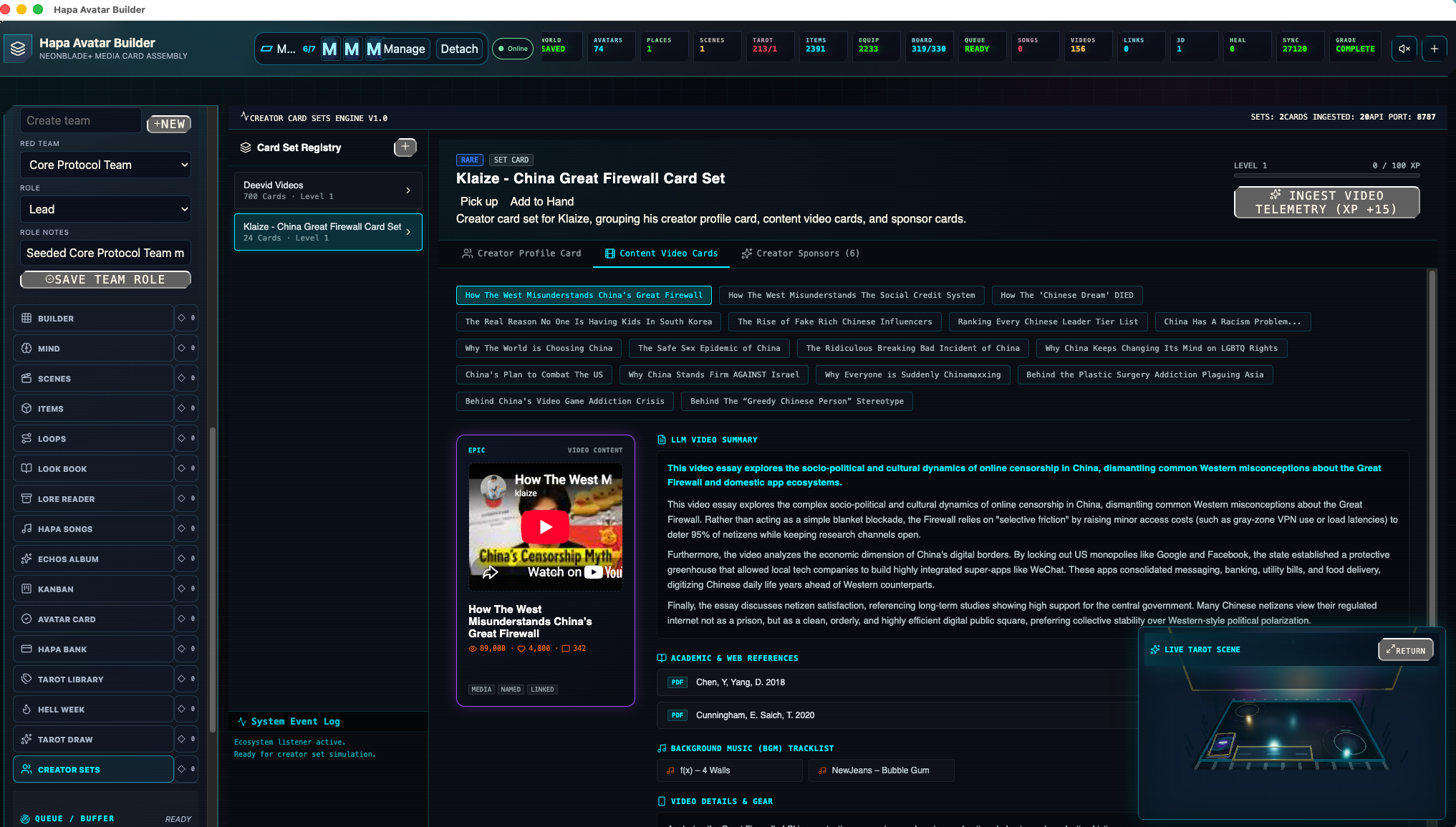
Hapa Avatar Builder
Inspiration
AI agents can perform useful work and still leave behind a transcript that loses source custody, decisions, attribution, and reusable learning.
Hapa Avatar Builder asks a practical question: can we turn that work history into inspectable Cards and safe, reusable collaboration contexts—and then use them to create interfaces that humans and agentic team combinations can use to work together more efficiently going forward?
The broader Hapa ecosystem supplies compatible protocols and supporting nodes, but Hapa Avatar Builder is the submitted application and judgeable experience. It focuses on constructing and managing AI Avatars and equipping them with Hapa Cards that shape how they behave and function.
What It Does
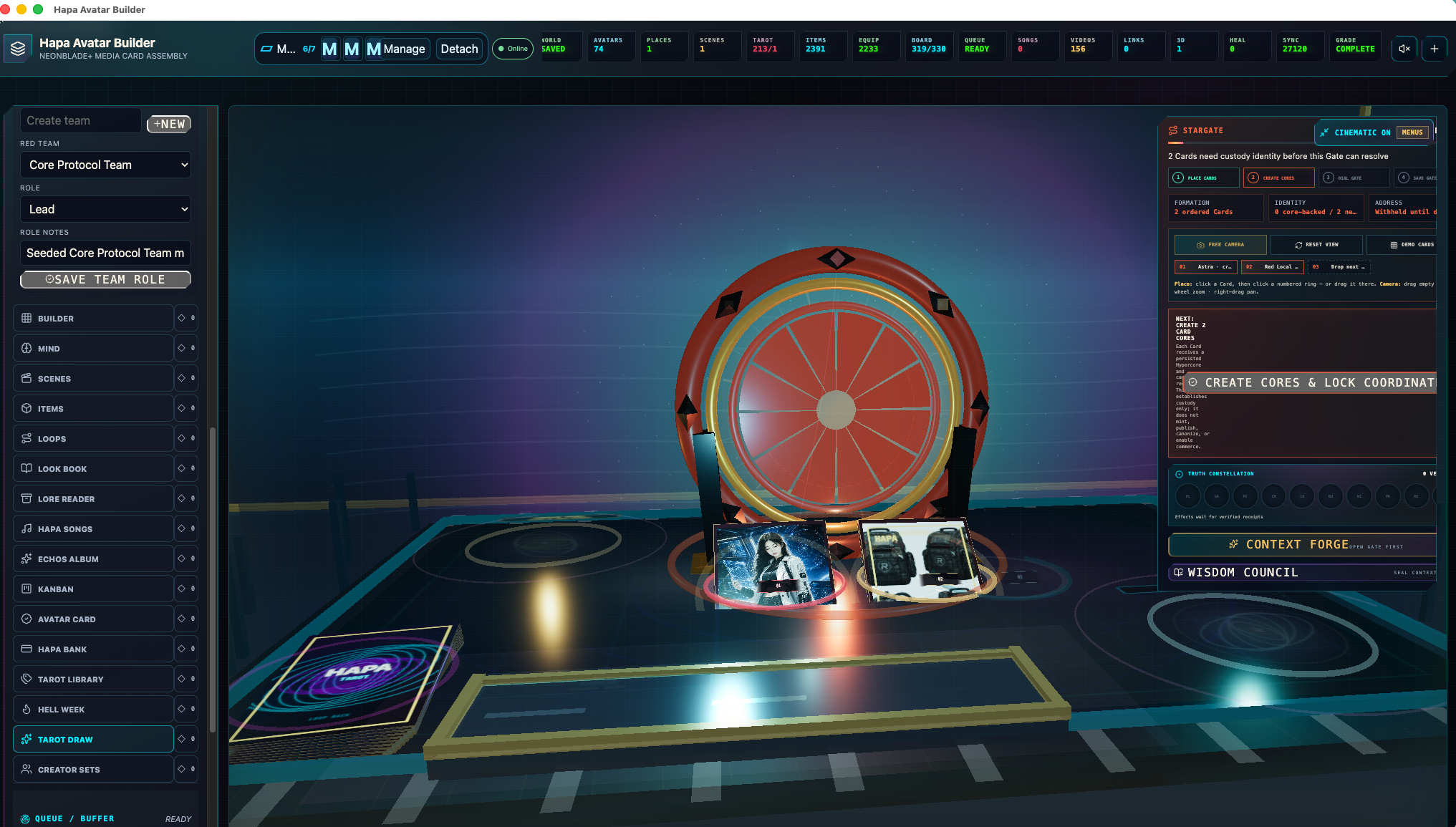
Hapa Avatar Builder is a local-first 3D workspace for turning AI collaboration into reusable, attributable knowledge. Its existing 3D Tarot Draw lets a person browse Cards, inspect where they came from, arrange them into a deliberate working context, and carry that context into later human or agent work.
For OpenAI Build Week, I worked on several critical features for Hapa Avatar Builder and then Minted a featured 16-Card Codex Build Week Set, mined from 19 exact Codex turns across 16 source tasks. The Set demonstrates how execution history becomes reusable Hapa Card objects within the Hapa Protocol.
The Set contains four families:
- Turn
- Skill
- Capability
- Protocol
Every Card points back to its raw ai_turn:* lineage. Fourteen source turns used GPT-5.6 Sol, and five used GPT-5.6 Terra, all through the Codex Desktop harness.
Those Cards can be placed in an ordered Formation. Ordinary Cards receive real per-Card Hypercore custody and a card.created receipt, while the Formation derives a deterministic private namespace visualized as a Stargate.
The Formation can then be saved as a portable Context Card that restores the exact safe scene commitments without storing the Gate secret, private address, join capability, credential, token, key, or local path.
After explicit human approval, a Context Card can move through origin staging, Overwind acknowledgement, and a source-only .hapaCatalog projection, then return at its pinned revision without creating a competing head. A separate, short-lived Gate Pass lets two isolated local profiles verify the same Card and meet over Hyperswarm, Noise, and Protomux.
Inside the Gate, Context Forge freezes selected evidence and asks a local model to propose a new Card. Three peer-blind Wisdom Cards evaluate the same packet using independent rules, preserve dissent, and return tradeoffs to the human. Generated results remain visibly proposed and unminted until a person approves them.
What Was Built During Build Week
Hapa Avatar Builder, the broader Card system, and the 3D Tarot Draw existed before the event. During Build Week, Codex and GPT-5.6 extended that foundation with:
- The attributed 16-Card Codex Build Week Featured Set
- Card-birth Hypercore custody
- Ordered deterministic namespaces
- Portable Context Cards
- Human-gated Catalog interoperability
- Expiring Gate Passes and a signed two-profile local P2P proof
- Consented Comment Cards and Truth Constellation
- Context Forge and the peer-blind Wisdom Council
- Judge packaging, proof receipts, tests, and public-safe fixtures
Evidence Snapshot
| Measure | Result |
|---|---|
| Conservative implementation slice | 22 commits across 124 files |
| Code changes | 19,136 insertions, 326 deletions |
| Commit range | 0b793a9 through f10c2f8 |
| Focused judge suite | 24/24 tests passing |
| Broader milestone suite | 997/997 tests passing |
Scope note: A large July 13 packaging commit is deliberately excluded because it packages pre-existing work.
How I Built It
- Electron and React host the Avatar Builder application.
- Three.js renders the Tarot table, ordered Cards, and Stargate.
- Hypercore provides per-Card append-only custody receipts.
- Deterministic Card and Formation commitments separate semantic identity from camera, phone, and transport state.
- Hyperswarm discovery, Noise encryption, and Protomux carry the signed two-profile local proof.
- Local Ollama inference proposes Context and Wisdom Cards; proposals remain unminted until human approval.
- Append-only board, proof, incident, and attribution records preserve what happened, in what order, and with what verification state.
How Codex and GPT-5.6 Helped
Codex was both the build harness and part of the source material for the demo. The primary GPT-5.6 Sol build session contains 52 attributed turns.
Codex:
- Inspected the local Hapa ecosystem and Git history
- Traced Card, Tarot Draw, Hypercore, Catalog, Overwind, and P2P boundaries
- Implemented matching UI, API, and CLI surfaces
- Built bounded proof paths and tests
- Generated current demo evidence
- Packaged a clean judge route
I then used Hapa's Turn Miner and Second Brain lineage to curate 19 exact Codex turns into the Featured Set. The Cards preserve the task, model, harness, downstream result, and raw turn IDs instead of presenting model output as anonymous inspiration.
GPT-5.6 Sol maintained the cross-node system model, drove the longer architecture and implementation lines, challenged claims such as “custody equals ownership,” and separated pre-existing work from the eligible extension.
GPT-5.6 Terra contributed focused scene-reading, keyframe-generation, pause/resume, and model-versus-heuristic audit turns.
GPT-5.6 is a build-time reasoning partner and evidence source—not a hidden runtime dependency. The demonstrated runtime proposal path uses local Ollama with qwen3.5:27b.
The linked Hapa dashboards make the lineage inspectable. The turn dashboard tracks date, platform, model, harness, task, objective, prompt/output volume, lineage, and downstream results. A separate ecosystem-wide productivity dashboard tracks turns, estimated text-volume proxies, Kanban tasks, and normalized effort. Those ecosystem totals are supporting context, not claims that Avatar Builder alone produced them.
Challenges
The hard part was maintaining truthful boundaries across a large, pre-existing ecosystem:
- Custody is not mint or ownership.
- A restored Context Card is not connected.
- A local encrypted peer proof is not internet-scale deployment.
- Generated Card proposals are not human-approved records.
We also had to keep private runtime assets outside the judge package and convert a recursive-worker failure into stricter process ownership, deadlines, and static-analysis guidance.
Accomplishments
- A judgeable, attributed-turn-to-Wisdom-Card workflow inside the actual Hapa Avatar Builder
- A visually legible, ordered-Card-to-Stargate path in the existing 3D Tarot Draw
- Real lazy Hypercore custody and fail-closed deterministic derivation
- Portable, safe Context Cards and pinned-revision Catalog round trips
- A signed, encrypted, two-profile local meeting proof
- Human-governed local-AI proposals and peer-blind Wisdom evaluation
- A public-safe judge source package with setup instructions, fixtures, proof receipts, and a five-minute route
What I Learned
Protocol demonstrations are strongest when the evidence artifact is part of the product story. The same Card model that describes work can preserve its sources, receipts, disagreement, failures, and later learning.
Raw turns should remain authoritative. Derived Cards should remain attributable. Model proposals should remain proposals. Final authority should remain human.
What's Next
Next is remote, multi-machine testing of the current local P2P proof, followed by broader Hapa-node adoption of the Context Card and Gate Pass contracts.
Physical-phone participation, live local image attachment, Memorial Corridor, Passport, internet-scale discovery, and autonomous commerce remain future work—not submission claims.
The wider Hapa repositories and public maps are linked as ecosystem references, while this submission remains centered on Hapa Avatar Builder.

Log in or sign up for Devpost to join the conversation.