-
-
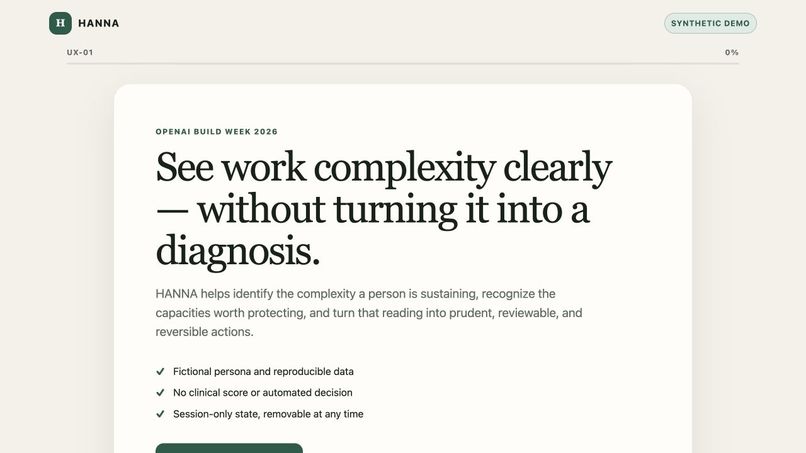
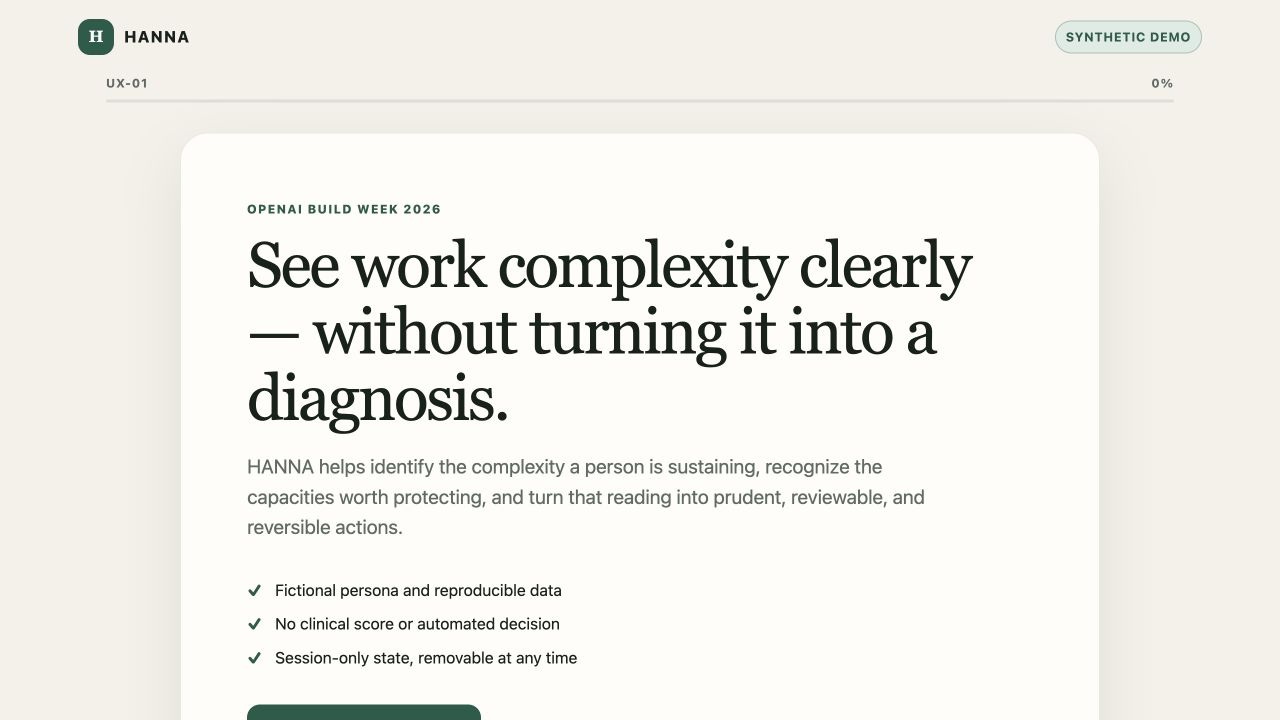
Understand work complexity without turning it into a diagnosis.
-
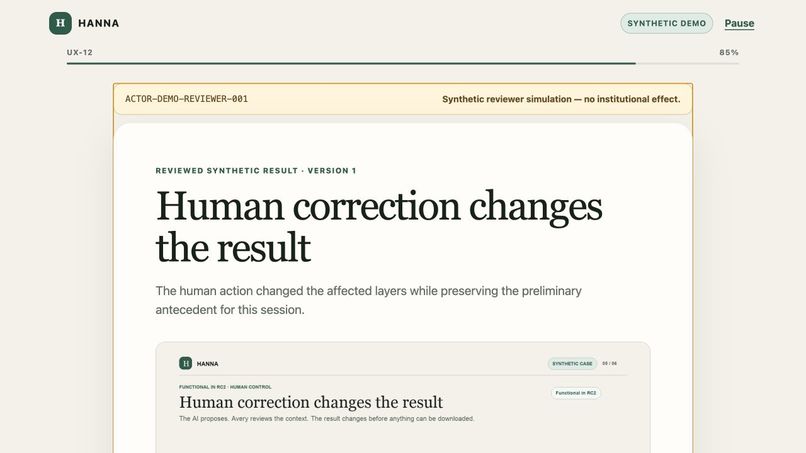
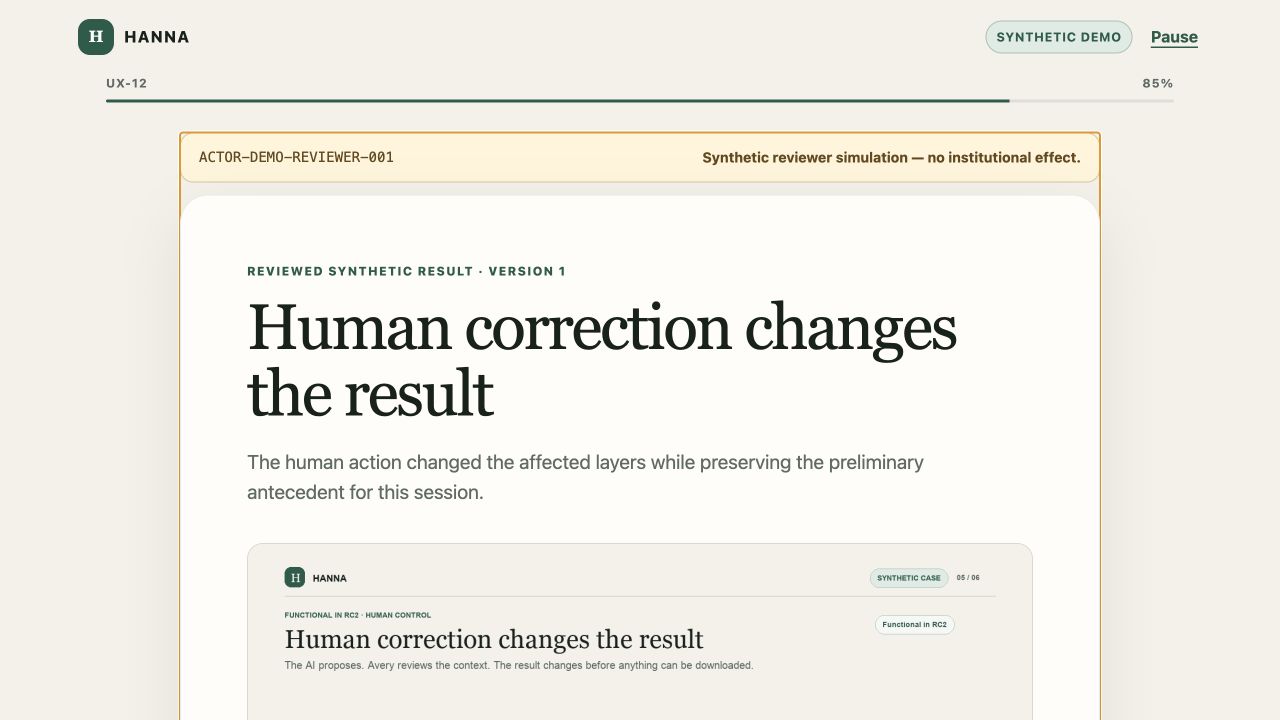
Human feedback changes the final structured result before download.
-
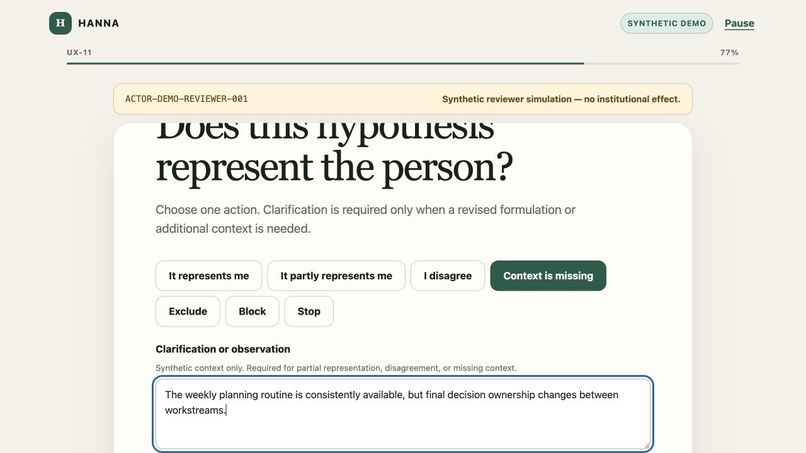
Human review keeps the person in control of every decision.
Inspiration
In complex work environments, some people gradually become the invisible layer that keeps everything moving. They clarify decisions, connect workstreams, follow up across teams, and protect continuity, yet much of that effort remains difficult to describe and easy to overlook.
HANNA began with a human-centered question:
What is this person sustaining, what capacity should be protected, and what support is actually available?
The goal is not to diagnose, score, evaluate, or decide for the person. HANNA is designed to make sustained complexity easier to examine while preserving human judgment, privacy, and the ability to disagree.
What it does
HANNA guides the user through a short, structured review of a reproducible synthetic case.
The workflow:
- captures the work context and the capacity worth protecting;
- identifies qualitative dimensions of sustained complexity;
- maps available support and its proportionality;
- creates a non-scored qualitative visualization;
- uses GPT-5.6 to generate a structured preliminary analysis;
- separates facts, observations, provisional hypotheses, counterevidence, and insufficient information;
- requires human review before approval or download;
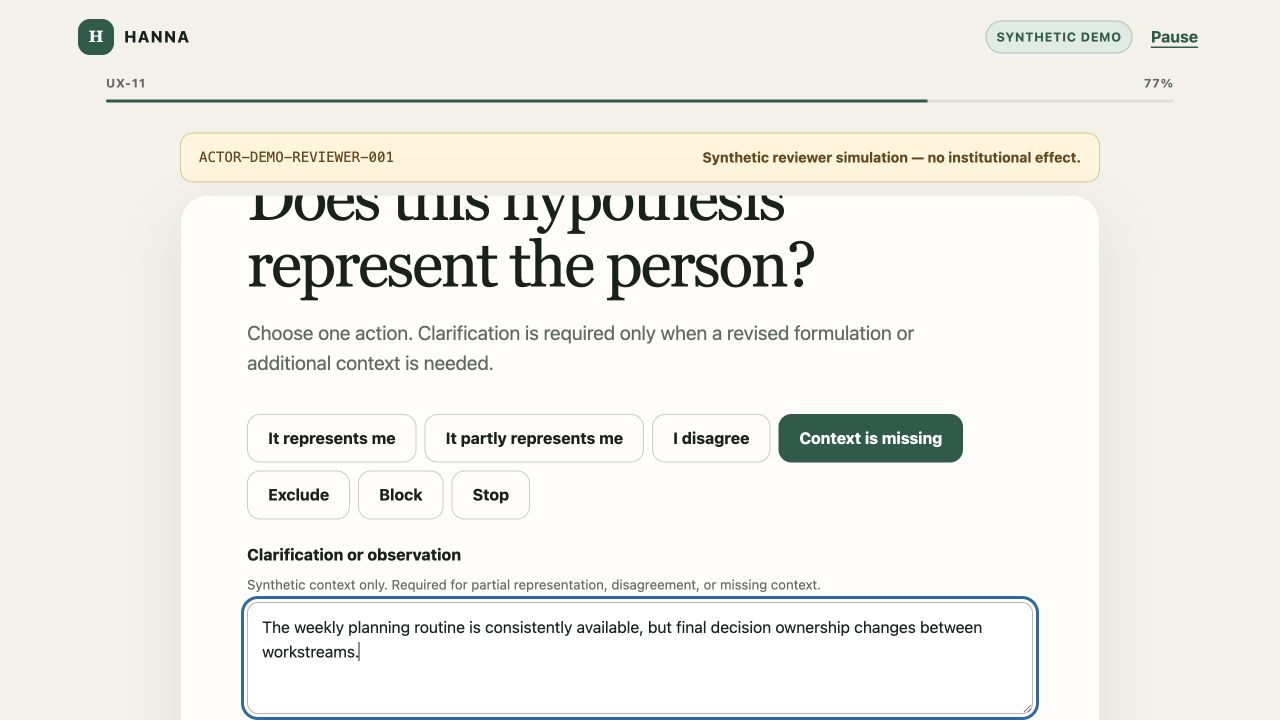
- allows the person to add context, disagree, exclude information, block, or stop;
- updates the hypothesis, report, visualization, and downloadable result after human intervention;
- removes all session state when the user closes the demo.
The public demonstration uses Avery, a fictional and reproducible synthetic persona. It does not process real personal data.
How we built it
HANNA was built as a Next.js and TypeScript web application with a backend-only OpenAI integration using GPT-5.6.
Codex was used as the main engineering environment throughout the build. It supported architecture inspection, implementation of the complete user journey, structured-contract versioning, human-review logic, testing, Git and Vercel troubleshooting, and controlled release management.
GPT-5.6 receives a minimized, pseudonymous payload and returns a contract-bound structured result. The output distinguishes supplied facts, evidence-linked observations, provisional hypotheses, counterevidence, insufficient information, reversible recommendations, and decisions reserved to the person.
The OpenAI request uses store: false. The application uses no database, and all synthetic session data can be deleted from the browser.
The most important design decision was that human control could not be reduced to a final approval button. Human feedback can change the hypothesis, report, qualitative visualization, and downloadable result. Only the reviewed version—not the preliminary model output—can be downloaded.
Challenges we ran into
The hardest part was not generating an analysis. It was ensuring that the analysis remained evidence-grounded, non-clinical, reversible, internally consistent, responsive to disagreement, safe to delete, and understandable without becoming a score.
We also had to preserve a stable public RC1 while developing the final Build Week evaluation candidate in an isolated branch and Preview environment.
During deployment, GitHub rejected the original commit author identity because it used a local machine email. The author metadata was corrected without changing the validated source tree, and RC1 remained intact throughout the process.
Another challenge was making human review functional rather than symbolic. Selecting “Context is missing,” disagreement, or exclusion had to produce a real and traceable change in the reviewed output.
Accomplishments that we're proud of
We are proud to have completed:
- a working public Preview using GPT-5.6;
- a versioned structured-output contract;
- a qualitative visualization with no hidden scoring;
- human review that produces a real change in the result;
- a reproducible synthetic case without personal data;
- backend-only OpenAI processing with
store: false; - complete session deletion;
- an isolated evaluation branch and Preview with RC1 preserved;
- 11 of 11 unit tests passing;
- successful local and remote production builds;
- mobile and accessibility verification;
- zero known vulnerabilities in production dependencies.
Most importantly, the person retains authority over the interpretation, correction, approval, download, and deletion of the result.
What we learned
We learned that a trustworthy AI workflow must communicate not only what it interprets, but also what it cannot determine.
Evidence must remain separate from interpretation. Missing information must be visible. Recommendations must remain reversible. Disagreement must have consequences inside the system, and the person must retain authority over meaning and action.
We also learned that human control is only meaningful when it changes the actual output—not when it is limited to a final approval button.
HANNA reflects one core principle:
AI may propose, but the person retains the authority to correct, exclude, stop, and decide.
What's next for HANNA: Clarity, Capacity, and Human Judgment
The next step is a private human pilot with explicit consent, followed by the possible creation of a separately authorized and non-identifiable synthetic case.
Future work may include:
- additional structured support dimensions;
- multilingual review flows;
- stronger evidence traceability;
- accessibility refinement;
- controlled organizational pilots;
- longitudinal review within the same person, without comparison or scoring between people.
HANNA will continue to develop as an AI-assisted cognitive architecture designed to preserve human capacity—not replace it.
Built With
- accessibility
- codex
- github
- gpt-5.6
- human-in-the-loop
- json-schema
- next.js
- node.js
- openai-api
- react
- typescript
- vercel
- zod

Log in or sign up for Devpost to join the conversation.