-
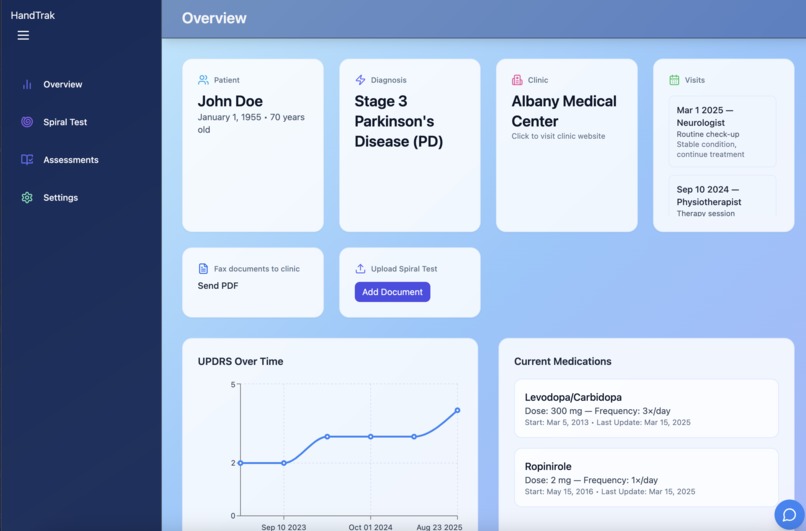
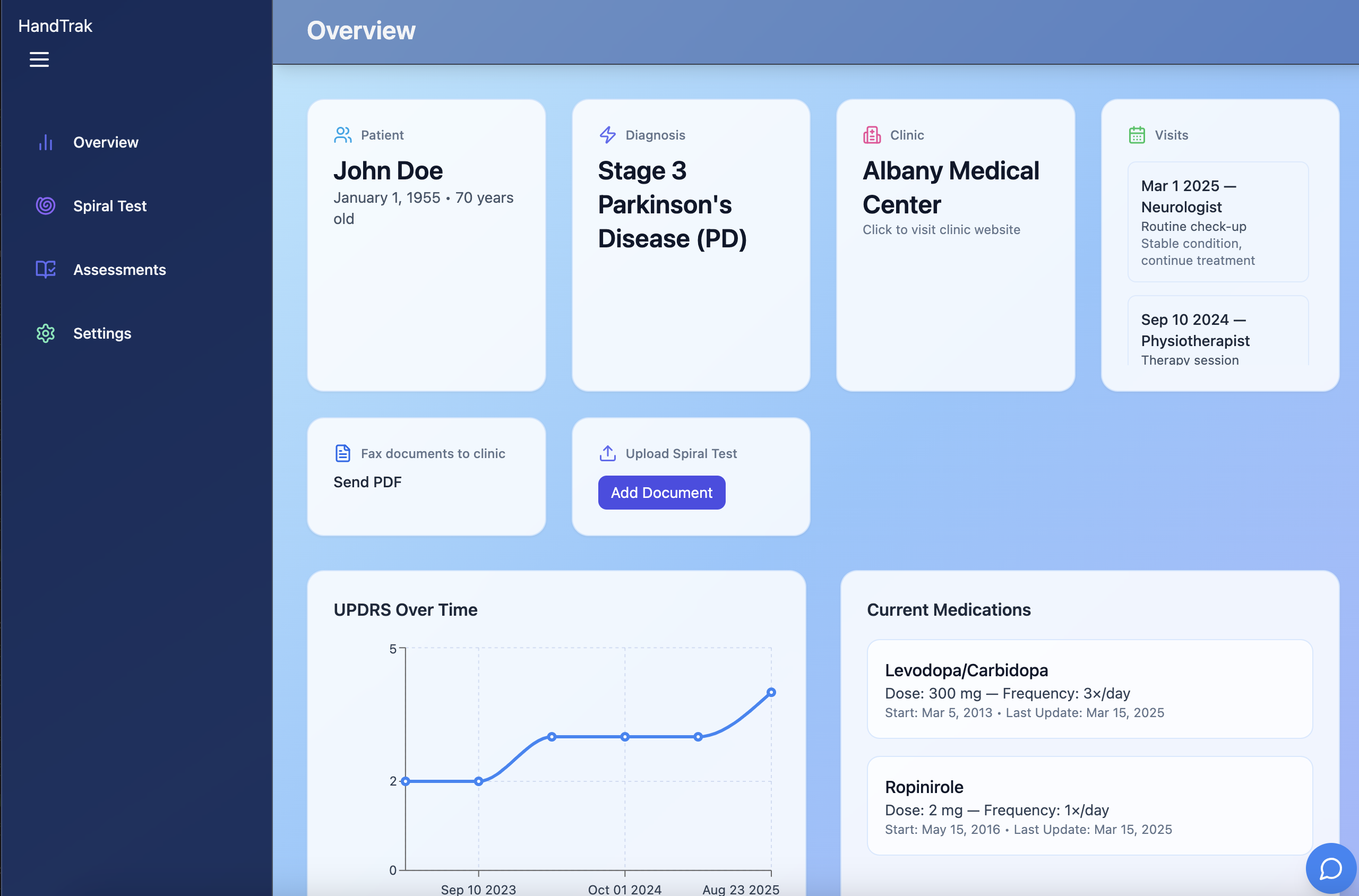
User-friendly interface to log and view data
What it does
HandTrak is an AI-powered platform that analyzes both spiral drawings and free handwriting tasks to detect micrographia. It outputs:
A binary classification (micrographia present or absent)
A severity score (0–4)
In addition, we integrated a symptom tracker that records prodromal and non-motor features such as:
RBD (REM sleep behavior disorder)
Sleep quality
Fatigue
Mood fluctuations
Results are displayed in a dashboard with:
Longitudinal tracking
Medication timing overlays
Exportable reports for EMR integration
How we built it
Developed and trained a YOLOv11 CNN on handwriting datasets with data augmentation + hyperparameter tuning
Validated performance using AUC, confusion matrices, and sensitivity/specificity analyses, achieving ~90% accuracy
Built a React-based interactive canvas for handwriting/spiral input, capturing velocity, pauses, and letter height variance
Added a symptom diary module to track RBD, sleep, and motor fluctuations
Designed a results dashboard with severity graphs, medication “on/off” overlays, and longitudinal plots
Challenges we ran into
Limited dataset diversity → required augmentation and normalization
Binary vs multiclass performance gap → severity harder to model
EMR interoperability and FHIR standards for export were challenging
Balancing scope vs feasibility in a hackathon timeframe
Accomplishments that we're proud of
Built a functional AI model and interactive tool within hackathon constraints
Expanded scope beyond motor symptoms to include prodromal and non-motor features
Created a clinically interpretable dashboard neurologists could realistically use
Positioned HandTrak as a precision neurology platform, not just a research demo
What we learned
Accuracy isn’t enough — AI in neurology must prioritize interpretability + workflow integration
Prodromal features like RBD and sleep disturbances are key for early detection
The role of UX design in translating AI into usable clinical tools
Longitudinal monitoring > single-time-point screening
What's next for HandTrak
Clinical validation studies in patient cohorts for regulatory translation
Expansion into multimodal biomarkers:
Voice (hypophonia)
Facial expressivity (hypomimia)
Eye movement (saccadic pursuits)
Build a cognitive screening module inspired by MoCA (digitally adapted tasks)
Partnerships with neurology clinics, advocacy groups, payers
Long-term: evolve into a comprehensive neurodegenerative disease monitoring ecosystem
Built With
- amazon-web-services
- aws-ec2
- chart.js
- d3.js
- express.js
- fhir
- figma
- firebase
- github
- google-cloud
- google-colab
- hl7
- javascript
- jupyter
- mongodb-atlas
- node.js
- onnx-runtime
- python
- pytorch
- react
- scikit-learn
- slack
- sqlite
- tensorflow.js
- vercel


Log in or sign up for Devpost to join the conversation.