Handshake
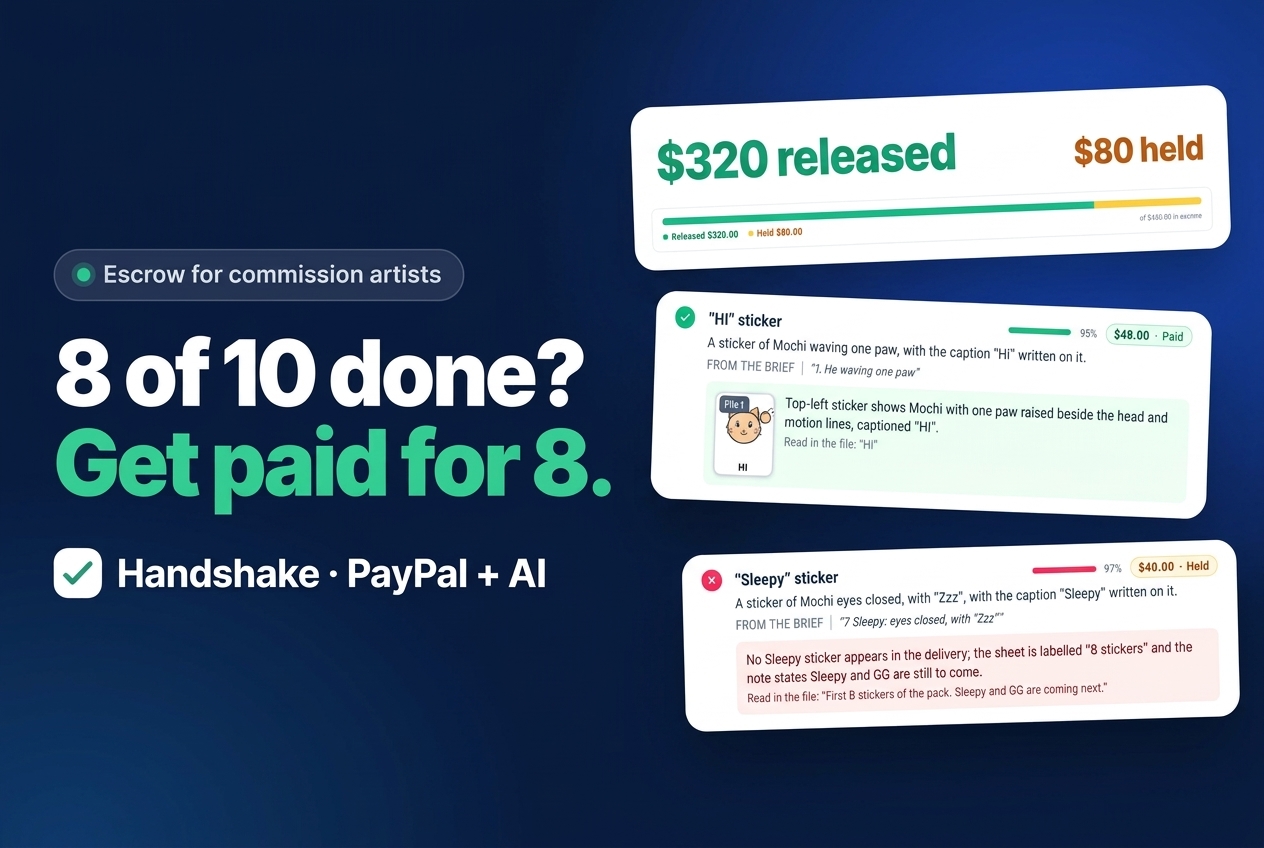
Tagline: Commission art escrow on PayPal: each piece paid the moment AI shows where it is.
Everything in the video and on the live site uses real PayPal sandbox calls and live AI reviews. Nothing is replayed or mocked.
Inspiration
Commission artists live on trust they can't enforce. An artist draws 8 of the 10 stickers a client ordered, and then either gets ghosted, or the client says "it's not what I asked for" and pays nothing. Clients have the mirror problem: they pay up front and get work that misses the brief.
Escrow should fix this, but escrow is all or nothing. Either the whole job is approved or nothing is paid, so 8 of 10 finished stickers is worth $0 until someone argues the last 2 into existence. Adding an AI judge doesn't help if it's a black box that says "PASS" or "FAIL" with no reasons and no way to push back.
What it does
Handshake is escrow for commission artists that pays piece by piece.
- Agree. The artist pastes the brief, even a messy DM. The AI splits it into priced items (one per sticker, emote or illustration). Every item quotes, word for word, the line of the brief it came from. Prices are editable and always add up to the total.
- Agents negotiate the deal. Before anyone agrees, an agent for each side negotiates the contract. The client's agent tightens every check so it can be verified from a delivery and proposes a price split. The artist's agent counters, moving money toward the pieces that take more work and rewriting checks a judge couldn't fairly verify. The agents only argue: a fixed rule settles it (prices meet in the middle and add up to the total; the artist's rewording is accepted only where a check can't be verified), and both people can still edit everything.
- Hold. The client funds the commission with PayPal. The money is authorized, not captured: held, not charged.
- Verify. The artist delivers. An AI judge checks every item and cites its evidence: which file, which region of the image (shown as a crop), and the caption it read there.
- Release, item by item. Each verified item is paid immediately: a partial PayPal capture of its price and a PayPal Payouts transfer to the artist. 8 of 10 stickers verified → $320 released, $80 held, with the reason the other two are held.
- Appeal. The artist can appeal a held item. An independent second AI review looks at the files again and answers the artist's argument. If it isn't convinced, the client decides.
- Receipt. Every decision produces a printable receipt: items, evidence, quotes, the rule applied, appeals, and the PayPal capture and payout IDs.
- Ledger. The activity page has a payments ledger: one row per PayPal payment across every commission, with who decided it (AI, appeal or client), the amount captured, the fee, the amount paid to the artist, and the PayPal IDs. Its totals follow the search and filters, and it exports to CSV.
- Insights (AG Studio). A dashboard over the same live ledger: held vs paid per commission, where each piece's money is, pieces by state, and the PayPal payments. Every chart cross-filters the page. Click Ask AI and AG Studio's agents read the data and build the chart you ask for. "Who released the money?" adds a chart of payouts by AI judge, appeal or client.
Designed as a full product, not a happy path
Every step has a failure path. A delivery that tries to manipulate the reviewer is caught and nothing is paid. A failed payout is recorded and retried without charging twice. A held item can be appealed, and a person makes the final call. A cancelled commission voids the rest of the hold, so the client is never charged for undelivered work. Every decision gets a receipt.
What makes Handshake different
Holding money while an AI checks the work is a natural idea, and other escrow tools do it. Handshake is built around five things they don't do together:
- Paid as each piece arrives. Not one settlement at the end: every verified batch is its own partial PayPal capture and its own Payouts transfer to the artist. In the demo, 8 stickers are paid as soon as they're verified ($320 captured, $304 paid out), and the last 2 are paid later with a second, final capture and a second payout.
- Evidence you can see on the art itself. For every piece, the verdict shows a crop of the region of the image where the AI found it, the caption it read there, and the exact line of the brief it fulfils. Quotes are checked against the brief on the server, so the evidence can't be made up.
- Built for commission art. Stickers, emotes, character art and illustration packs: work that comes in pieces, is judged by looking at it, and is often delivered in batches.
- Live, not replayed. The demo video is a real run on the deployed site: real PayPal sandbox authorizations, captures and payouts, and live AI reviews.
- A way to push back. A held piece can be appealed. An independent second review answers the artist's argument, and if it isn't convinced, the client decides. Every step gets a receipt.
Who it's for
Commission artists (stickers, emotes, character art, illustration packs) and the streamers, small businesses and fans who commission them. Work that is naturally split into pieces, and is often delivered in batches, is exactly where all-or-nothing escrow fails.
How i built it
- PayPal: Orders v2 with
intent: AUTHORIZE; one partial capture per release (final_capture: false),final_capture: trueon the last; void of the uncaptured remainder if a commission stops; Payouts after every release. Every capture and payout has a numberedPayPal-Request-Id, so a retry after a timeout replays the original capture instead of charging twice. Each capture is recorded before its payout, so a failed payout never loses a capture. - AI: any vision model on OpenRouter, structured outputs validated with Zod. Brief quotes are verified against the brief on the server (paraphrases are dropped). Evidence regions are validated and clamped. Deliveries and appeals are treated as evidence only: text that tries to instruct the reviewer is detected, and nothing is paid.
- Agentic commerce: before money is held, a client agent and an artist agent negotiate the contract with structured outputs (prices, objections, reasons). The settlement is deterministic code, so the agents can't talk money into moving.
- Rules decide, not the AI: an item is paid automatically only when it passes with at least 75% confidence and the reviewer raises no concern about the delivery. An appeal pays only if the second review is at least 75% sure.
- Receipts: each receipt is sealed with a SHA-256 fingerprint of its contents.
- AG Grid: the payments ledger uses custom cell renderers (decision and payout status pills, a paid-so-far bar per commission), a pinned totals row recomputed from the filtered rows, quick-filter search across PayPal IDs, and CSV export.
- AG Studio: the Insights tab joins three tables by commission: commissions (the PayPal hold), PayPal payments (one row per partial capture and payout, plus voided holds) and pieces (who released each piece's money). It ships a pre-built, cross-filtering report, and judges can switch to edit mode and drag in their own charts. The AI assistant runs on AG Studio's Agent Framework with AG's own agents. We wrote the LLM adapter: each turn goes through a server function that holds the OpenRouter key (Claude Haiku 5.5, fast at many short tool calls), with per-visitor and daily limits for the public demo.
- Stack: TanStack Start (React, server functions), Nitro on Vercel, libSQL (Turso), Tailwind, AG Grid, AG Studio.
Testing
- 25 automated tests run the real escrow code against a fake PayPal that enforces authorization rules: capture → final capture → further capture refused; capture → void → capture refused; retry after a lost response (one charge, not two); payout failure; currency; appeals; the cheating case; exact-cent price settlement for the agent negotiation.
- The demo samples were run through the real AI judge 5 times each: 15 of 15 verdicts as expected.
- End-to-end on the live deployment with the PayPal sandbox: fund $400 → $320 captured and $304 paid out → appeal → final $80 captured and $76 paid out.
- The Insights assistant was run on production with "Who released the money?": it built the chart in 30 to 90 seconds with no failed turns.
Challenges
- Making a nondeterministic judge safe to move money. The AI only recommends; deterministic rules decide what is paid, and anything uncertain goes to a person.
- Partial captures are a sequence, not a call. Getting idempotency, final captures and voids right across retries took a dedicated test harness.
- Citations you can trust. Quotes are checked against the source on the server, and regions are validated, so the UI never shows evidence the model made up.
What's next
PayPal multiparty (Commerce Platform) so artists are paid as sellers directly; accounts instead of private links, so each person sees only their own commissions; email notifications when work is delivered, an item is paid or an appeal needs a decision; and reauthorization for commissions longer than PayPal's authorization window.
Try it
Live demo: https://handshake-paypal.vercel.app → Try the live demo (PayPal sandbox, fake money, about 2 minutes).
Built With
- ag-grid
- ag-studio
- javascript
- tanstack
