-
-
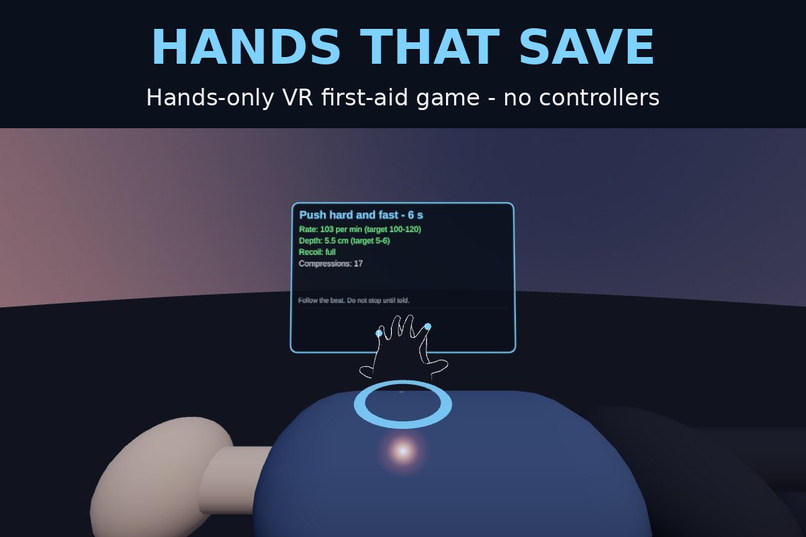
Compressions with both hands on the chest: rate, depth and recoil all on target (recorded in the IWSDK XR emulator, hands mode).
Inspiration
Since 2004 I have held one idea: no one should face an emergency alone. When someone collapses, the people nearby are the first help, and their bare hands are the tool that keeps blood moving until the ambulance arrives. Hands That Save turns those hands into the controller.
What it does
A hands-only VR first-aid game for adult basic life support, played seated. The steps follow the European Resuscitation Council (ERC) Guidelines 2025:
- Check that it is safe to approach.
- Tap the shoulder - no response.
- Call 112 (the EU emergency number) on speaker.
- Check breathing. If you answer NORMAL, the game explains why abnormal breathing after a collapse must be treated as not breathing.
- Put both hands on the centre of the chest and push hard and fast, following a metronome beat.
- A bystander brings an AED. During the rhythm analysis you must take your hands off - touching pauses it. If a shock is advised, you press SHOCK only when nobody is touching the person.
- Keep pushing until the ambulance crew takes over.
At the end you get a score from your rate, depth, full recoil and hands-on time. Not certified CPR training - learn CPR in a certified course.
Crash reports from real headsets
The game sends anonymous crash reports and two events (page opened, VR entered) to my own receiver, FIELD REPORT, so bugs on real headsets can be found and fixed. Each report holds the build id, the browser and device, the screen size, a random id kept in the browser and the last console lines - no name, no account, no cookies. The start screen says so in one line. Gameplay is unchanged.
How I built it
Built solo with Meta's Immersive Web SDK (IWSDK 1.1.0-rc.2, WebXR), TypeScript and Vite, with Claude (Anthropic) as my AI coding assistant. Every object, panel and sound is made in code: no models, textures or audio files. The metronome and tones use WebAudio; spoken prompts use the browser's speech synthesis when available, and every prompt is also shown as text.
Hand interactions
- Buttons are pressed with the index fingertip; the fingertip must leave a button before it can press again, so there are no accidental repeats.
- Compressions are measured from the palms: depth from their vertical travel, rate from the time between pushes, recoil from whether the chest is released fully.
- The game watches your hands during the AED analysis and pauses it while you touch the person.
- A one-hand input option lets players who can use only one hand take part.
Challenges
- Text and buttons in VR: the panels shrink their text to fit and keep a reserved band for the buttons, so nothing overlaps.
- Measuring compressions reliably at any frame rate.
- Testing without a headset: the game was developed and tested in the IWSDK XR emulator in hands mode, with an automated test that drives the whole game and checks every step.
What's next
Next, I will test and tune the game on a real Meta Quest headset with hand tracking, and have a certified CPR instructor review every step before the public launch. Then I will add more languages, starting with Greek, package it as an installable app for the Meta Horizon Store, and add new scenes, such as a collapse on a busy street or at home. Target launch: 31 March 2027.
Built With
- github
- hand-tracking
- immersive-web-sdk
- three.js
- typescript
- vite
- webaudio
- webxr
