Inspiration
What it does
How we built it
Challenges we ran into
Accomplishments that we're proud of
What we learned
What's next for Handover Hub
Inspiration
Offboarding checklists cover laptops and badges. Nobody has a list of the Jira work. When a person leaves, changes team or goes on parental leave, their open issues stay assigned to them, the projects and components they lead keep routing new work to a dead inbox, and the filters and dashboards only they own quietly stop being maintained. HR and managers discover the gaps weeks later, one escalation at a time.
What it does
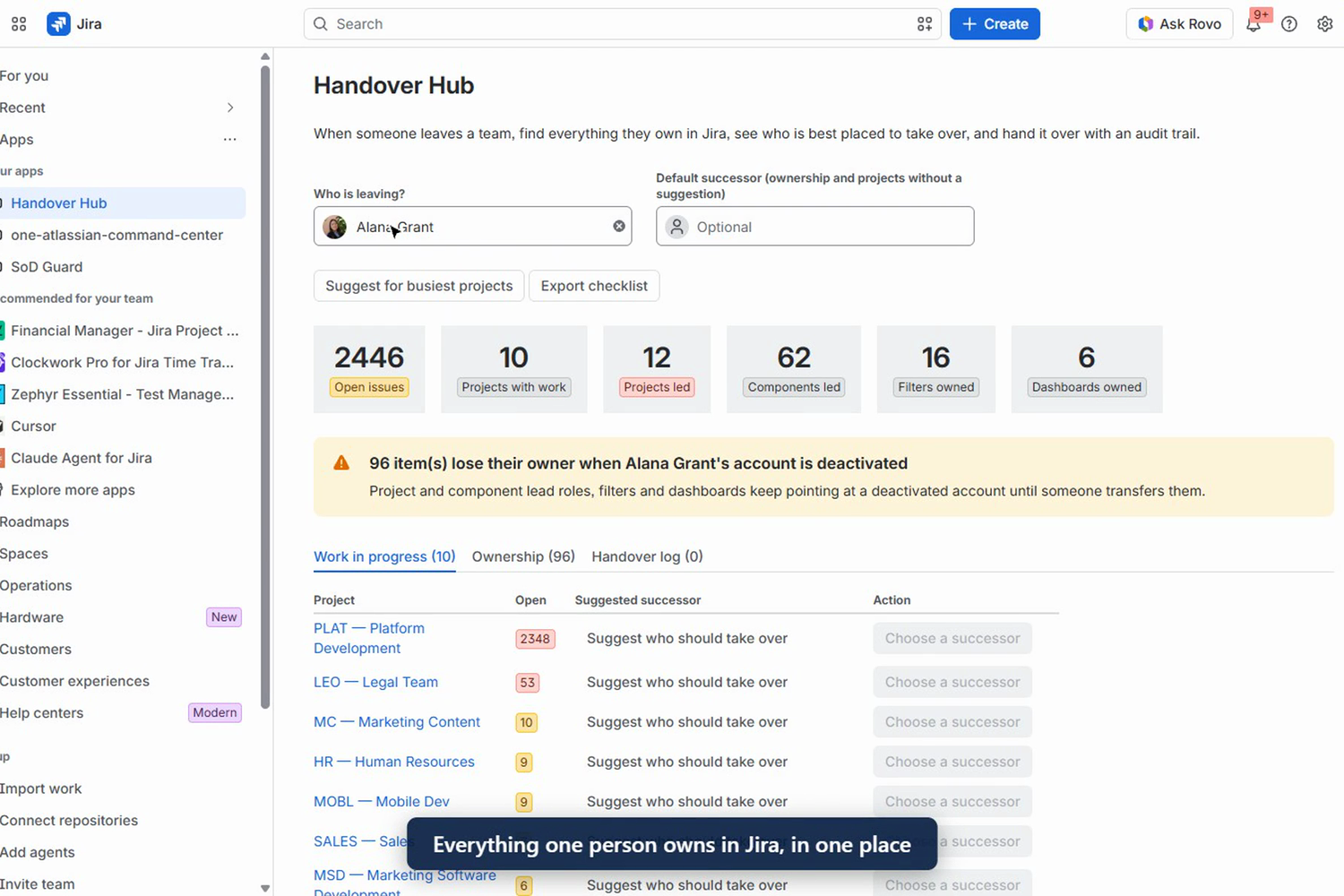
- One inventory per person. Pick a name and Handover Hub lists, with the viewer's own permissions: open issues per project, projects and components the person leads, and filters and dashboards they own. It calls out how many items would lose their owner when the account is deactivated.
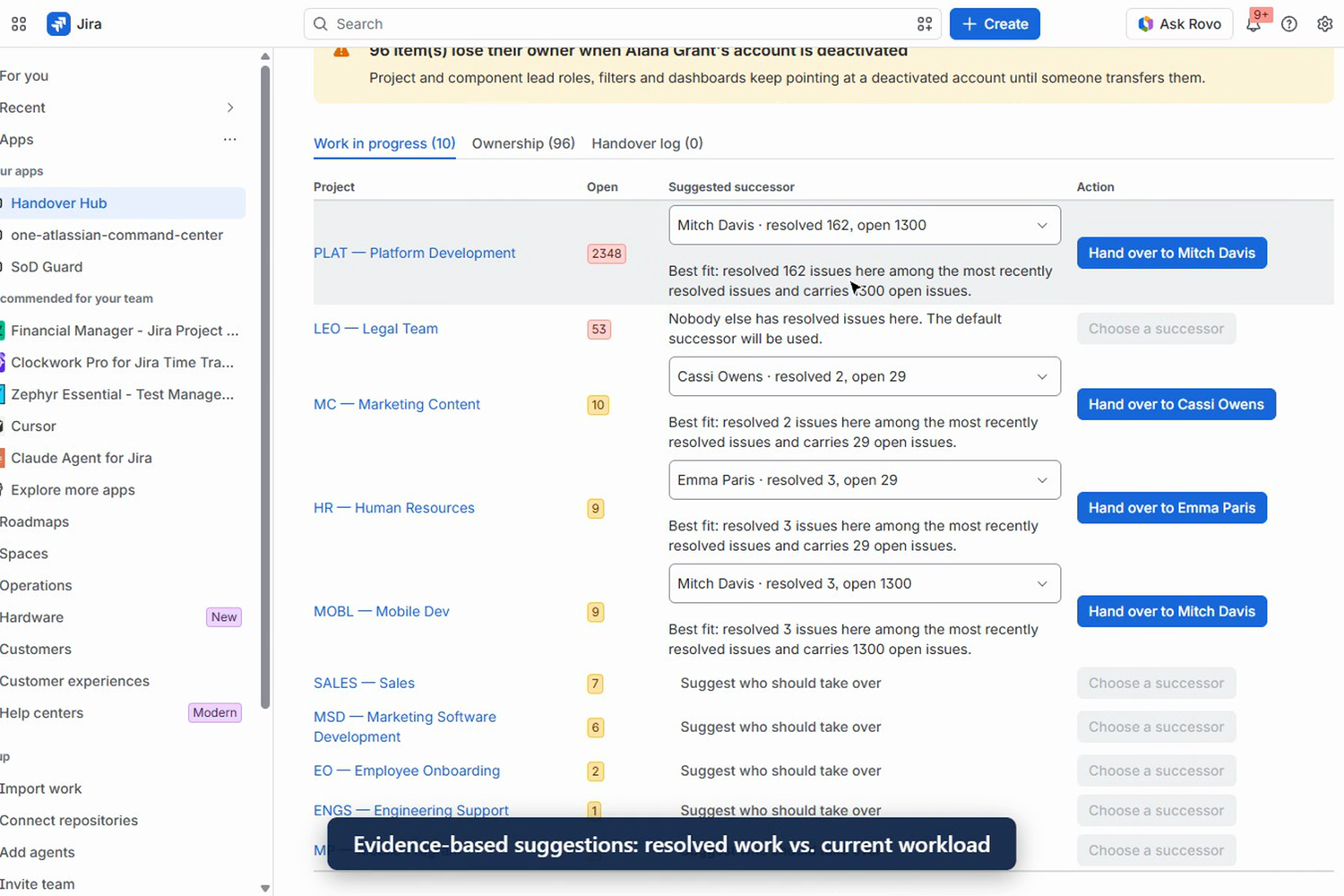
- Evidence-based successor suggestions. For each project it ranks the colleagues who actually resolved work there, and discounts people who already carry a heavy open workload. Every suggestion states its evidence ("resolved 162 issues here … and carries 1,300 open issues"), so the manager decides with facts, not guesses. The evidence window widens automatically (90 days → 12 months → most recent work) on quieter projects.
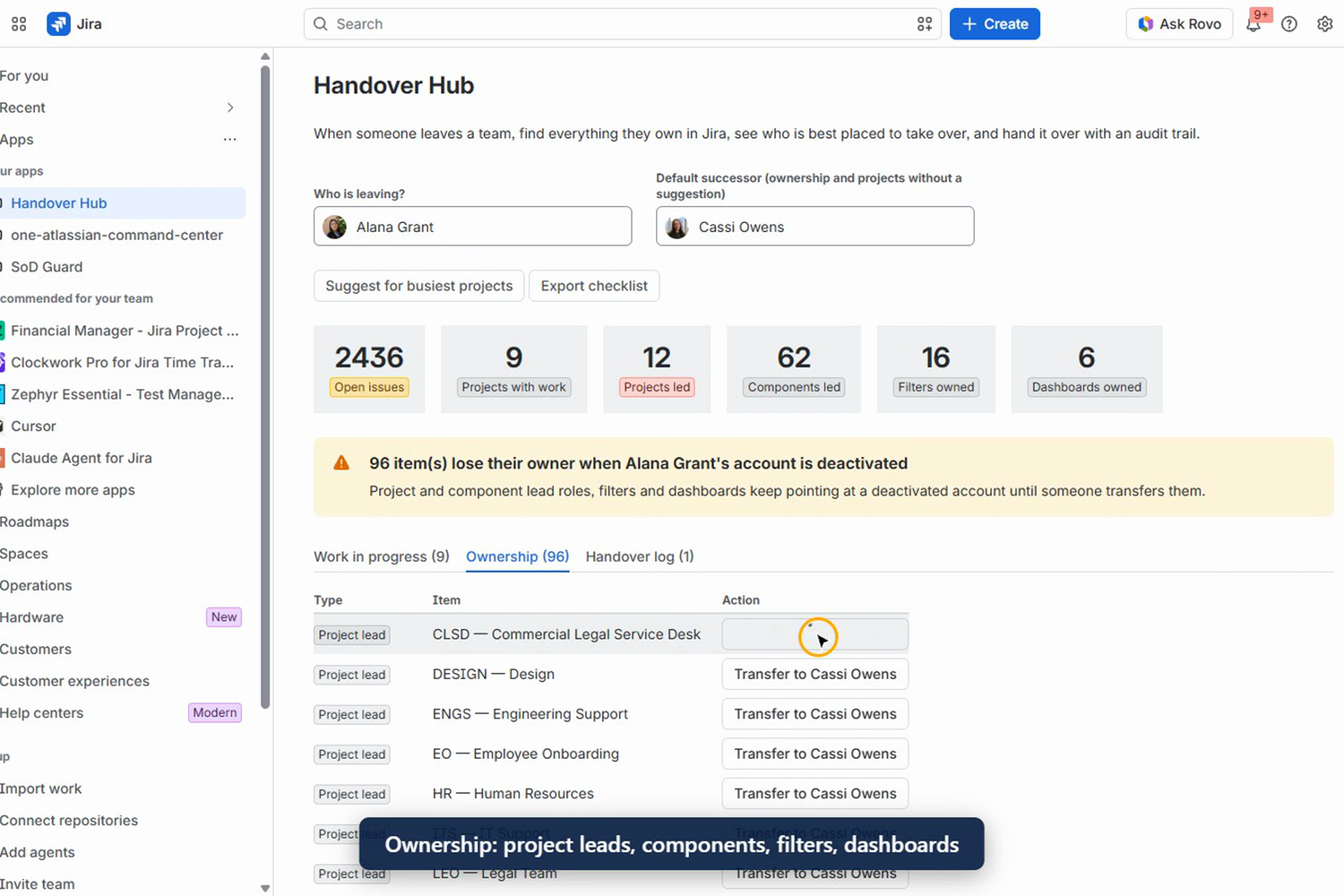
- Hand over in one click. Issues are reassigned in batches with live progress. Project lead roles, component leads, filters and dashboards are transferred to the chosen successor.
- Audit trail and checklist. Every move is written to a handover log (what, from whom, to whom, when, by whom) and the whole plan exports as a Markdown checklist for the manager or HR ticket.
- Rovo agent "Handover Assistant". "What does Alana own in Jira?", "Who should take over Alana's work in PLAT?" — answered from the same three read-only actions. The agent never moves work; people confirm every move in the app.
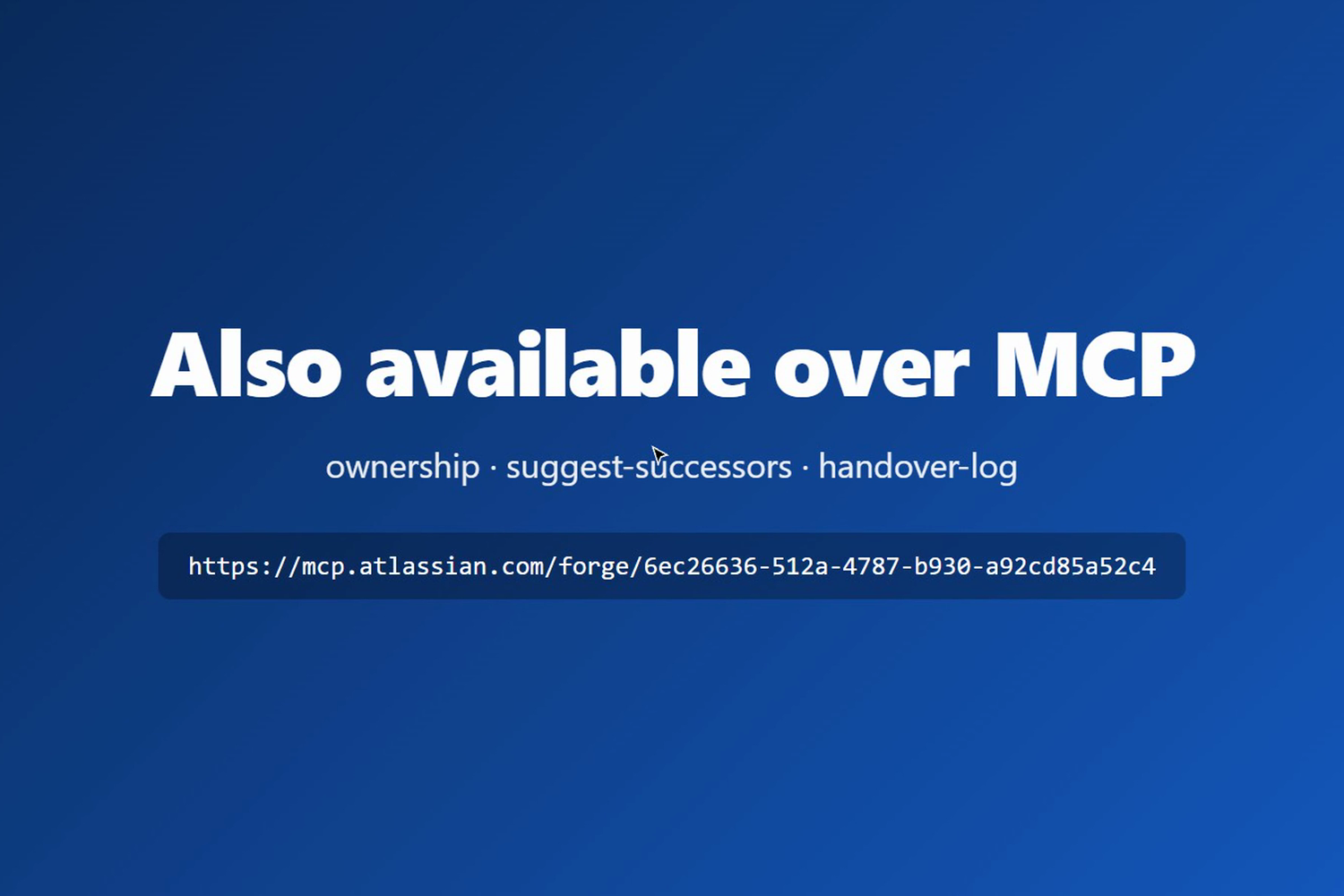
- MCP. The same actions (
ownership,suggest-successors,handover-log) are exposed throughrovo:mcpfor an HR assistant or any other agent.
How we built it
- Forge only, Runs on Atlassian: no egress, no remote backend. Modules:
jira:globalPage(UI Kit),rovo:agent,rovo:mcp, threeactionmodules, Forge KVS for the log. - Everything runs
asUser(): the inventory shows only what the viewer may see, and a transfer only succeeds if the viewer already has the Jira permission for it. - Per-project counts use Jira's approximate-count API with bounded concurrency, so a site with dozens of projects and thousands of issues is inventoried in seconds. Reassignment runs in batches of 60 so no invocation approaches the Forge time limit, and the UI loops with a progress bar.
- The ranking is a small pure module (
src/rank.js, unit-tested): experience divided by a soft workload penalty; the leaver, deactivated accounts, apps and service accounts are never suggested.
Challenges we ran into
- "Who should take over" must not become a popularity or performance score. We restricted it to two neutral facts — resolved work in that project and current open workload — and told the agent explicitly not to comment on performance or on why someone is leaving.
- Real sites are uneven: some projects have no recent activity. A fixed 90-day window returned nothing on quiet projects, so the evidence window widens and the app (and the agent) always says which window was used.
- Bulk changes on thousands of issues inside serverless limits: batches, bounded concurrency and a "stuck" signal so the UI stops instead of looping when a successor cannot be assigned in a project.
Accomplishments that we're proud of
On a demo site with 24 projects the app found 2,447 open issues, 12 led projects, 62 components, 16 filters and 6 dashboards for one person, suggested successors with reasons, and moved the work — with no configuration at all.
What we learned
Agents are most useful as planners, not actors, in HR-sensitive flows: read-only actions for the agent, human-confirmed writes in the UI, one shared log.
What's next
- Teamwork Graph: prefer successors from the same team and include Confluence pages and Bitbucket repositories in the inventory.
- Scheduled hand-overs (start on the leaving date) and temporary cover for leave with automatic hand-back.
- Automation rule and board ownership.
Built With
- forge
- javascript
- jira
- mcp
- node.js
- rovo
- ui-kit
