-
-
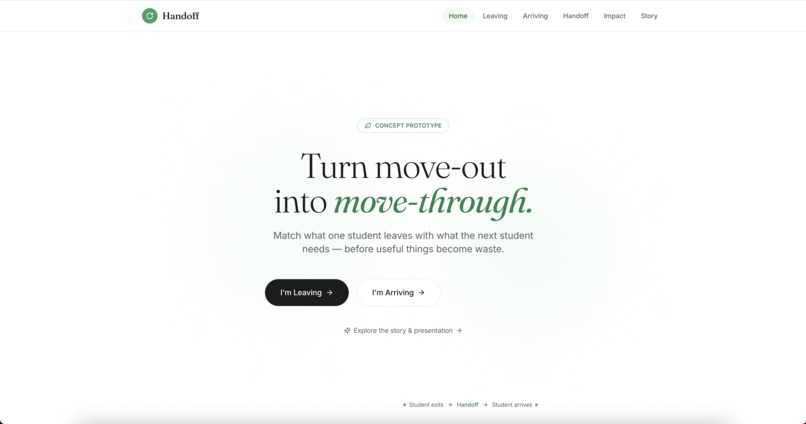
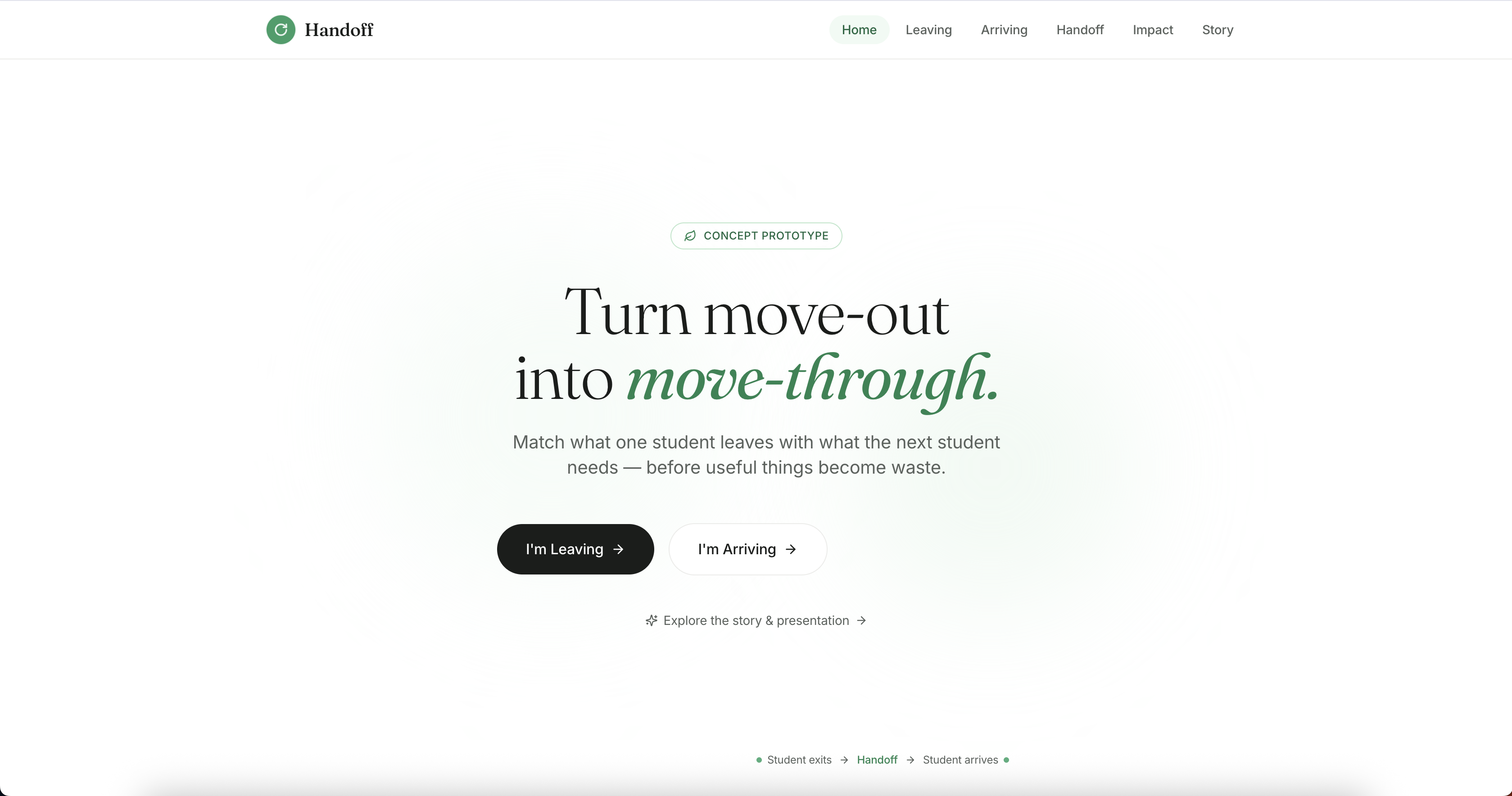
HERO
-
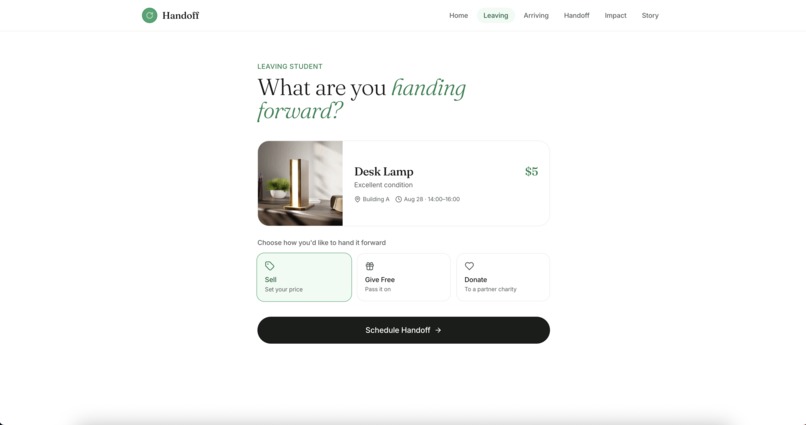
Leaving Student
-
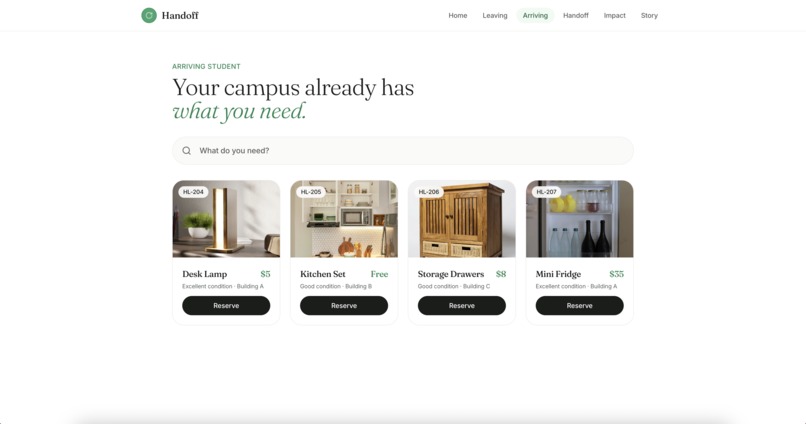
Arriving Student
-
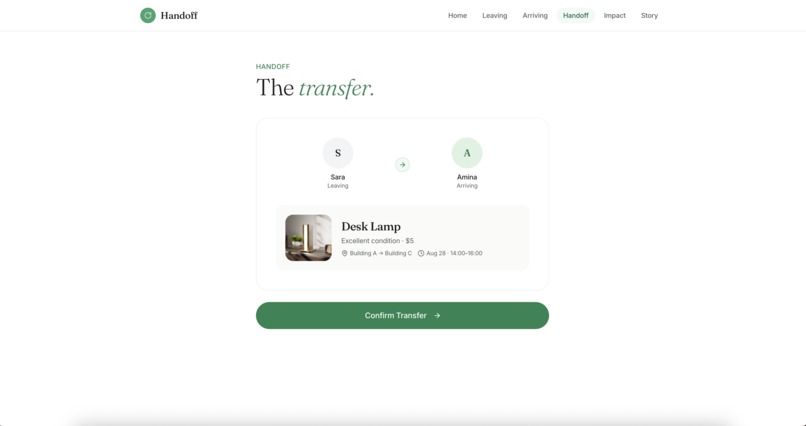
Handoff
-
Handoff Passport
-
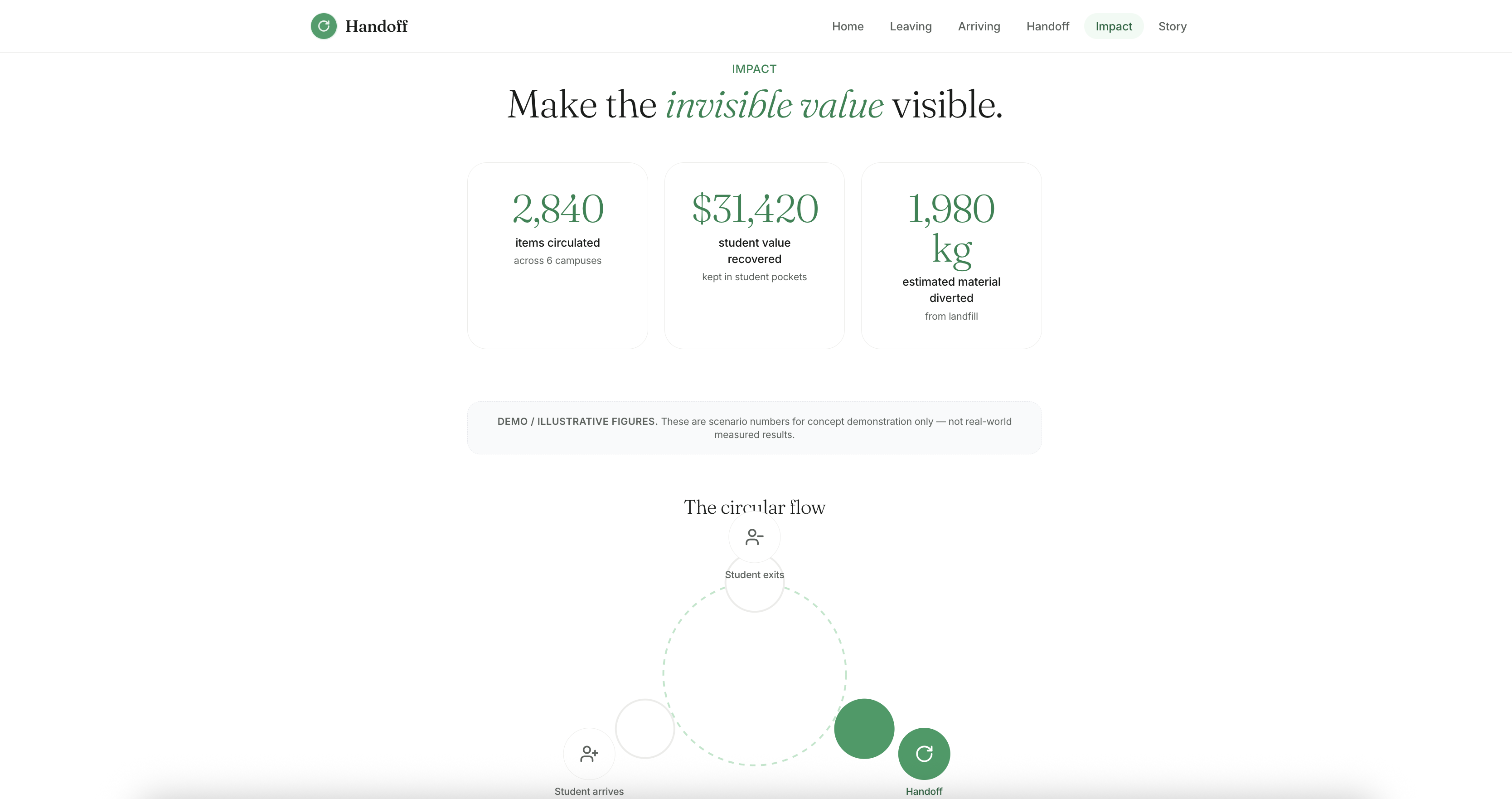
Impact
-
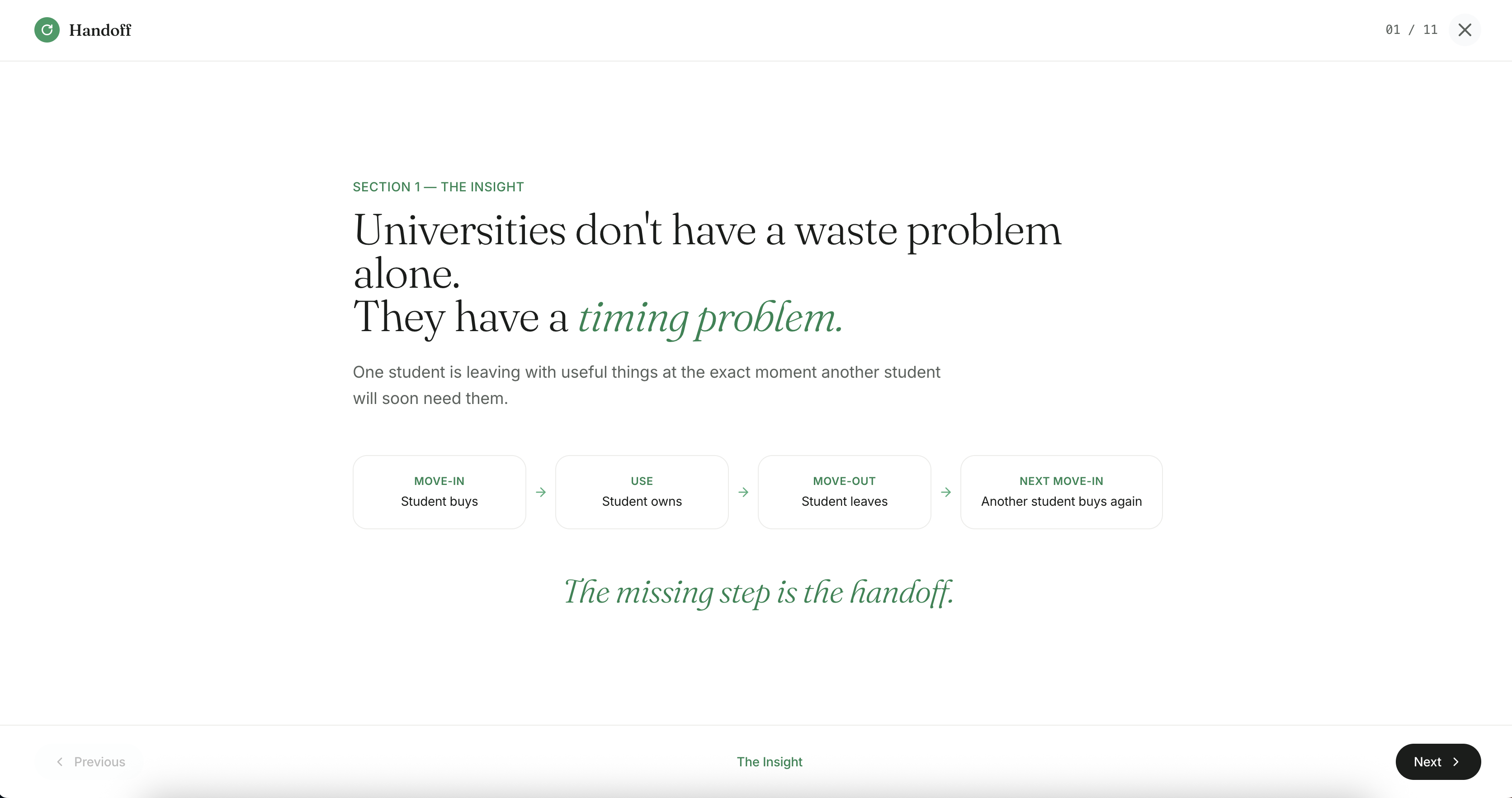
The Insight
-
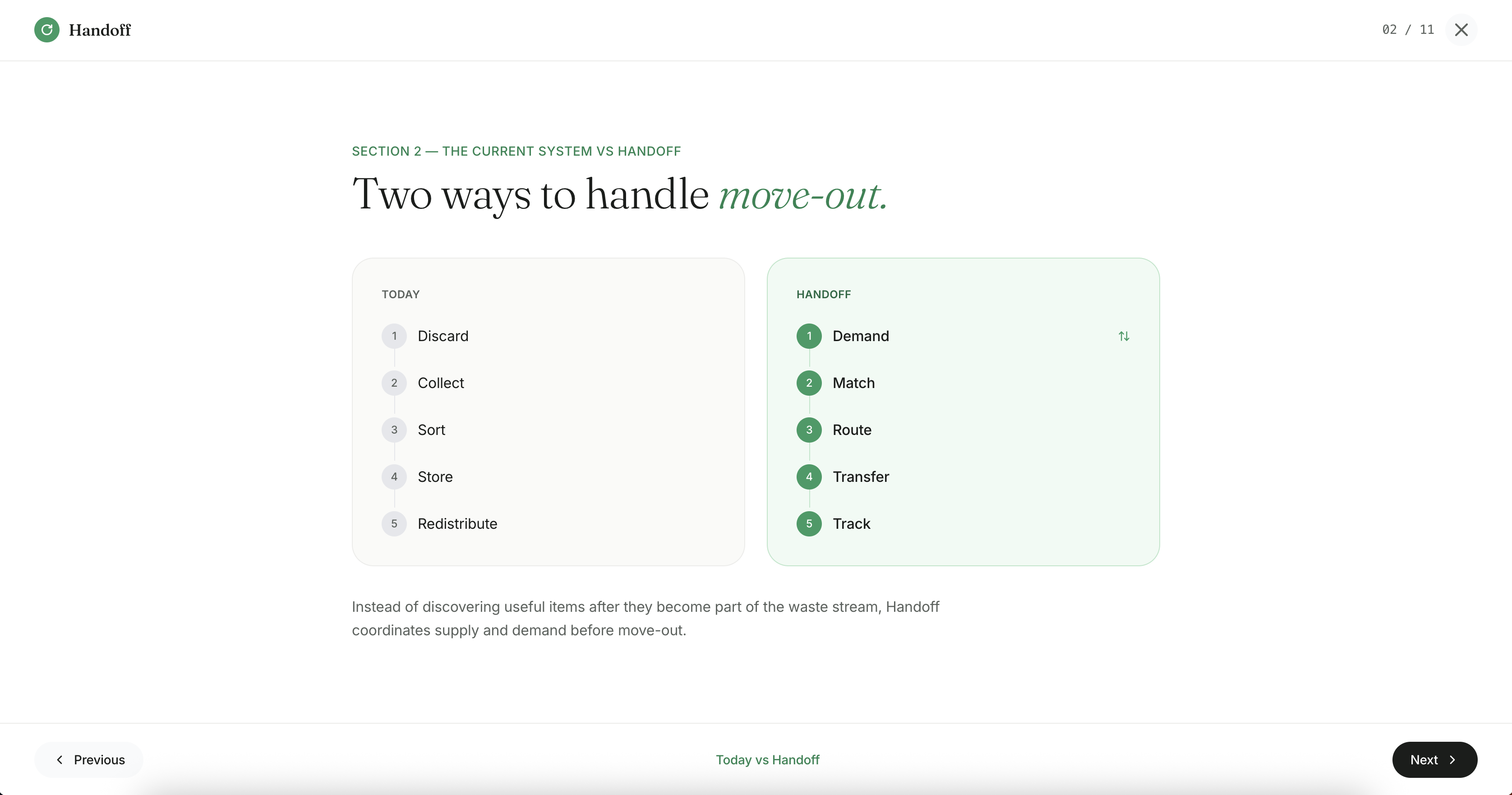
Today vs Handoff
-
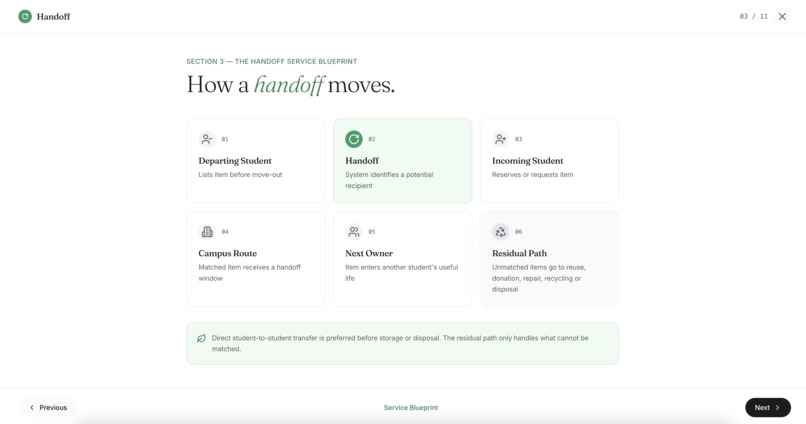
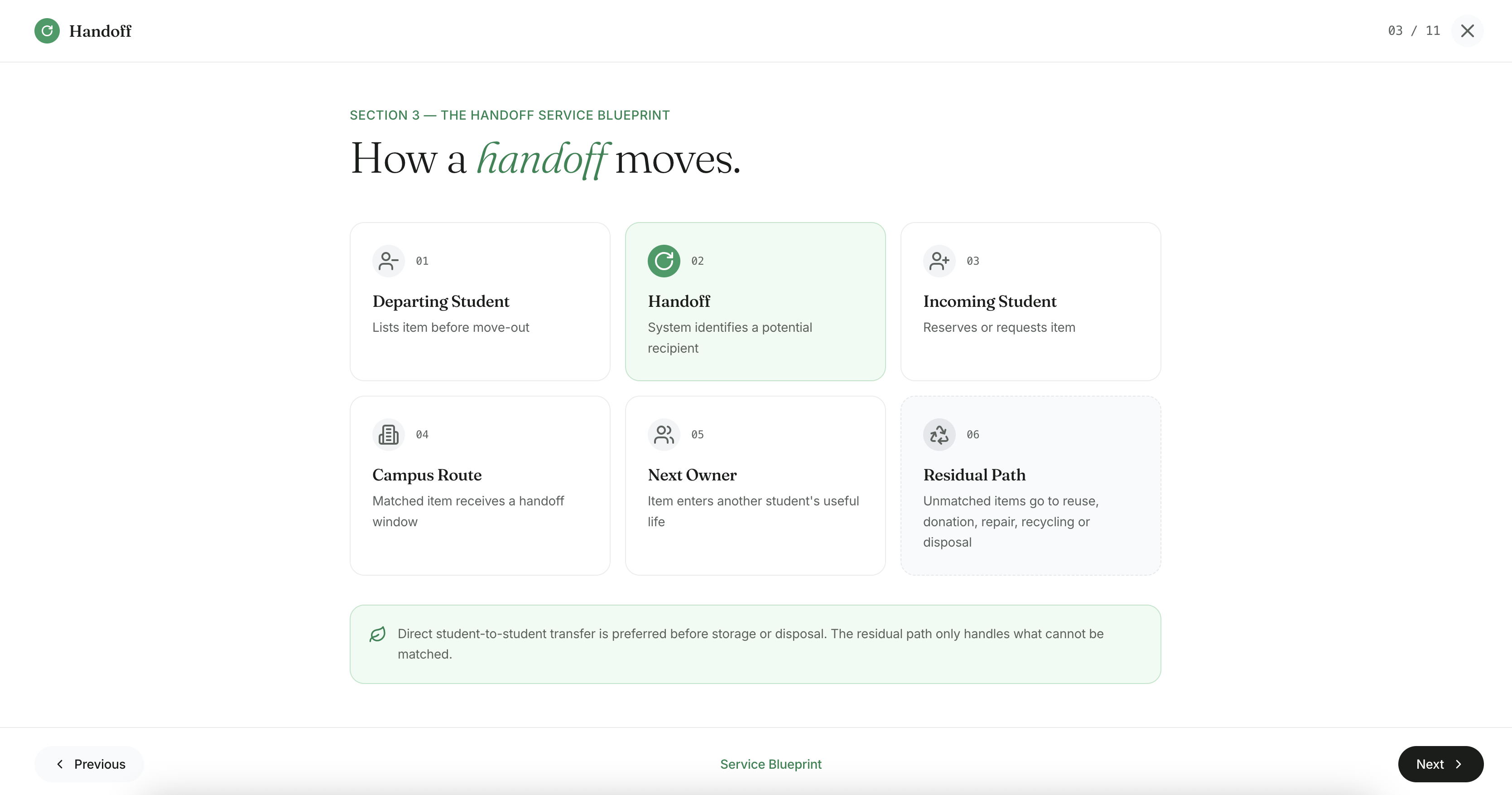
Service Blueprint
-
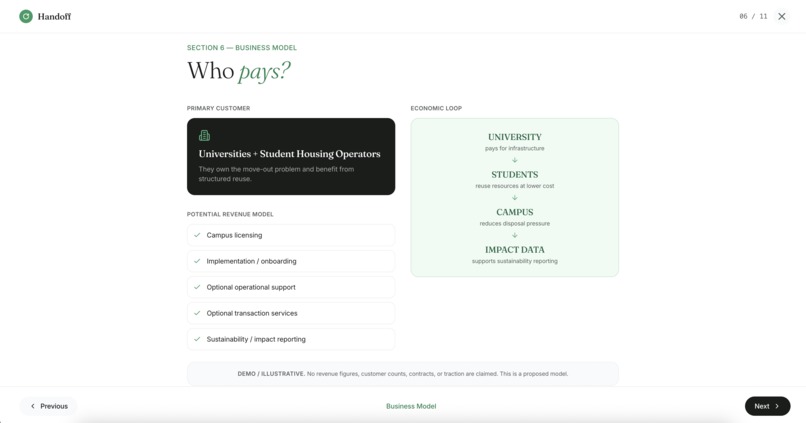
Business Model / Pilot
-
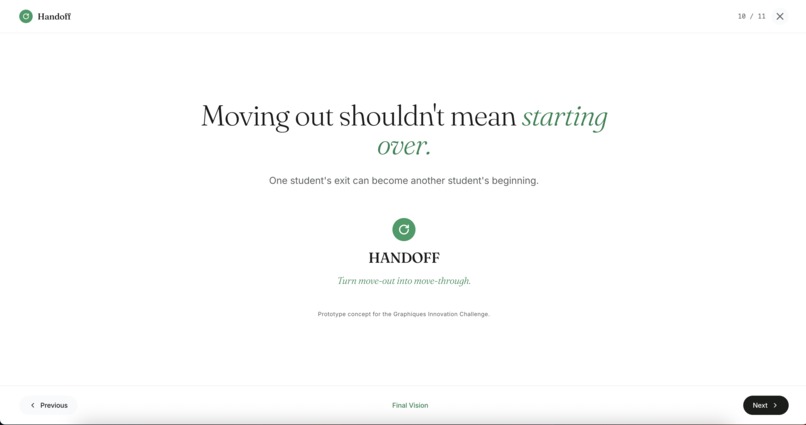
Final Vision
HANDOFF
Turn student move-out into student move-through.
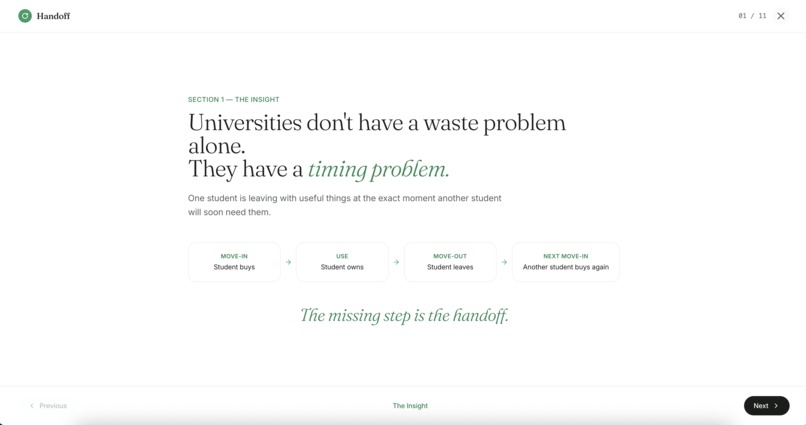
Every year, students move out of university housing carrying things they no longer need.
At roughly the same time, another group of students is preparing to move in and purchase many of those same categories again.
The problem isn't only waste.
It's timing.
One student has supply at the exact moment another student will soon have demand, but the existing process often discovers that connection too late.
The Problem
Move-out creates a predictable surge of items:
- lamps
- kitchen equipment
- storage
- small appliances
- study equipment
- furniture
- bicycles
Universities have already demonstrated that move-out reuse can recover substantial quantities of useful material. UCL documents significant additional move-out waste alongside reuse initiatives, while Imperial College London's 2026 halls initiative reported recovering more than 7,000 household and kitchen items for incoming students. Georgetown's 2026 Move Out Drive reported more than 55,000 lb of materials diverted, with recovered materials valued at more than $415,000.
These programs demonstrate that the underlying opportunity is real.
HANDOFF redesigns how the opportunity is coordinated.
The Solution
HANDOFF is a proposed campus circular-resource system that matches departing-student supply with incoming-student demand before move-out.
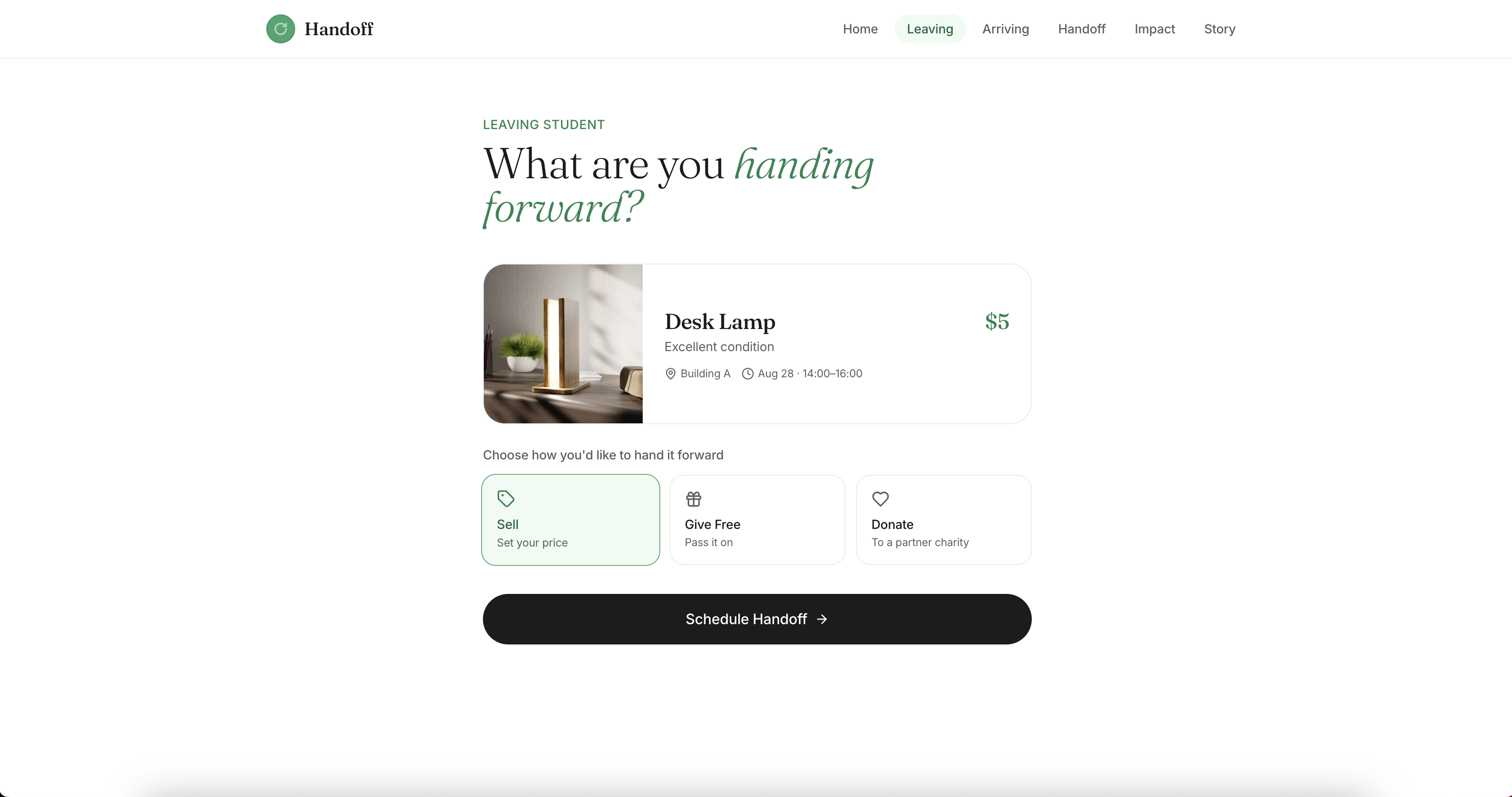
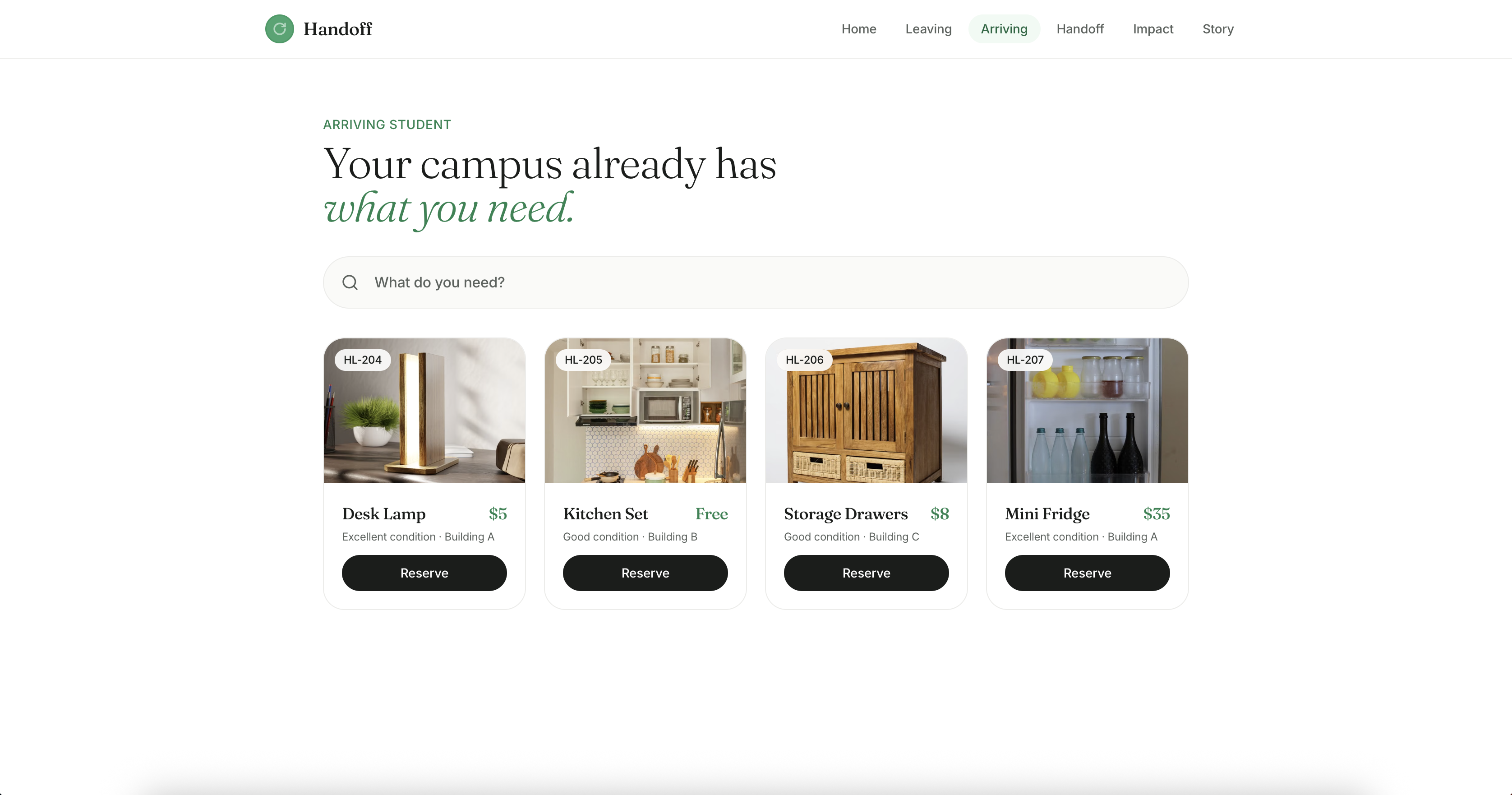
Instead of waiting for useful items to enter a donation pile, departing students declare what they plan to leave while incoming students create a needs list.
HANDOFF then connects the two sides and schedules a coordinated transfer.
The workflow
DECLARE
A departing student lists an item before moving out.
↓
MATCH
The system identifies an incoming student's need.
↓
RESERVE
The incoming student reserves the item.
↓
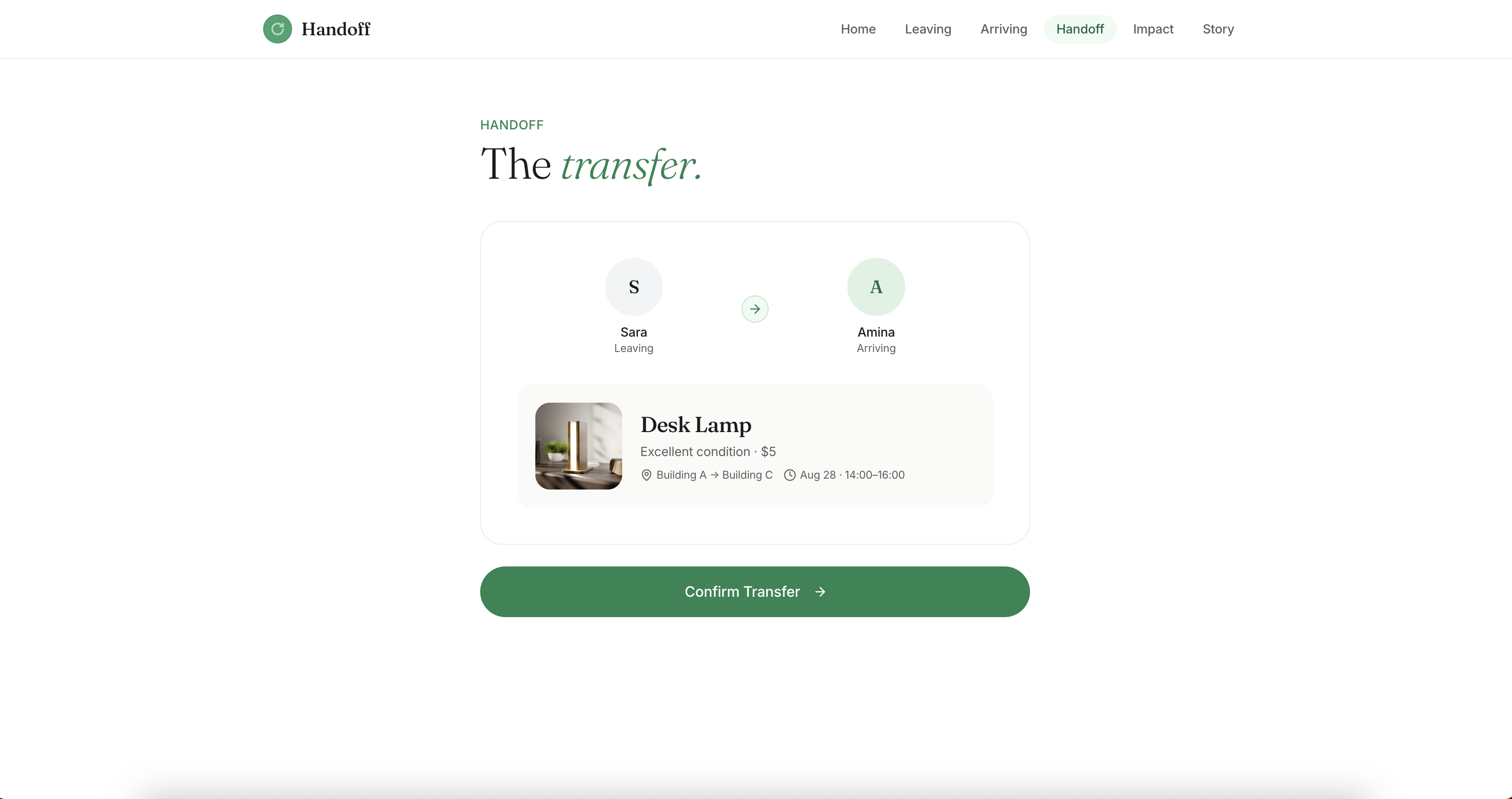
ROUTE
The campus assigns a handoff location and time window.
↓
TRANSFER
The item moves directly to its next owner.
↓
TRACK
The item can remain visible as a circulating campus resource.
Whenever a direct match is not possible, the item can continue through reuse, donation, repair, recycling or disposal channels.
What Makes It Different
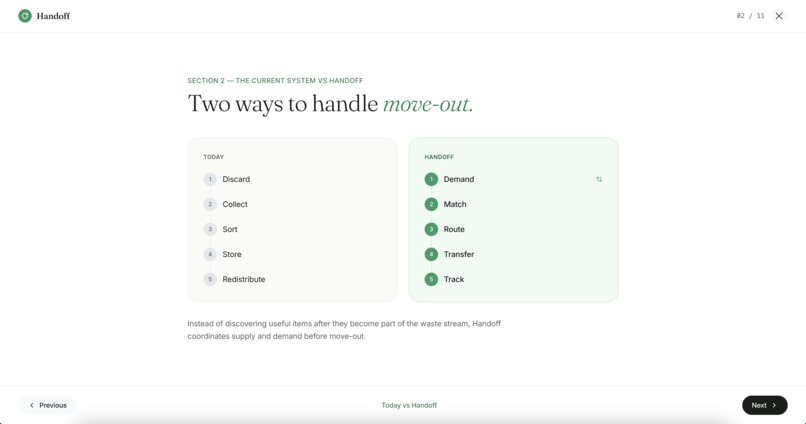
HANDOFF is not simply another student marketplace.
Traditional reuse can look like:
Discard → Collect → Sort → Store → Redistribute
HANDOFF proposes:
Demand → Match → Route → Transfer
The key innovation is the coordination layer around time.
The university calendar already creates predictable waves of supply and demand. HANDOFF uses that predictable timing to intervene before useful objects become waste.
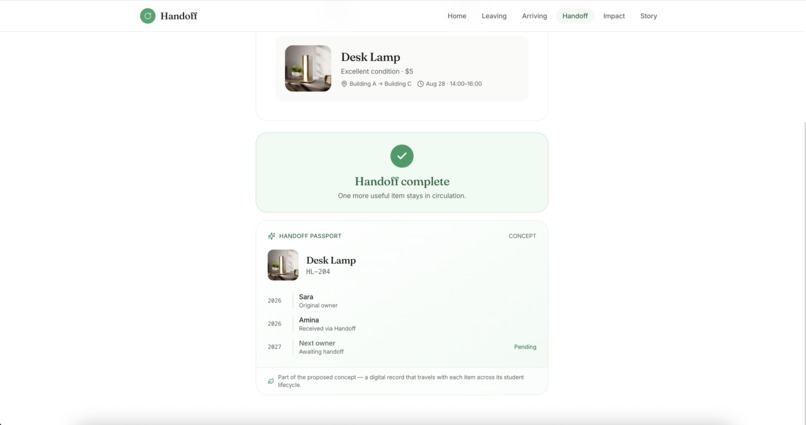
Handoff Passport
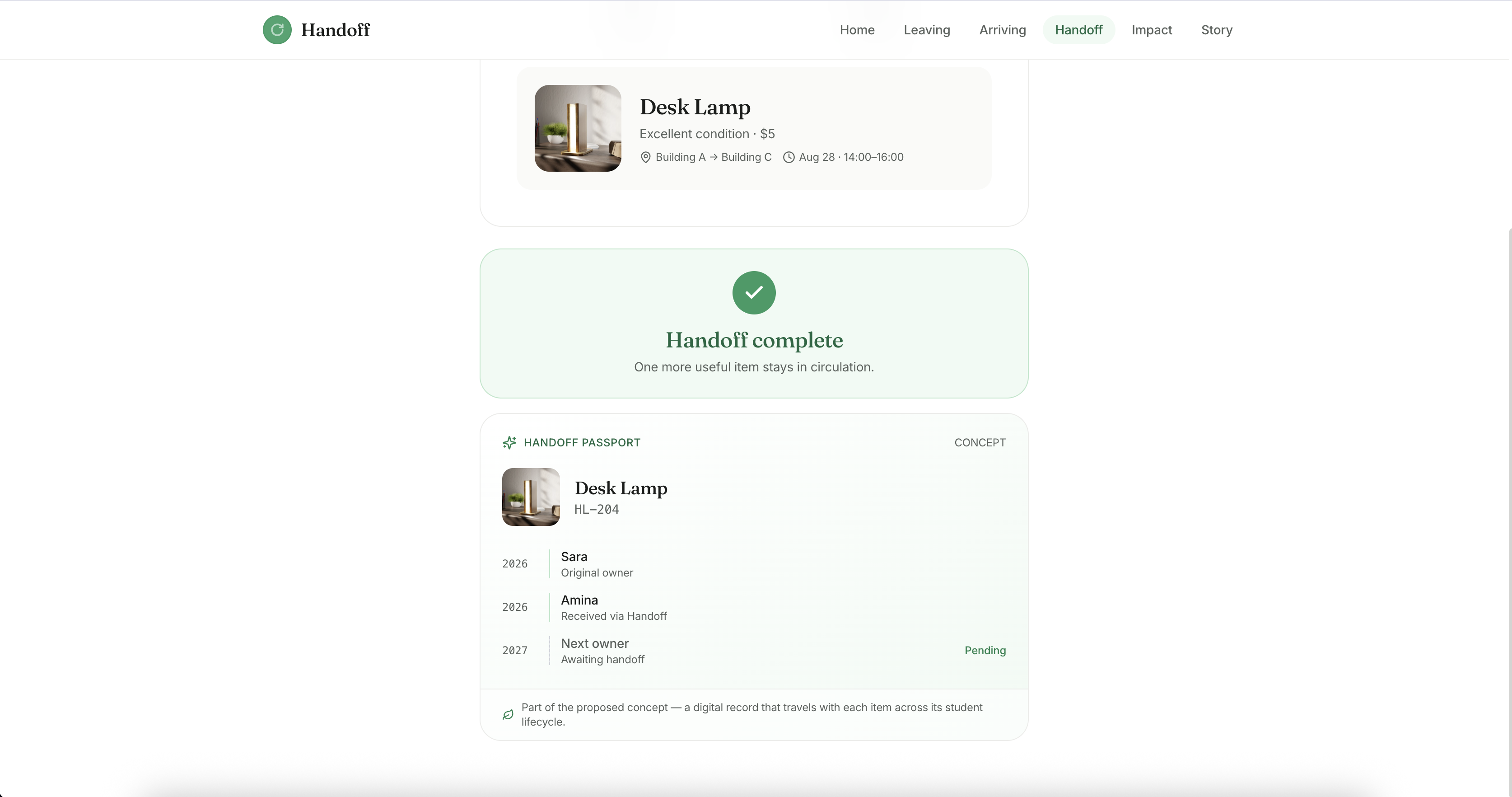
The concept also introduces the Handoff Passport.
Each reusable item can have a lightweight identity showing its circulation history.
For example:
DESK LAMP #HL-204
Sara · 2026 ↓ Amina · 2026 ↓ Next owner · 2027
The purpose is not surveillance or ownership tracking.
It is to change the mental model from:
"This is an item I am throwing away."
to:
"This is a resource that can keep moving."
The Passport is a proposed concept and is not presented as existing university infrastructure.
Who Benefits?
Departing Students
Recover value from items they no longer need or pass them directly to another student.
Incoming Students
Access everyday essentials at lower cost.
Universities
Gain a structured move-out reuse workflow with measurable circularity and operational metrics.
Community Partners
Receive unmatched items through donation, repair, reuse and recycling pathways.
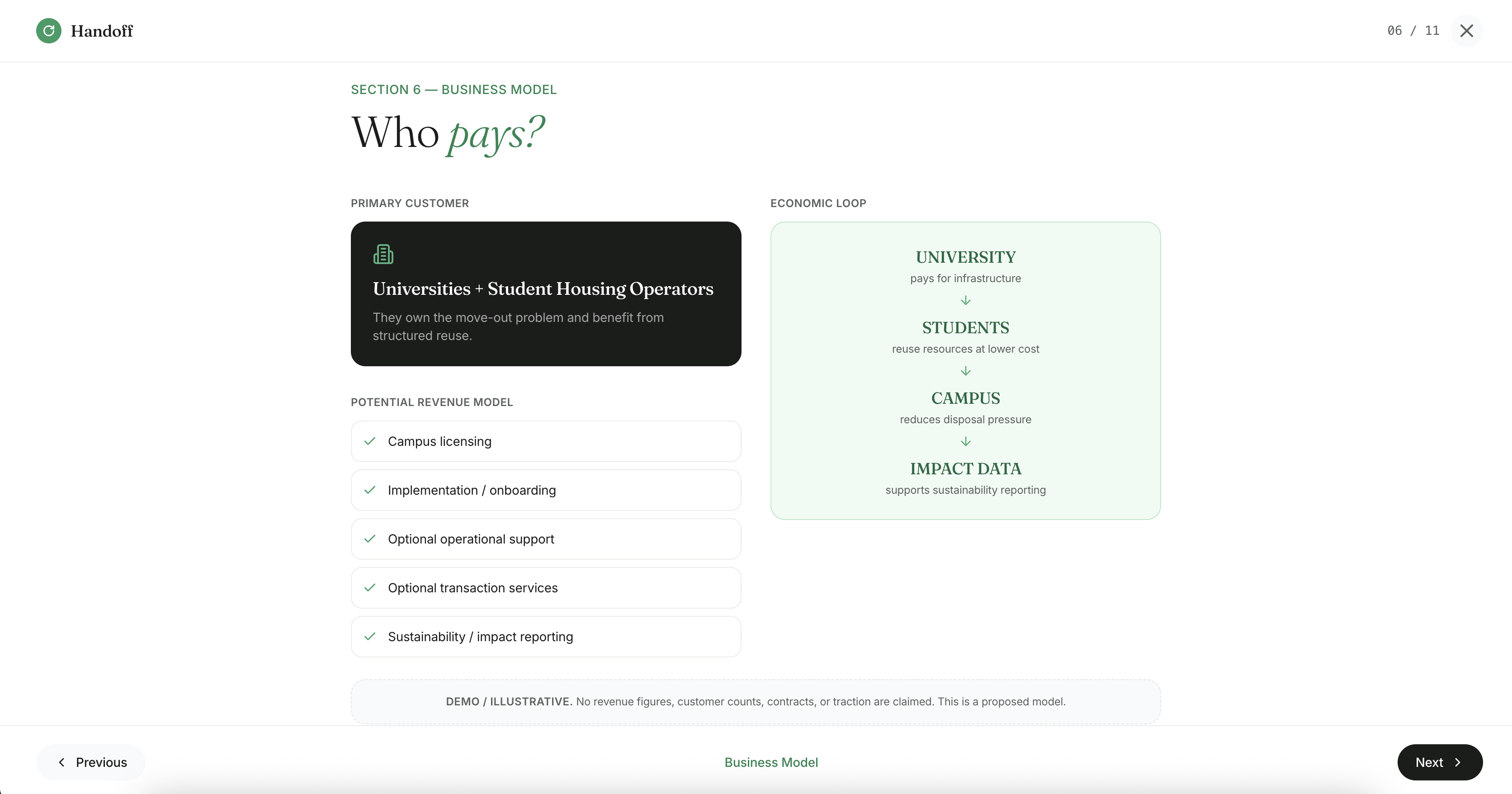
Business Model
The primary customer would be the:
University or student-housing operator
Potential revenue could come from:
- campus licensing;
- implementation and onboarding;
- optional operational support;
- optional transaction services;
- sustainability and impact reporting.
Students would ideally face little or no participation barrier.
No customer numbers, contracts, revenue or traction are claimed in this prototype.
Pilot Model
HANDOFF can start with a single residence hall.
Illustrative pilot
100–300 students
4–6 item categories
One move-out period
One coordinated handoff workflow
Initial categories could include:
Kitchenware Lighting Storage Small appliances Study equipment Bicycles
The pilot would measure what percentage of listed items can be directly matched, how much material stays in circulation, how much value students recover or save, and how much storage or disposal is avoided.
This is an illustrative pilot design, not a completed pilot.
What We Would Measure
A real deployment could track:
Direct handoff rate
What percentage of listed items reach another student directly?
Items kept in circulation
How many useful objects avoid the disposal pathway?
Student value recovered
What value is recovered by departing students?
Student savings
How much would incoming students otherwise have spent?
Material diverted
How much material avoids disposal?
Storage avoided
How many items can bypass temporary storage?
Time to transfer
How long does it take for a listed item to find its next owner?
Repeat participation
Do students use the system again in future semesters?
Why Now?
Universities already have the calendar.
They already have residence halls.
They already have students moving out.
They already have students moving in.
They already have sustainability goals.
The missing piece is a system designed around the moment when supply and demand overlap.
The Bigger Vision
HANDOFF begins with university move-out, but the underlying idea is broader:
predictable transitions create predictable supply and demand.
The same approach could eventually apply to student housing, apartment communities, vocational campuses and other seasonal communities.
The goal is not to create another place to sell things.
The goal is to redesign the transition itself.
Final Thought
Today, moving out often means getting rid of things.
Tomorrow, moving out could mean handing them forward.
HANDOFF
Turn move-out into move-through.
Evidence note
The university examples referenced above are independent examples of existing reuse and move-out programs. They do not use or endorse HANDOFF.
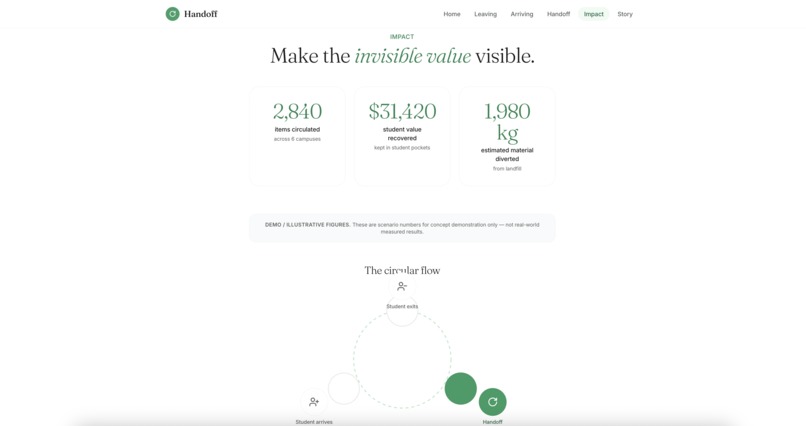
All prototype metrics shown in the interface are explicitly illustrative/demo figures.
HANDOFF is a proposed innovation concept, not a claim of existing deployment.
Built With
- bolt.new
- css
- pexels
- react
- tailwind
- typescript
- vite


Log in or sign up for Devpost to join the conversation.