-
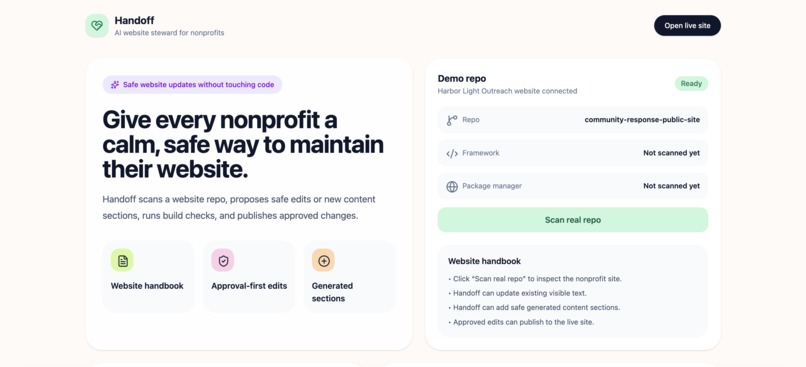
Home page
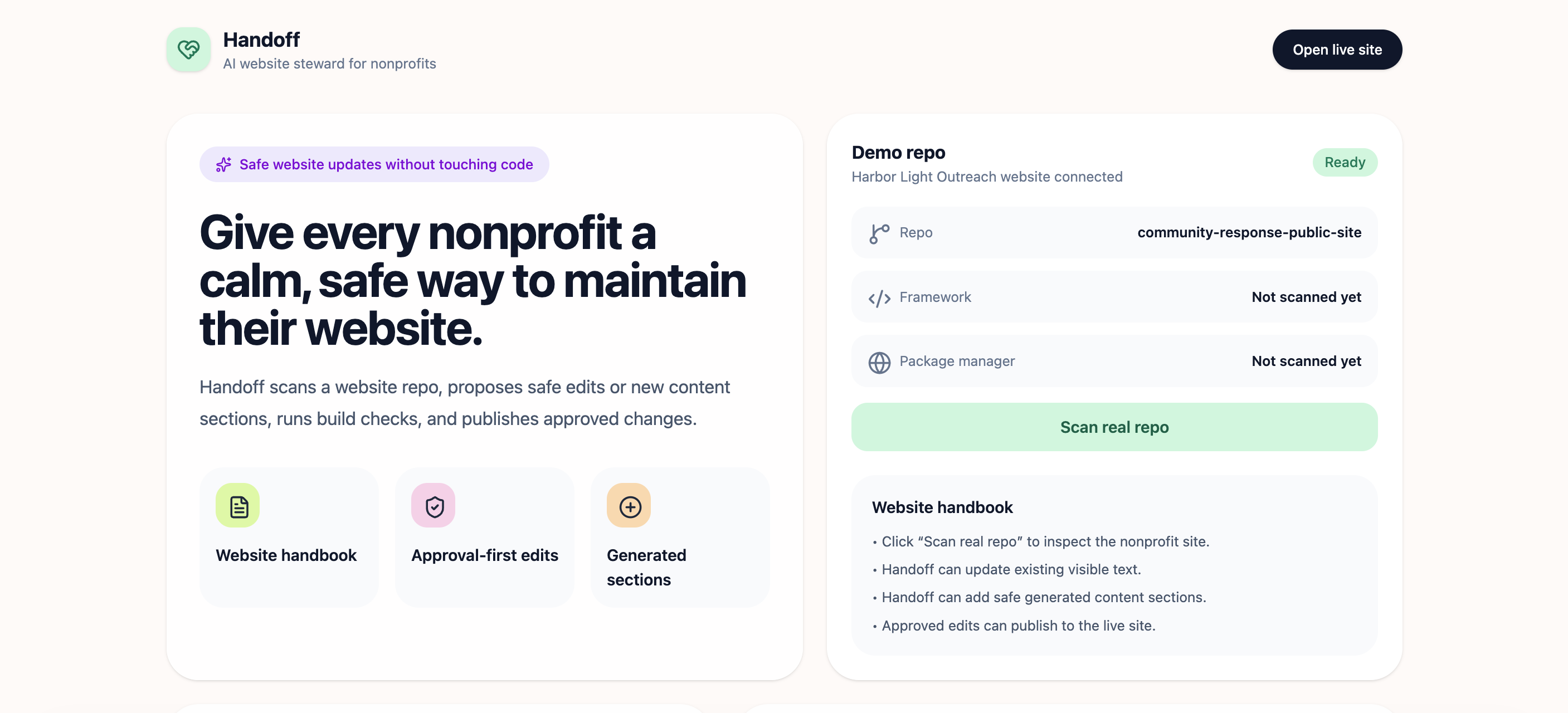
What it does
Handoff is an AI website steward for nonprofits.
Many small nonprofits rely on one freelancer, volunteer, or student developer to build their website. Once that person leaves, the organization is often stuck. Even simple updates like changing a donation goal, adding an event announcement, or updating volunteer information can require using Git, the command line, dependencies, builds, and deployments.
Handoff lets nonprofit staff request website changes in plain English. It scans the website’s codebase, detects the framework, finds safe editable areas, proposes a clear preview of the change, and waits for human approval before doing anything. After approval, Handoff updates the code, runs a production build, commits the change, pushes it to GitHub, and triggers deployment.
For our demo, Handoff can:
- update existing website text
- generate and insert new nonprofit website sections
- show a before/after preview
- run build checks
- commit and publish to a live site
The goal is not to replace developers. It is to make developer handoff safer, clearer, and more sustainable for organizations that cannot always afford ongoing technical support.
Challenges we ran into
One major challenge was keeping the AI powerful but safe. Letting an AI freely rewrite a website repo is risky, especially for nonprofits that depend on their website for donations, volunteers, and public trust. We solved this by creating a workflow where Handoff scans only safe files, asks Gemini to propose specific edits, verifies that the old text exists before modifying anything, and requires user approval before publishing.
Another challenge was integrating multiple workflows into one cohesive system. Our project combined AI prompting, repository scanning, React frontend logic, backend file manipulation, Git operations, production builds, GitHub pushes, and live deployment through Vercel. Making all of those systems communicate reliably required a lot of debugging and iteration.
We also learned an important lesson about scope. Early on, we initially tried to build a much broader platform with multiple interconnected workflows and AI coordination systems. While ambitious, we realized we had bitten off a bit more than we could chew for a hackathon timeline. Refocusing on a single clear problem, helping nonprofits safely maintain their websites after a developer leaves, ultimately made the project much more polished.
Accomplishments that we're proud of
We are proud that Handoff can modify a completely separate live website from a plain-English request.
Our project does more than generate text. It actually:
- reads a real website repo
- reasons over the code
- proposes a safe diff
- edits the website
- runs a build
- commits and pushes to GitHub
- updates the deployed site
We are especially proud of the approval-first workflow, because it makes the AI feel trustworthy rather than reckless.
What we learned
We learned that building useful AI agents is less about giving the model total control and more about designing safe boundaries around it. The most important parts of Handoff were not just prompting Gemini, but deciding what files it could inspect, what kinds of edits it could make, how to validate those edits, and when a human should approve the final change.
We also learned how quickly an idea can evolve during a hackathon. Handoff started as a general AI website helper, but became much stronger once we focused on one specific pain point: what happens to a nonprofit website after the developer leaves?
What's next for Handoff
Next, we want to expand Handoff beyond our demo workflow. Future improvements include:
- support for more frameworks and CMS platforms
- safer pull-request based publishing
- accessibility checks
- multilingual website updates
- emergency alert banners
- team approval workflows
- rollback support
- analytics and donation campaign insights
- more advanced component and page generation
Built With
- gemini
- react
- tailwindcss
- typescript
- vite

Log in or sign up for Devpost to join the conversation.