Inspiration
Be sure to write what inspired you, what you learned, how you built your project, and the challenges you faced. Format your story in Markdown, with LaTeX support for math.
Every year, around 3.6 million babies are born in the U.S., and families purchase dozens of baby products that are often used for only a few months. This creates a cycle of high spending and high waste—especially for plastic-heavy items like toys, walkers, and feeding equipment.
At the same time, plastic waste continues to impact ocean ecosystems, contributing to long-term environmental damage. We saw an opportunity to address both problems at once:
reduce waste through reuse make parenting more affordable and convenient
Existing platforms like Facebook Marketplace and eBay weren’t designed for baby products, where trust, safety, and convenience are critical.
What it does
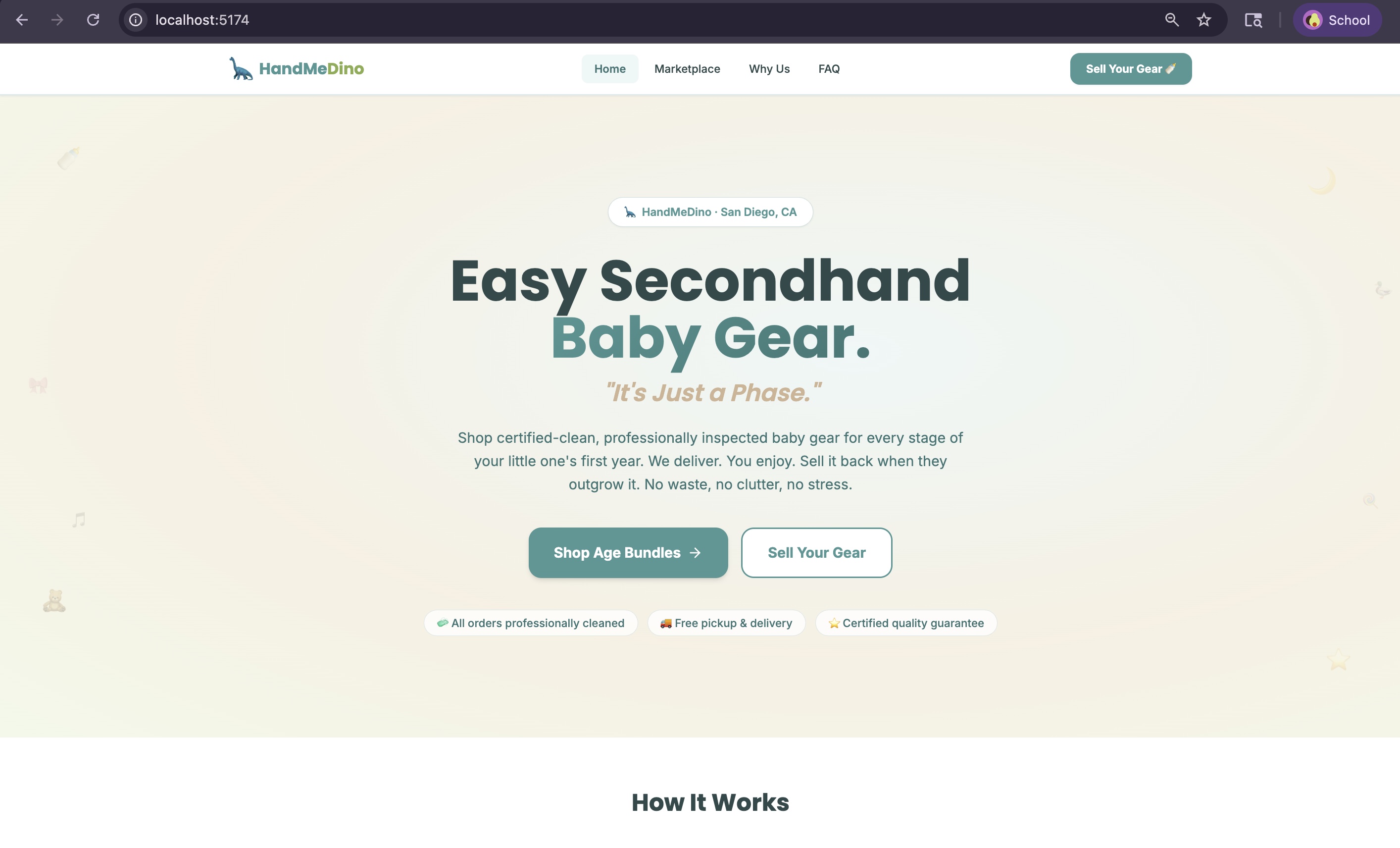
HandMeDino is a full-service circular marketplace for baby products that makes it easy for parents to buy, rent, and resell safely—without the hassle of meeting strangers, negotiating, or worrying about product quality.
We solve the problem of short-lived, expensive baby products that quickly become waste by creating a trusted, logistics-driven platform that extends product lifecycles and reduces plastic waste.
By combining convenience, safety, and sustainability, HandMeDino transforms how families access baby essentials—making parenting more affordable while reducing environmental impact.
How we built it
After conducting market research, we built out our project to prioritize feasibility and the product-market fit. We wanted our service to be hosted on a webpage for convenience for our target audience, price-conscious parents. We learnt the importance of reducing friction in user experience to drive adoption of our product.
Challenges we ran into
Some challenges we faced were addressing gaps in our service. We needed to answer key questions like: How is this better than facebook marketplace? What would encourage parents to buy second hand? How can our service scale and provide value to our customer base? We meticulously answered these questions as we developed our product to ensure the best fit with our target market.
When building our website, we ran into a few issues with the AI integration. One key feature of our service is the ability to sell unwanted baby products, but to ensure that our marketplace only contained valuable products, we needed to classify the quality of image uploads. Integrating this aspect into our site was challenging because of the need to use APIs, but we were able to resolve this after troubleshooting.
Accomplishments that we're proud of
Conducted deep market research to validate product-market fit, refining our features around real parent pain points and behavioral data As data science students with no prior business background, we successfully built and pitched a full business model — revenue streams, pricing, logistics, and all Designed a solution that connects two urgent problems: financial pressure on parents and plastic waste in our environment
What we learned
How to rapidly prototype and validate a business idea under time pressure Explored and leveraged a new generation of AI tools (including Manus, Gamma, Claude, and others) to accelerate research, design, and development How to translate data science thinking into product and business decisions
What's next for HandMeDino
Pilot launch in one city to test the pickup, inspection, and delivery logistics model Partner with pediatric safety organizations to build a trusted recall-verification database Carbon impact tracking — showing users exactly how much CO₂ and plastic waste each transaction saves Expand the rental model for high-cost, short-use items like swings and bouncers HandMeDino+ subscription rollout with AI-personalized product planning by baby stage

Log in or sign up for Devpost to join the conversation.