Inspiration
Paying vendors is still a copy-paste job. Invoices arrive as PDFs and images, someone retypes the vendor, amount, due date and PO into a system, then logs into a payment tool and pays each one by hand. We wanted the two hard parts — reading the invoice and paying it — to be the only two things that happen, and for a human to stay in control of the money.
What it does
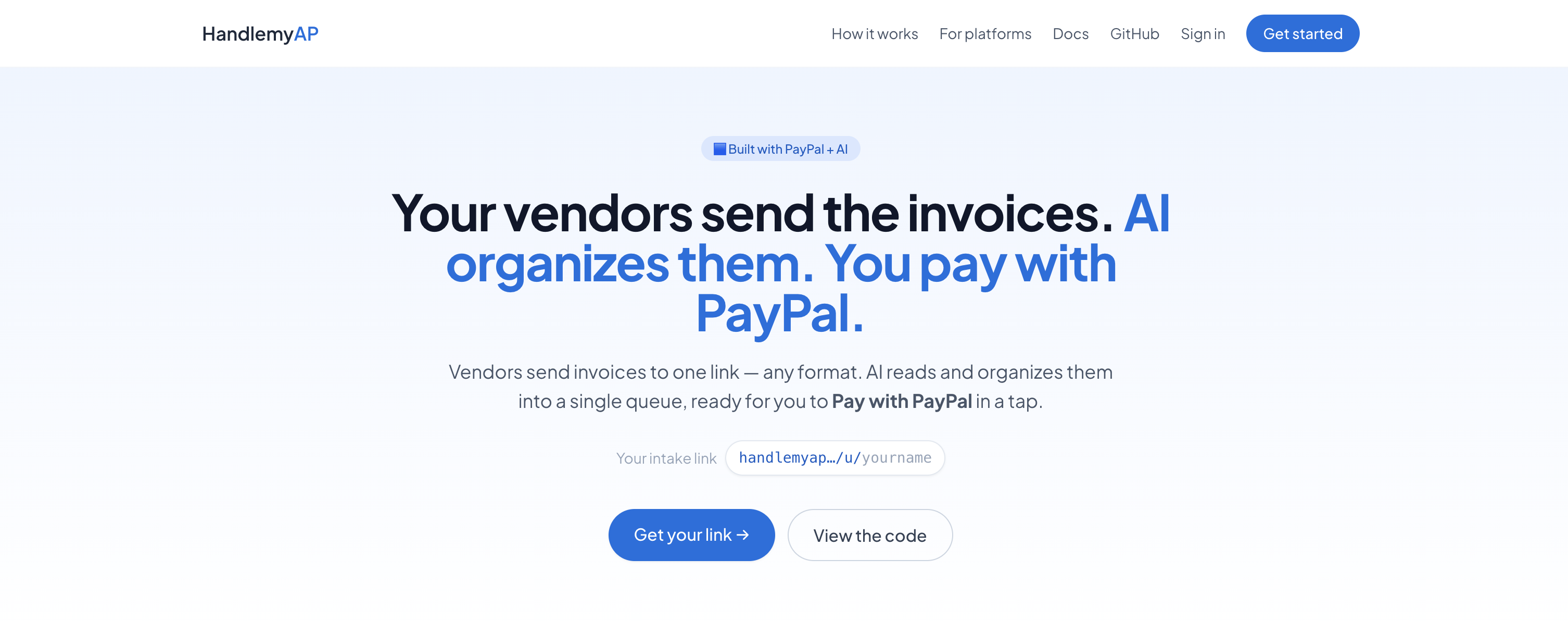
HandleMyAP is an accounts-payable app built around one simple loop:
- Vendors send invoices to a public link (e.g. handlemyap.com/u/demo) — no account needed on their side.
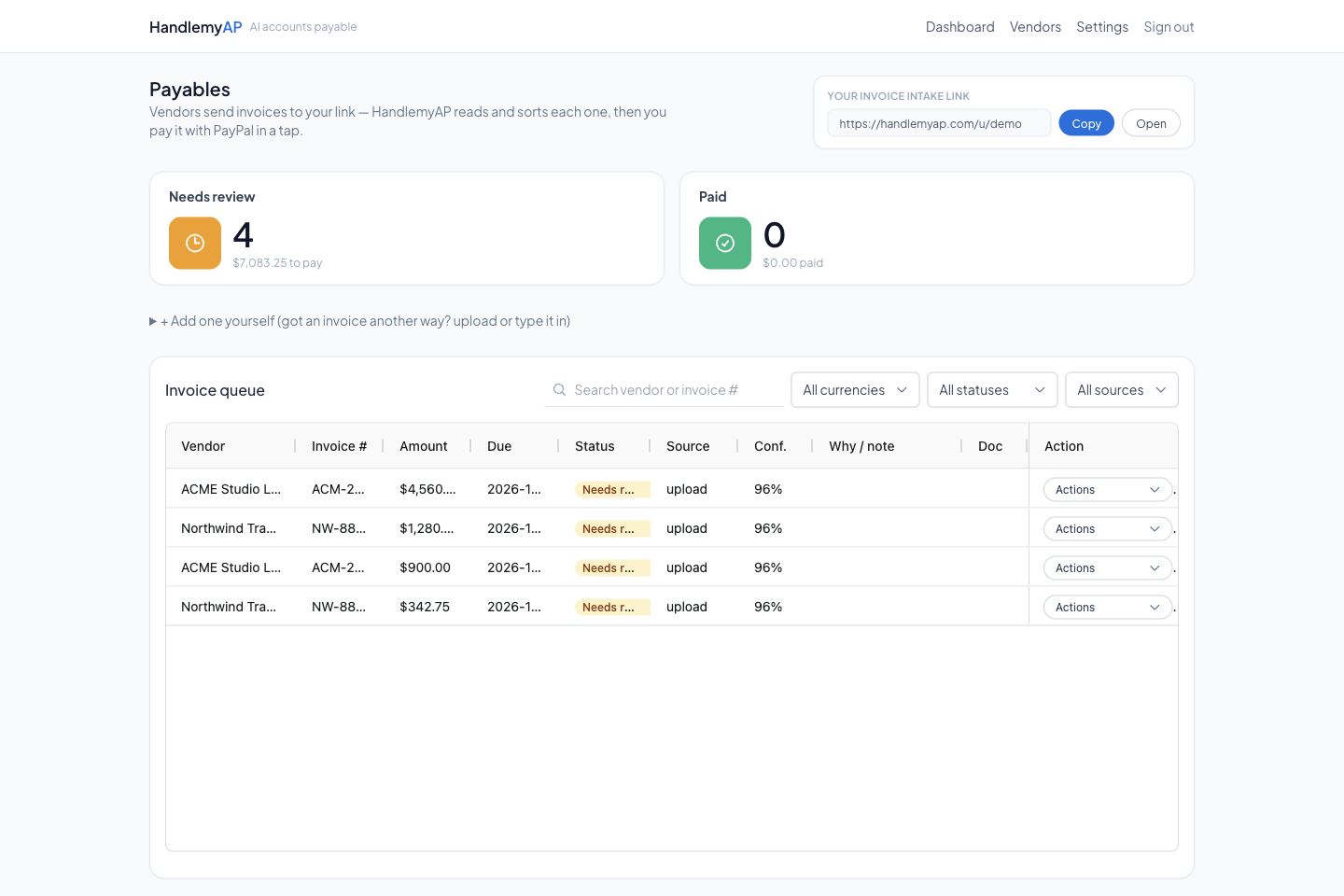
- Claude AI reads each invoice. It extracts and normalizes the vendor, amount, currency, due date, PO number and line items into structured data, with a confidence score, and drops it into a "needs review" queue.
- You review and pay in one click with PayPal. Hitting "Pay with PayPal" opens PayPal Checkout — you log into your own PayPal and pay the vendor directly (the vendor is the payee). Nothing moves without you.
Everything lands in a clean dashboard (AG Grid) with Pay / Hold / Reject actions per invoice.
How we built it
- Laravel 13 (PHP 8.4), Blade + Tailwind + AG Grid for the UI.
- Claude (Anthropic API) powers invoice extraction via a vision extractor that reads PDFs/images into structured JSON; a deterministic stub extractor is the offline fallback so the app runs with zero keys.
- PayPal Checkout / Orders v2 is the payment rail: an in-page smart-button popup (PayPal JS SDK →
/pay/paypal/order+/pay/paypal/capture), with a full-page redirect flow as a fallback. - MCP server exposes the same core as tools (
submit_invoice,list_invoices,get_invoice,list_payouts) so an agent can drive it. - Deployed on Render (Docker) with a managed PostgreSQL database and invoice files stored in AWS S3, behind a Cloudflare-registered domain with TLS — fully persistent across deploys.
Challenges we ran into
Making the money flow trustworthy: we deliberately removed every background/platform-funded payout path so the only way money moves is a human clicking "Pay with PayPal" and authenticating themselves. Getting invoice extraction reliable across messy formats — and degrading gracefully to an offline stub when no AI key is present — took real iteration. Standing up persistent hosting (Postgres + S3 + custom domain + TLS) so the demo survives restarts was the last mile.
Accomplishments that we're proud of
A genuinely working end-to-end demo on a real domain: a brand-new invoice submitted to the public link gets read by Claude and shows up payable in the dashboard, and PayPal Checkout is wired with real smart buttons. The AI and the payment rail are both load-bearing, not decoration.
What we learned
Keeping a human at the payment step isn't a limitation — for accounts payable it's the whole point. The valuable automation is in reading and organizing the invoice; the decision to pay should stay one deliberate click.
What's next for HandleMyAP
Multi-user vendor directories, duplicate-invoice detection, approval thresholds, and syncing paid invoices back to accounting tools.
Built With
- ag-grid
- amazon-web-services
- anthropic-claude
- claude
- cloudflare
- docker
- laravel
- mcp
- orders-api
- paypal
- paypal-checkout
- php
- postgresql
- render
- tailwindcss
