-
-
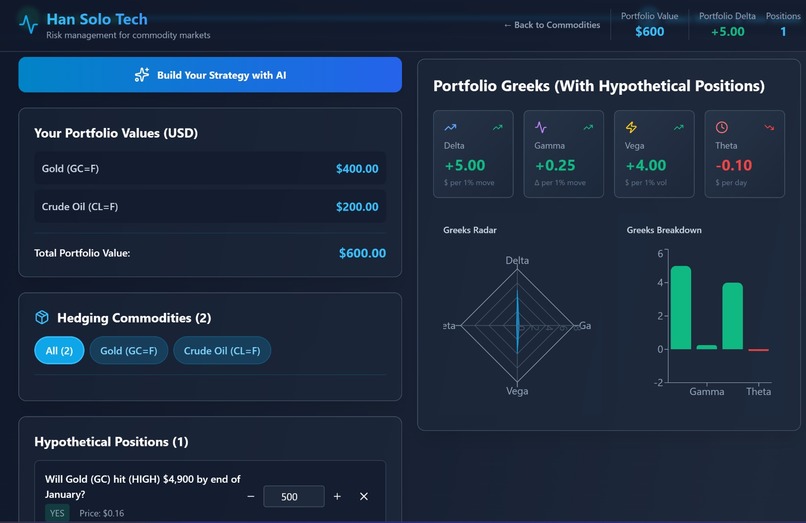
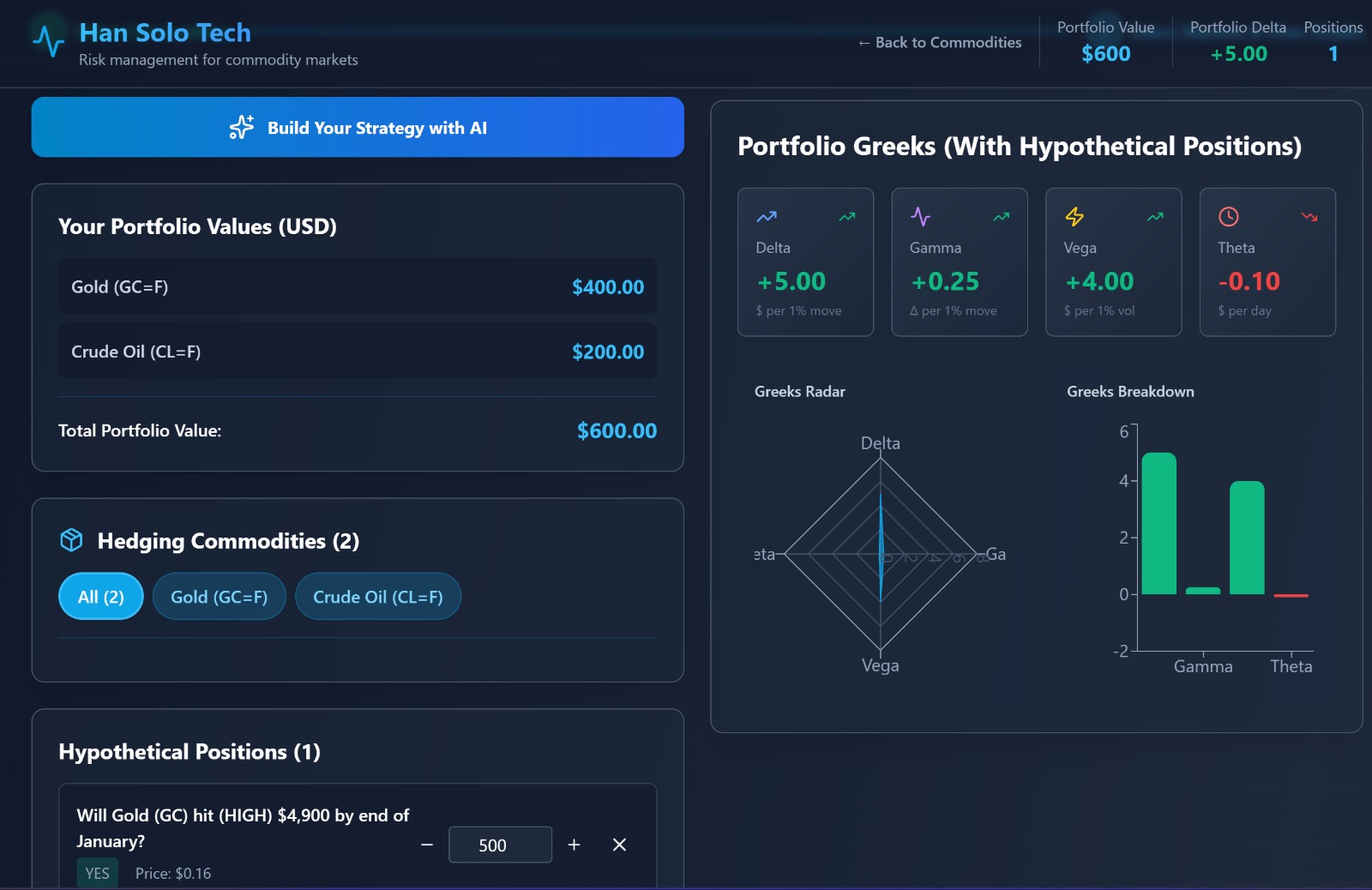
Portfolio Risk Calculator UI
-
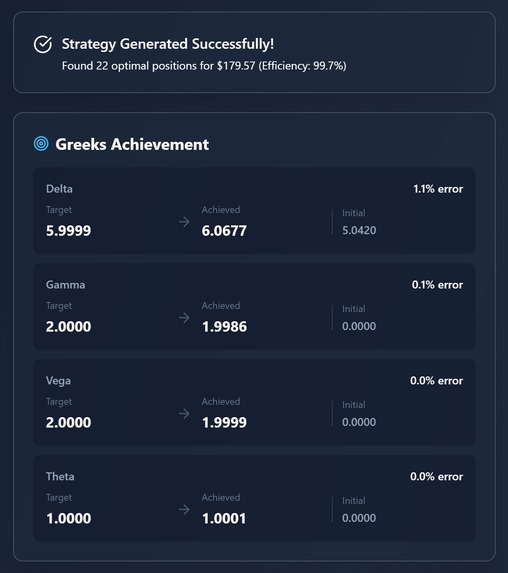
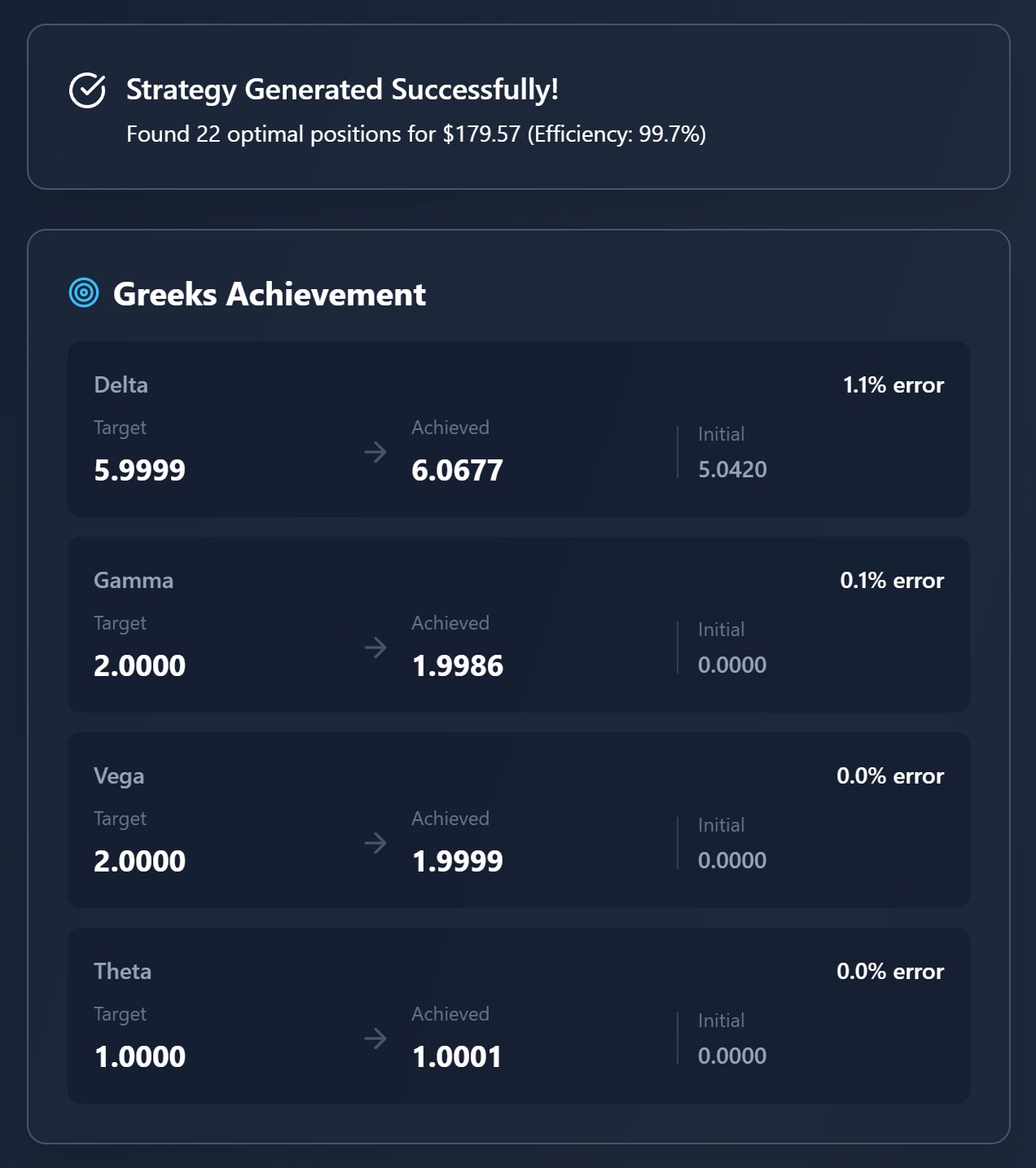
AI Greeks Strategy Example
Inspiration
Commodity markets are among the largest and most liquid markets in the world, with annual trading volumes exceeding $135 Trillion across futures and options on oil, metals, agriculture, and energy. These markets don’t run on intuition or narratives. They run on risk decomposition: delta, gamma, correlations, and hedging.
Polymarket has already proven something fundamental: prediction markets work. Liquidity exists, prices respond to information, and real money is at risk. But the tooling stopped halfway. Traders can see individual positions, but they have no visibility into portfolio risk. That might be fine for casual speculation. It is completely unacceptable for institutional capital.
We built Han Solo Tech because prediction markets will not attract serious money until they offer the same level of risk visibility that professional derivatives markets take for granted.
What it does
Han Solo Tech is the first portfolio Greeks calculator built for prediction markets. We treat Polymarket positions as what they really are: derivatives. Given a user’s positions, we compute Delta, Gamma, Theta, and Vega at the portfolio level, not per market and not per bet.
Each market is mapped to liquid commodity underlyings already active on Polymarket (oil, gold, and silver) using correlations, implied probabilities, and real-time pricing. This turns prediction trading from isolated bets into controlled, risk-managed exposure.
It then uses AI to propose the best possible risk-adjusted strategy for the user.
How we built it
We built directly on top of Polymarket’s Gamma APIs to ingest live positions and market data, and combine that with pricing for underlying assets. Correlation matrices allow us to model the cross-market exposure, while a real-time optimization engine computes the Greeks continuously.
The front end is built in React, intentionally designed to feel intuitive even for users without prior exposure to professional risk tools. We started with commodities by design: clear underlyings, deep liquidity, and macro drivers that most traders already understand. This gives us a clean, defensible foundation before expanding further.
Challenges we ran into
Prediction markets don’t expose risk directly. Everything is binary, while risk is fundamentally continuous. Bridging that gap meant translating discrete outcomes into continuous exposures, mapping qualitative events to quantitative underlyings, and modeling correlations across vastly different asset classes. The hardest part wasn’t the computation, it was giving the Greeks real economic and mathematical meaning in a binary market. Designing metrics that actually measure risk required developing a theory for modifying Greeks using Brownian motion to handle the extreme behavior near payout boundaries in a binary (1/0) market.
We had to adapt the industry-standard Black-Scholes model, to a binary digital market. Using a Brownian Bridge on top of the Black-Scholes model, we were able to succesfully price the risk involved in the different correlated markets.
Accomplishments that we're proud of
We built the first Greeks-based risk engine for prediction markets, which delivers real-time portfolio risk instead of isolated market stats. The system is something institutions would immediately recognize as legitimate, and could use in order to hedge their positions, be it within Polymarket or in other exchanges such as the financial market. It turns Polymarket from a "betting" interface into a risk-aware trading platform.
What we learned
Prediction markets don’t yet offer deep liquidity or comprehensive price discovery. But liquidity can be effectively managed and amplified by mapping positions to high-activity underlyings: commodities and crypto such as gold, silver, oil, USD where there's many markets and bets active at any given time.
By applying correlation matrices and hedging across these popular commodities, we can construct a fully risk-managed portfolio even when individual markets are thin. Once portfolio Greeks exist, visibility, control, and hedging follow naturally. From there, capital can scale safely, positions can be mathematically optimized, and prediction markets can transition from isolated speculation into structured, institution-ready trading.
What's next for Han Solo Tech
The next step is execution. Our idea is to end up integrating wallet connections using AI agents so that users can move directly from analysis to action, click to add positions, hedge their exposures, and rebalance portfolios in real time.
The idea is to provide a tool as innovative as IBKR's AI Options Wizard for financial markets, with automated hedging, risk alerts, strategy templates, and easy-to-follow dashboards. Han Solo Tech isn’t another prediction market, it is the professional risk layer that prediction markets have been missing.
Built With
- flask
- javascript
- polymarket-api
- postcss
- python
- react
- recharts
- rest-api
- tailwind
- typescript
- vite
- yahoo-finance


Log in or sign up for Devpost to join the conversation.