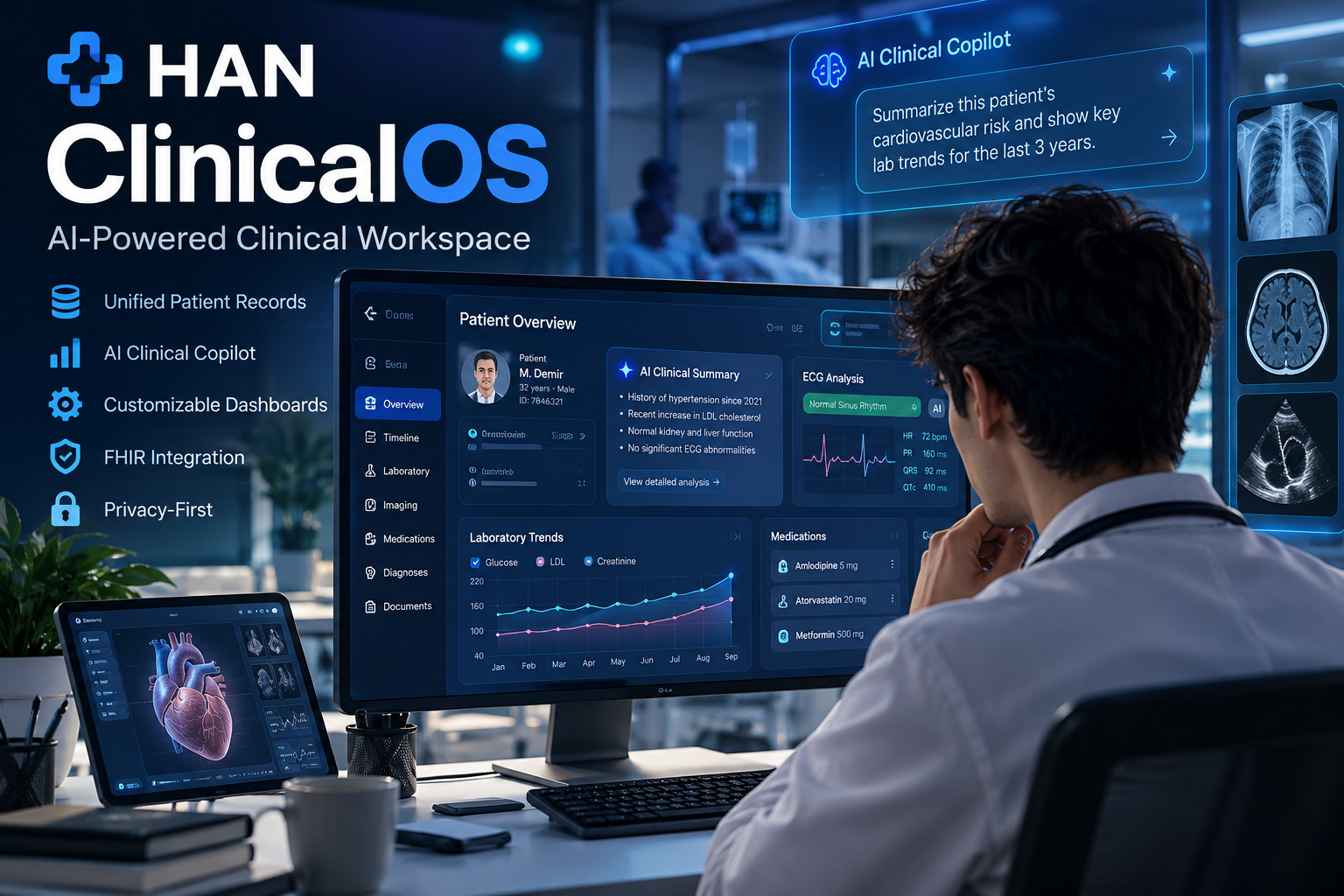
HAN ClinicalOS
One Workspace. Every Patient Insight. Powered by AI.
Inspiration
Healthcare professionals spend valuable time navigating fragmented electronic health records, laboratory systems, medication lists, and clinical applications.
A cardiologist, for example, may need to review ECG results, laboratory trends, medication history, previous diagnoses, and medical documents across multiple interfaces before making a clinical decision.
We believe doctors should spend less time navigating software and more time caring for patients.
This inspired HAN ClinicalOS: an AI-powered, customizable clinical workspace designed to bring relevant patient information, intelligent assistance, and medical workflows into one unified interface.
Our vision is simple:
One doctor. One workspace. All relevant patient information.
What It Does
HAN ClinicalOS is being developed as an intelligent workspace that connects clinical information, specialty-specific dashboards, and AI-assisted workflows.
Rather than replacing existing Electronic Health Record (EHR) systems, our goal is to create an intelligent layer that works alongside them.
1. Unified Clinical Workspace
Bring relevant patient information into a single interface:
- Medical history and diagnoses
- Laboratory results and historical trends
- Medication information
- ECG and cardiovascular records
- Clinical documents
- Patient timelines
The objective is to reduce unnecessary navigation between disconnected applications.
2. Fully Customizable Doctor Dashboards
Different medical specialties require different information.
HAN ClinicalOS is designed to allow clinicians to organize their own workspaces.
Examples include:
Cardiology
- ECG information
- Cardiovascular history
- Relevant laboratory trends
- Medication history
Urology
- Kidney function results
- PSA trends
- Urinalysis history
- Relevant clinical records
Doctors can prioritize information according to their specialty and workflow.
3. AI Clinical Copilot
A central part of HAN ClinicalOS is an AI assistant designed to help clinicians understand and navigate patient information.
Our target architecture uses NVIDIA Nemotron models through Nebius Token Factory.
Instead of simply answering generic medical questions, the assistant is designed to work with structured, authorized patient information.
Example:
"Summarize this patient's cardiovascular history and highlight significant laboratory changes over the last three years."
The system is designed to retrieve relevant information, organize historical results, generate visual summaries, and provide references to the underlying records.
Our approach emphasizes retrieval-grounded responses, transparent data sources, and human oversight.
4. AI-Assisted Patient Intake
HAN ClinicalOS also aims to simplify the information-gathering process before medical appointments.
Patients can provide symptoms, medical history, medications, and other relevant information through a structured digital intake experience.
The AI assistant can organize these responses into a concise summary for clinician review.
The objective is to reduce repetitive documentation and improve consultation preparation.
5. Interoperability and International Healthcare
HAN ClinicalOS is designed with international interoperability in mind.
We are exploring HL7 FHIR and SMART on FHIR standards to support future integration with existing healthcare infrastructure.
This approach is particularly relevant for healthcare organizations in the United States and Europe.
Our hackathon prototype focuses on synthetic patient information rather than accessing real hospital systems.
How We Are Building It
Our architecture separates the clinical interface, structured data services, and AI reasoning components.
The planned AI workflow follows five stages:
- Retrieve authorized patient information.
- Normalize relevant medical records.
- Identify the information required for the clinician's request.
- Use an NVIDIA Nemotron model through Nebius Token Factory to generate an evidence-grounded response.
- Present the result alongside its supporting records for clinician review.
The system is designed to minimize unnecessary exposure of sensitive information and keep clinicians responsible for medical decisions.
Challenges
Building AI for healthcare introduces challenges beyond ordinary software development.
Fragmented medical information
Healthcare data may come from different systems, formats, and medical specialties.
AI reliability
Clinical assistants must distinguish supported information from uncertain or missing data.
Workflow complexity
A useful interface must adapt to different medical specialties without overwhelming clinicians.
Privacy and security
Healthcare information requires careful access controls, data minimization, and secure processing.
Our approach is to develop and test these components incrementally using synthetic data.
What We Learned
An effective healthcare AI assistant needs more than a powerful language model.
It needs structured information, reliable retrieval, transparent evidence, carefully designed workflows, and a usable interface.
We also recognized that the goal of clinical AI should not be to replace medical professionals.
Instead, it should help them access relevant information faster and make better-informed decisions.
What's Next?
Our long-term roadmap includes:
- Broader EHR interoperability
- Additional specialty-specific dashboards
- AI-assisted clinical documentation
- ECG and medical signal analysis
- Longitudinal patient health timelines
- Advanced workflow automation
- Privacy-preserving deployment options
- Integration with patient-controlled health applications
We envision HAN ClinicalOS becoming a unified AI operating layer for modern healthcare.
Our Mission
Make healthcare information easier to access, understand, and use.
HAN ClinicalOS is designed to support healthcare professionals, not replace clinical judgment.
The hackathon prototype uses synthetic medical data and is intended for demonstration and research purposes, not autonomous diagnosis or treatment.
Built With
- docker
- fastapi
- hl7-fhir
- nebius-token-factory
- next.js
- nvidia-nemotron
- postgresql
- python
- rag
- react
- typescript


Log in or sign up for Devpost to join the conversation.