
Made during HopHacks 2022 - Ireland Parrish, Jam Navarro, and Shalom Cesar
Inspiration
We were inspired by Johns Hopkins University's Campus Accessibility Map that was made in collaboration with the Institute for Human Centered Design (IHCD). The Student Disability Services office released this accessibility map in August 2022, after being requested to do so by disabled students on campus for multiple years and we wanted to translate this into a mobile, more easily accessible platform.
What it Does
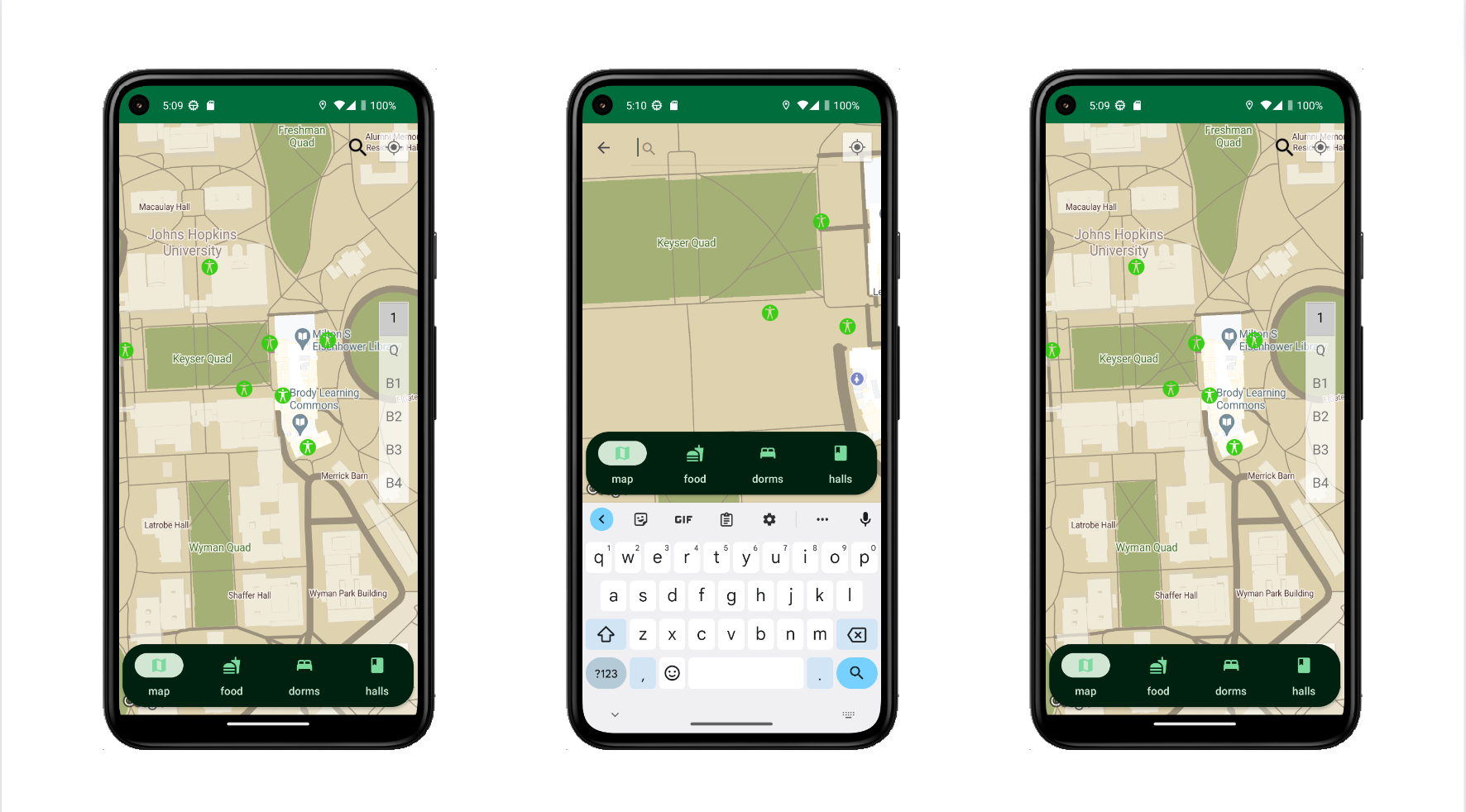
When users allow access to their current location, given their starting location and destination (that can be chosen from the options in the toolbar below or in the search bar above), they’ll be presented with an accessible path to take on campus; that is, a path that has wheelchair access and is ADA compliant. The map also contains markers that show where accessible entrances and elevators are in buildings.
How We Built It
The initial design was organized in Figma. We built the entire application in Android Studio using Java, HTML, CSS, and Javascript, along with various .xml and JSON files. The logo was created with Canva, Procreate, and Vectornator using bitmap and vectorized files. For version control, we maintained a shared repository in Github.
Challenges We Ran Into
We found the restrictions of the Google Maps API made our application more limited than we anticipated, since custom navigation wasn't allowed without permission and we needed to find a workaround to implement this.
Accomplishments That We're Proud Of
We're really proud of how we were able to learn many different programs and interfaces in this short timeframe! We learned how to use Figma, vectorize files, use APIs, work with Android Studio, and utilize JSON files for the first time.
What We Learned
As a group, we learned a lot about using Google Maps APIs and using them into Android Studio. For frontend, we gained some experience experimenting with the Figma interface and workflow. This also included the transition from UI design into implementation in the Android Studio layer editor.
What's Next for HAM
Better determined routes, expansion to other JHU dormitories and amenities.
Other expansions towards accessibility such as speech-to-text with the search bar to assist low vision users.