HaloCare — Make the home notice. Not watch.
🏠 Private home awareness from ordinary Wi-Fi—without cameras, microphones, or wearables.
🔗 Explore HaloCare
🖥️ Launch the Live Caregiver Dashboard
- 🔒 Hackathon demo note: This page shows live data from the HaloCare system running in our founder's home. We temporarily made the local
halocare.localdashboard publicly reachable through a secure tunnel and public domain so judges can review it remotely. The dashboard itself still runs locally; production installations do not require a public or cloud-hosted dashboard.
- 🔒 Hackathon demo note: This page shows live data from the HaloCare system running in our founder's home. We temporarily made the local
💡 Inspiration
What happens when someone living alone needs help, but no one is there?
Cameras can feel invasive. Wearables are easy to forget, remove, or leave uncharged. Emergency buttons still require the person to act. HaloCare asks a different question: can the home notice an unusual change without watching the person?
HaloCare applies the XPRIZE challenge to a socially meaningful, AI-operated small business.
🏠 What HaloCare does
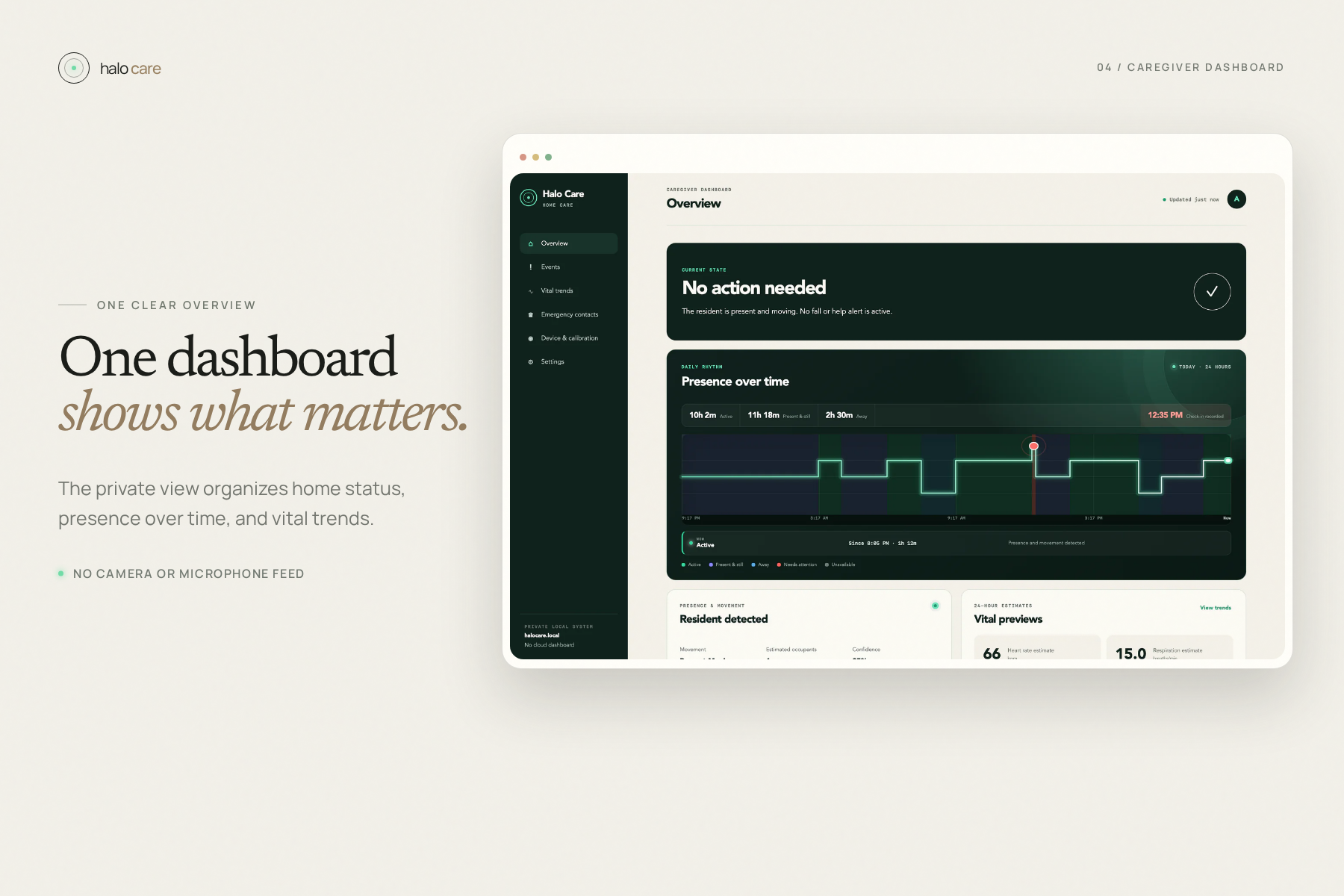
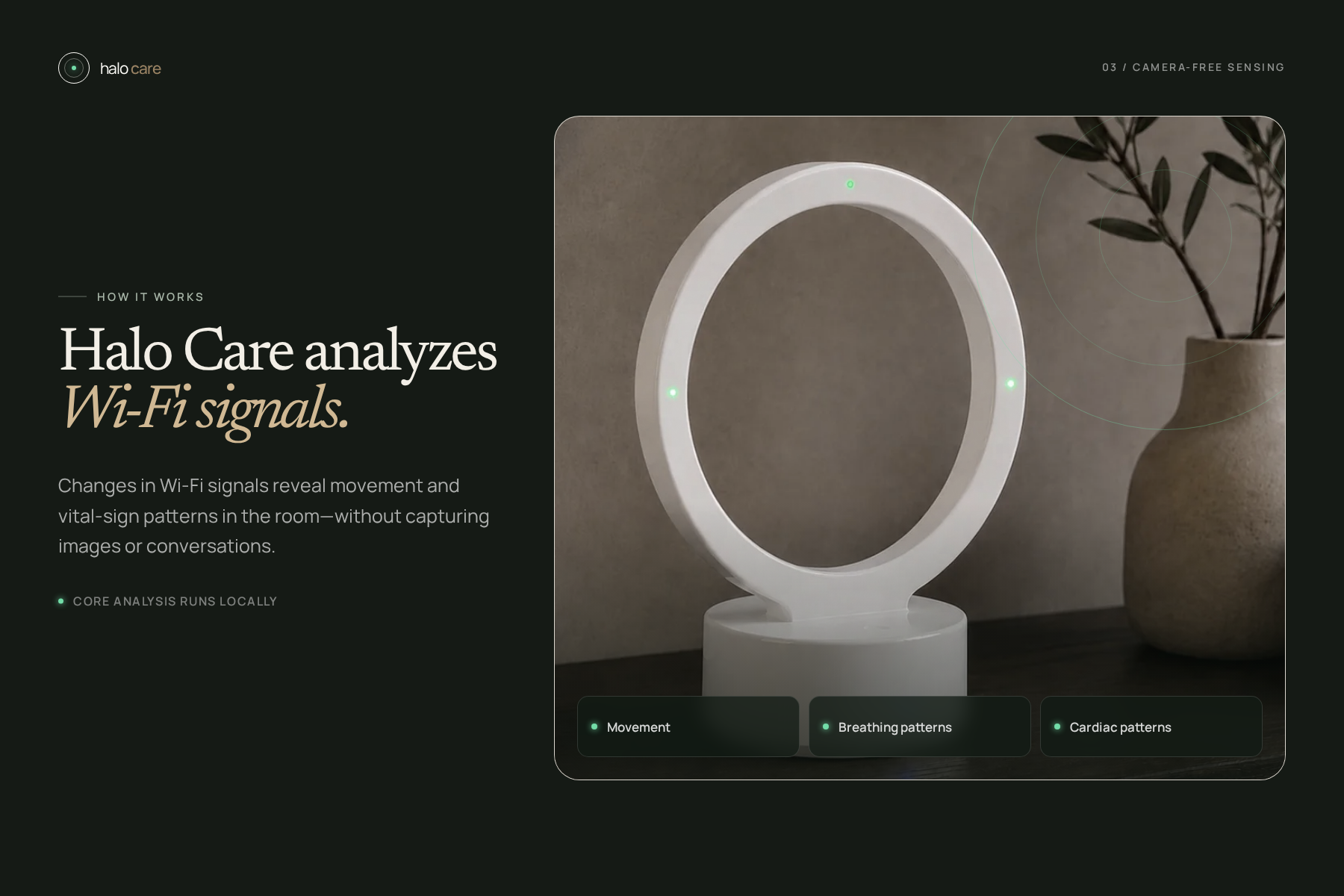
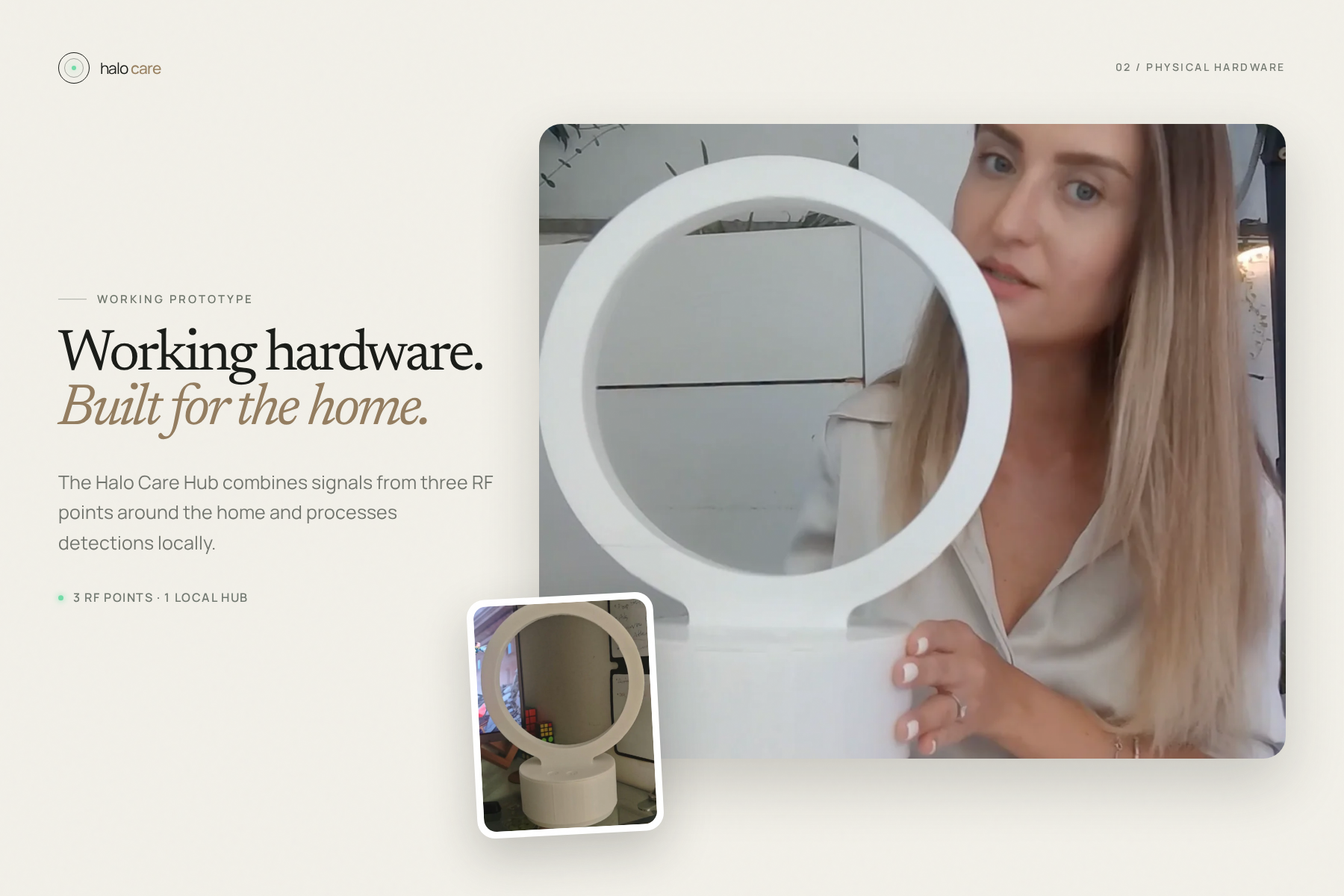
Three inexpensive ESP32 RF Points observe changes in ordinary Wi-Fi radio paths. A Raspberry Pi inside the home performs the sensing and maintains an empty-room calibration. The caregiver dashboard reports only evidence-backed states such as:
- ✅ trustworthy room awareness;
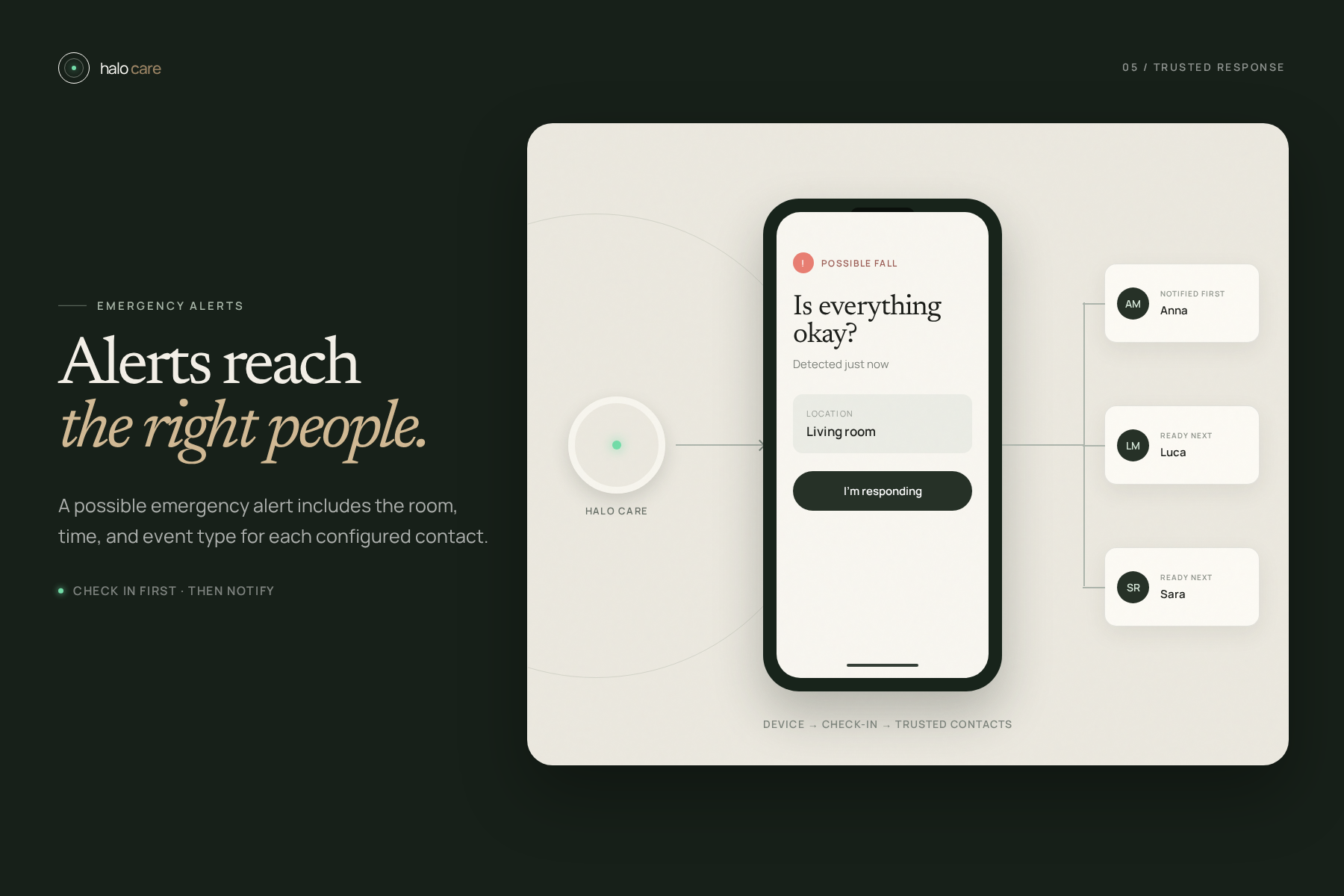
- ⚠️ caregiver review requested;
- 🛠️ sensing system needs attention; or
- ❓ insufficient data.
HaloCare does not silently turn missing evidence into “safe.” A current observation is usable only when the local service is healthy, the source is live ESP32 hardware, enough fresh RF Points agree, signal quality is acceptable, the timestamp is current, and calibration is compatible:

📡 How the RF Points reach quorum
Each ESP32 keeps its own local classification instead of copying the room result. The Raspberry Pi then combines only the RF Points that are currently fresh. Every eligible point votes for a room state, with newer observations carrying more weight as older ones decay toward the stale limit. The result is deterministic and independent of which packet arrived last. A silent or stale RF Point contributes nothing; if too few required points are fresh, their confidence is insufficient, or agreement does not remain stable, HaloCare reports degraded or unknown rather than reusing an old state.
Before the readings are fused, HaloCare also links CSI frames that describe approximately the same instant. Sync packets associate each ESP32's node ID and frame sequence with a mesh-aligned capture time. The Hub chooses the nearest queued frame from every active RF Point around a common time anchor and rejects the set when its timestamp spread exceeds the configured guard. Because ESP32 radio modes can produce different CSI widths, the selected readings are resampled onto the same 56-tone grid while preserving their amplitude scale. The aligned links can then be fused as several views of the same room instead of mixing unrelated “latest” packets. This improves temporal consistency and RF coverage; it is not, by itself, a claim of clinical accuracy.
$$ T = H \times S \times Q \times F \times C $$
Each gate is binary: 1 = pass and 0 = fail. Therefore, the observation is trustworthy (T = 1) only when service health (H), live sensing source (S), quorum and signal quality (Q), freshness (F), and compatible calibration (C) all pass.
When evidence is incomplete, the displayed state remains degraded or unknown.

🩺 Clinical detection and medical-accuracy position
HaloCare is designed to detect fall-like movement followed by prolonged inactivity, changes in breathing patterns, and changes in heart-related body motion. These product claims and the caregiver escalation logic have been reviewed by our team, including a physician. The system is assistive: it requests a human check-in and does not diagnose a fall, respiratory condition, or cardiac condition.
Our accuracy claim is deliberately precise: HaloCare reports an observation only when the evidence gate above passes; otherwise it reports degraded or unknown. We do not claim a clinical sensitivity or specificity percentage yet. Those metrics require labeled independent studies, which are part of our validation plan. Preliminary test showcase around 97.4% accuracy on CSI bonding and around 120sqm coverage with single device enclosure.
✨ How Gemini operates the business
HaloCare’s hackathon build adds a bounded Gemini operations agent for small care providers. Local deterministic logic remains responsible for sensing, event creation, and notifications. The cloud agent receives a deliberately small operational snapshot—system state, trust issues, aggregate RF Point availability, and minimal event type/status—and converts it into one of three work items:
- 👤
request_caregiver_review - 🔧
open_maintenance_work_order - ✅
no_operational_action
Gemini drafts the handoff, separates known facts from unknowns, and prioritizes the work. A deterministic guard prevents the model from suppressing a real event or describing degraded sensing as safe. Raw CSI, pose data, vital estimates, names, contact details, caregiver notes, room identity, and location are excluded.
Human caregivers make every resident-related decision; technicians accept maintenance work. Gemini does not diagnose, recommend treatment, declare safety, or contact emergency services.
☁️ Google technology
- Cloud Run hosts the stateless operations-agent service.
- Vertex AI provides the Gemini
generateContentcall. - Cloud Logging records pseudonymous operational telemetry and policy overrides.
If Google Cloud is unavailable, local sensing and deterministic caregiver notifications continue. The cloud agent fails closed.
🧑💼 Why Small Business Services
HaloCare powers independent home-care agencies with an affordable, AI-operated platform that turns privacy-preserving home sensing into prioritized caregiver and maintenance work—helping smaller providers deliver continuous support without cameras, monitoring centers, or large technical teams.
Because it is built from simple, widely available hardware, installation can remain inexpensive: customers can buy the product off the shelf and install it themselves, while providers that need help can use a local installer instead of a specialized deployment team.
📊 Market and price advantage
The EU had 99 million people aged 65+—22% of its population—on 1 January 2025. Our serviceable market is approximately 3.5 million EU long-term-care beds (team calculation from the Eurostat dataset for 26 countries; Portugal unavailable). A 1% beachhead is roughly 35,000 beds.

Team-verified competitor price snapshot used for this submission (August 2026; estimates because enterprise pricing can be quote-based):
| Solution | Camera-free | Indicative price |
|---|---|---|
| HaloCare | ✅ | $99 + $20/month |
| Foresite | ✅ | ~$2,000 |
| Nobi | ❌ | ~$2,800 |
| Vayyar | ✅ | ~$1,000 + $20/month |
That makes HaloCare’s intended upfront price about 10–28× lower than the compared systems. Final customer pricing and competitor quotes may vary by market, installation, taxes, and contract.
The model enables work for local installers, support technicians, independent care coordinators, and home-care professionals who perform human check-ins.
The business combines installation with a recurring monitoring and operations subscription; actual revenue and customers belong in the attached evidence.
🛠️ How we built it
HaloCare builds on open-source RuView. Three ESP32-S3 RF Points collect CSI from different radio paths while a local Raspberry Pi handles persistent calibration, freshness checks, deterministic quorum, encrypted caregiver data, event history, notifications, and the private dashboard. We changed the firmware-to-Pi path so frames are matched by synchronized capture time rather than Wi-Fi arrival order. In a fresh two-node test, 1,920 of 1,920 timestamped pairing attempts were admitted within the configured timing guard. This demonstrates reliable temporal pairing, not fall-detection or medical accuracy.
We trained and quantized HaloCare's local fall-and-distress model for the ESP32-S3 N16R8, following RuView's compact-model approach; its recommended 4-bit CSI model is only 8 KB. We also modeled and 3D-printed the RF Point and Hub enclosures and added configurable power management, including duty cycling, Wi-Fi modem saving, frequency scaling, and light sleep. Gemini, Vertex AI, and Cloud Run receive only sanitized operational facts and create bounded caregiver-review or maintenance work items. Humans design the hardware, set safety policy, validate evidence, approve claims, and make every care decision.
🧠 Challenges and lessons
The hardest problem was turning asynchronous CSI telemetry into trustworthy room evidence without sacrificing privacy or affordability. HaloCare matches frames by synchronized capture time, rejects stale or misaligned readings, normalizes accepted data, and applies calibration and quorum before multi-link or tomographic interpretation. Raw CSI, tomography, health estimates, identities, notes, and location stay on the local Hub; Gemini receives only a sanitized operational summary when a caregiver or maintenance decision is needed. Local edge inference keeps continuous processing private and inexpensive, while Google AI is used selectively. This preserves the difference between measured, AI-generated, and unknown: Gemini can explain and prioritize evidence, but it cannot turn missing or unreliable data into a medical fact.
🚀 What’s next
Next, we will run labeled real-room studies, publish sensitivity, specificity, and false-alert results, improve installer diagnostics, and validate the workflow with care providers. Breathing and cardiac-pattern detection will remain assistive research functionality—not a diagnosis—until independently clinically validated.
Our goal is simple: help care providers extend human attention in a cost efficient way without extending surveillance.
👥 The team
HaloCare is built by a four-person team spanning AI, RF hardware, growth, and clinical review.
Ignas Gaucys leads AI and signal intelligence, developing models that turn RF patterns into actionable events.
Lorenzo Castagnone leads Wi-Fi sensing, embedded hardware, and deployment.
Kate Zusmann leads marketing, AI-native growth, positioning, and go-to-market.
Dr. Daniele Marano guides clinical framing, medical research, and validation.
Across their previous work, team members have won more than 30 hackathons, helped projects raise over $4 million through launchpads, and managed more than $80 million in total value locked. That mix lets us work across the full problem—from an edge model running on constrained hardware to a caregiver workflow that can be explained, deployed, and clinically challenged.
Built With
- esp32
- gemini
- raspberry-pi
- rust
- ruview
- typescript


Log in or sign up for Devpost to join the conversation.