Inspiration
Our team identifies as introverts, and we often struggle with networking events and approaching people we don’t know. In a world increasingly shaped by AI and digital communication, face-to-face interaction has become harder, even though people still want to connect. We wanted to explore how technology could support social interaction rather than replace it. At the same time, we believe AI-powered sensing should be ethical and empowering, helping people understand social environments while leaving control over personal representation in their own hands.
—
What it does
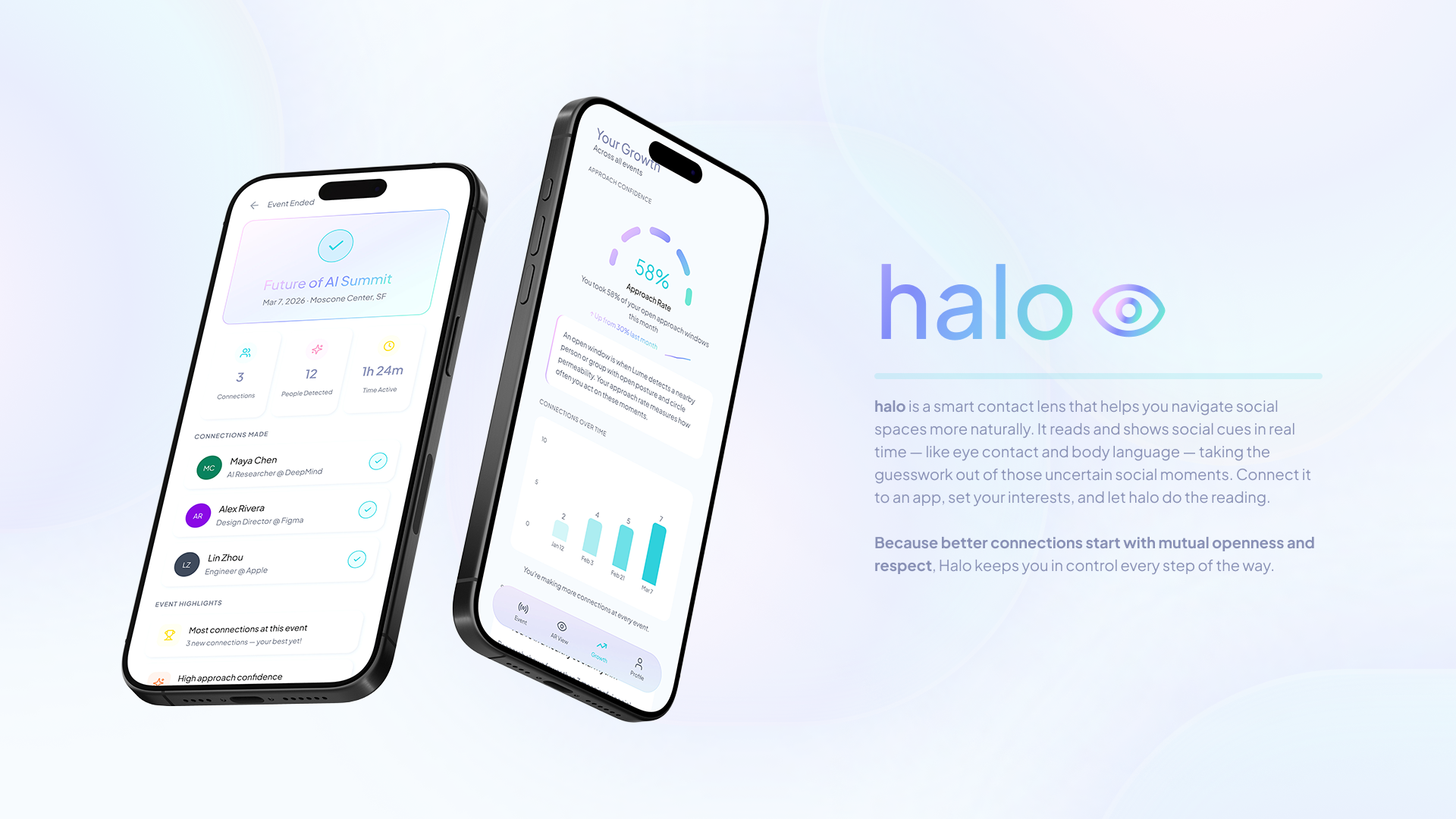
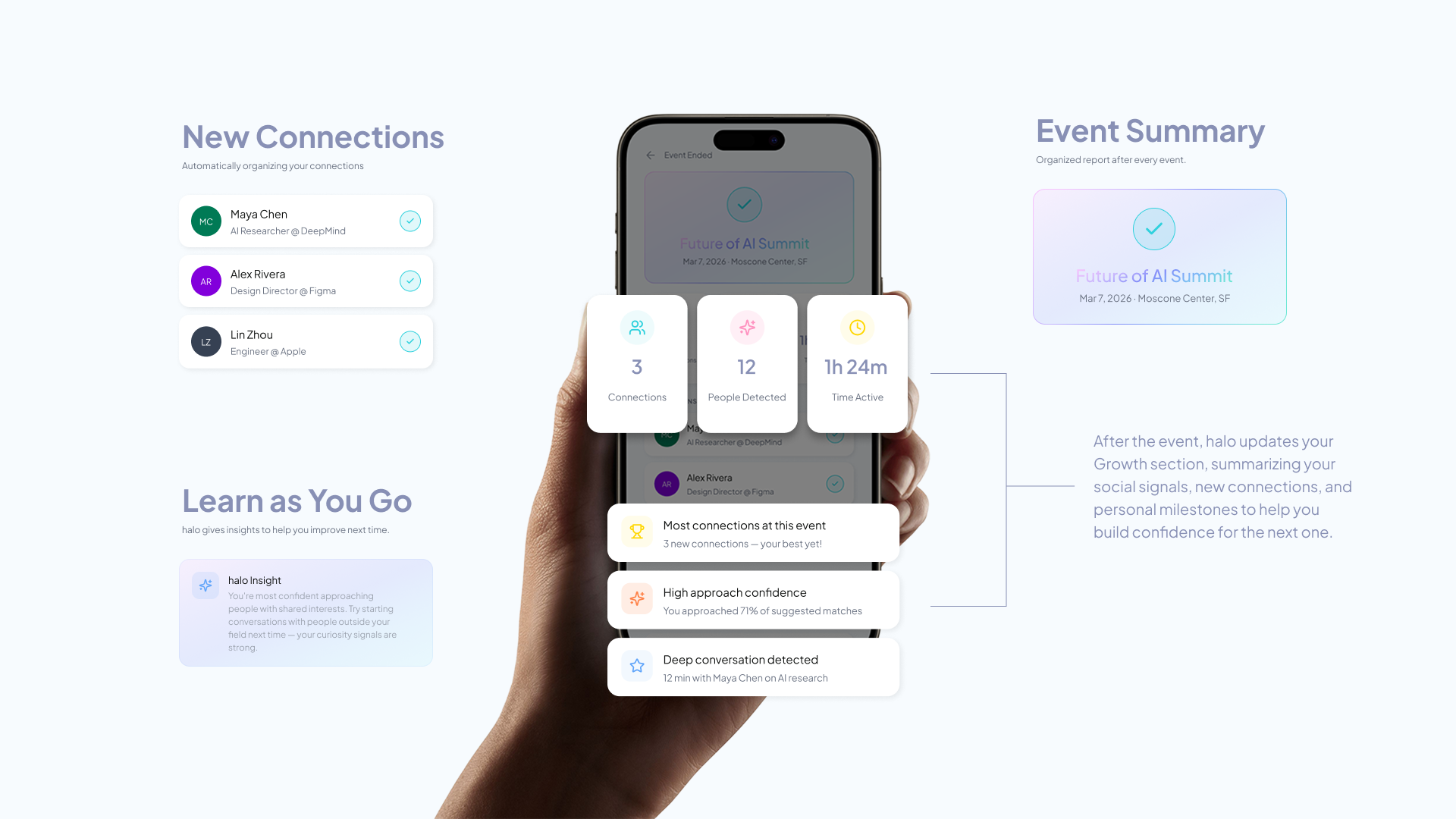
halo (yes, it’s lowercased) is a smart contact lens system that helps people navigate social environments. The lens analyzes multiple signals at once — including eye contact, mouth movement, body language, posture, and openness — to interpret the social dynamics of a space. Rather than detecting a simple binary state like “talking” or “not talking,” halo measures and visualizes social proprioception — the subtle signals that indicate when someone may be open to conversation. Paired with a mobile app, users can set their interests, connect to events, and receive real-time visual cues through the lens. After the event, halo provides a summary of interactions and connections, helping users reflect and improve their networking experience.
—
How we built it
We used a combination of AI tools and design software to rapidly prototype halo.
🤖 Anthropic Claude & OpenAI ChatGPT — ideation, user flows, prompt engineering
🎨 Figma + Figma Make — UI design & interactive prototype
🎬 Adobe After Effects, Premiere Pro, Midjourney & FLORA — motion design & video
—
Challenges we ran into
Changing Design Direction Mid-Process
Once a visual direction was established, modifying global styles such as color palettes or typography often disrupted existing components.
Style Carryover in Figma Make
Even in new files, previous style patterns sometimes persisted, requiring manual cleanup to maintain a consistent design system.
Inconsistent Micro-animations
Some icons behaved differently across screens, with reversed motion directions or inconsistent easing styles, creating visual inconsistencies.
Overall, because this was a rapid three-day build, we were designing and iterating simultaneously — constantly refining the system as the product evolved.
—
Accomplishments that we're proud of
In just three days, we created a fully interactive concept that resonates with many people, including ourselves. This was our first time vibe-coding an interactive application, and it pushed us to think differently about rapid prototyping and design workflows. We were especially excited about developing the idea of social proprioception. While proprioception normally refers to awareness of the body in space, we expanded it to describe the intuitive sense people feel in social environments — the subtle awareness of who might be approachable and when it feels natural to connect.
—
What we learned
While working with Figma Make, we discovered that prompt structure significantly affects output quality. By asking Claude to optimize prompts specifically for Figma Make, the generated components became much more accurate and aligned with our design intentions. This helped us better integrate AI tools into our workflow and demonstrated how prompt refinement can dramatically improve rapid prototyping.
—
What's next for halo - Your Social Sixth Sense
Elements of this concept already exist in early forms, such as spatial awareness and movement tracking in AR devices like Meta’s smart glasses. Because of this, we’re interested in exploring how Halo could evolve into a real product and potentially sharing the concept with teams working in AR and wearable technology.
Looking ahead, we want to explore how halo could function responsibly in real-world environments where privacy, consent, and misuse must be carefully considered.
We also plan to expand the system’s social indicators. Future versions could include additional roles such as event hosts, staff members, or other attendee types, helping users better understand and navigate social environments.
Built With
- aftereffects
- artlist
- chatgpt
- claude
- figma
- figmamake
- midjourney
- premierepro


Log in or sign up for Devpost to join the conversation.