Before you read
Please watch the demo video and look through the screenshots above first. Every screenshot is from the working app.
Inspiration
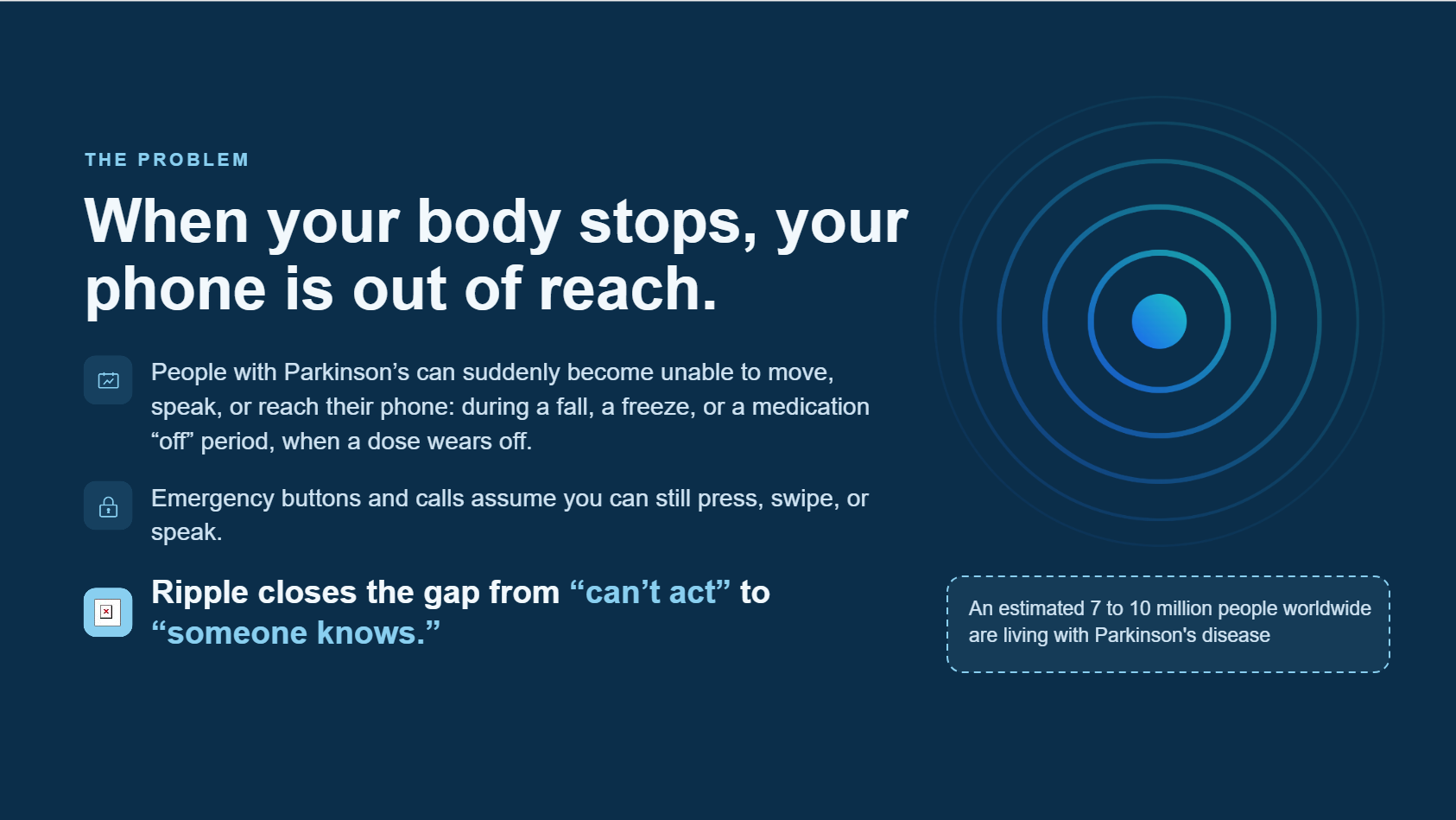
Parkinson's can take away a person's ability to move, speak or reach their phone, often without warning. A fall or an "off" period after a dose wears off can leave someone stuck and alone. Over 8.5 million people live with Parkinson's worldwide, and around 60% of them fall every year.
Most safety tools only work if you can press a button or make a call. People with Parkinson's often can't. So Ripple asks them, and if they can't answer, help is on the way.
This project is personal to us. Our teammate Gloria volunteered in the ICU at Markham Stouffville Hospital for 2 years, where she met a patient living with Parkinson's. Seeing how much the disease takes away made her want to build something that could help.
What it does
Ripple is a safety check-in system for the Apple Watch and iPhone.
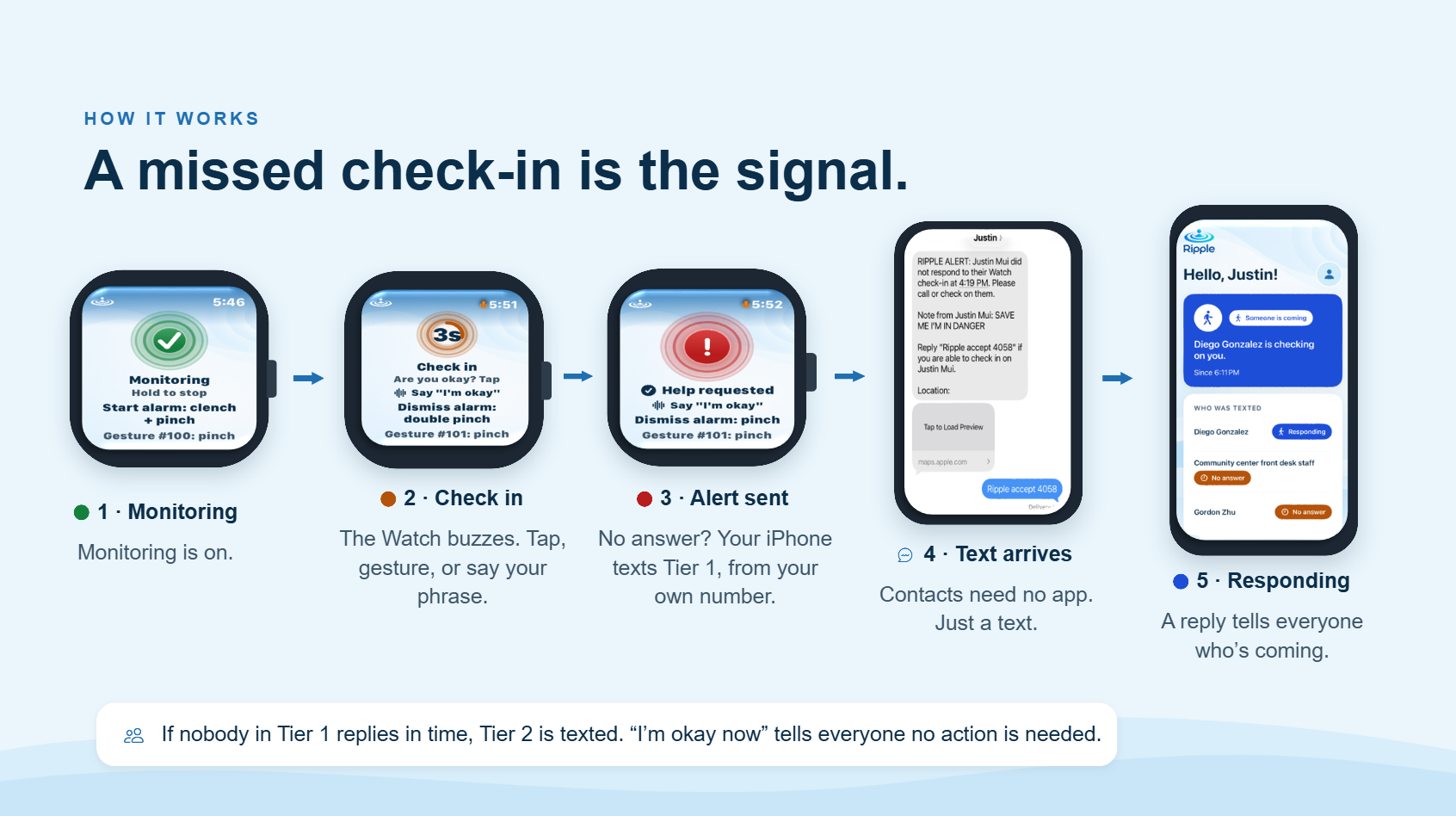
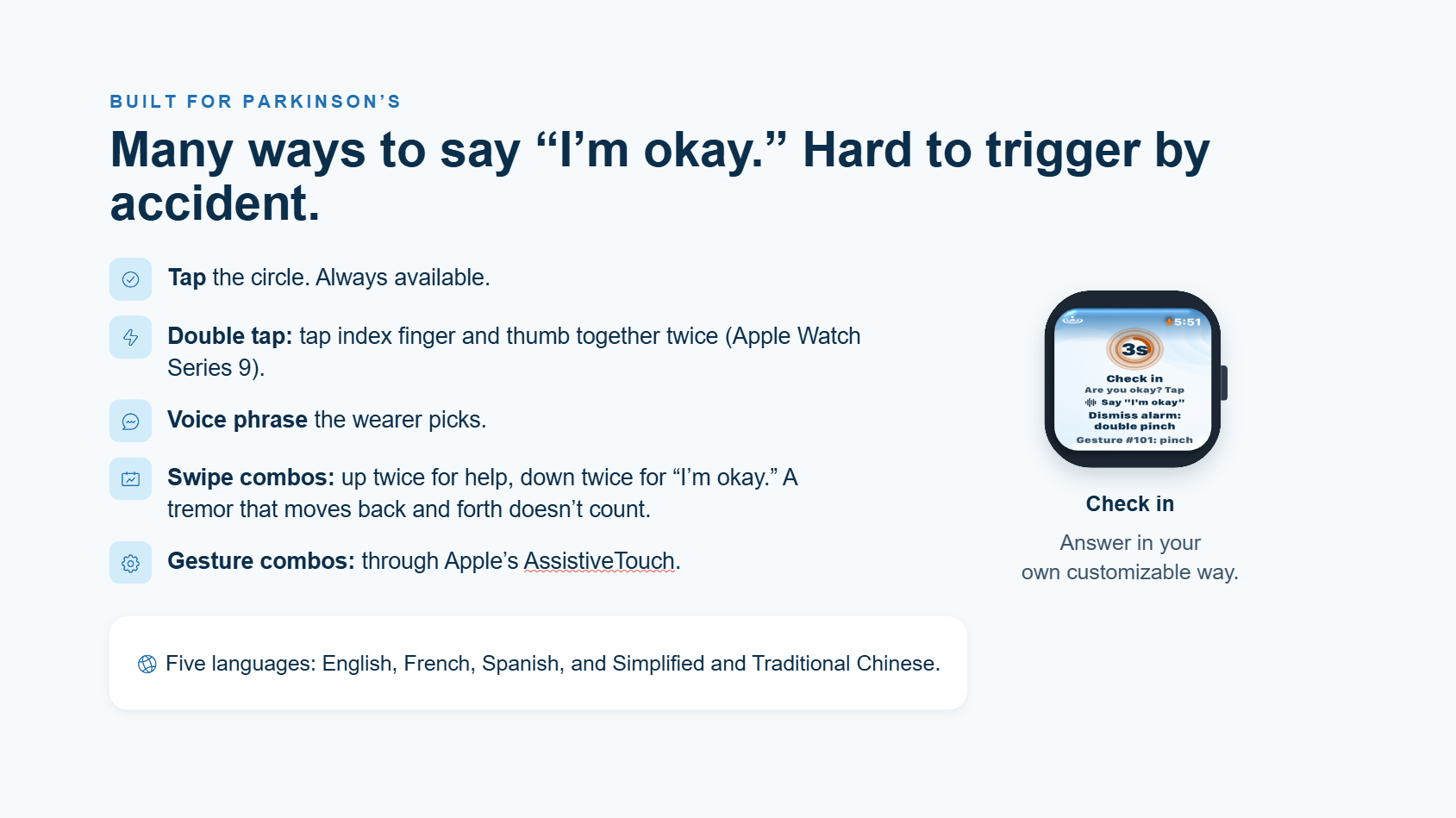
- Check-ins: The Watch buzzes and shows a large I'm okay circle with a countdown. The wearer answers with a tap, a gesture or their voice. Check-ins run on a timer, around medication times, or after a fall alert.
- Texts when there's no answer: The wearer's iPhone texts their contacts from the wearer's own number, with their location if allowed. Contacts don't need an app.
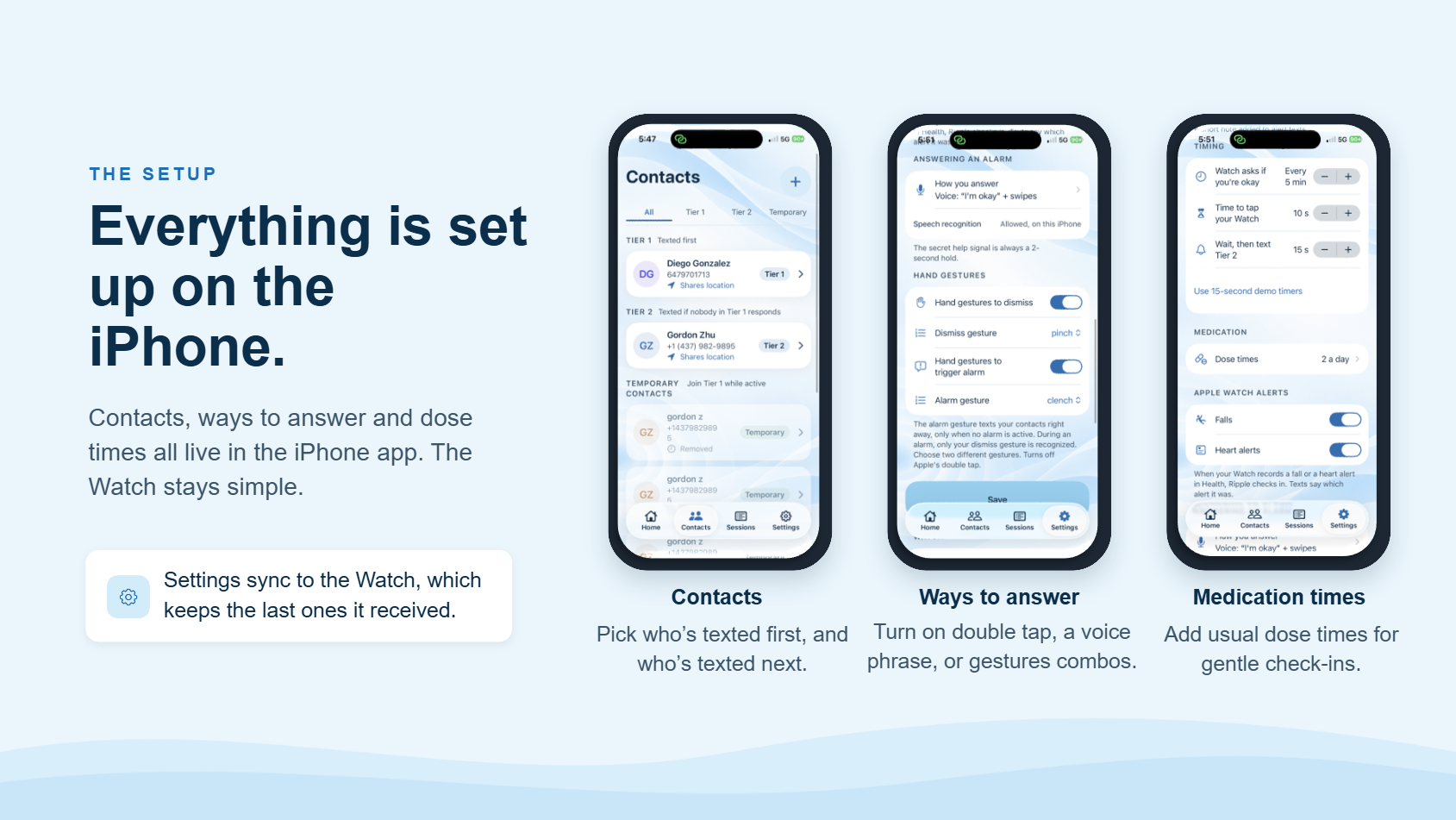
- Escalation: A contact replies "Ripple accept" to respond. If nobody in Tier 1 replies, Tier 2 gets texted. One tap sends an "okay now" text when the wearer recovers.
- Duress: Holding the circle for 2 seconds looks like a normal dismissal, but the alert still goes out.
- Backup: If the phone goes quiet for 30 seconds, our server sends the alert instead.
Designed for Parkinson's
In the US, Europe and Japan, more than 90% of people diagnosed with Parkinson's are 60 or older. Ripple might look plain at first, but every choice is on purpose.
- Easy to read: Dark text on light backgrounds, 4.5:1 contrast, and support for the largest text sizes and VoiceOver.
- Big targets: Main buttons are at least 60pt, and every status has an icon and a word.
- Tremor-friendly input: Shaky taps still count, and swipes ignore back and forth shaking.
- Touch first: Everything that works by voice also works by touch, for people whose voice has become soft.
How we built it
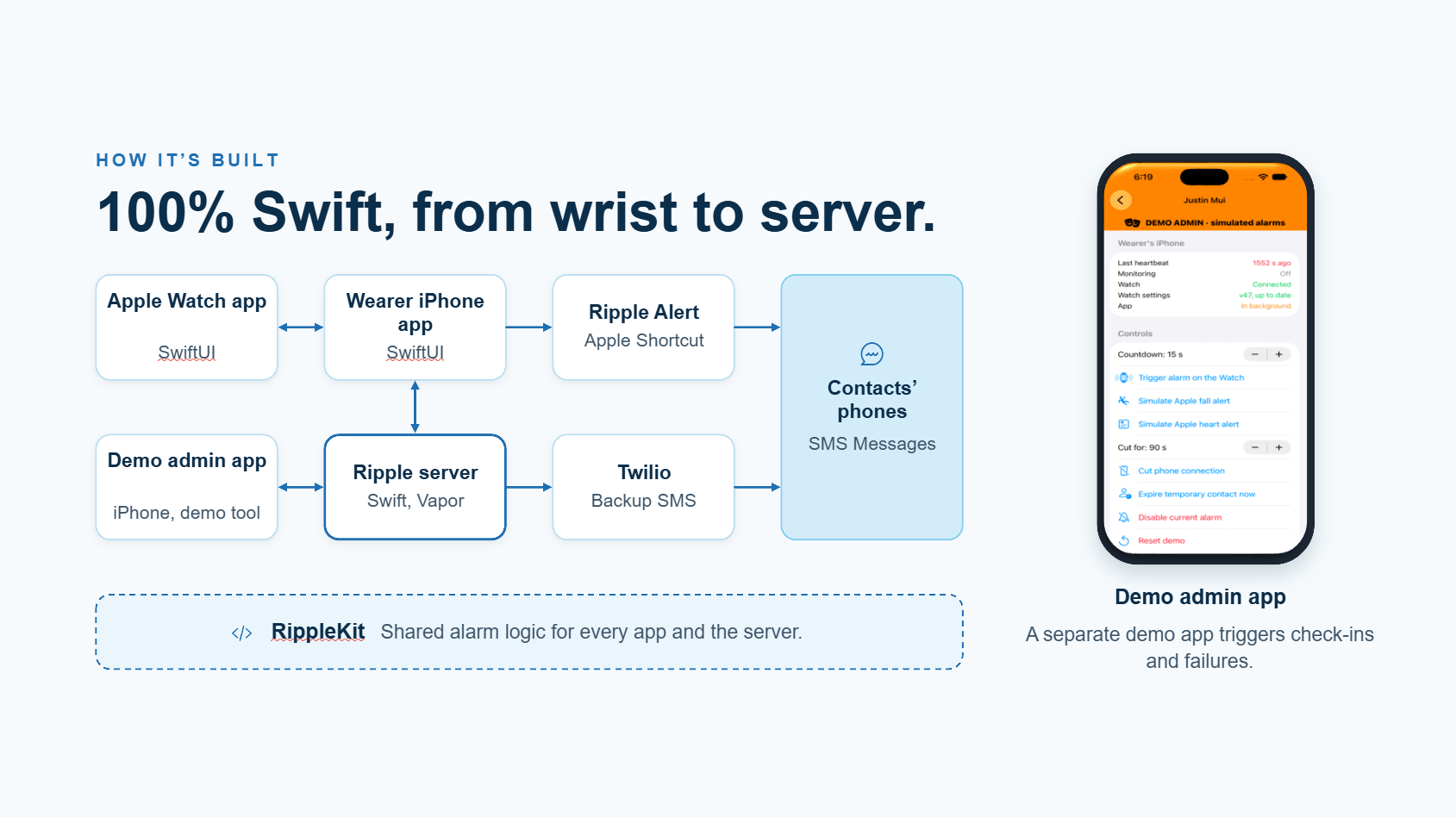
Everything is native Swift: SwiftUI apps for the Watch and iPhone, HealthKit for fall alerts, and a Vapor server that sends backup texts through Twilio. Shared alarm logic lives in one tested package, RippleKit, so the Watch, phone and server always agree. Texts go out through iOS Shortcuts, so they come from the wearer's real number.
Challenges we ran into
- Texting from the wearer's own phone. iOS won't let apps send texts silently, so we use Shortcuts. We haven't confirmed it works while the phone is locked.
- Keeping the phone and server in sync, so contacts never get duplicate texts.
Accomplishments that we're proud of
- It actually works on Apple Watch and is a downloadable app on iPhones.
- Contacts can help with just a text and a reply, so there's no need to install, very convenient.
What we learned
Sending an alert was the easy part. The hard part was everything around it: who gets told first, what happens when someone responds, and what happens when technology fails. We also learned that trust matters as much as safety, so we kept location off by default and put every setting in the wearer's hands.
What's next for Ripple
- Sending texts while the phone is locked
- Working fully offline
- Using Apple Watch tremor data to give contacts more context
- Testing with people living with Parkinson's
Sources
- World Health Organization, Parkinson disease fact sheet. who.int
- Parkinson's Foundation, Fall Prevention (2024). parkinson.org
- GlobalData, Parkinson's Disease Epidemiology Analysis and Forecast to 2033. globaldata.com
- Apple Developer Documentation, CMMovementDisorderManager. developer.apple.com


Log in or sign up for Devpost to join the conversation.