Inspiration
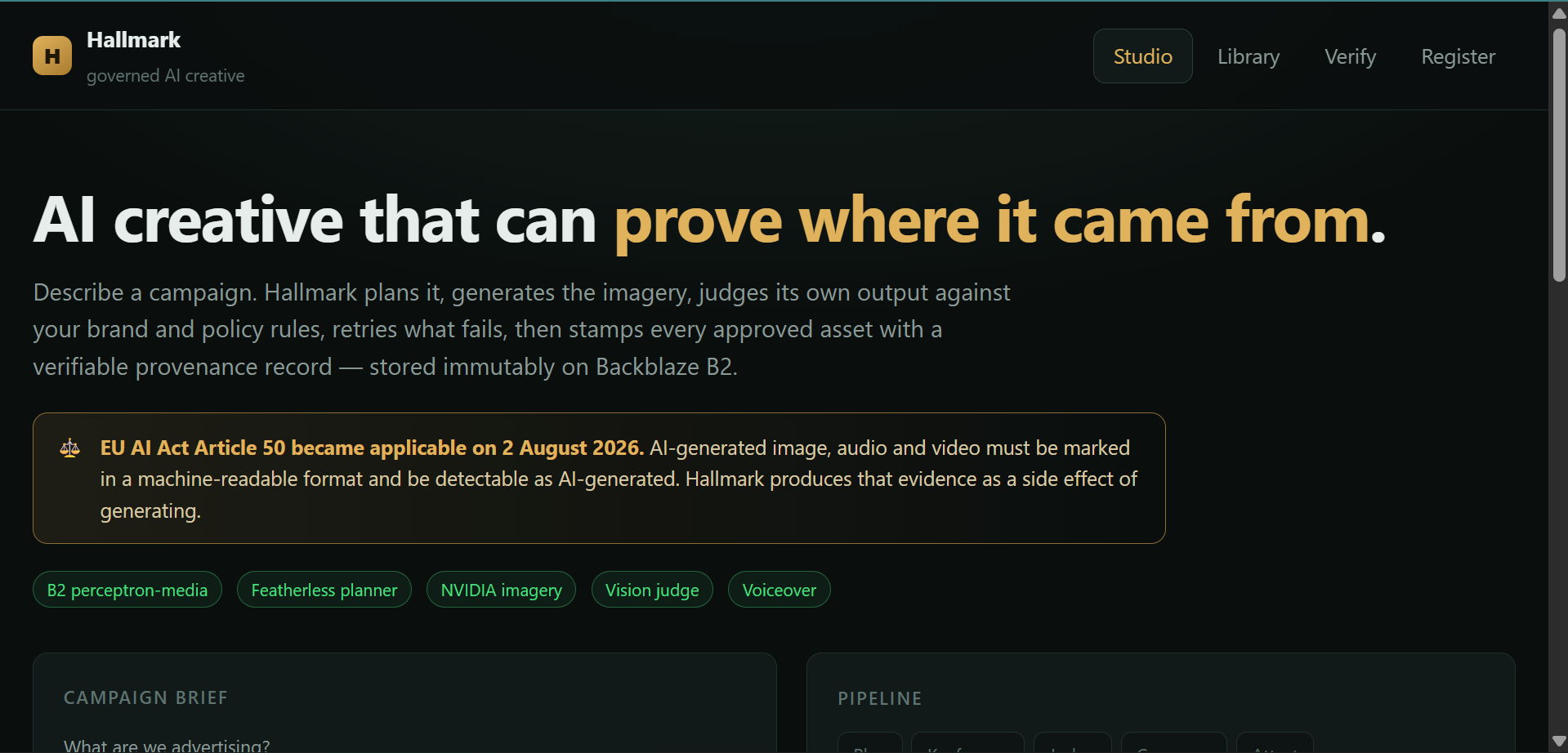
EU AI Act Article 50 became applicable on 2 August 2026 — the day we started building. It requires AI-generated image, audio and video to be marked in a machine-readable format and detectable as AI-generated.
Every AI creative tool we looked at hands you a file and, at best, a prompt history. Neither survives a compliance review. Meanwhile Genblaze already emits a canonical, SHA-256-bound manifest that can be embedded directly into an MP4 or PNG, and Backblaze B2 has Object Lock. Those two things are almost exactly what the regulation asks for — nobody had connected them. That gap is Hallmark.
What it does
You write a one-line brief and a brand kit (tone, visual rules, banned claims, required disclosure). Hallmark then:
- Plans the campaign into structured scenes with an LLM.
- Generates keyframes per scene and per format.
- Judges its own output — a vision model scores brand adherence, a text model checks
copy for banned claims. Failures are retried with the critique fed back into the
prompt, and each attempt is linked by
parent_run_id, so the reasoning trail is part of the provenance. - Discloses — burns the required AI-disclosure onto the creative.
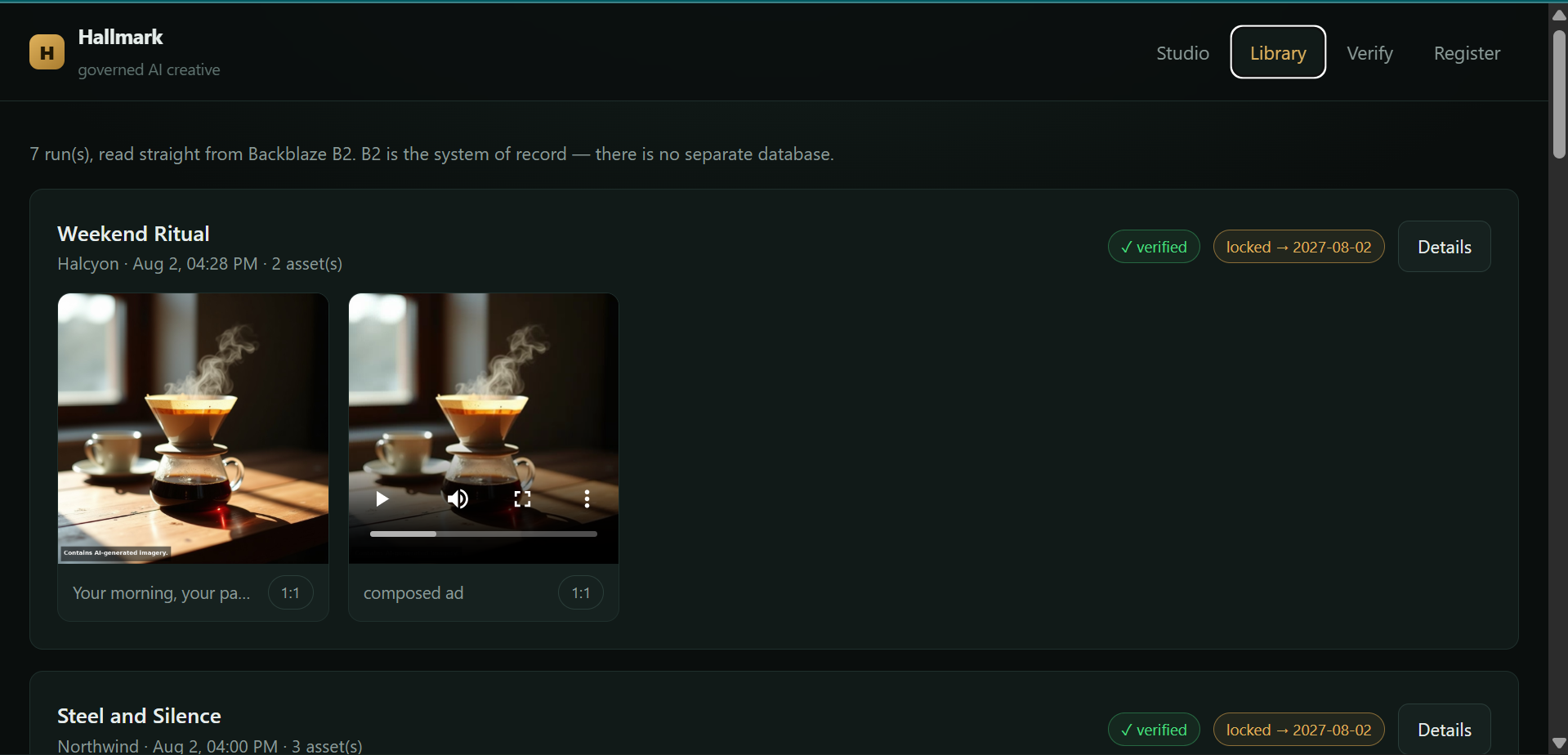
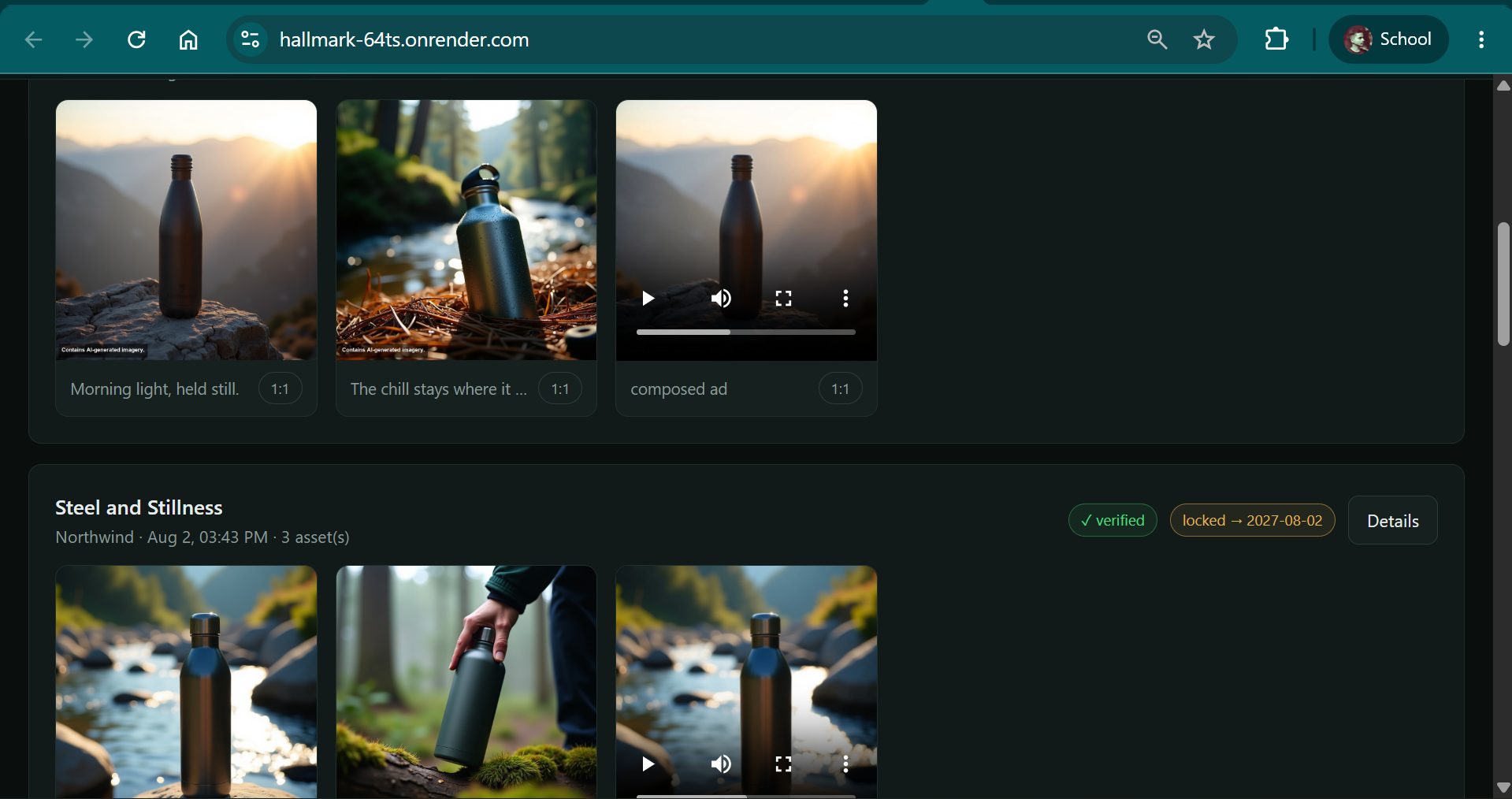
- Composes an MP4 ad from the approved stills with ElevenLabs voiceover.
- Attests — embeds the manifest inside each delivered file and writes an immutable copy to B2 under Object Lock.
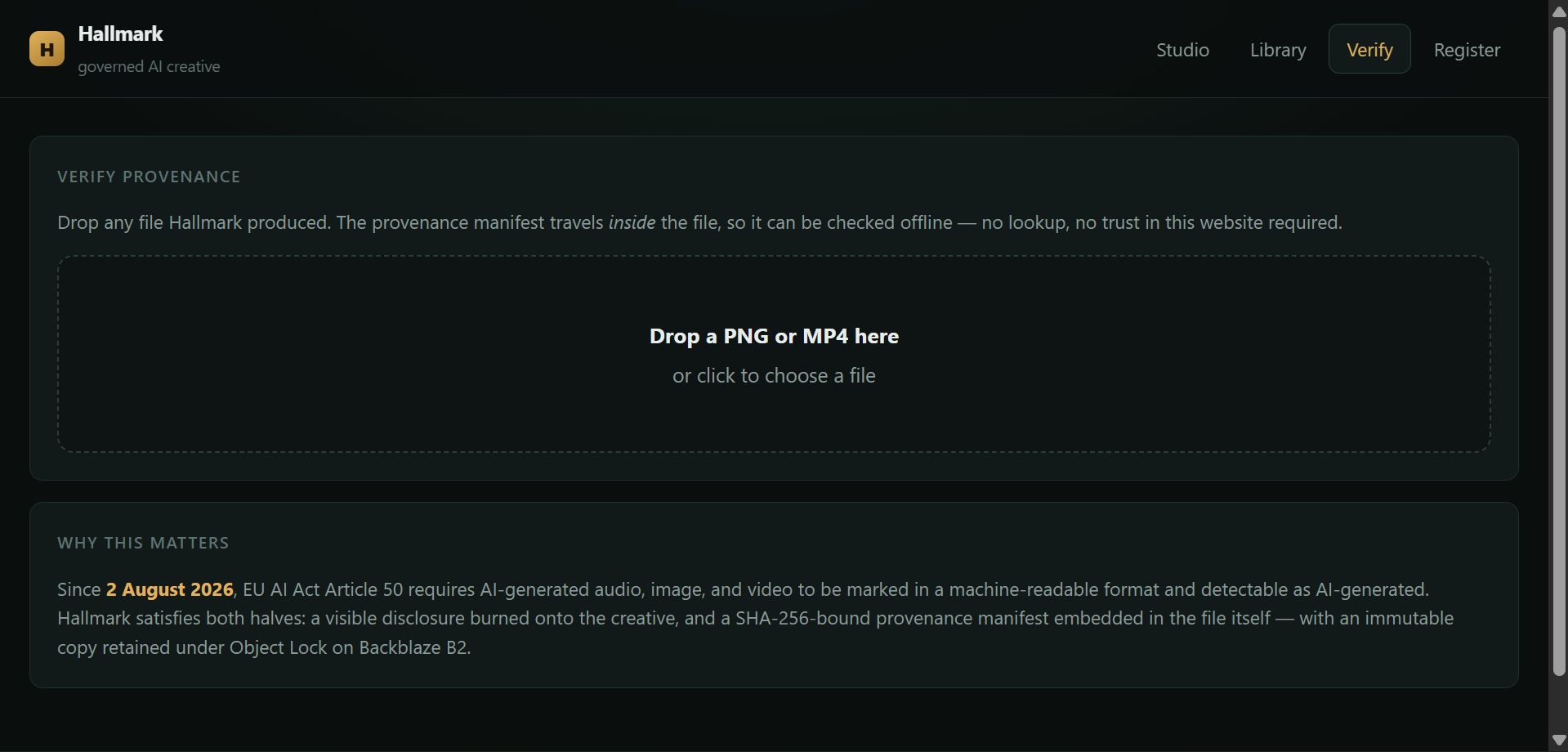
- Verifies — anyone can drop a file into the public
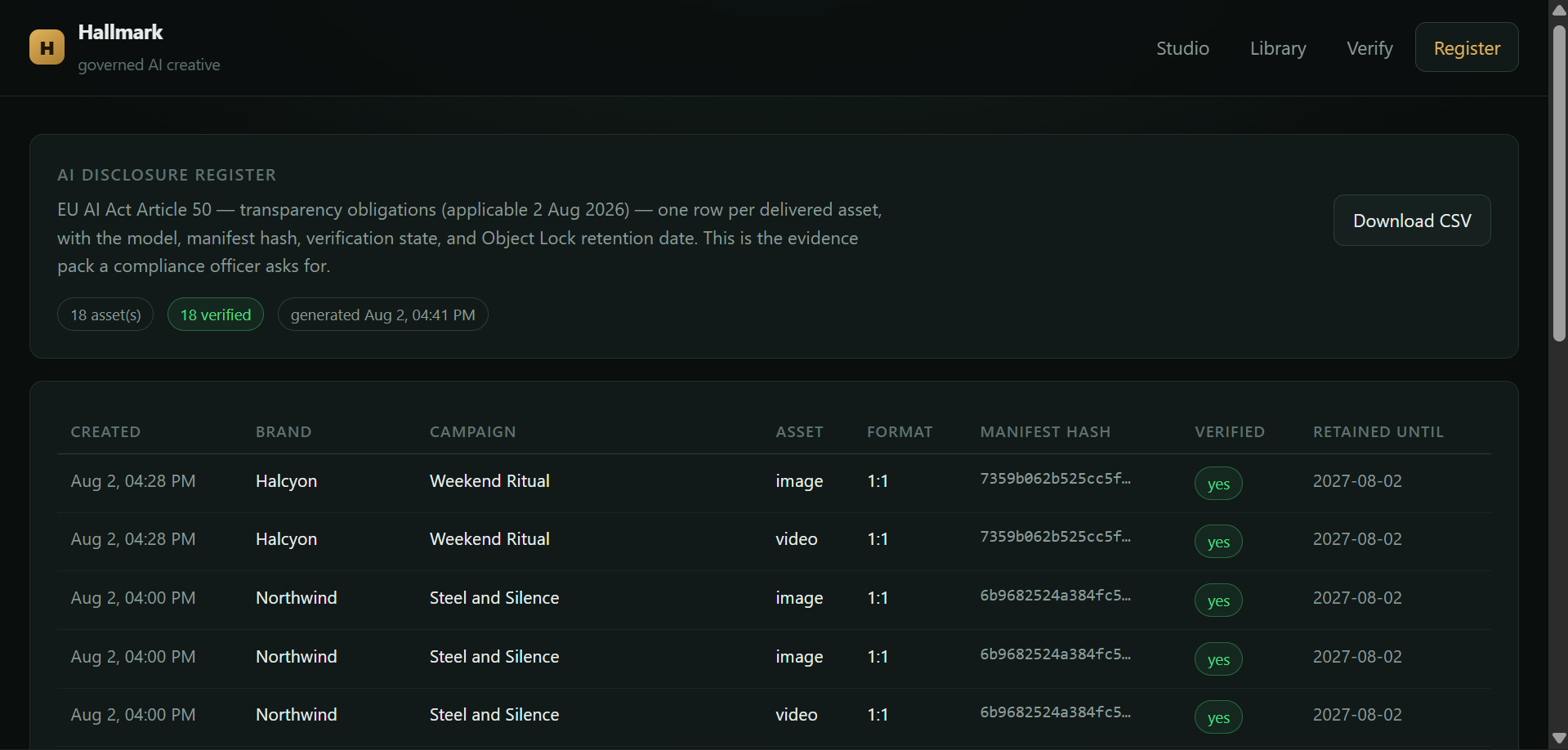
/verifypage and read its full lineage offline. No lookup, no need to trust our website. - Exports the Article 50 disclosure register as CSV.
How we built it
FastAPI + React in one Docker container, with all Genblaze usage deliberately confined to a
single pipelines.py so the orchestration boundary is inspectable. B2 is the system of
record — run records live in the bucket as JSON, so the Library and Register survive
restarts with no database at all.
The judge loop is Genblaze's AgentLoop with a CallableEvaluator; the planner is a custom
SyncProvider that wraps chat(base_url=…) so the LLM call becomes a real manifest'd Step
rather than an untracked side call.
Challenges we ran into
- The free NVIDIA NIM catalog is much smaller than the docs suggest. We probed it
directly: only
flux.1-devwas reachable. Cosmos video, Riva TTS, Fugatto, SDXL and SD3.5 all returned 404, andflux.1-schnellhung indefinitely. So there is no video model in this stack — the ad is composed from generated stills with ffmpeg instead. Honest, fast, and every frame is still provenance-covered. - Genblaze rejects presigned URLs in manifests (they decay before the manifest does). On a private bucket that means durable URLs aren't browser-loadable, so the app mints short-lived signed URLs at read time. This turned out to be the better architecture.
ObjectStorageSinknever forwardsallowed_rootstoAssetTransfer, sofile://assets can only be read from temp roots. All provider scratch moved underTMPDIR.FFmpegTransformdeclares only VIDEO/AUDIO modalities, so the image disclosure overlay uses Pillow while the video path stays a real pipeline step.zoompansilently defaults to 1280x720, which broke the Ken Burns crop until we pinneds=.- Hugging Face Spaces now requires PRO for Docker Spaces, so we moved the deploy to Render.
Accomplishments we're proud of
The verify portal. Drop a file in and it reads its own provenance out of the bytes — no database lookup, no trust in our server. And the governance is real, not decorative: the copy judge caught a genuine borderline claim during testing and rejected it.
What we learned
Provenance is only worth anything if it is a side effect of the normal workflow. The moment it becomes a separate step someone has to remember, it stops happening.
What's next
Ed25519 manifest signing (Genblaze trust mode 2) to prove who generated an asset, not just that it is unmodified; C2PA interop; and B2 Event Notifications to trigger verification automatically on upload.

Log in or sign up for Devpost to join the conversation.