-
-

-
-
-
-
-
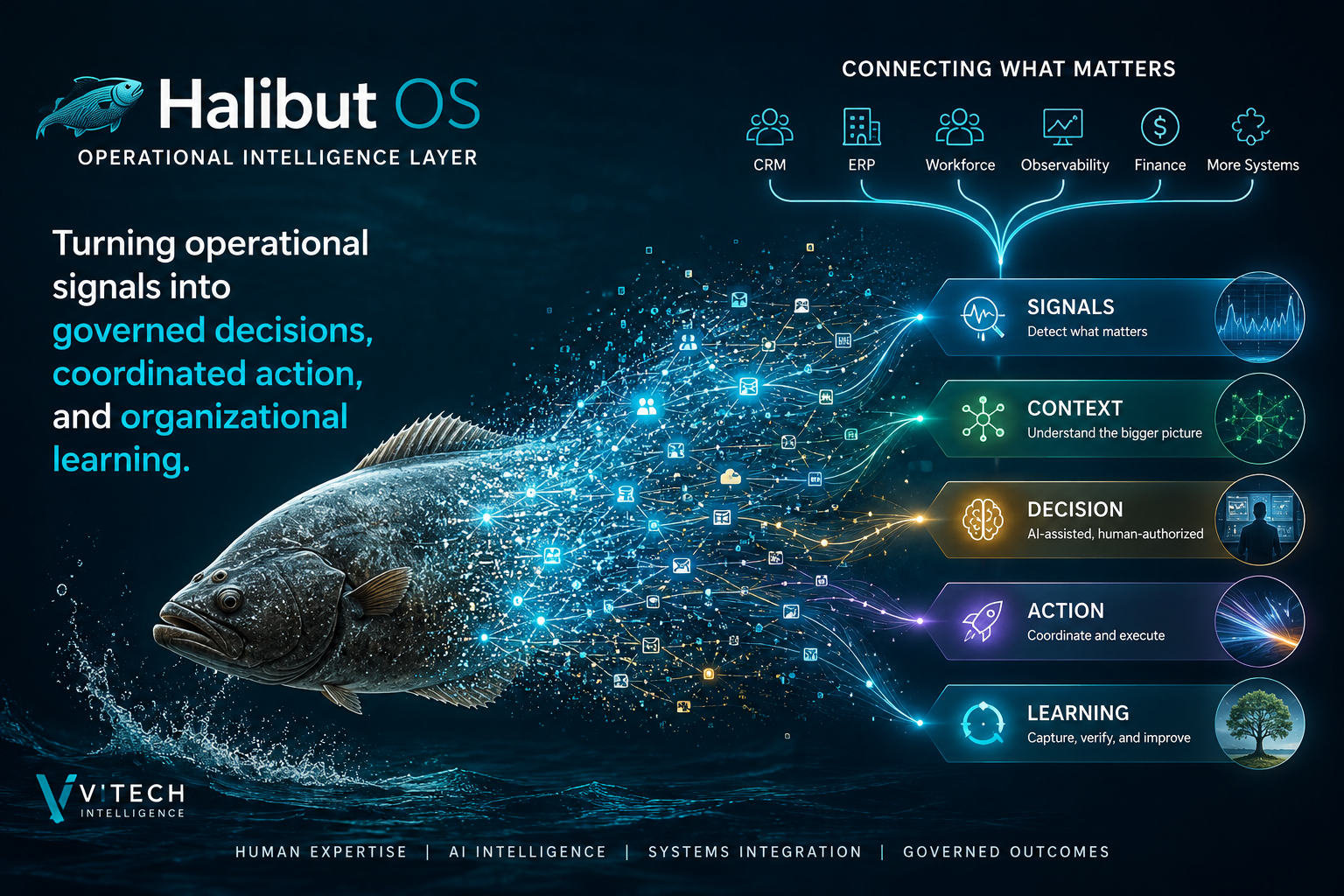
Sees Beyond. Decide Confidently. Execute Intelligently. Learn Continuously


Inspiration
Businesses generate thousands of operational signals every day—from customer requests, staff activity, system alerts, production updates, payments, documents, and conversations. Yet these signals often remain scattered across spreadsheets, chat platforms, CRMs, ERPs, and disconnected reporting tools.
The problem is not a lack of data. The problem is the lack of connected context at the moment a decision must be made.
Halibut OS was inspired by the need for an intelligence layer that can observe what is happening across a business, understand relationships and dependencies, identify emerging risks or opportunities, and help people make better decisions without removing human authority.
What it does
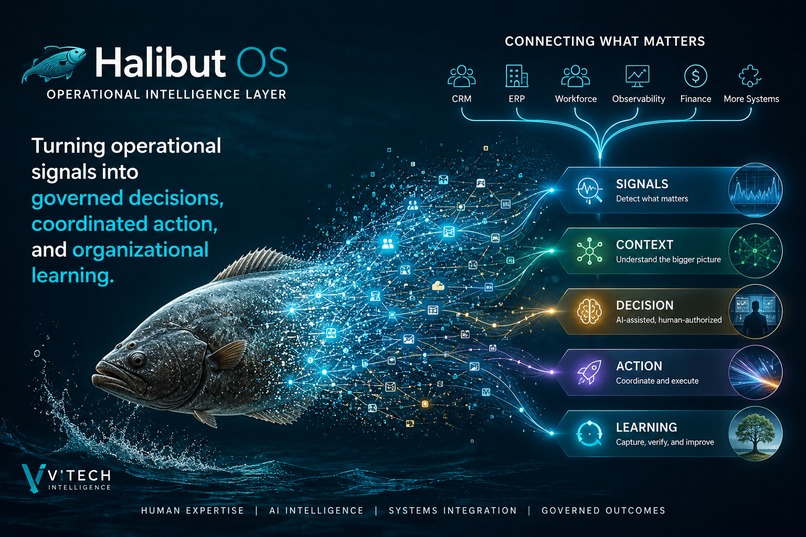
Halibut OS is an operational intelligence layer that sits above existing business systems.
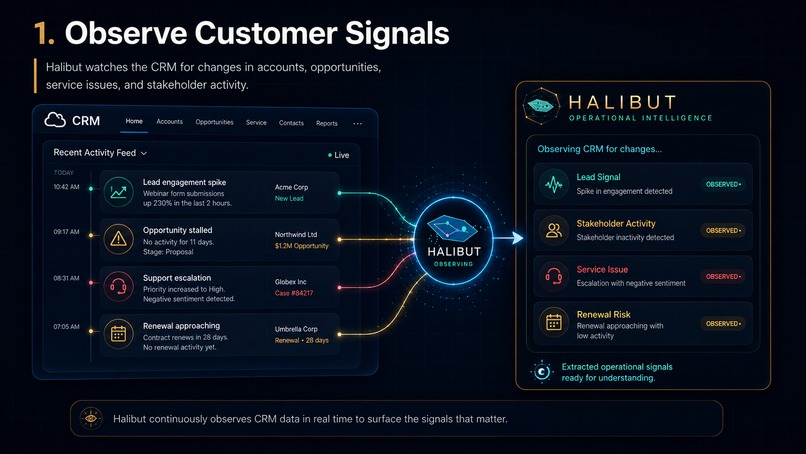
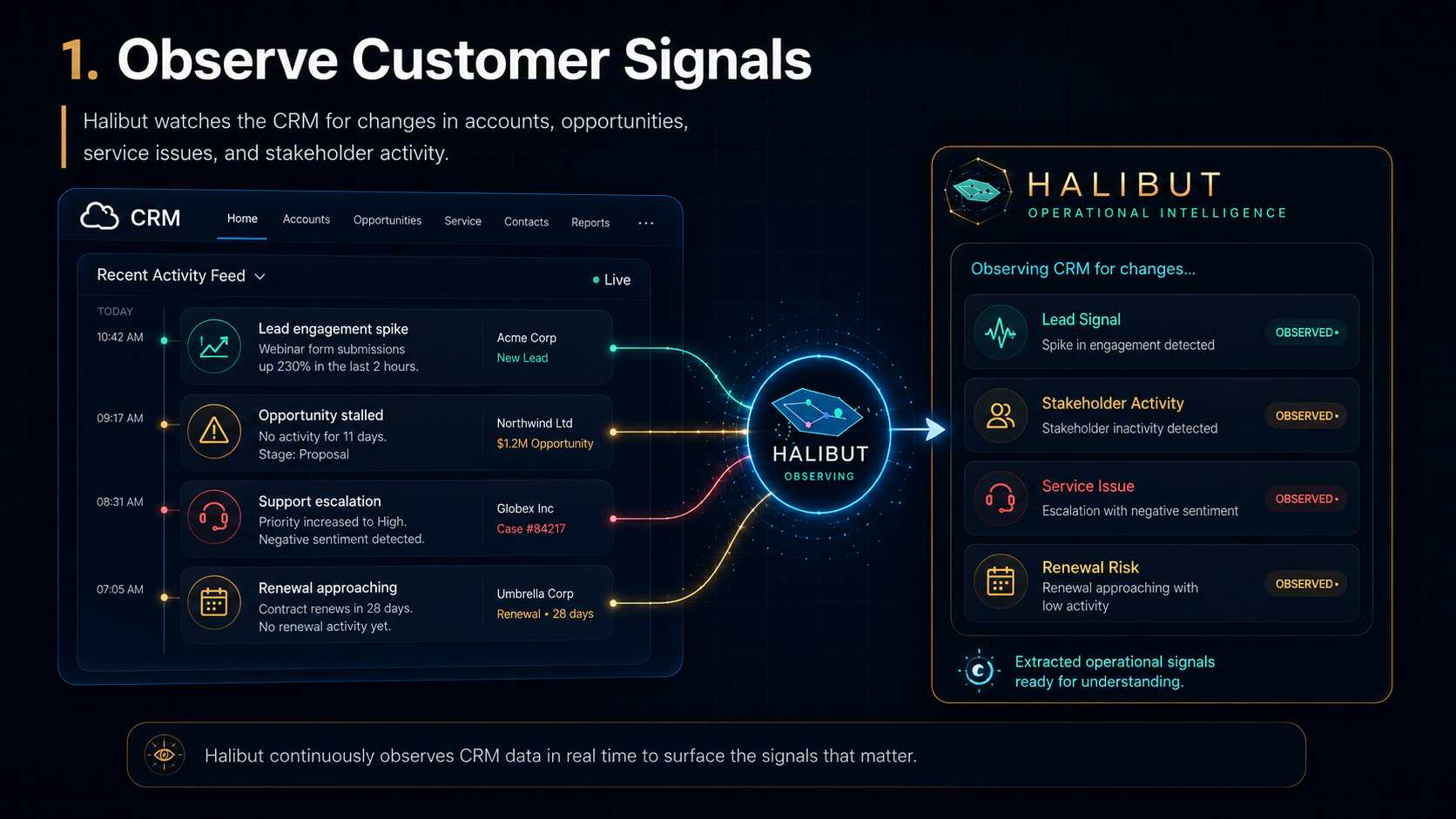
It receives operational events from systems, workflows, documents, and human inputs, then connects those signals into a shared business context.
The platform can:
- Detect operational risks, delays, anomalies, and dependencies.
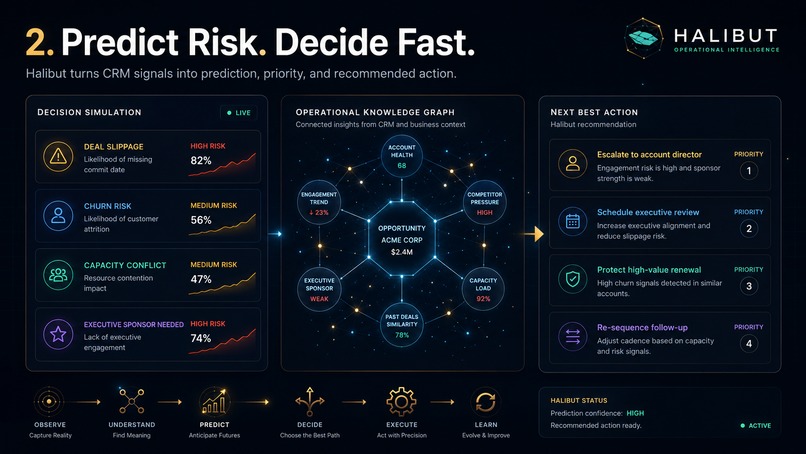
- Explain why an issue matters and what business areas may be affected.
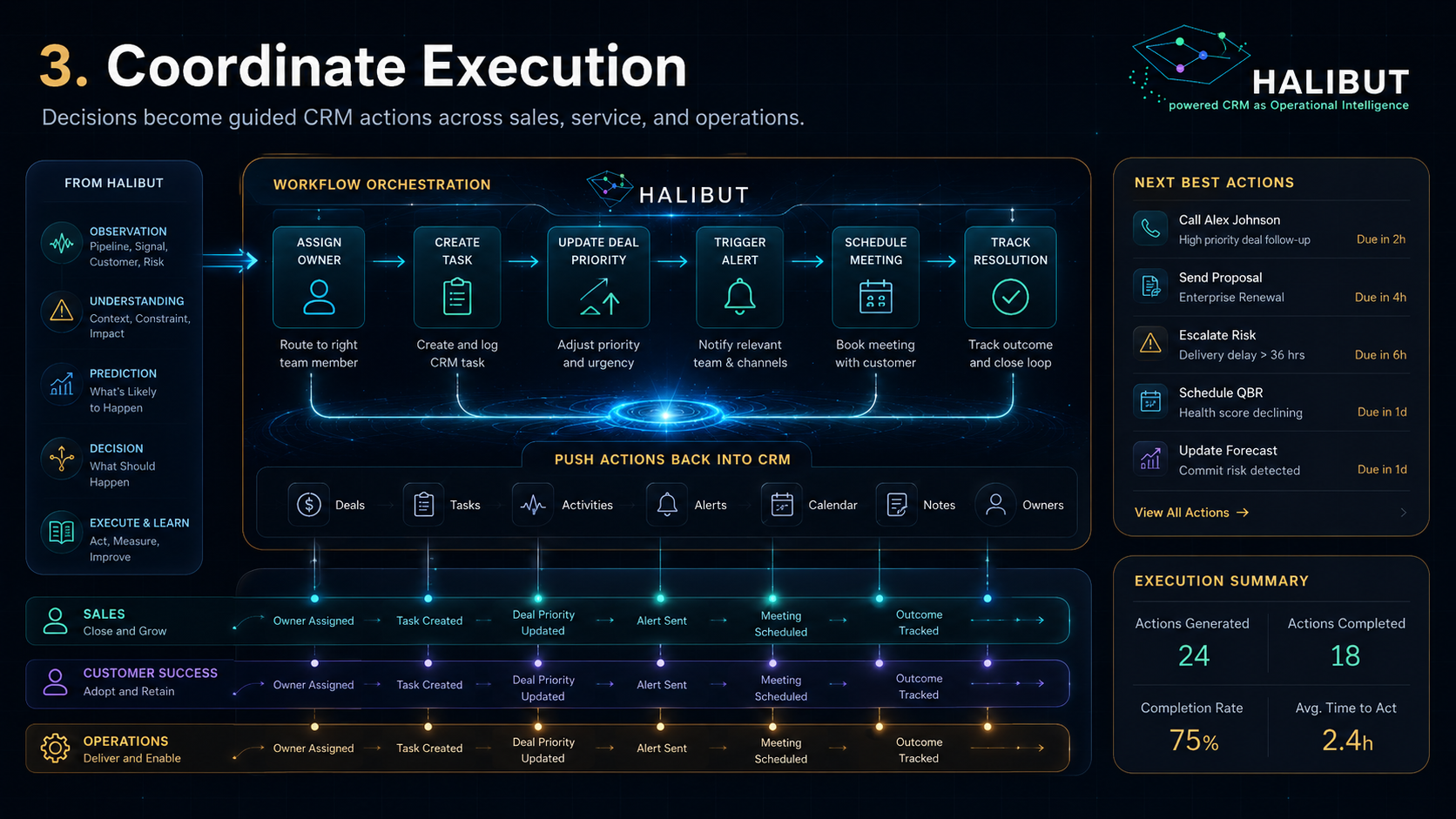
- Recommend practical next actions based on available context.
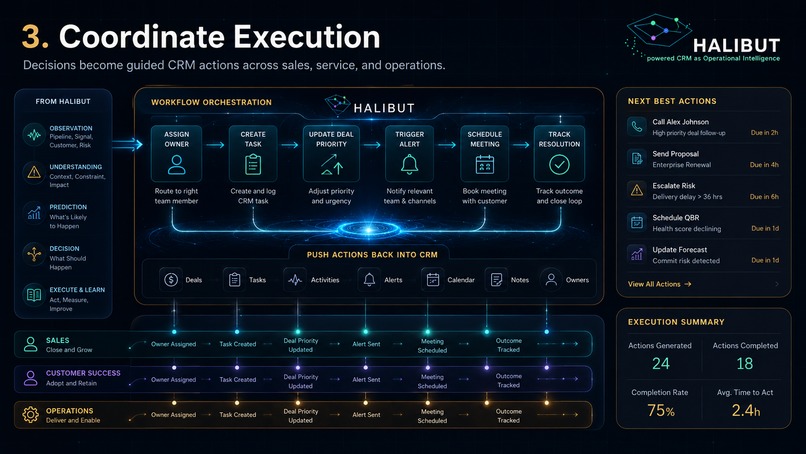
- Route important decisions to the appropriate human owner.
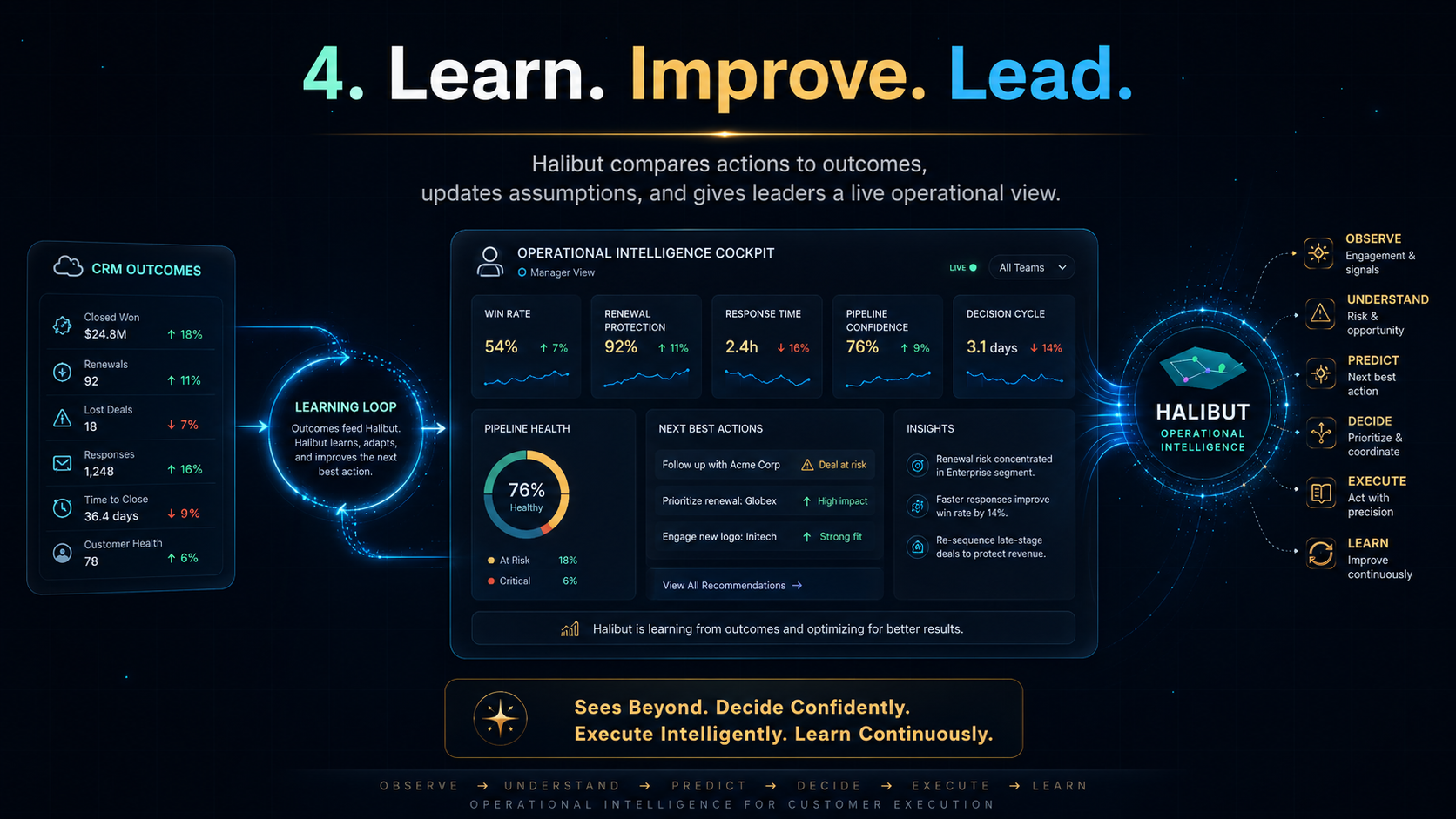
- Record decisions, approvals, actions, and outcomes for accountability.
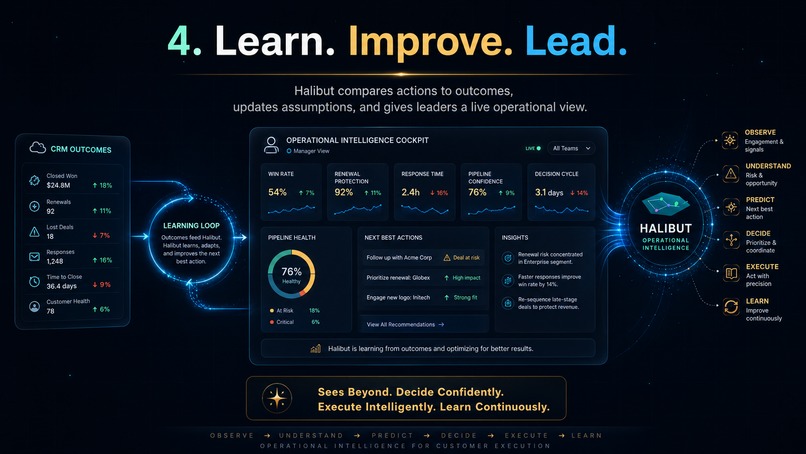
- Build organizational knowledge from completed operational cases.
Instead of replacing CRM, ERP, workforce, or observability tools, Halibut OS helps them work together as a coordinated decision system.
How we built it
We designed Halibut OS as a modular intelligence architecture with five main capabilities:
- Signal ingestion for operational events, system alerts, workflow updates, documents, and human reports.
- Context mapping to connect customers, people, assets, processes, risks, and dependencies.
- AI-assisted reasoning to summarize situations, identify patterns, evaluate impact, and recommend actions.
- Human authorization for decisions that require leadership, operational, financial, or policy approval.
- Decision memory to preserve the original signal, supporting evidence, selected action, responsible owner, and final outcome.
The prototype follows a cloud-native architecture using a web interface, edge-based services, authenticated user access, structured operational data, and OpenAI models for contextual analysis and decision support.
Codex supported implementation, code review, debugging, architecture refinement, and the conversion of the system design into a working product experience.
Challenges we ran into
The greatest challenge was avoiding the creation of another generic AI dashboard or chatbot.
Operational intelligence requires more than generating a response. The system must understand where a signal originated, what other processes depend on it, who has authority to act, what evidence supports the recommendation, and how the final decision should be recorded.
We also had to balance intelligence with control. AI recommendations must remain explainable and reviewable, especially when they affect customers, employees, production, finance, or compliance.
Another challenge was reducing a much larger enterprise vision into a clear hackathon demonstration. We focused on one complete journey:
Operational signal → connected context → AI analysis → human decision → recorded outcome
Accomplishments that we're proud of
We are proud that Halibut OS demonstrates a practical alternative to fragmented business intelligence.
Rather than presenting AI as an isolated assistant, the project shows how AI can become part of a governed operational process.
Key accomplishments include:
- Creating a clear operational event-to-decision workflow.
- Connecting technical signals with business and human context.
- Preserving human authorization for consequential actions.
- Producing recommendations that include reasoning, impact, and supporting evidence.
- Recording decisions and outcomes instead of losing them in chat history.
- Designing the platform to complement existing enterprise systems rather than requiring businesses to replace them.
- Turning a complex operational intelligence concept into a focused, understandable product demonstration.
What we learned
We learned that the most valuable role of AI in operations is not simply answering questions. Its greater value comes from helping people recognize what requires attention, understand why it matters, and determine what should happen next.
We also learned that context is more important than volume. A small number of connected, trustworthy signals can support a better decision than a large dashboard filled with isolated metrics.
Another important lesson was that human-in-the-loop design should not be treated as a limitation. Human review, authorization, and accountability make AI-supported decisions more reliable and more suitable for real organizations.
Finally, we learned that organizational knowledge grows when decisions and outcomes are structured and preserved—not when intelligence disappears inside disconnected conversations.
What's next for Halibut OS · Operational Intelligence Layer
The next stage is to expand Halibut OS from a focused prototype into a configurable operational intelligence platform.
Planned development includes:
- Additional connectors for CRM, ERP, workforce, finance, customer service, IT, and operational systems.
- A richer operational context graph for mapping dependencies and business impact.
- Scenario simulation for comparing possible actions before execution.
- Policy-based approval and escalation workflows.
- Confidence, evidence, and risk indicators for AI recommendations.
- Stronger observability for model activity, operational events, actions, and outcomes.
- Multilingual support for organizations operating across Vietnam and Southeast Asia.
- Industry-specific intelligence modules for SMEs, service operations, education, manufacturing, and distributed workforces.
- A Halibut Readiness Assessment to help organizations identify context gaps, decision delays, and high-value pilot opportunities.
Our long-term goal is for Halibut OS to become the intelligence layer that helps organizations:
See beyond isolated systems. Decide confidently. Execute intelligently. Learn continuously.
Built With
- ai-agents
- augmented-intelligence
- business-intelligence
- business-operations
- context-aware-ai
- decision-intelligence
- decision-support
- enterprise-ai
- explainable-ai
- human-ai-collaboration
- human-centered-ai
- human-in-the-loop
- institutional-knowledge
- knowledge-management
- openai-codexoperational-intelligence
- operational-intelligence
- operational-observability
- organizational-intelligence
- organizational-memory
- process-intelligence
- responsible-ai
- risk-detection
- workflow-automation
- workforce-intelligence

Log in or sign up for Devpost to join the conversation.