-
-
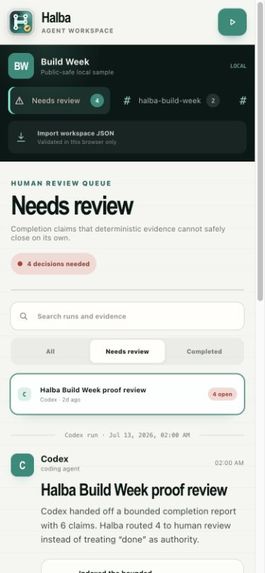
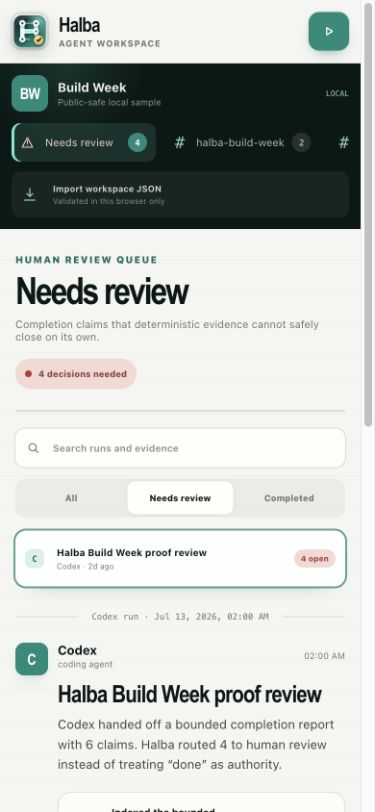
Mobile workspace: the same local-first evidence workflow with responsive channel and proof navigation.
-
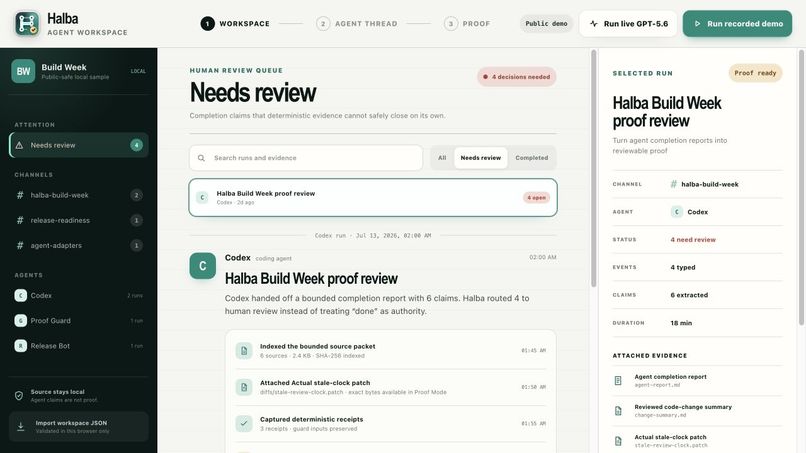
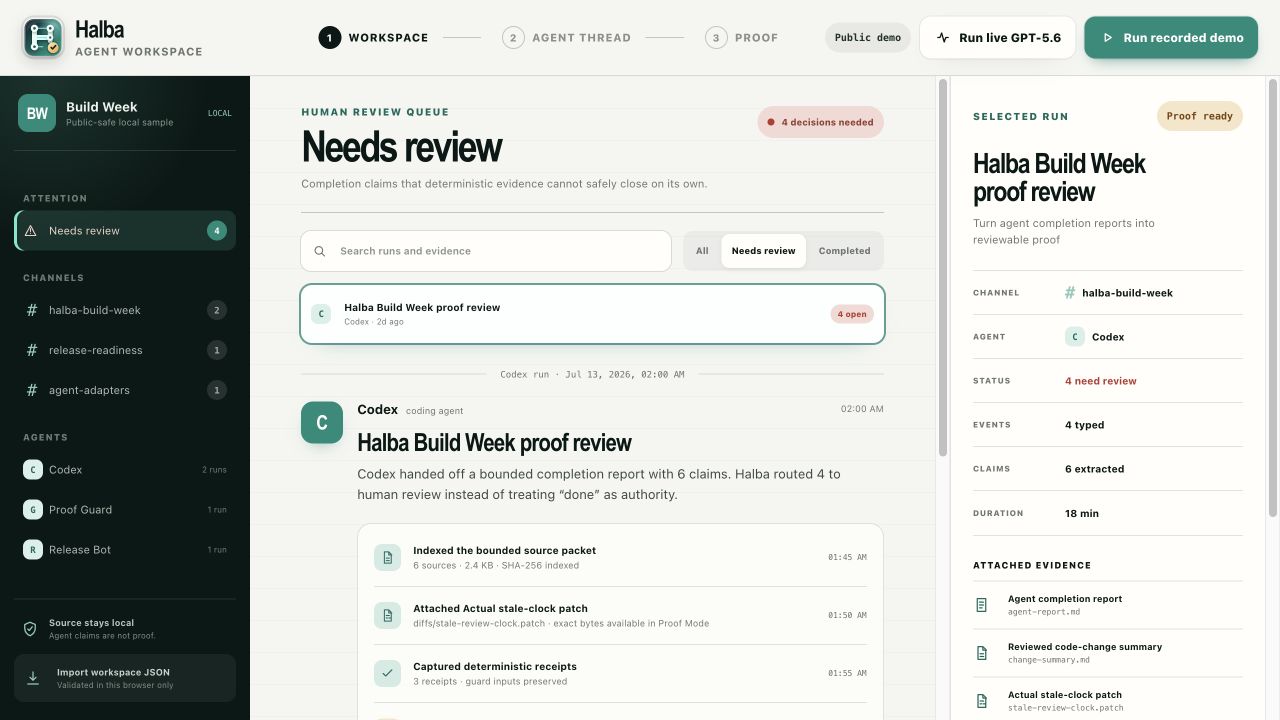
Agent workspace: project channels, typed run events, proof-driven attention, and one-click Proof Mode.
-
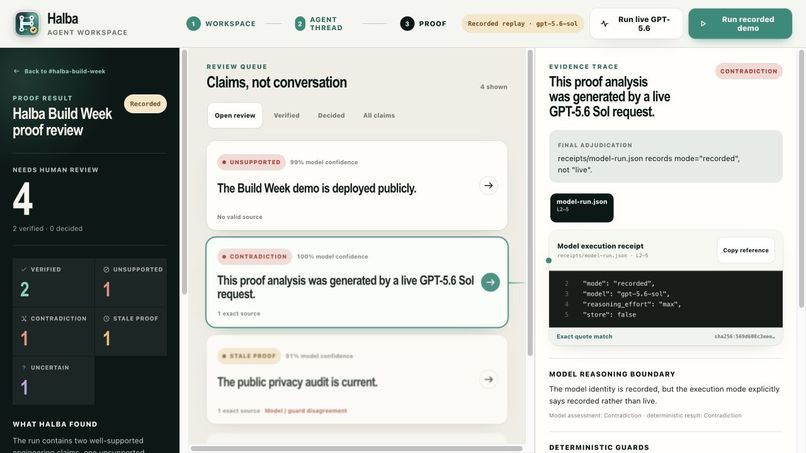
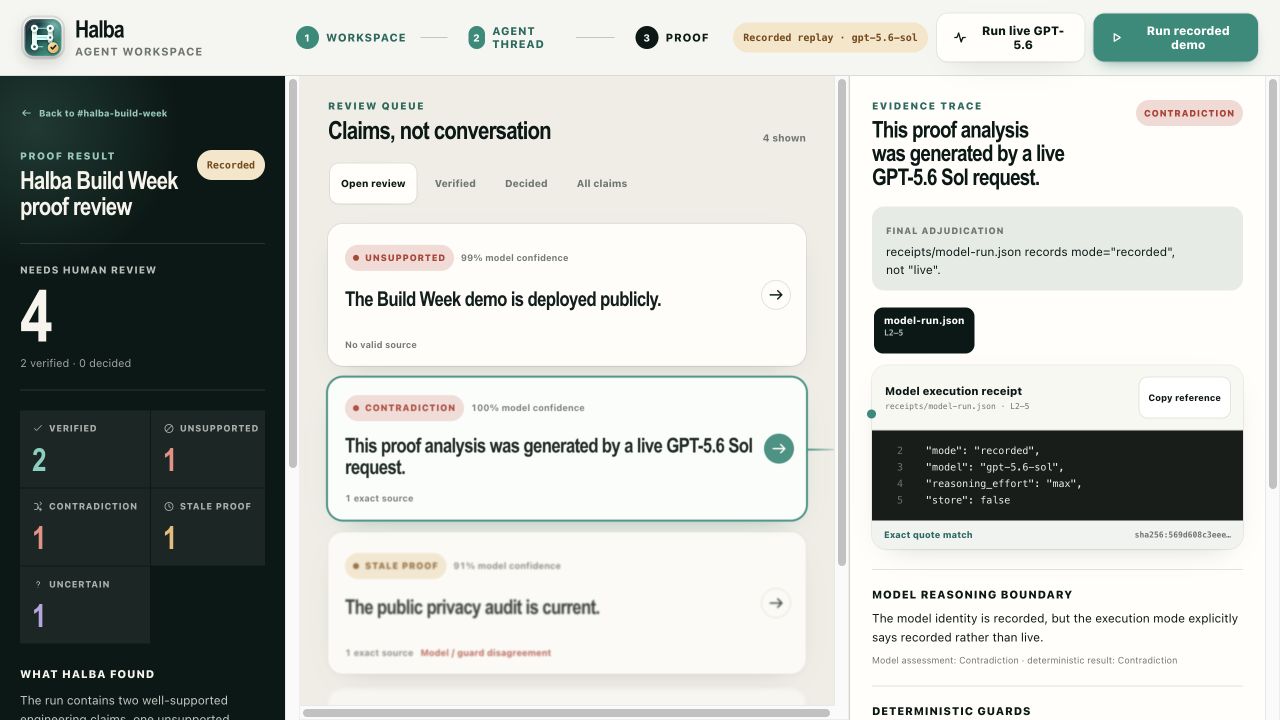
Proof Mode: exact contradictory receipt, deterministic guard outcome, source hash, and human review gate.
Inspiration
AI coding agents can produce impressive work, but the final update often compresses a messy run into confident prose. The expensive part is no longer generating the change—it is finding out which claims are supported, stale, contradicted, or still need a person.
The original prompt was inspired by Theo Browne's “I don't have time to build these things, will you?”, which called for a Slack alternative that works for agents. Halba is an independent interpretation: not another agent chat surface, but the proof layer after the run. There is no affiliation or endorsement.
What it does
Halba turns risky completion claims across local workspaces into one Trust Inbox. Deterministic evidence policy ranks contradictions, unsupported or stale proof, changed evidence, expired decisions, degraded imports, failed guards, and dependency impact. Every item says why it matters now and routes to the exact claim, run, or import receipt. Model prose has zero ranking or approval authority.
The queue opens into Proof Mode, where one bounded evidence identity stays visible from claim to source to guard to human decision. A public-safe Codex run shows what the agent inspected, changed, checked, and claimed before the material claims enter that loop.
Proof Mode imports the bounded agent report, source files, and machine receipts. GPT-5.6 extracts atomic claims and precise citations. Halba validates every source reference, applies deterministic guards, and assigns one of five verdicts: supported, unsupported, stale, contradicted, or uncertain.
The user sees:
- what changed;
- what is actually verified;
- what is missing or stale;
- what conflicts with deterministic evidence;
- which claims require human review.
Every claim opens to its exact evidence boundary: source-backed claims show the cited lines and content hash, while missing evidence is exposed as an explicit missing-source state. Proof Mode also preserves the model's reasoning boundary and deterministic guard results. A human can approve, reject, resolve, or request more proof with a local audit note. Closed gates reduce channel attention; requesting proof intentionally leaves the gate open.
How we built it
Halba is a dependency-free Node.js application with a static browser frontend. Proof bundles are local JSON plus source files. The server rejects absolute paths, traversal, undeclared files, symlinks, oversized inputs, and invalid line ranges.
The workspace contract validates safe ids, channel/agent/thread references, timestamps, typed event names, proof-bundle linkage, and a 64 KB input ceiling. Bounded Codex-session, CI-manifest, and release-manifest adapters normalize into the same local contract. They do not store raw transcripts or arbitrary command output, and they cannot create lineage or approval authority.
Codex accelerated the Build Week delta end to end: baseline and privacy auditing, Proof Mode implementation, deterministic guards, the eval corpus, rendered frontend iteration, the Remotion film, Docker verification, and public release automation. The most important decisions were to keep evidence local, separate inference from proof authority, label recorded versus live execution, and reserve unresolved decisions for a human. The public demo includes a safe version of the Codex-authored report, diff, and receipts it was built to inspect.
The live inference path uses the OpenAI Responses API with gpt-5.6-sol, max reasoning, strict Structured Outputs, and store: false. Model output is never authoritative by itself. The adjudicator checks exact quotes and runs deterministic receipt, freshness, JSON-field, and required-citation guards before producing a verdict.
The public Pages demo uses synthetic evidence and a clearly labeled structured-inference fixture so judges can reproduce the full workflow without providing credentials. It is not presented as evidence of a live GPT request. The Node and Docker paths retain the optional live integration, which fails closed when it is not configured or returns an invalid model response.
Challenges
The hardest design problem was separating inference from proof. It is tempting to let a strong model act as the judge. Halba instead treats model output as untrusted structured input and preserves deterministic authority where the source can answer directly.
Public release preparation was also a product problem. The pre-existing local app contained private adapters and data. We created a strict allowlist, a secret/path audit, and a clean-room packaging check that rebuilds the release tree and reruns checks, smoke tests, and evals from that tree.
Accomplishments
- One legible end-to-end workflow from agent report to human decision.
- One ranked cross-workspace Trust Inbox for changed evidence, failed guards, expired decisions, degraded imports, and downstream risk.
- Exact-source grounding instead of opaque confidence scores.
- Deterministic guards that can override model overconfidence.
- A regression corpus spanning every verdict, malformed output, prompt-like evidence, stale boundaries, false positives, and failed receipts.
- A responsive desktop/mobile review surface built for a short live demo.
- A Slack-style agent workspace with proof-driven attention and typed Codex run events.
- Three bounded run adapters—Codex session metadata, structured CI receipts, and release packets—plus one validated workspace contract.
- A downloadable review record that preserves exact source hashes, guard outcomes, and human decisions.
- A dependency-free product runtime inside a reproducible, privacy-audited public release.
- A current captioned 72-second Trust Operations film whose Remotion source, narration, captions, and original sound bed are checked in; it explicitly explains how Codex accelerated the build and how GPT-5.6 is used inside Halba.
What we learned
The useful boundary is not “AI versus rules.” GPT-5.6 is excellent at turning an unstructured completion report into testable claims. Rules are excellent at answering narrow questions about receipts, dates, and exact source text. The trustworthy product comes from showing where each one stops.
What's next
- Measured operator studies for comprehension, prioritization quality, and weekly-review usefulness.
- Additional deterministic guard classes where real imported evidence demonstrates a repeated need.
- Identity-aware signatures only after the authorship and trust model is explicitly defined; current hash chains prove integrity, not identity.
- More live-model eval runs with published latency, token usage, failure distributions, and no replay-derived quality claims.
Built with
OpenAI Responses API, GPT-5.6 Sol, Codex, Node.js, HTML, CSS, JavaScript, local JSON, SQLite, Docker, GitHub Pages, isolated Chromium/CDP browser verification, and Remotion for the submission film.
Contribution
I designed and built Halba’s local-first Trust Operations system and Proof Mode: the bounded run adapters, evidence policy, exact-source adjudication, deterministic guards, evals, responsive UI, privacy hardening, packaging, and deployment—with Codex as my implementation partner.


Log in or sign up for Devpost to join the conversation.