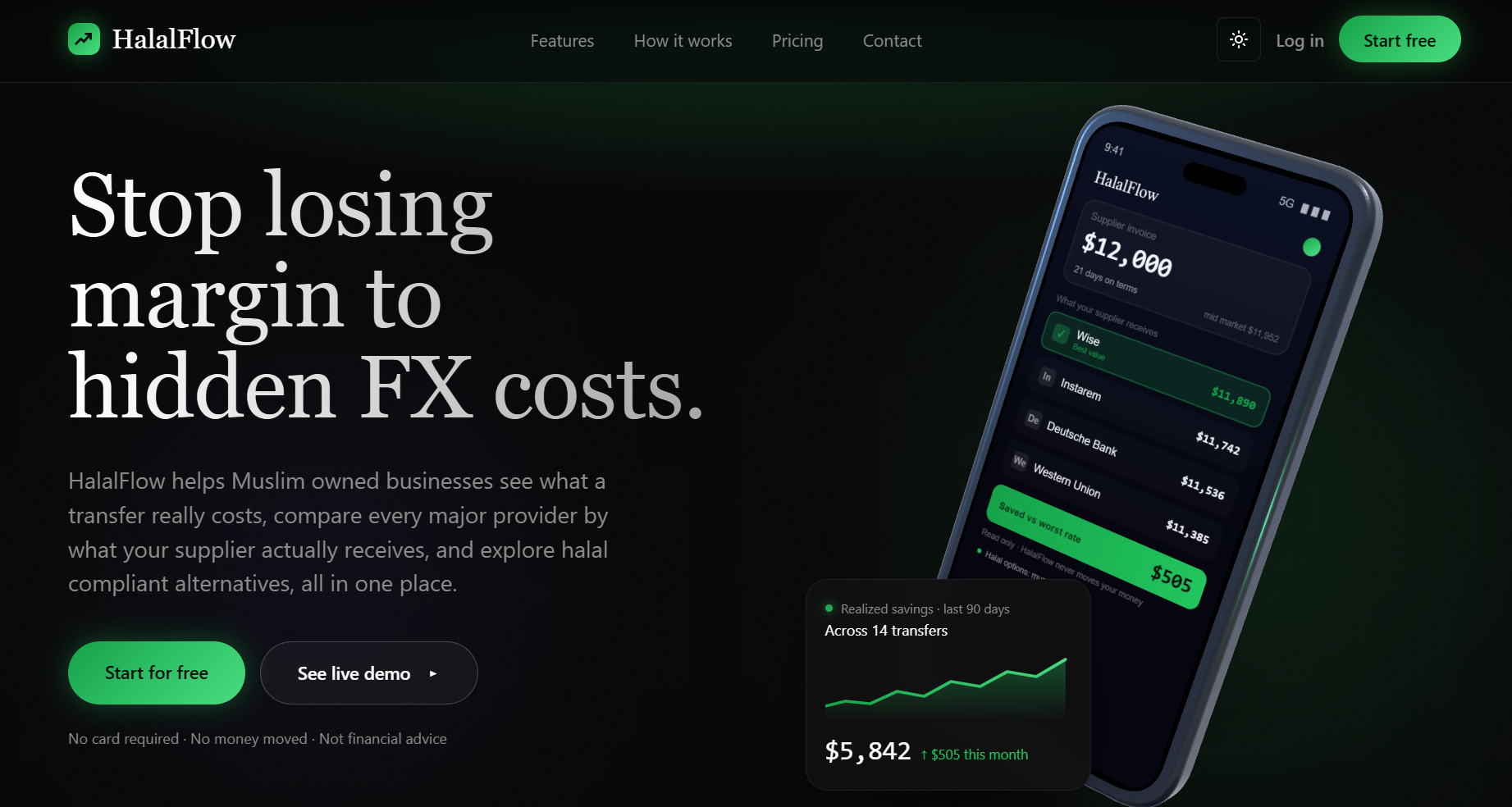
HalalFlow — Stop losing margin to hidden FX costs
Inspiration
Every import business that pays a supplier overseas gets quoted an exchange rate — and almost never the real one. The gap between the mid-market rate and what a provider actually delivers is quietly absorbed as margin, and most small business owners have no easy way to see it, let alone compare it across providers. For Muslim-owned businesses, there's a second layer of difficulty: many conventional hedging tools (forwards, swaps) rely on structures that raise riba concerns, leaving owners to either accept FX risk blind or use instruments they're not comfortable with. We wanted a tool that made the true cost of a payment visible in one place — and that treated Islamic finance as a first-class option, not an afterthought.
What it does
HalalFlow gives import businesses one dashboard to understand and act on foreign-currency supplier payments:
- Live FX and history — pulls real ECB reference-rate data so every calculation starts from an actual market rate, not an estimate.
- Provider comparison — ranks providers like Wise, Instarem, Deutsche Bank, and Western Union by what the supplier would actually receive, surfacing the hidden markup buried in each provider's rate.
- Risk and breakeven engines — estimates downside exposure using historical rate movement over windows comparable to the user's payment terms.
- Natural hedge detection — flags when a business's incoming and outgoing currency flows can offset each other, reducing the need to hedge at all.
- Sharia-aware guidance — explains murabaha, wa'd, and natural hedges as halal-compliant alternatives to conventional forwards, with cited sources and clear disclaimers.
- Business zakat calculator — helps calculate zakat obligations on foreign holdings and receivables.
HalalFlow never moves money and never predicts where rates are headed. It's a visibility and decision-support layer, not a trading or advisory platform.
How we built it
The app is built on Next.js 16 with React 19 and TypeScript, styled with Tailwind CSS 4, and charted with Recharts. Supabase handles auth and application data. The core financial logic — pricing, risk modeling, breakeven calculations, hedge detection, and zakat math — lives in a dedicated lib/ layer with Vitest unit tests to keep the engines deterministic and verifiable, since correctness matters a lot more than cleverness when the numbers represent real money. A Sharia-guidance assistant, powered by Groq, answers structured questions about halal alternatives and always responds with disclaimers rather than rulings.
Challenges we ran into
- Keeping "no predictions" honest. It would have been easy to add a "projected rate" feature to make the product feel smarter — we deliberately didn't, because forecasting FX movement isn't something we could responsibly claim to do, and it would undermine trust with users who came to us specifically for transparency.
- Representing halal alternatives responsibly. Explaining murabaha and wa'd structures without overstepping into issuing religious rulings meant grounding every explanation in cited scholarly sources and being explicit that HalalFlow is educational, not a fatwa.
- Making "hidden markup" legible. Providers don't publish their effective spread, so translating raw rate data into an honest, provider-by-provider comparison that a small business owner can act on in under a minute took real iteration on both the pricing engine and the UI.
Accomplishments that we're proud of
- A working end-to-end flow — from entering an invoice to seeing a real, provider-by-provider cost comparison — in under a minute.
- A financial logic layer with deterministic unit tests, so the risk and breakeven numbers aren't just plausible-looking, they're testable.
- A genuine Islamic finance layer built with cited sources and appropriate disclaimers, rather than a token feature bolted on for the theme.
What we learned
We learned how much of "fintech trust" is really about restraint — what you choose not to claim (predicted rates, guaranteed savings, religious rulings) matters as much as what you build. We also got much deeper into the mechanics of FX provider pricing than expected, and into the practical differences between murabaha-based and wa'd-based hedging structures.
What's next for HalalFlow
- Expanding provider coverage beyond the current set and adding real-time rate feeds alongside the ECB reference data.
- Building out multi-invoice and multi-currency portfolio views for businesses managing several supplier relationships at once.
- Partnering with qualified Islamic finance scholars to expand and formally review the Sharia-guidance content.
- Exploring a lightweight API so accounting tools can pull true-cost data directly.
Built With
- css
- next.js
- react
- recharts
- supabase
- tailwind
- typescript
- vitest


Log in or sign up for Devpost to join the conversation.