-
-
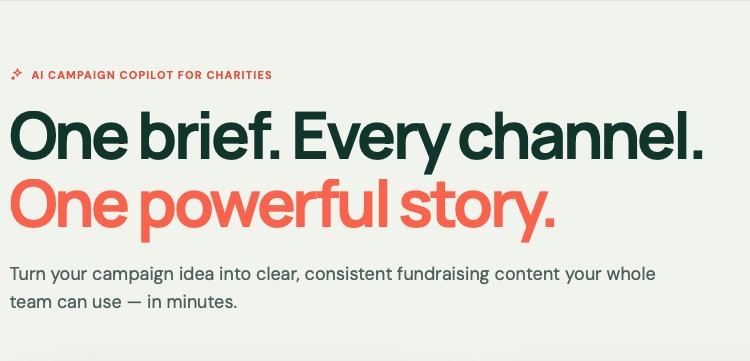
One Brief. Every Channel. One Powerful Story.
-
concept
-
1
-
2
-
3
-
4
Hala Impact AI
Inspiration
During years of working with charities and humanitarian organisations, I repeatedly saw the same challenge.
Launching a fundraising campaign required hours—or sometimes days—of repetitive work. A single campaign needed a landing page, donation email, social media posts, WhatsApp messages, SMS, posters, and campaign messaging. Although the channels were different, the core story should always remain the same.
Small charities rarely have dedicated marketing teams. Communications staff often rewrite the same campaign several times for different platforms, resulting in inconsistent messaging, slower fundraising, and unnecessary workload.
I wanted to build an AI system that could act like an experienced fundraising communications team—helping charities spend less time writing content and more time helping people.
That idea became Hala Impact AI.
What it does
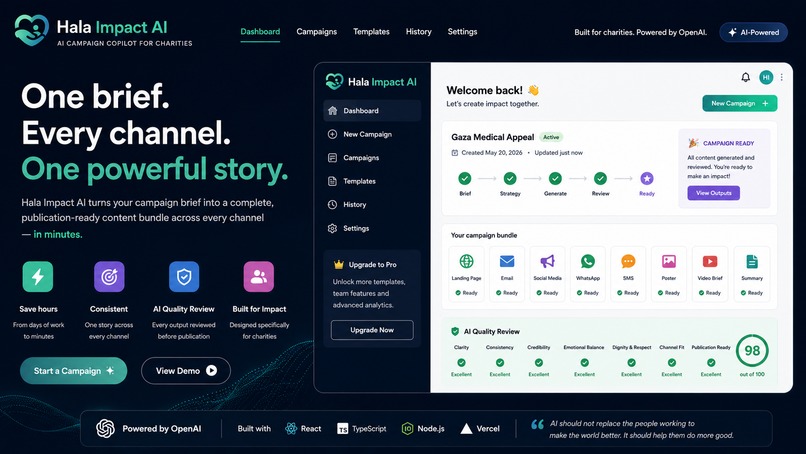
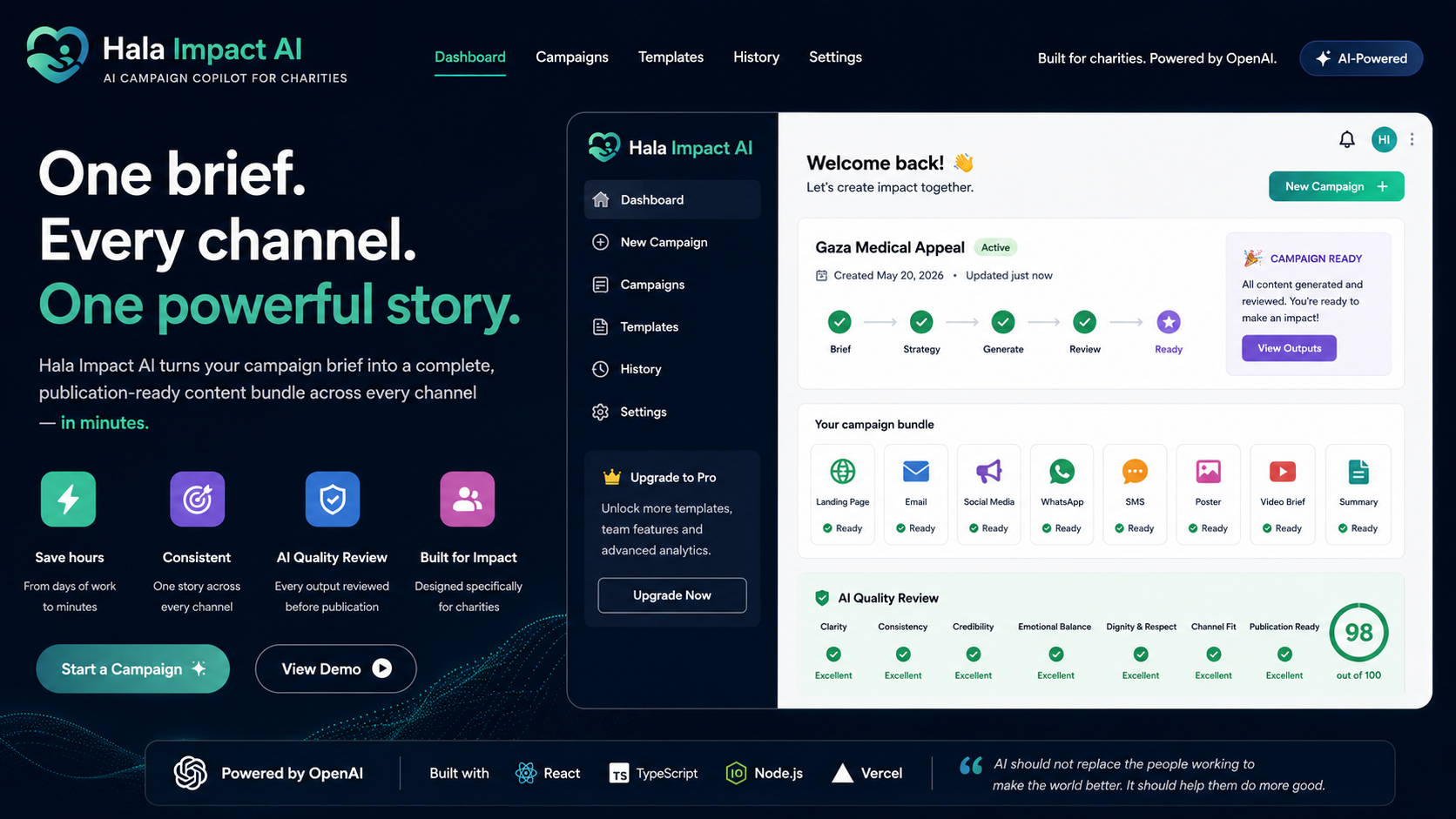
Hala Impact AI is an AI Campaign Copilot designed specifically for charities and nonprofit organisations.
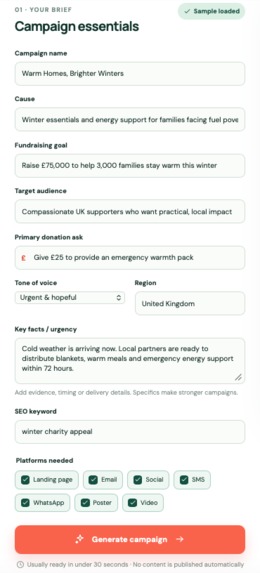
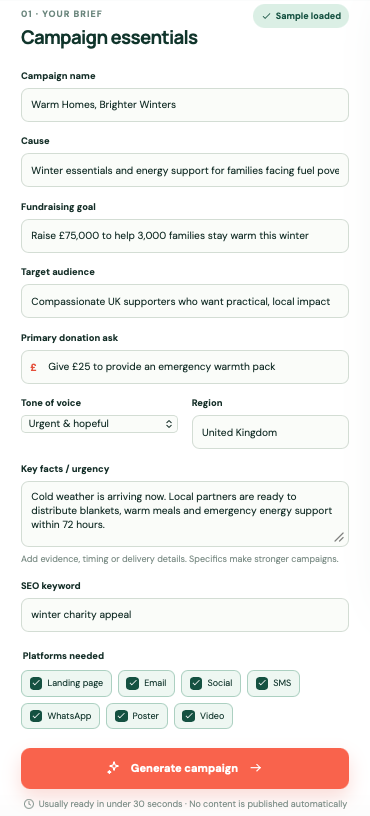
Instead of creating content separately for every platform, users provide one structured campaign brief describing:
- Campaign name
- Cause
- Fundraising objective
- Target audience
- Donation ask
- Tone
- Key facts
- SEO keyword
- Required channels
The application then creates a complete campaign bundle within minutes.
Outputs include:
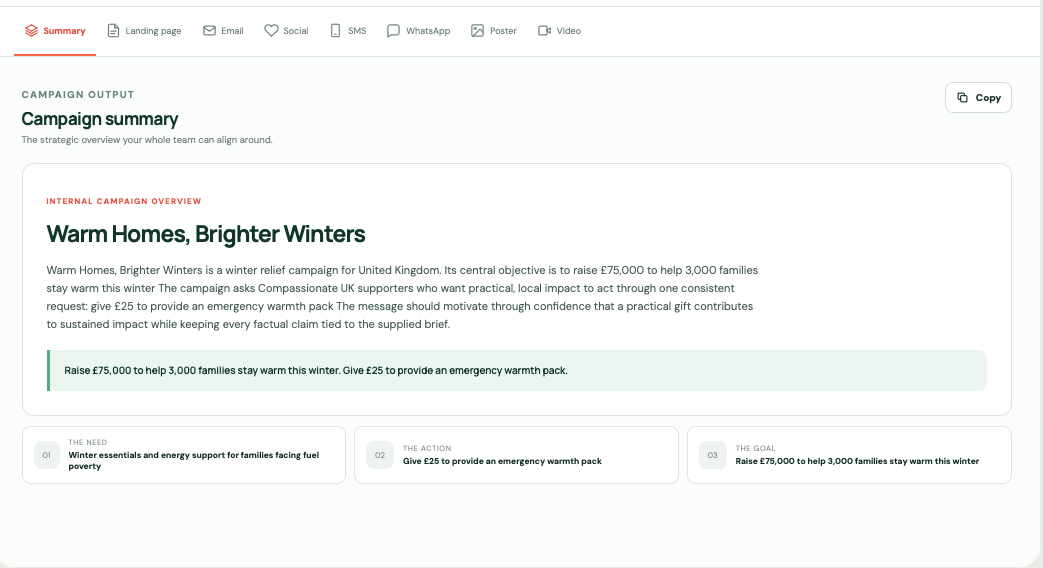
- Landing Page
- Social Media Content
- WhatsApp Message
- SMS
- Campaign Poster Brief
- Video Content Brief
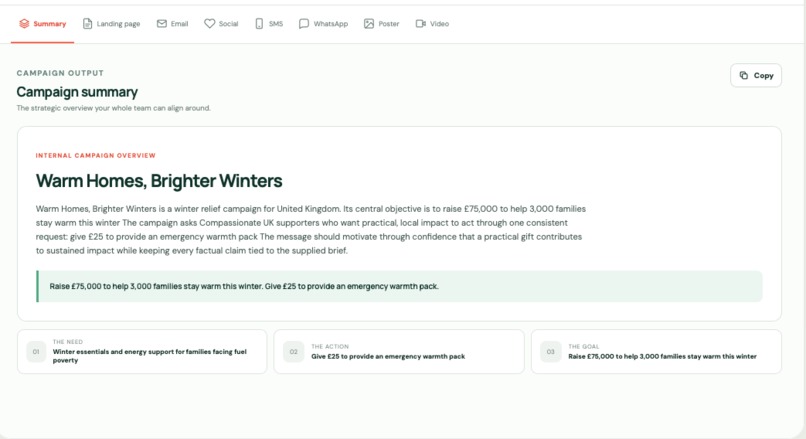
- Internal Campaign Summary
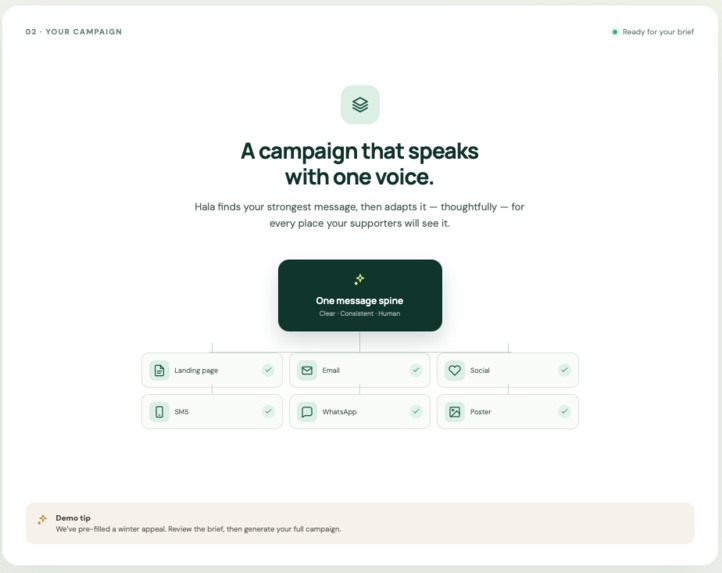
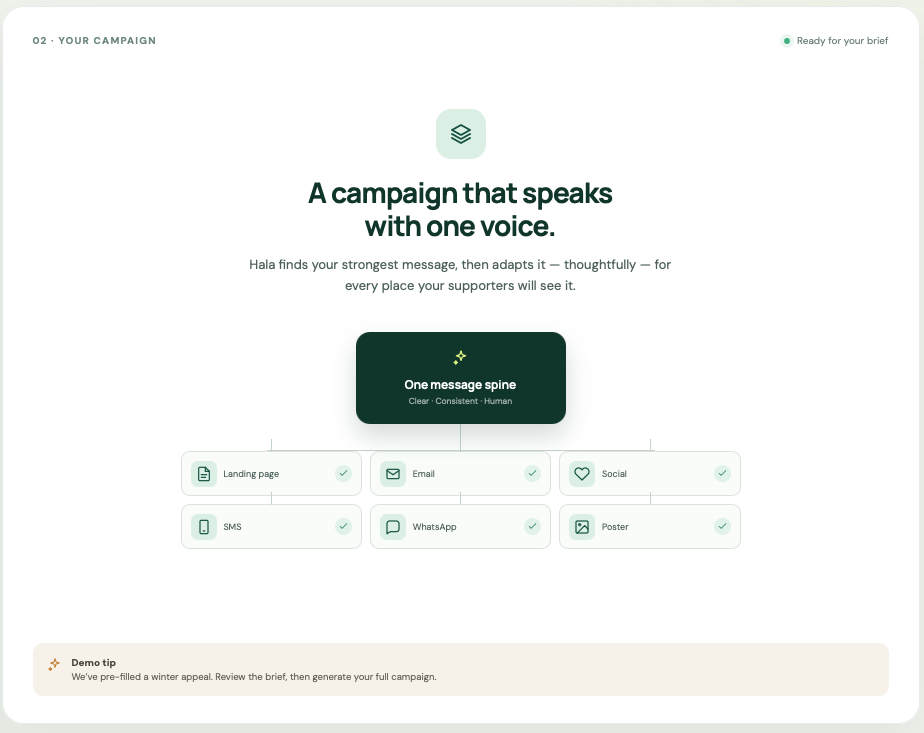
Unlike generic AI writing tools, every output is built from one shared campaign strategy, ensuring all communication channels tell the same story while adapting language for each audience.
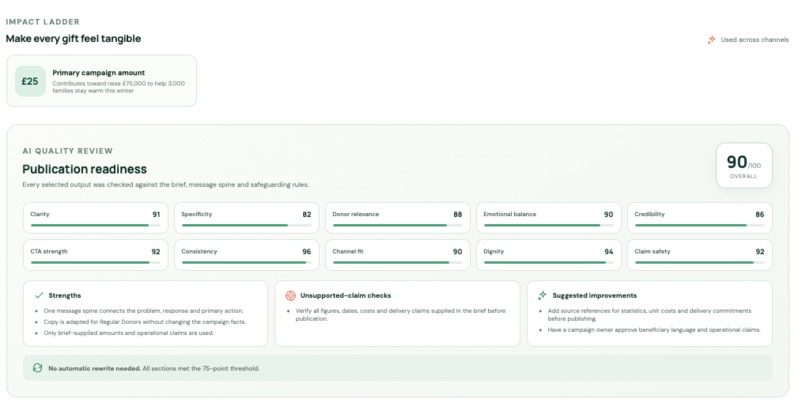
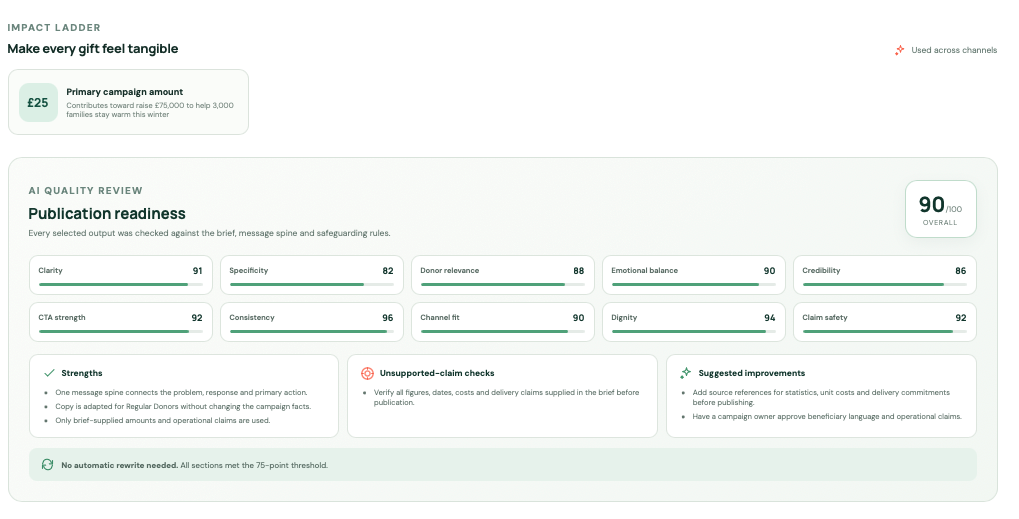
The platform also performs an AI-powered publication readiness review, evaluating clarity, consistency, credibility, emotional balance, safeguarding, and overall campaign quality before publication.
How we built it
Hala Impact AI was built using:
- OpenAI GPT-4o
- React
- TypeScript
- Vite
- Node.js
- Express
- OpenAI API
- Vercel
- GitHub
The generation pipeline follows several AI-assisted stages.
First, the campaign brief is analysed to identify the fundraising objective and build a central Message Spine that represents the single narrative of the campaign.
That message spine becomes the foundation for every generated output.
Each communication channel is then generated independently while remaining aligned with the same campaign strategy.
Finally, an AI quality review evaluates the generated campaign against multiple publishing criteria including:
- clarity
- consistency
- donor relevance
- credibility
- emotional balance
- dignity
- channel fit
- claim safety
The result is a publication-ready campaign bundle rather than isolated AI responses.
Challenges we ran into
One of the biggest challenges was maintaining consistency across multiple AI-generated outputs.
Generating individual pieces of content is relatively straightforward. Ensuring that every email, social post, landing page, SMS, WhatsApp message, poster, and video brief all communicate exactly the same campaign story is much more difficult.
Another challenge involved distinguishing between temporary provider failures and application errors so that fallback behaviour only occurred when appropriate.
During development we also improved:
- request validation
- diagnostic reporting
- timeout handling
- production deployment
- error classification
- Vercel deployment reliability
- client/server validation consistency
These improvements made the application significantly more reliable while keeping human review firmly in control before publication.
Accomplishments that we're proud of
We're particularly proud that Hala Impact AI goes beyond simple AI text generation.
Key achievements include:
- Transforming one campaign brief into multiple publication-ready outputs.
- Maintaining one consistent campaign message across every communication channel.
- Building an AI-powered publication readiness review before content is used.
- Creating a workflow designed specifically for charities instead of adapting generic AI writing tools.
- Successfully integrating OpenAI into a structured multi-stage content generation pipeline.
Most importantly, the platform demonstrates how AI can amplify the impact of small nonprofit teams rather than replace them.
What we learned
This project reinforced that building useful AI products requires much more than connecting an LLM to a prompt.
We learned the importance of:
- structured prompting
- quality evaluation
- consistent information architecture
- reliable backend diagnostics
- strong validation
- human oversight
We also discovered that nonprofit communication has unique requirements that general-purpose AI tools do not automatically address.
Trust, consistency, safeguarding, and factual accuracy are just as important as creativity.
What's next for Hala Impact AI
OpenAI Build Week allowed us to validate the core concept.
Our roadmap includes:
- multilingual campaign generation
- collaborative team workspaces
- CRM integrations
- Mailchimp integration
- Canva integration
- Meta publishing integration
- donor audience intelligence
- campaign analytics
- impact reporting
- fundraising knowledge base
- charity-specific AI agents
Our long-term vision is to make Hala Impact AI the operating system for nonprofit fundraising communications, helping charities around the world create better campaigns faster while remaining transparent, responsible, and human-centered.
We believe AI should not replace the people working to make the world better.
It should help them do even more good.## Inspiration
What it does
How we built it
Challenges we ran into
Accomplishments that we're proud of
What we learned
What's next for Hala Impact AI
Built With
- css3
- express.js
- github
- html5
- javascript
- node.js
- openai-api
- openai-gpt-4o
- react
- typescript
- vercel
- vite

Log in or sign up for Devpost to join the conversation.