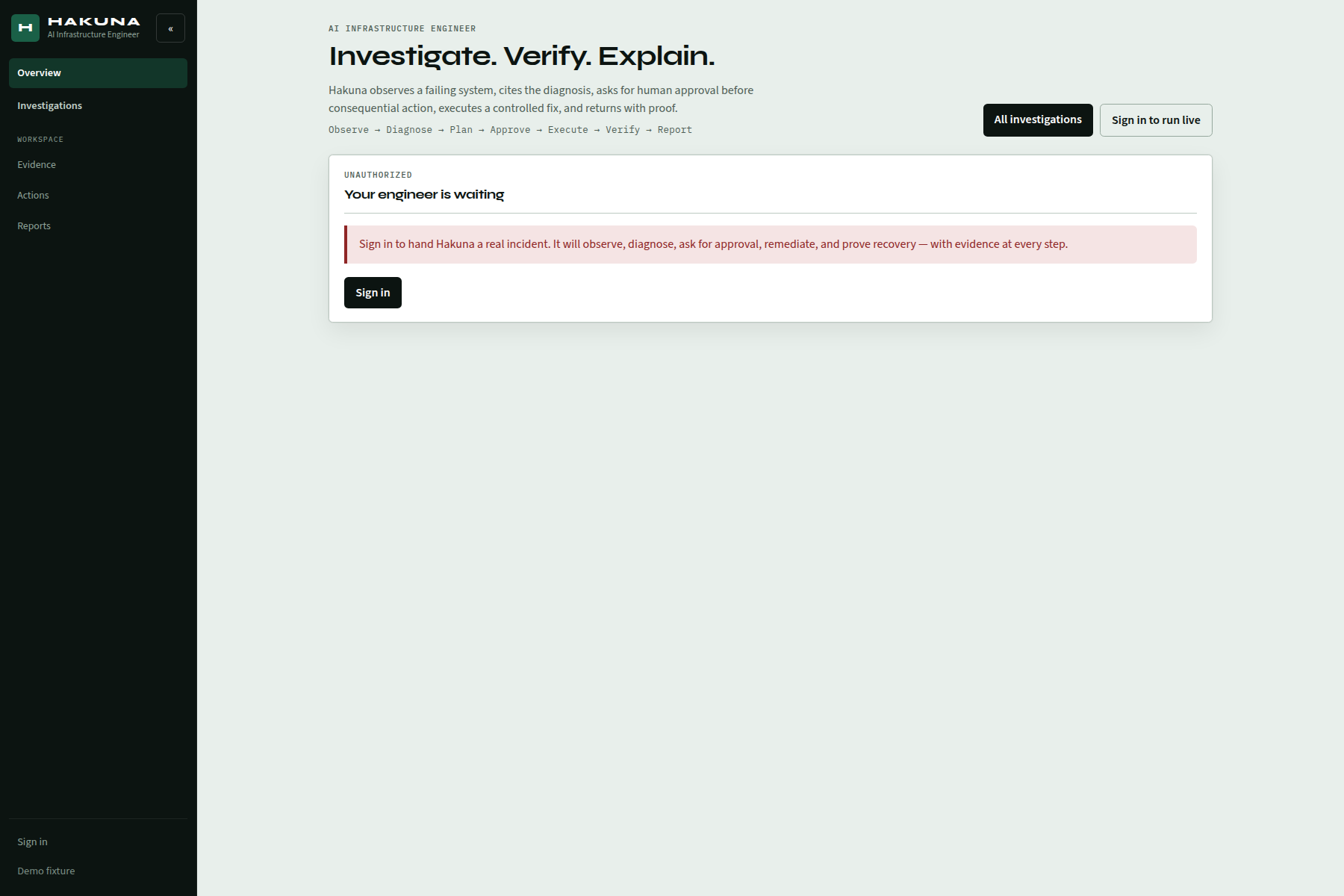

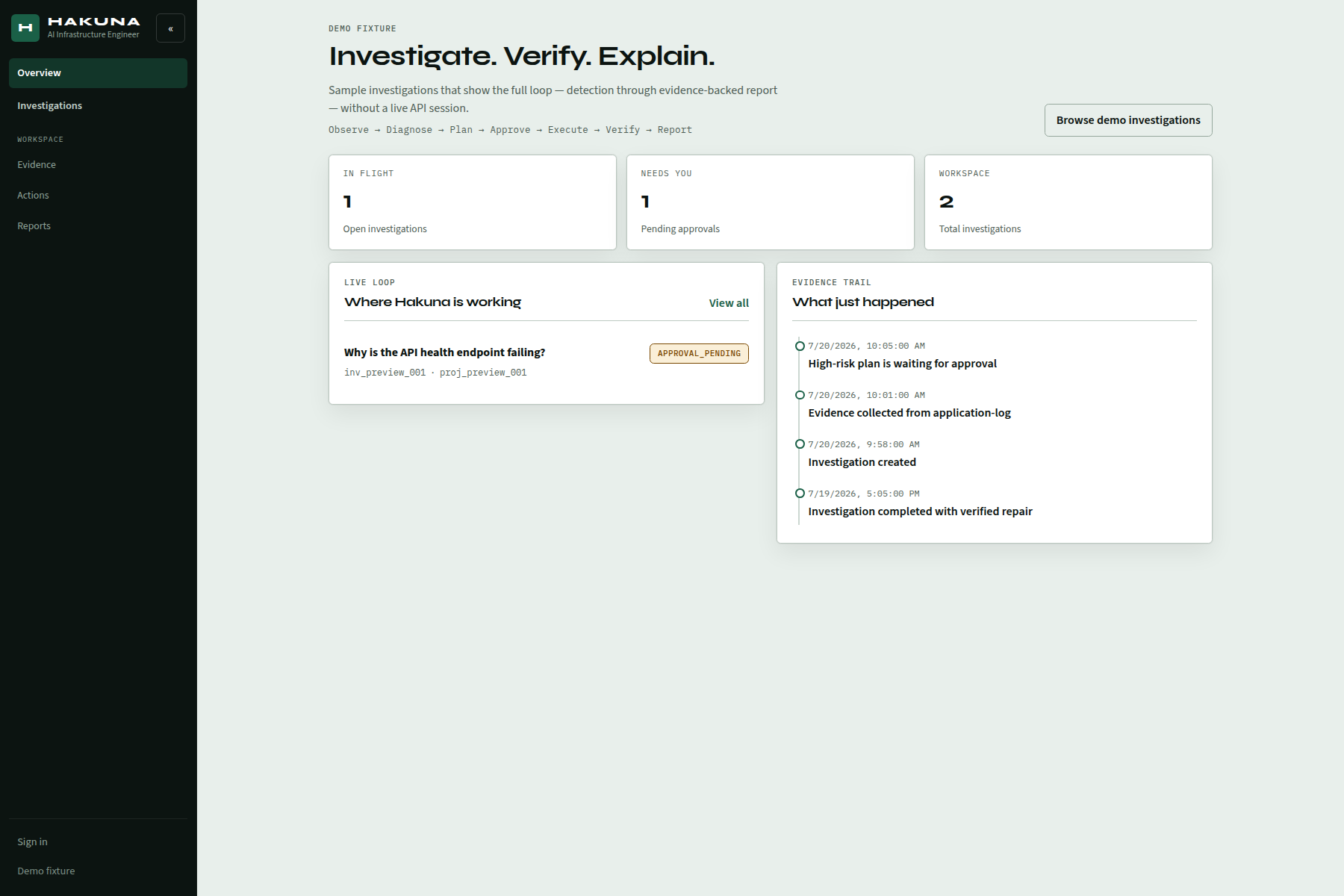
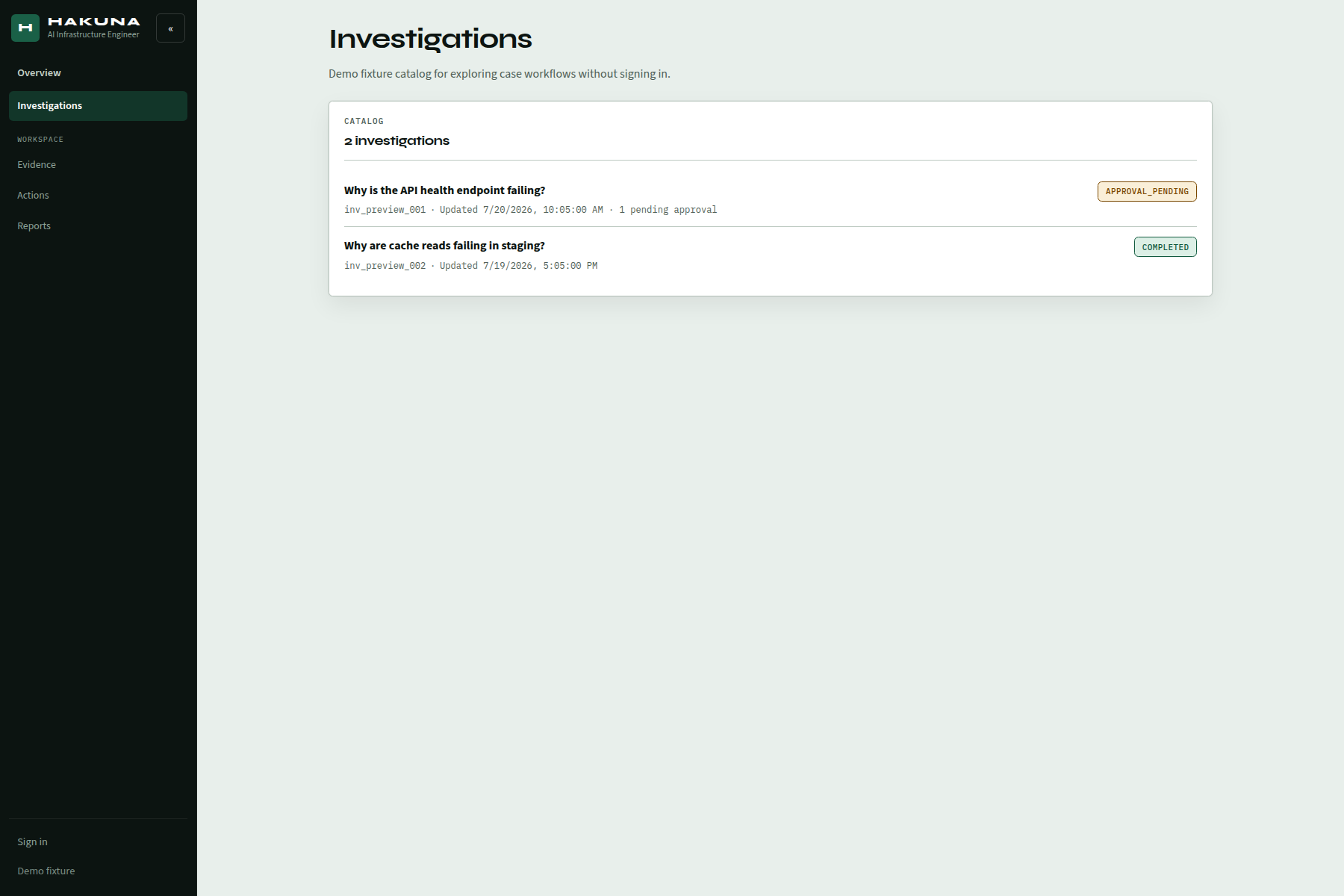
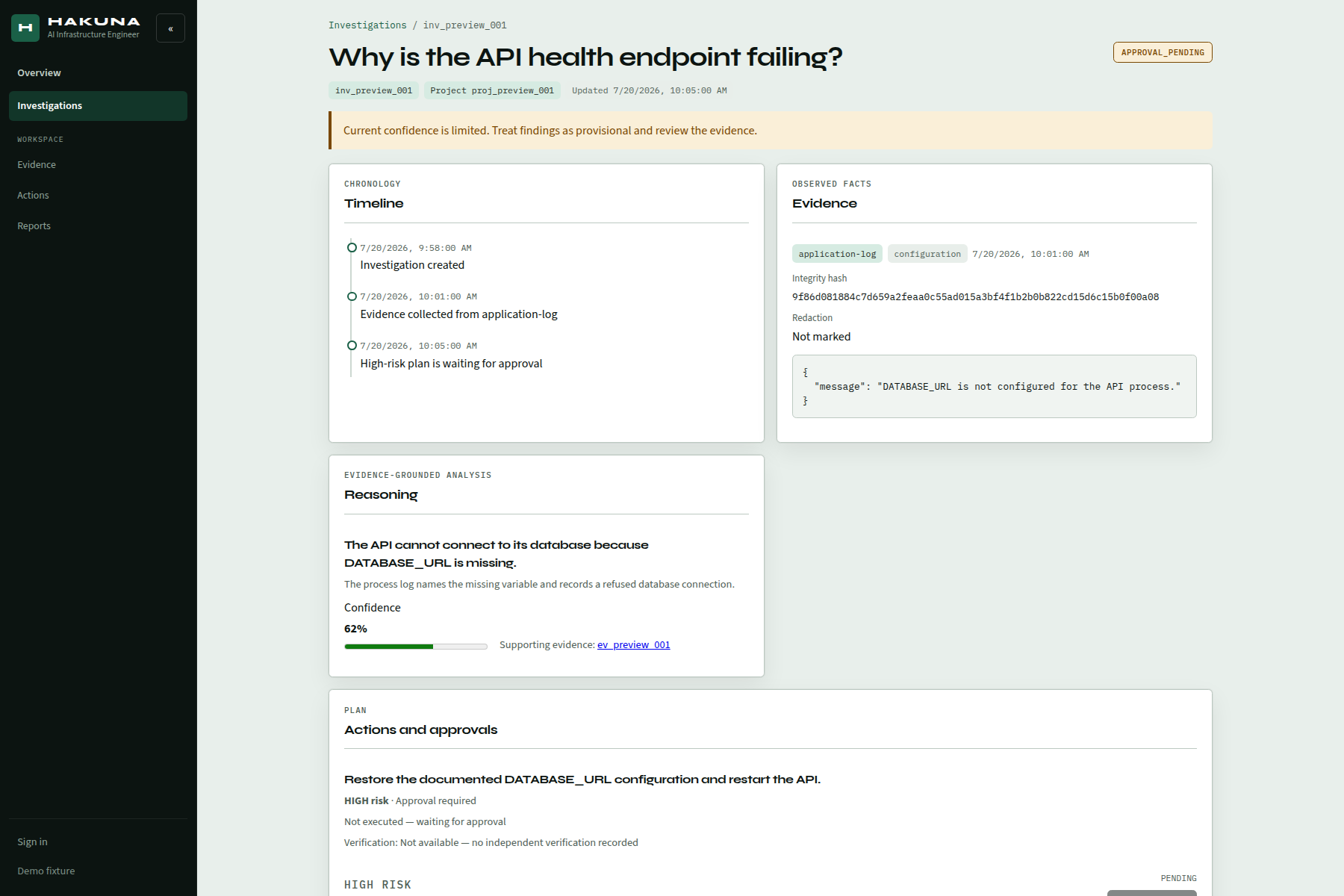
Hakuna — AI Infrastructure Engineer
Inspiration
Every major leap in software has been driven by a new abstraction layer. We moved from machine code to assembly, from assembly to high-level languages, and from writing everything ourselves to frameworks and cloud platforms.
Today, AI is creating the next abstraction layer. Developers are moving from writing instructions to expressing intent. The challenge is verifying outcomes, and executing safely against real systems rather than code generation
We built Hakuna because infrastructure engineering still relies on manual investigation: digging through logs, guessing root causes, applying risky fixes, and hoping they worked. Existing AI tools generate answers, but production engineering demands something more trustworthy.
We believe the future requires an AI that behaves like an experienced infrastructure engineer—not just a chatbot.
What it does
Hakuna is an AI Infrastructure Engineer.
Given a natural-language problem report, Hakuna executes a structured engineering workflow:
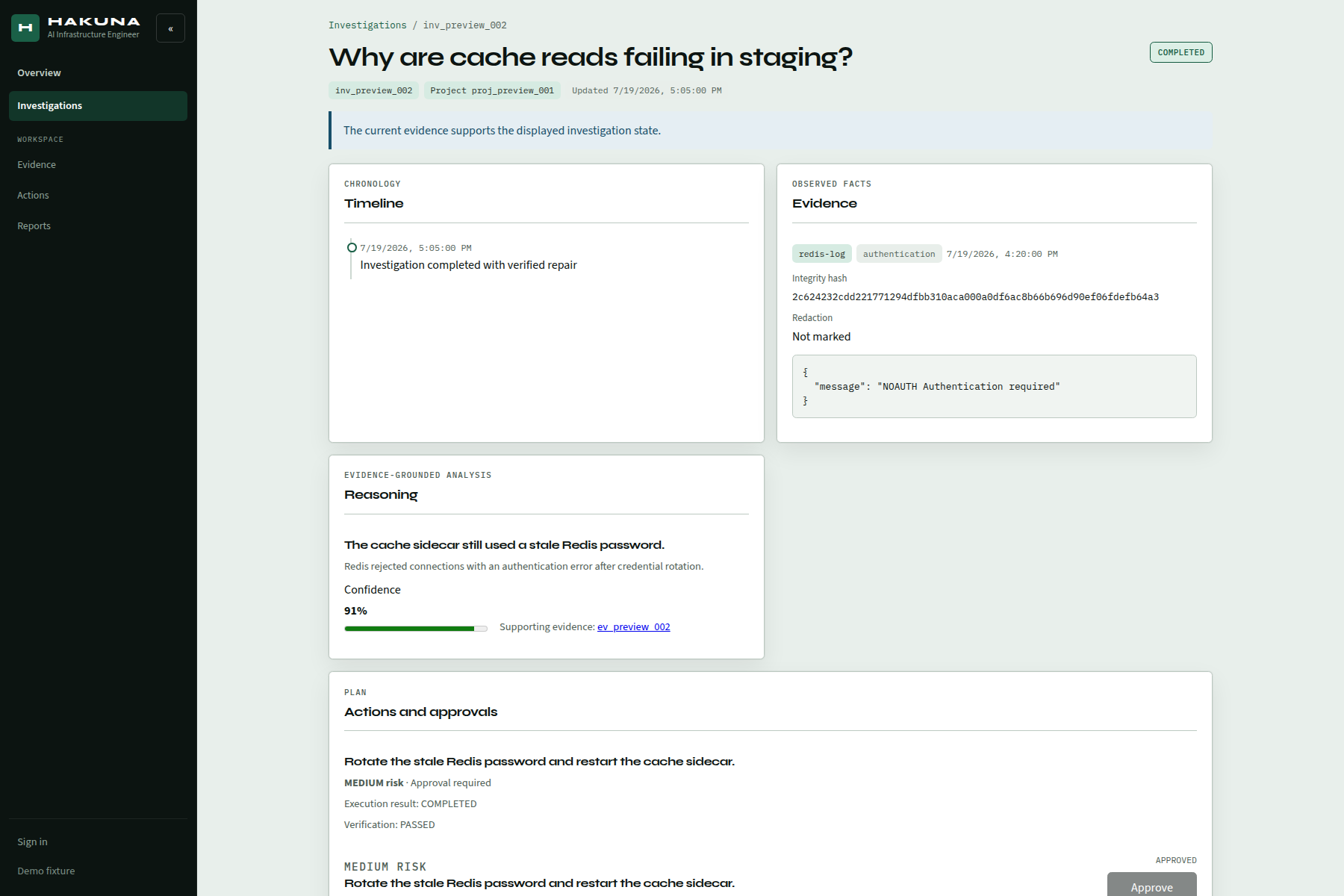
Investigate → Diagnose → Plan → Approve → Execute → Verify → Report
Rather than jumping directly to an answer, Hakuna:
- Observes system health, logs, files, Git history, and operational signals.
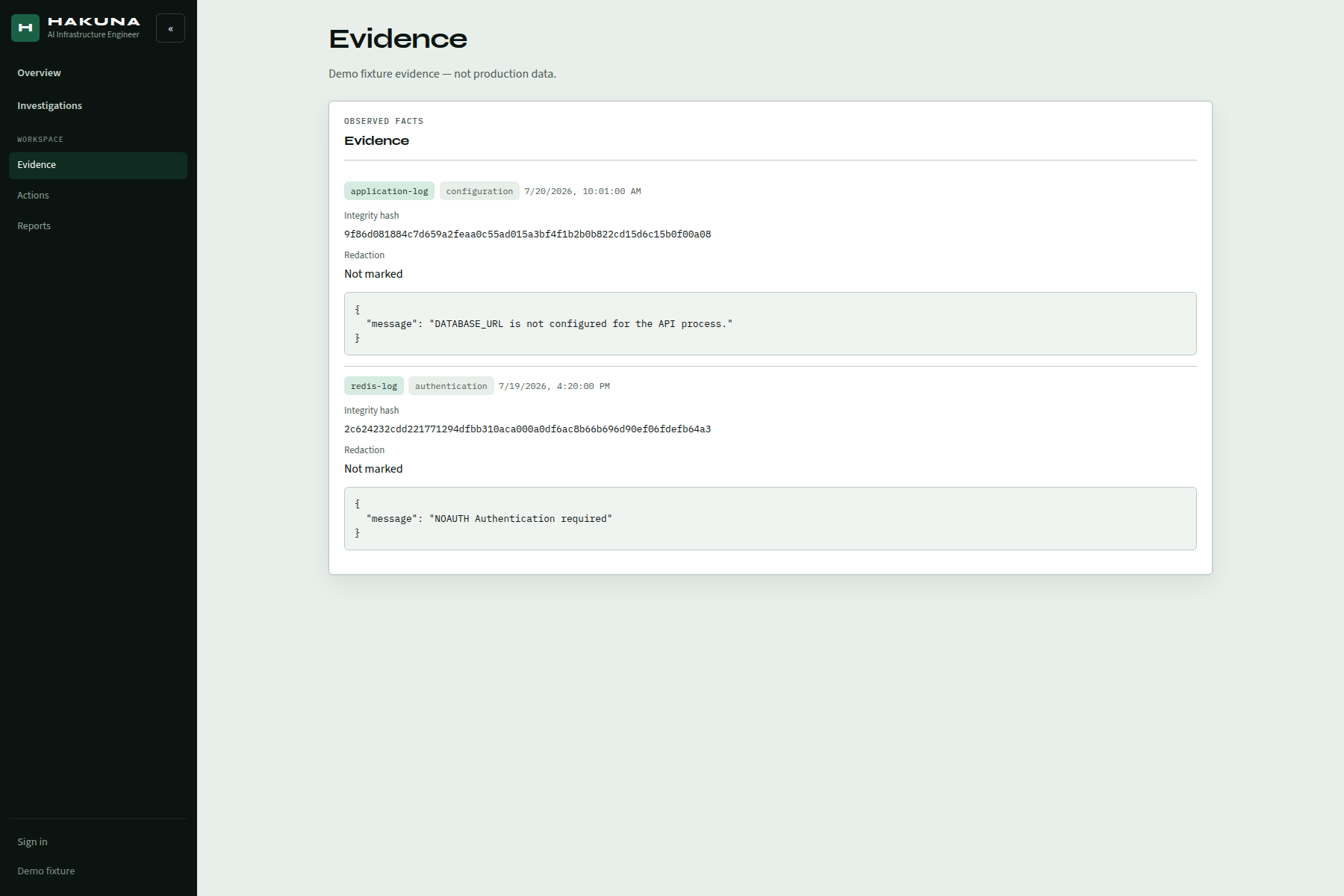
- Collects evidence before making conclusions.
- Uses GPT-5.6 to reason over that evidence and generate ranked hypotheses.
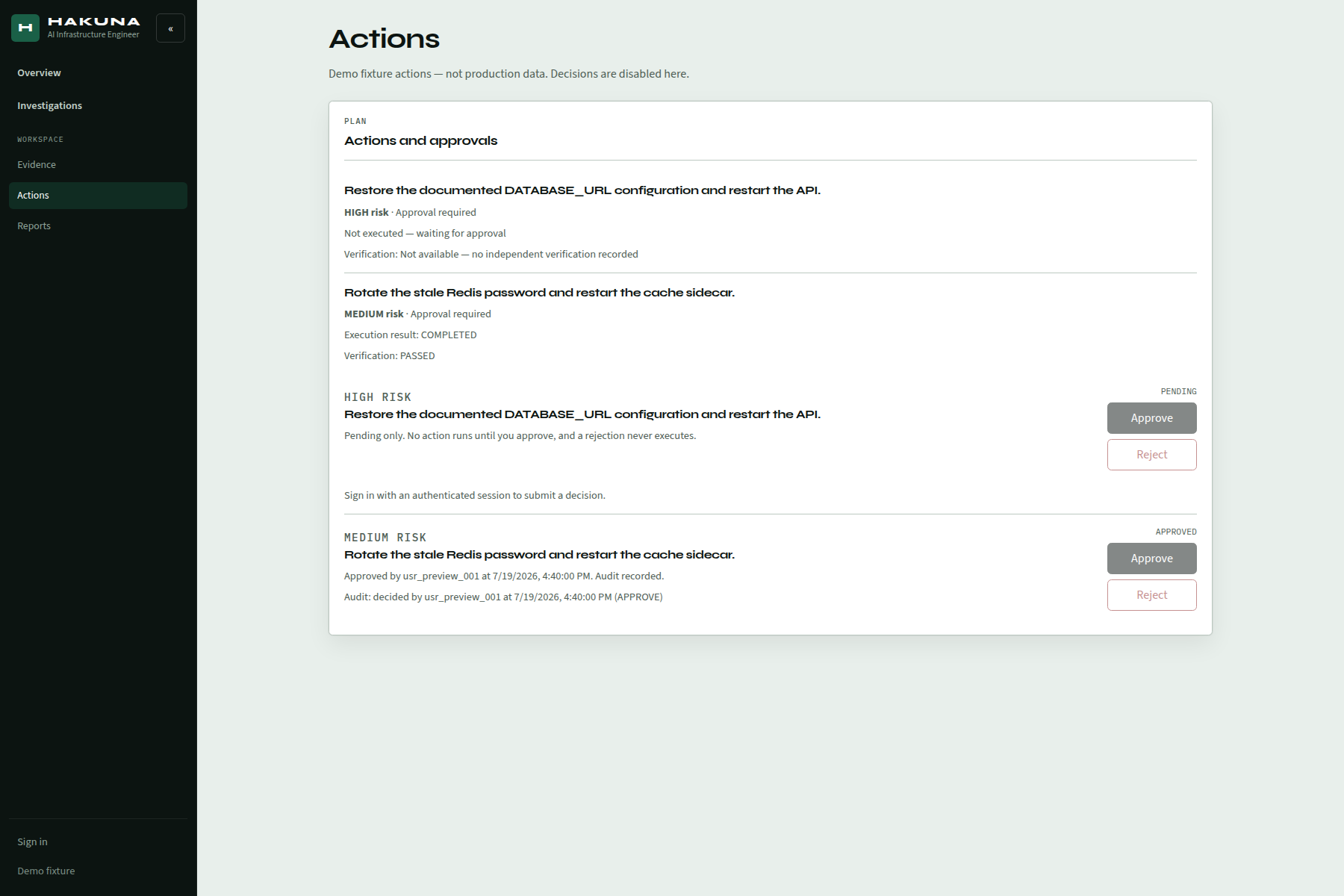
- Produces an explainable, risk-scored remediation plan.
- Requires explicit human approval before any consequential action.
- Executes only approved actions through an allowlisted tool system.
- Independently verifies recovery.
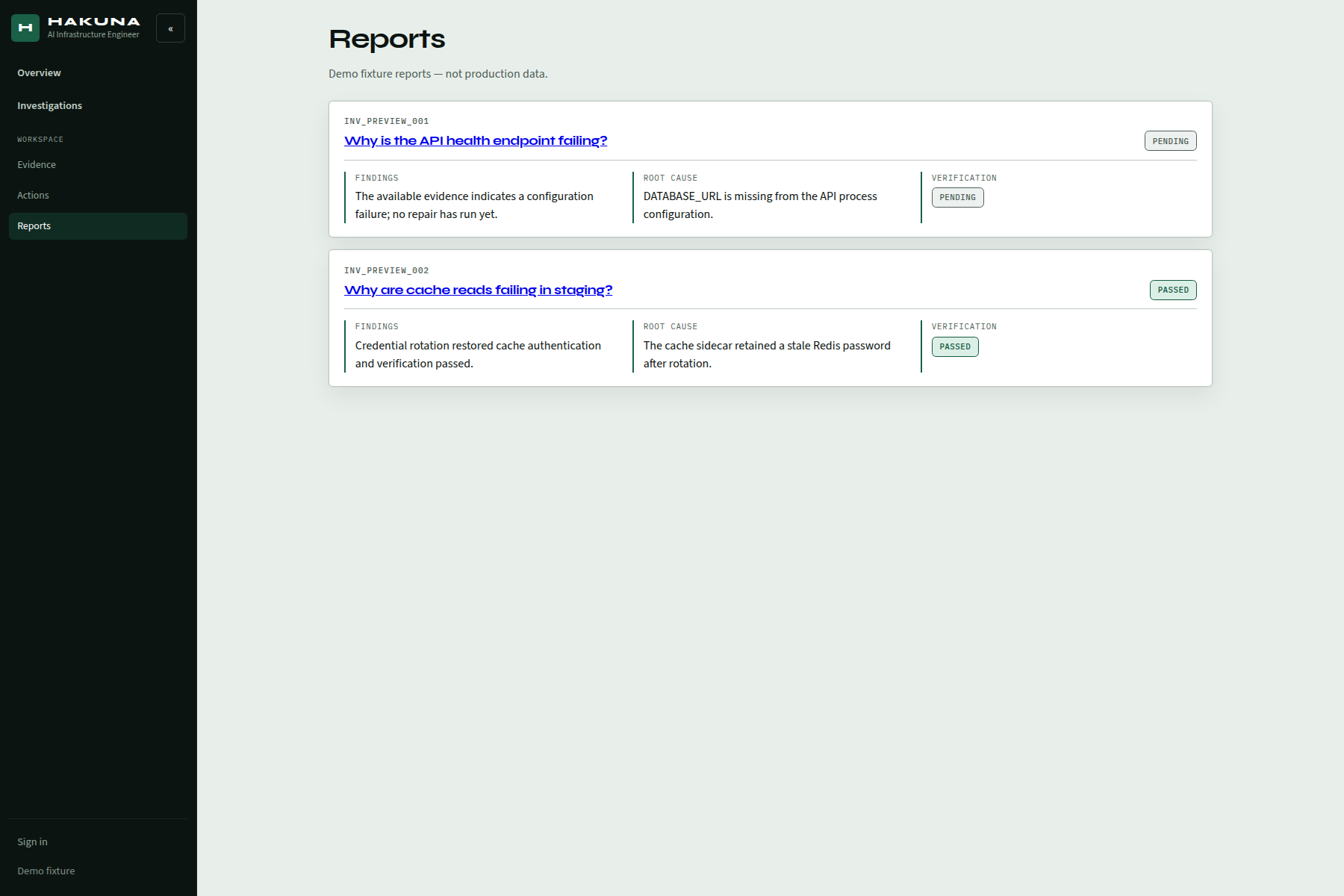
- Produces a structured investigation report backed by evidence instead of a chat transcript.
Today, Hakuna includes:
- A web dashboard
- A Railway-hosted API and investigation worker
- A CLI with browser authentication
- Supabase Auth + PostgreSQL with Row-Level Security
- Redis-backed durable investigation jobs
For Builder Week, the demo investigates a deliberately broken sandbox environment, proposes a fix, waits for approval, remediates the issue, verifies recovery, and generates a final engineering report.
How we built it
Hakuna is built as a modular, event-driven engineering platform.
The system consists of:
- Dashboard deployed on Vercel
- API and investigation worker deployed on Railway
- CLI distributed through npm
- Shared packages for investigation lifecycle, tool runtime, and evidence modeling
Investigations move through durable states:
Observation → Evidence Collection → Reasoning → Planning → Waiting for Approval → Execution → Verification → Reporting
gpt-5.5-terra serves as Hakuna's reasoning engine. Instead of treating the model as a chatbot, we use it to analyze evidence, generate competing hypotheses, rank likely root causes, synthesize remediation plans, and produce structured engineering reports.
Codex accelerated implementation across the repository, helping us rapidly build architecture, backend services, shared packages, documentation, and engineering workflows while preserving a clean, production-oriented design.
The platform also incorporates a safety-first execution model:
- JWT-backed authentication
- PostgreSQL Row-Level Security
- Explicit approval gates before consequential actions
- Allowlisted execution tools
- Evidence-backed verification after execution
Challenges we ran into
Building trustworthy infrastructure AI turned out to be much harder than generating code.
Some of our biggest challenges included:
- Designing durable approval workflows that survive worker crashes and deployments.
- Synchronizing Railway deployments, health checks, worker lifecycles, and runtime configuration.
- Balancing PostgreSQL Row-Level Security with privileged worker execution without compromising tenant isolation.
- Coordinating dashboard, API, Redis, Supabase, workers, and sandbox environments into a reliable end-to-end workflow.
These problems pushed us to think beyond AI prompts and focus on building dependable engineering infrastructure.
Accomplishments that we're proud of
We're proud that Hakuna is more than another coding assistant.
We built a complete engineering loop capable of:
- Investigating a real failing environment
- Producing evidence-backed diagnoses
- Generating explainable remediation plans
- Waiting for human approval
- Executing approved actions safely
- Independently verifying recovery
- Delivering structured engineering reports
We're also proud of building the product around safety, transparency, and explainability from the beginning rather than adding those features afterward.
What we learned
Building with GPT-5.6-terra taught us that the future of engineering AI is not about producing better answers—it's about producing more trustworthy engineering decisions.
We learned that separating investigation into evidence collection, reasoning, planning, execution, and verification creates significantly more reliable systems than relying on a single prompt.
We also learned that durable workflows, auditability, approval gates, and verification matter just as much as model intelligence when AI interacts with production infrastructure.
What's next for Hakuna
Our immediate roadmap is to move beyond a Builder Week sandbox into real engineering environments.
Next, we're building:
- GitHub App and repository integrations
- Secure customer infrastructure connections
- Multi-tenant workspaces
- Expanded allowlisted execution tools
- Richer observability and enterprise integrations
Long term, we believe software is entering a new abstraction layer.
Developers won't spend their time writing instructions—they'll express intent.
Hakuna is building the engineering intelligence layer that turns that intent into safe, explainable, and verifiable execution.
We believe the next interface for software isn't code. It's engineering intent.
Built With
- bash
- codex
- css
- gpt-5.6-terra
- javascript
- railway
- redis
- supabase
- typescript


Log in or sign up for Devpost to join the conversation.