-
-
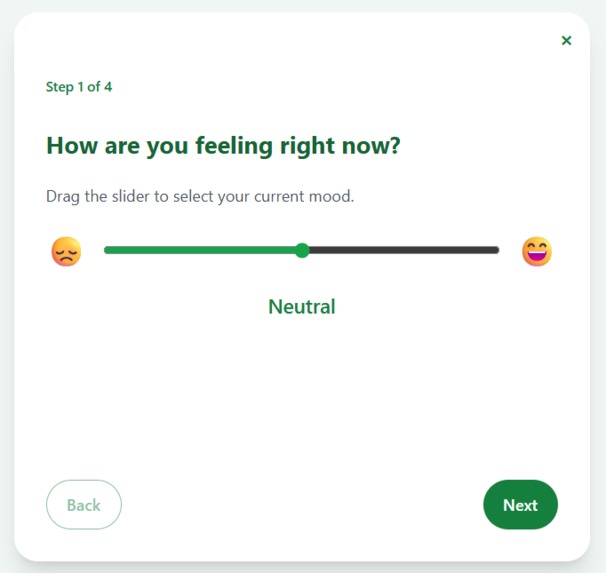
Initial Survey
-
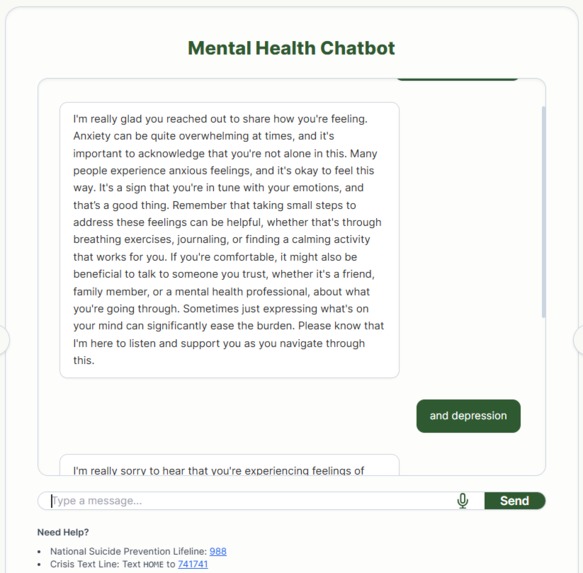
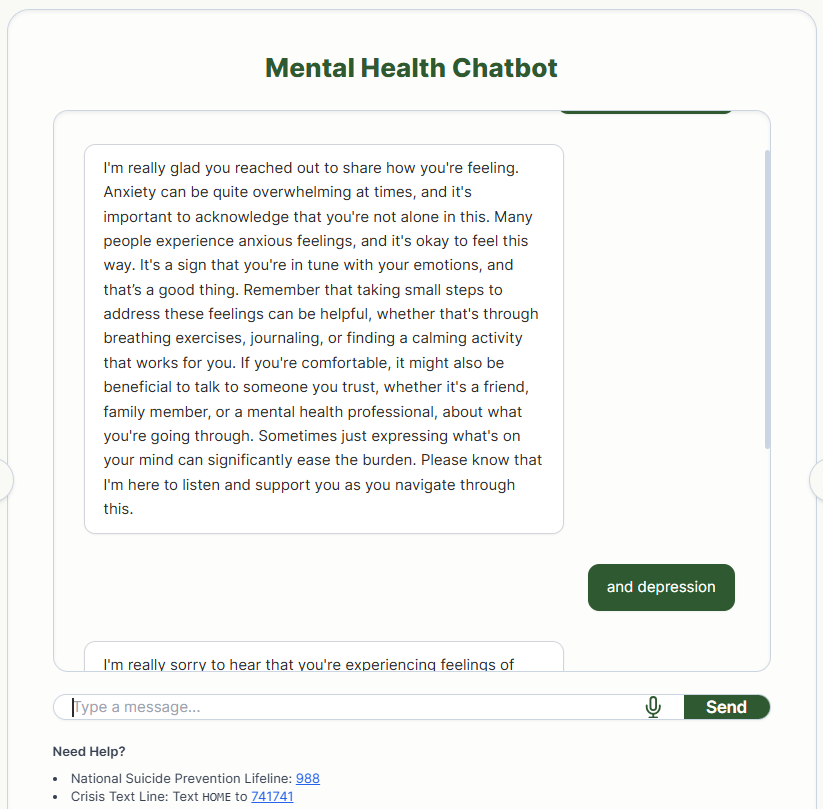
Chatbot
-
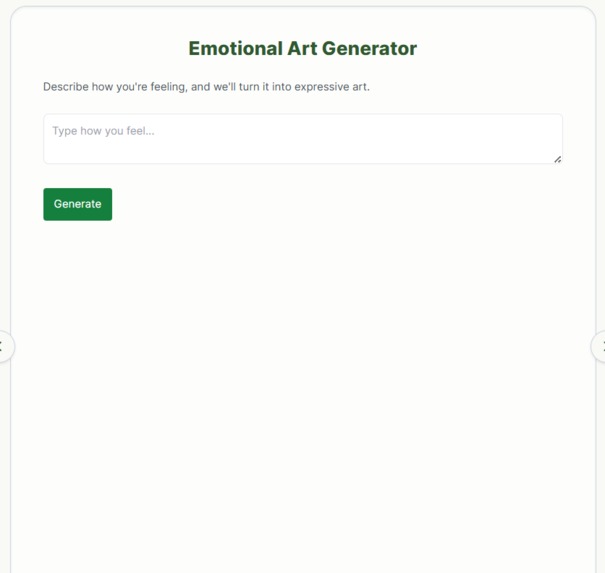
Art Generator
-
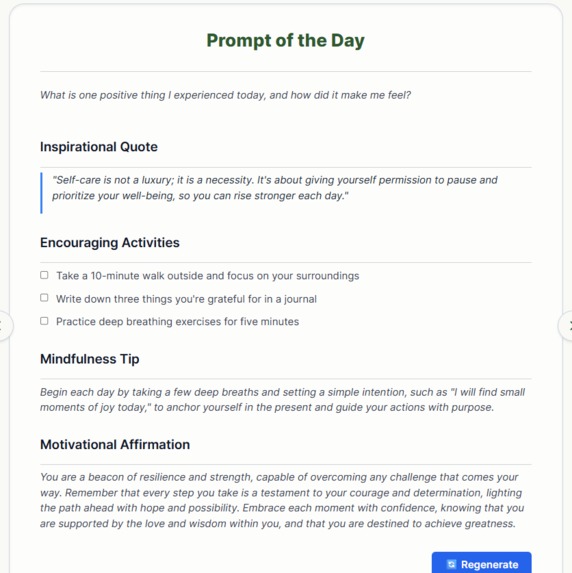
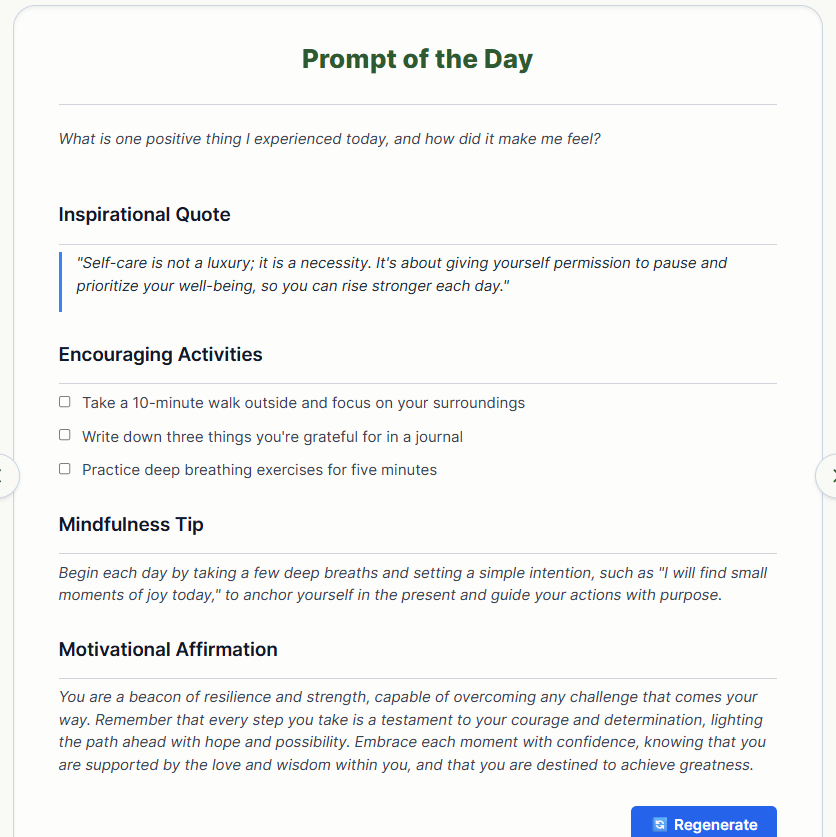
Activities Suggestion
-
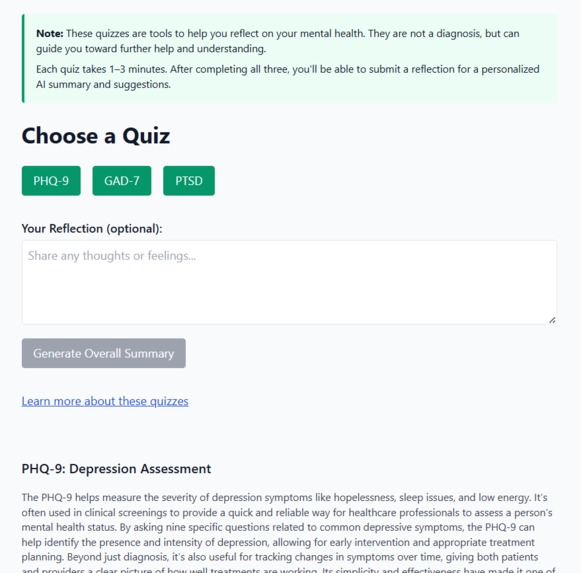
Quiz Page
-
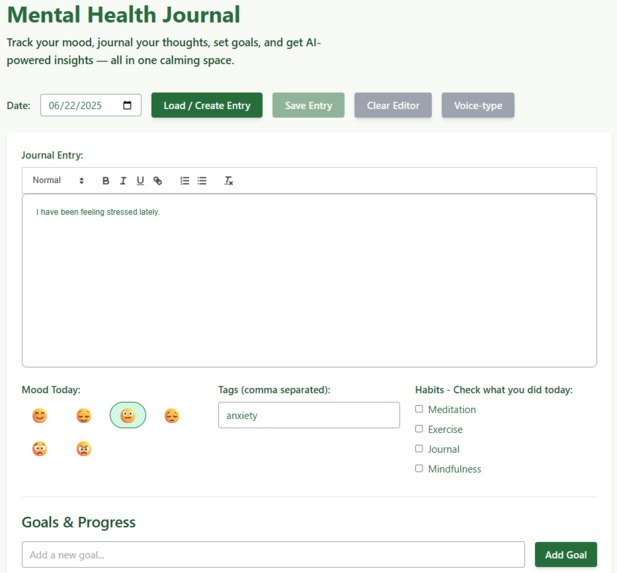
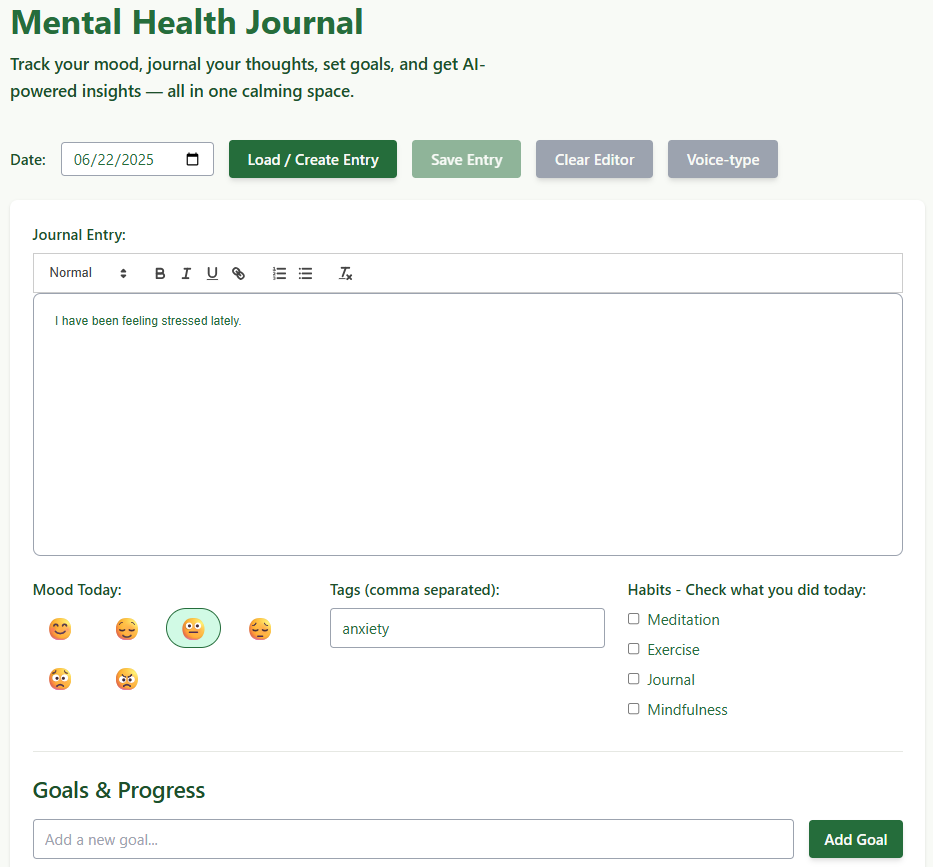
Journal Page
-
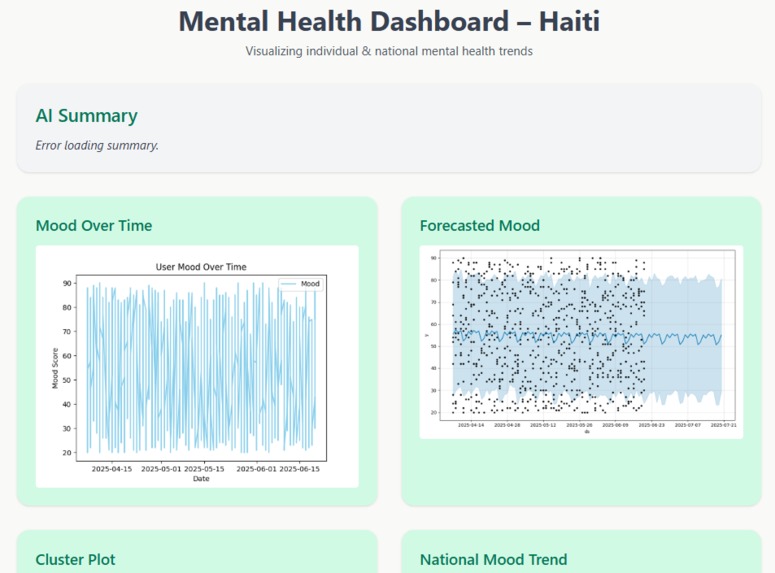
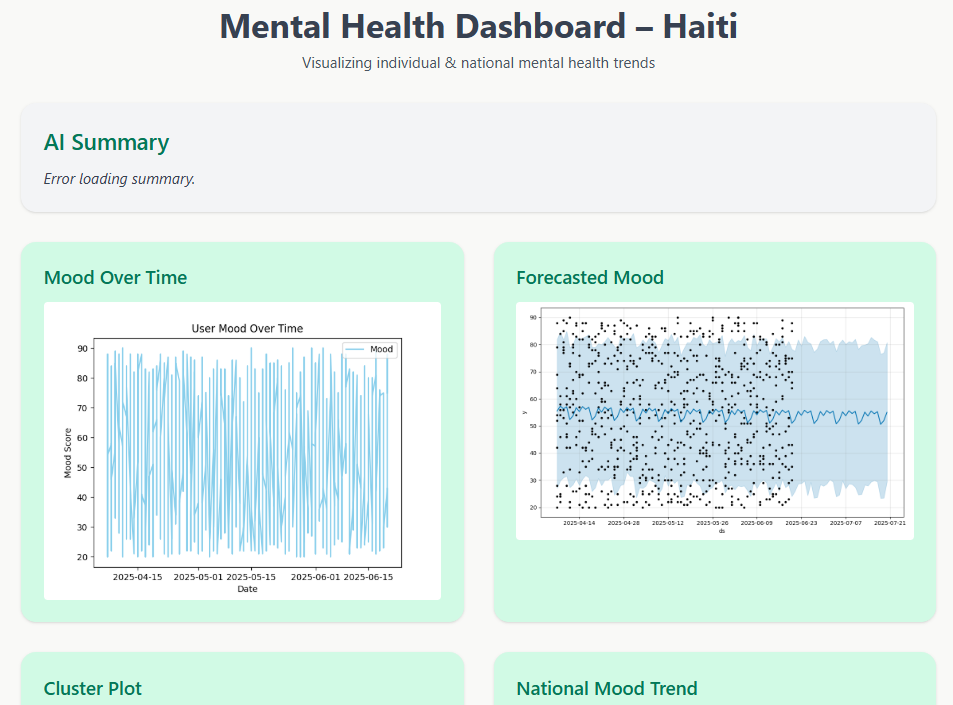
Stats Page
-
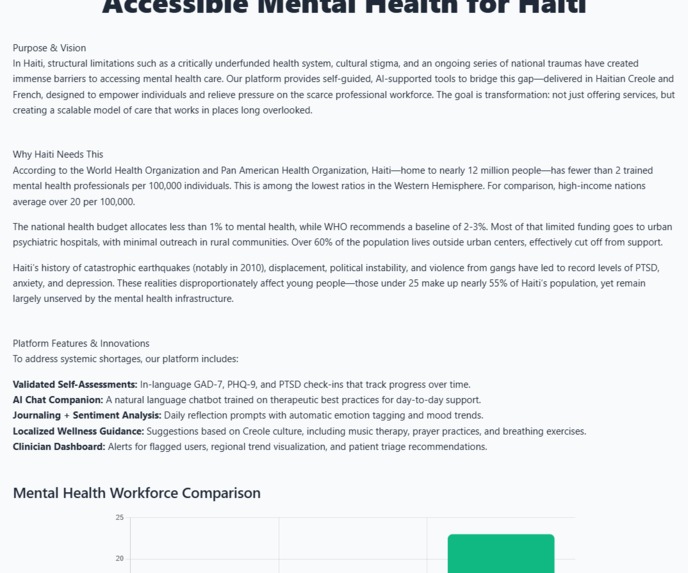
Info Page



Inspiration
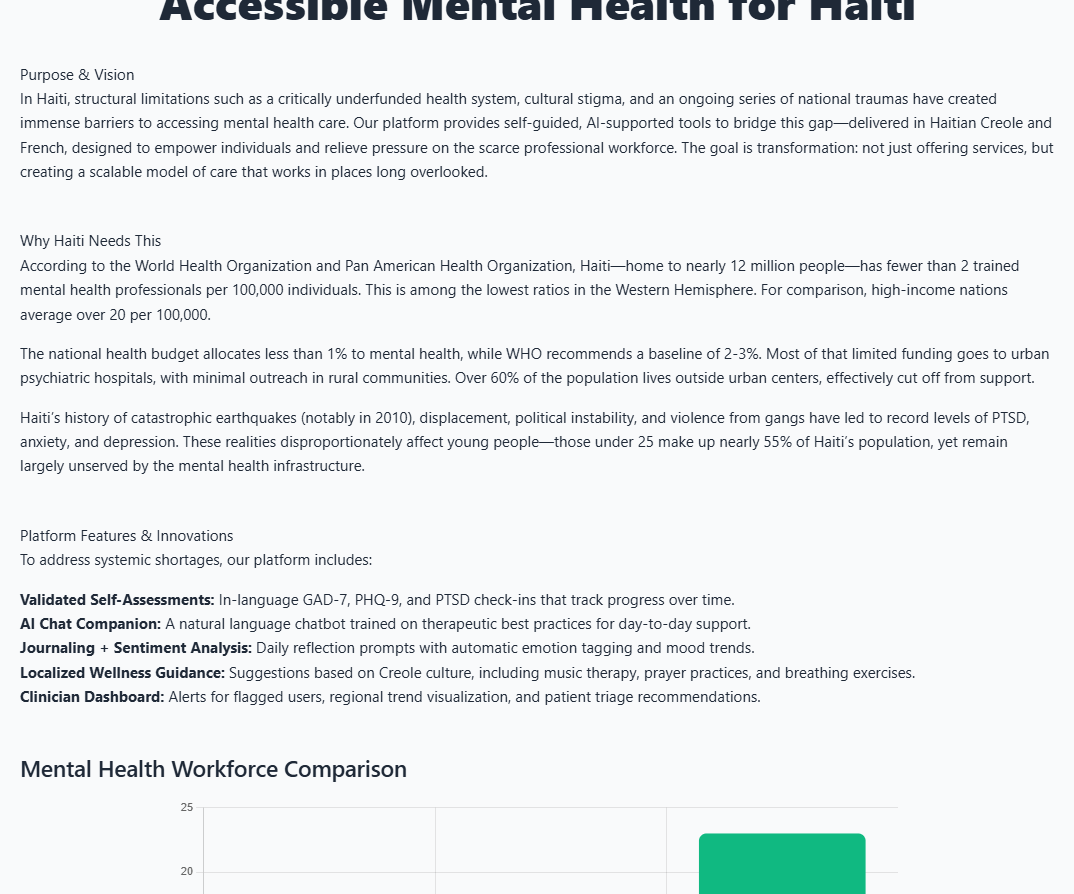
Haiti faces one of the most severe mental health crises in the Western Hemisphere, a condition largely hidden in plain sight. With fewer than two mental health professionals per 100,000 people and fewer than 300 professionals serving a population of over 11 million, the country has long struggled to address the psychological wounds left by political instability, extreme poverty, displacement, and recurring natural disasters. Events such as the 2010 earthquake, which displaced over 1.5 million Haitians, and the escalating gang violence in Port-au-Prince have compounded national trauma, especially among the youth. Over 55% of the population is under 25, yet the mental health infrastructure for this demographic is virtually nonexistent.
Inspired by the resilience of Haitian youth and the urgent need for scalable tools, I created HaitiHealth. This digital, offline-first, culturally-informed mental wellness tracker speaks to Haiti’s lived experience. As a high school student with a passion for humanitarian design, I wanted to build a system that doesn’t wait for national infrastructure reform to bring relief. Instead, HaitiHealth empowers individuals directly with emotional support tools, trauma education, and local language accessibility.
What it Does
HaitiHealth is a self-guided, multilingual platform designed to help users recognize, reflect on, and respond to their mental health challenges in a dignified, anonymous way. Unlike traditional mental health apps that rely heavily on internet access or clinical partnerships, HaitiHealth functions completely offline and doesn’t store personal identifiers. It consists of four primary components.
First, it provides validated self-assessments in Haitian Creole, French, and English—specifically, the GAD-7 for anxiety, PHQ-9 for depression, and PTSD symptom checklists. Each assessment is user-scored, with visual cues and localized language explanations that help individuals understand what their score means.
Second, HaitiHealth includes a guided journaling system that encourages users to reflect on their emotions through daily prompts. They can tag their entries with emotional states such as “triste” (sad), “anxieux” (anxious), or “vide” (numb), and review trends in their emotional states over time. This data stays local to the device and is presented through basic visualizations like bar charts and mood streak trackers built from scratch—no third-party chart libraries are used.
Third, the app includes a growing mental health education section that explains conditions like PTSD, substance abuse, and generalized anxiety in plain, culturally sensitive terms. Coping strategies are adapted to Haitian traditions, including prayer, herbal remedies, music therapy, and storytelling.
How I Built It
HaitiHealth was built as a static, responsive web application using HTML5, TailwindCSS, JavaScript, Flask, and Python. The layout and design emphasize clarity, minimalism, and culturally appropriate color themes—emerald green accents for calm, warm off-whites for comfort, and dark grays for readability.
Because the platform had to function entirely without backend servers, every assessment, journal entry, and interaction is stored in the browser’s localStorage. Visualizations, such as score trends or emotional tagging data, are generated through handcrafted bar charts and counters, rather than relying on libraries like Chart.js. This approach also ensures the app is extremely lightweight and can be deployed on basic mobile devices common in Haiti.
Accessibility was central to development: all text is high-contrast, readable at multiple screen sizes, and navigable with limited tech literacy. While future versions will include voice prompts and offline audio for Creole speakers with low literacy, the current version is already deployable on most Android browsers.
Challenges I Faced
One major challenge was building trust into a system that requires vulnerability. In Haiti, mental illness is often misunderstood or associated with shame, spiritual possession, or weakness. The UI had to be welcoming, affirming, and completely anonymous to earn trust from users. Even small details—such as avoiding red error indicators or “clinical” language—were important in reducing the emotional barrier to entry.
Moreover, developing offline data visualization was technically difficult without libraries. I had to simulate basic chart behavior (e.g., changing colors with score thresholds, animating journal streaks) using native JavaScript, Tailwind transitions, and manual coding of visual feedback systems.
Lastly, designing for devices with limited power, screen space, or connectivity meant extensive testing on older mobile browsers. Since I avoided frameworks like Alpine.js or React, I had to write all interactivity manually in JavaScript, balancing performance with clarity.
Accomplishments I Am Proud Of
I'm proud of the app’s clean, lightweight UI—fully responsive, touch-friendly, and suitable for transferring it to be offline. I am also proud of creating a complex app with Flask and Python, a skill I have been learning.
The journaling and mood tagging feature, in particular, allows users to see how their emotions change over time without feeling surveilled or judged. This small feature has had an outsized emotional impact during testing, particularly with Haitian youth groups who had never before tracked their feelings or been asked how they felt.
Through the statistics page, mental health professionals can have access to a large database of data to better understand the current situation of the nation and the primary issues that the nation has been facing. Therefore, through tools like this, the medical field in Haiti and the world can be drastically improved.
Finally, I’m proud that HaitiHealth doesn’t just address a problem—it proposes a replicable model. Its modular, offline-first architecture can be cloned for other low-resource, high-trauma regions around the globe.
What I Learned
This project taught me that designing for low-resource environments demands more than removing features—it requires a mindset shift. Most platforms assume internet access, cloud storage, and medical literacy. But in Haiti, users may have a shared family phone, zero access to data, and a fear of being labeled as "crazy" if they open a mental health app. Every element of HaitiHealth—from the tone of the copy to the journaling UI—had to be designed with that in mind.
From a technical standpoint, I gained deep experience building progressive, resilient interfaces using just HTML, JavaScript, and Tailwind. I am also happy that I used Python libraries to create well-made charts.
What’s Next
What’s next for HaitiHealth is both deeply ambitious and fundamentally necessary. First of all, it’s important to recognize that this website is only a small snippet of the functionalities that can—and should—exist in a robust, trauma-informed mental health platform for a country like Haiti. While the current system includes operational core features such as self-assessments, journaling tools, and multilingual interface toggles, there are several components, such as the statistics dashboard and the mental imagery support system, that are still placeholders. These sections are designed to be expanded into fully interactive, data-driven tools: for example, the statistics page will eventually include real-time visualized trends on anxiety, depression, and PTSD symptoms reported across regions or age brackets, using anonymized, localStorage-based aggregation models. Similarly, the image generator will become a therapeutic tool, allowing users to visually represent their feelings or symptoms through AI-generated visual metaphors, useful for those who cannot always articulate their trauma verbally.
Language support will be further refined and embedded into the entire system architecture. By utilizing a Flask-based backend, the website can soon handle smart routing and translation using stored dictionaries and community-reviewed language banks. This means that all content, including error messages, user tips, and journaling prompts, will appear organically in Haitian Creole and French, ensuring not only accessibility but emotional relatability. Creole, in particular, is critical for cultural trust; many Haitians may be able to read French, but feel more emotionally safe in Creole, especially when dealing with topics of vulnerability, fear, and mental illness. This backend also opens up future potential for language expansion, regional dialect adaptation, and even user-contributed vernacular glossaries.
A major focus is offline accessibility. Given that less than 36% of Haitians have consistent internet access, and even fewer own laptops or high-end smartphones, HaitiHealth must evolve into a completely offline-first web app with optional downloadable components. This includes caching all language files, educational materials, and assessment tools locally, so they can run without any connection at all. This is already in motion with the current use of localStorage for data retention, but future builds will include service workers and bundled resources for complete progressive web app (PWA) deployment, allowing installation directly on Android devices. Once offline-first deployment is perfected, HaitiHealth can be installed via SD cards in rural clinics or preloaded on school or church devices without any reliance on servers.
Mobile optimization is another significant area of growth. Many Haitians only access the internet through low-end Android smartphones, and some may rely on shared or public devices. Thus, HaitiHealth must be tailored to smaller screens, with touch-friendly interfaces, voice input support, and text magnification options. We are currently designing a dedicated mobile app version using Flutter or React Native, depending on eventual device testing feedback. This app will include push-based journaling reminders, offline assessment history, and community messages that users can download during brief periods of connectivity and review later at their own pace.
As for actual psychological support, HaitiHealth will soon integrate guided therapeutic response pathways. For example, if a user scores high on the PTSD screener, they will be led into a trauma-informed coping sequence that includes visual breathing tools, grounding exercises, audio affirmations in Creole, and links to printable support sheets for their family or religious leader. These sequences are informed by Cognitive Behavioral Therapy (CBT) principles, but localized to Haitian cultural norms and idioms. Long-term, we will also pilot peer-support modules where users can anonymously share coping ideas or receive motivational messages from others who’ve reported similar symptoms, all within a moderated, privacy-respecting format.
The full-scale impact of HaitiHealth, once fully realized, could be profound. If adopted widely across schools, clinics, churches, and youth centers, it has the potential to support mental health recognition and resilience-building for hundreds of thousands of people who would otherwise suffer in silence. By educating people about their symptoms, offering private and stigma-free ways to reflect and cope, and tracking emotional data over time it can destigmatize mental illness and replace fear with empowerment. More importantly, by being usable offline, in Creole, and on low-cost devices, HaitiHealth sidesteps the very barriers that have kept professional mental health care out of reach for most Haitians.
Over time, HaitiHealth could even serve as a model for trauma-informed digital wellness tools in other post-disaster, post-conflict, or underserved regions globally. The modular design allows for replication in other languages and countries, creating a blueprint for equitable, low-tech mental health care worldwide. In this way, a tool designed for Haiti might not just change Haiti, but inspire a new global standard in community-centered, offline-first digital mental health solutions.


Log in or sign up for Devpost to join the conversation.