-
-
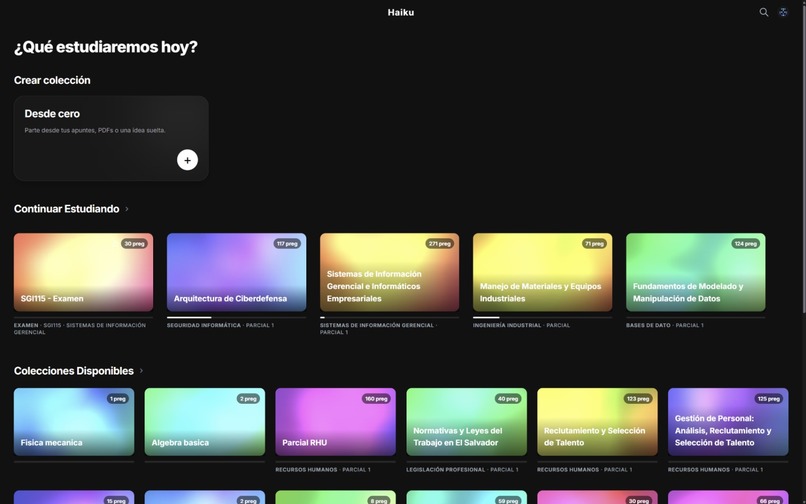
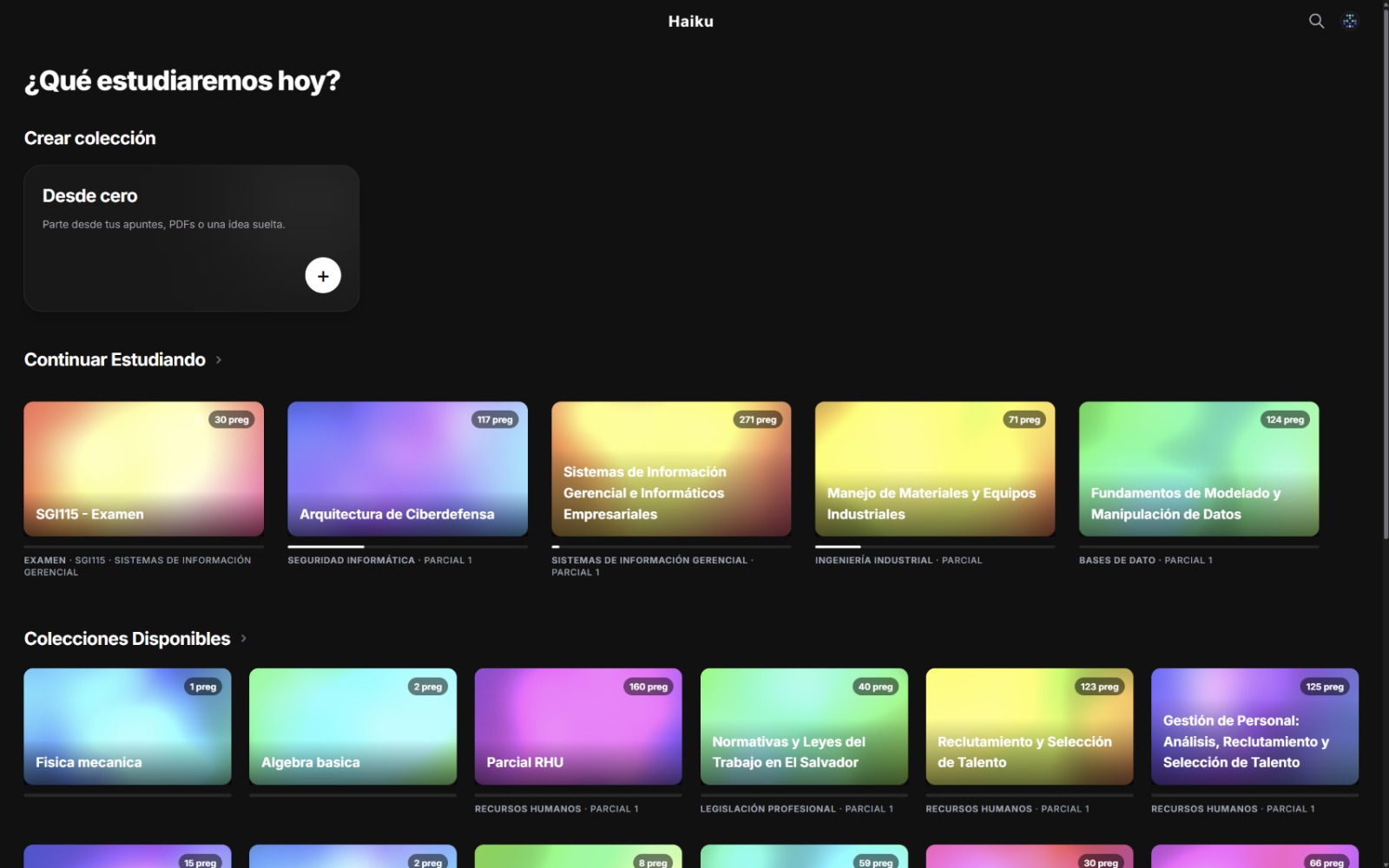
Discover and continue collections across subjects.
-
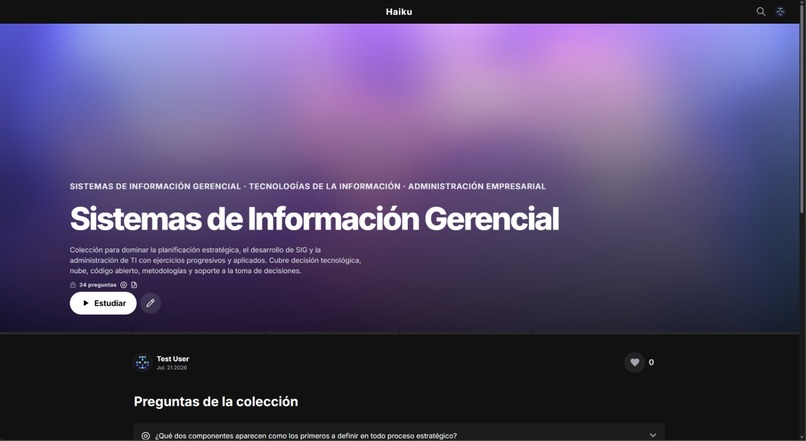
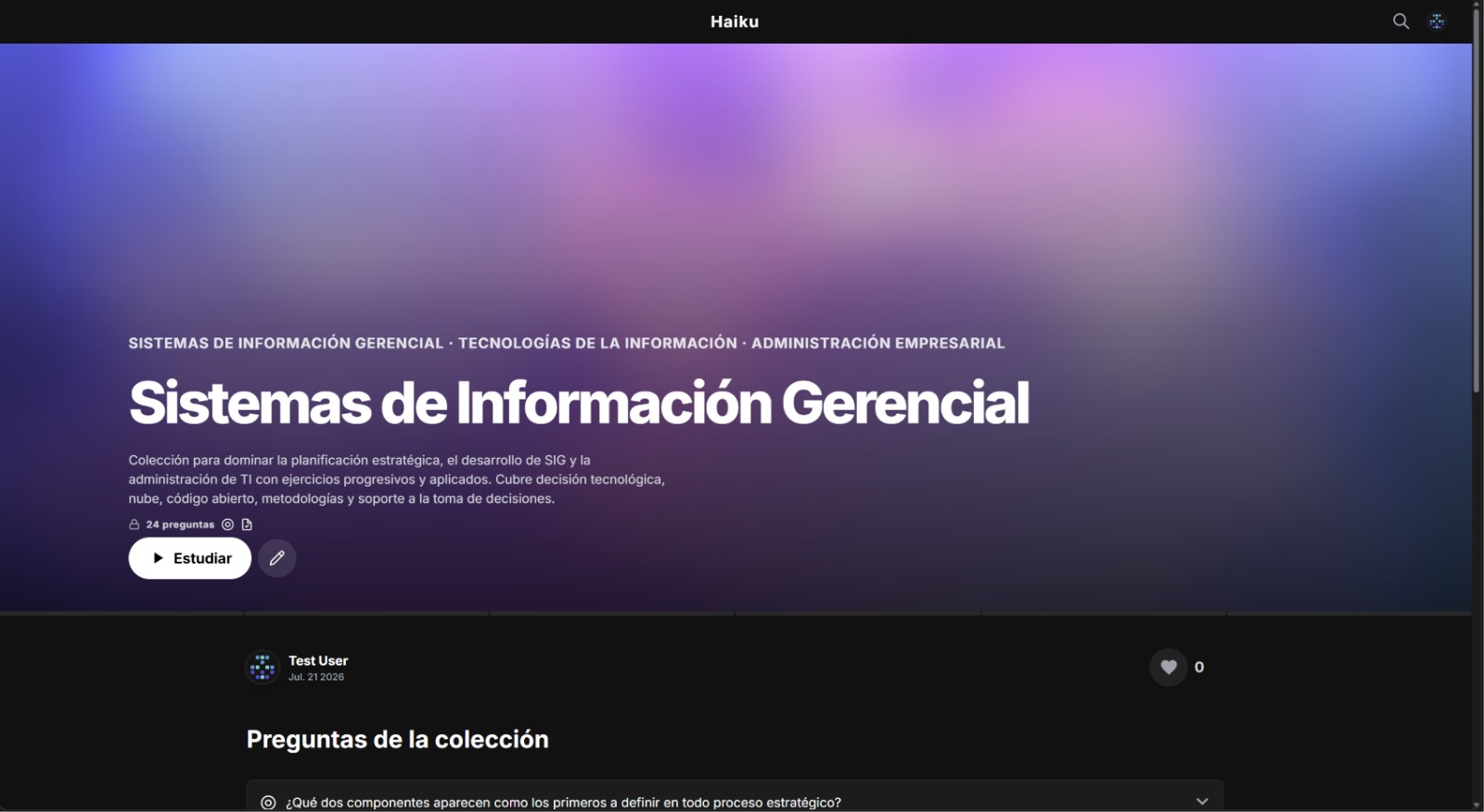
Study from structured, shareable question collections.
-
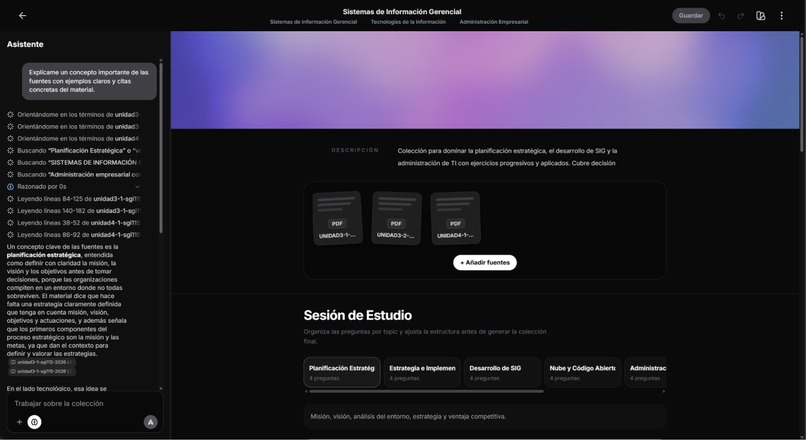
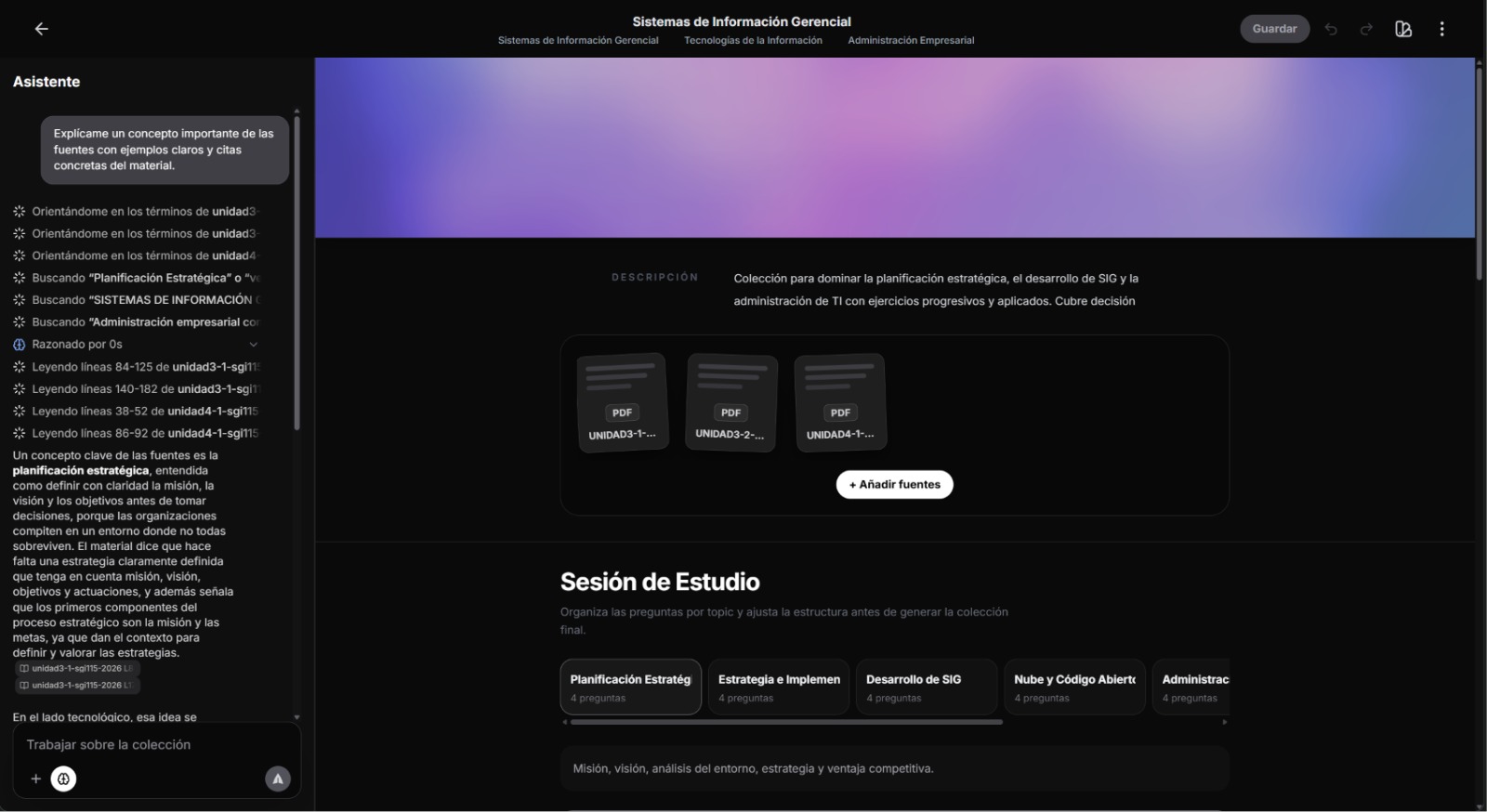
Build collections with a source-aware AI assistant.
-
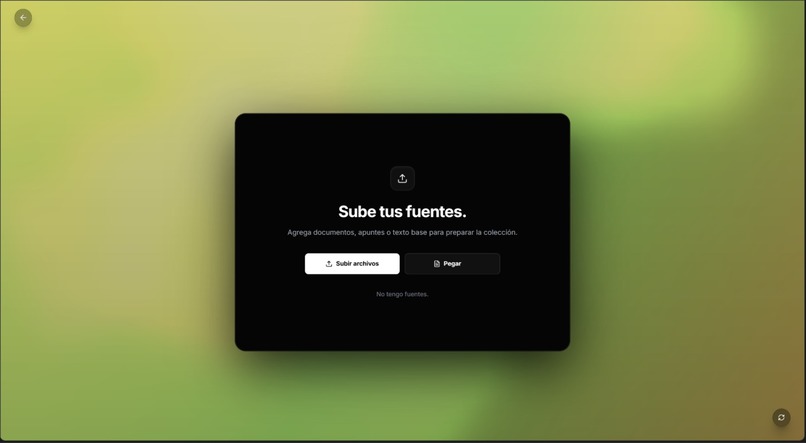
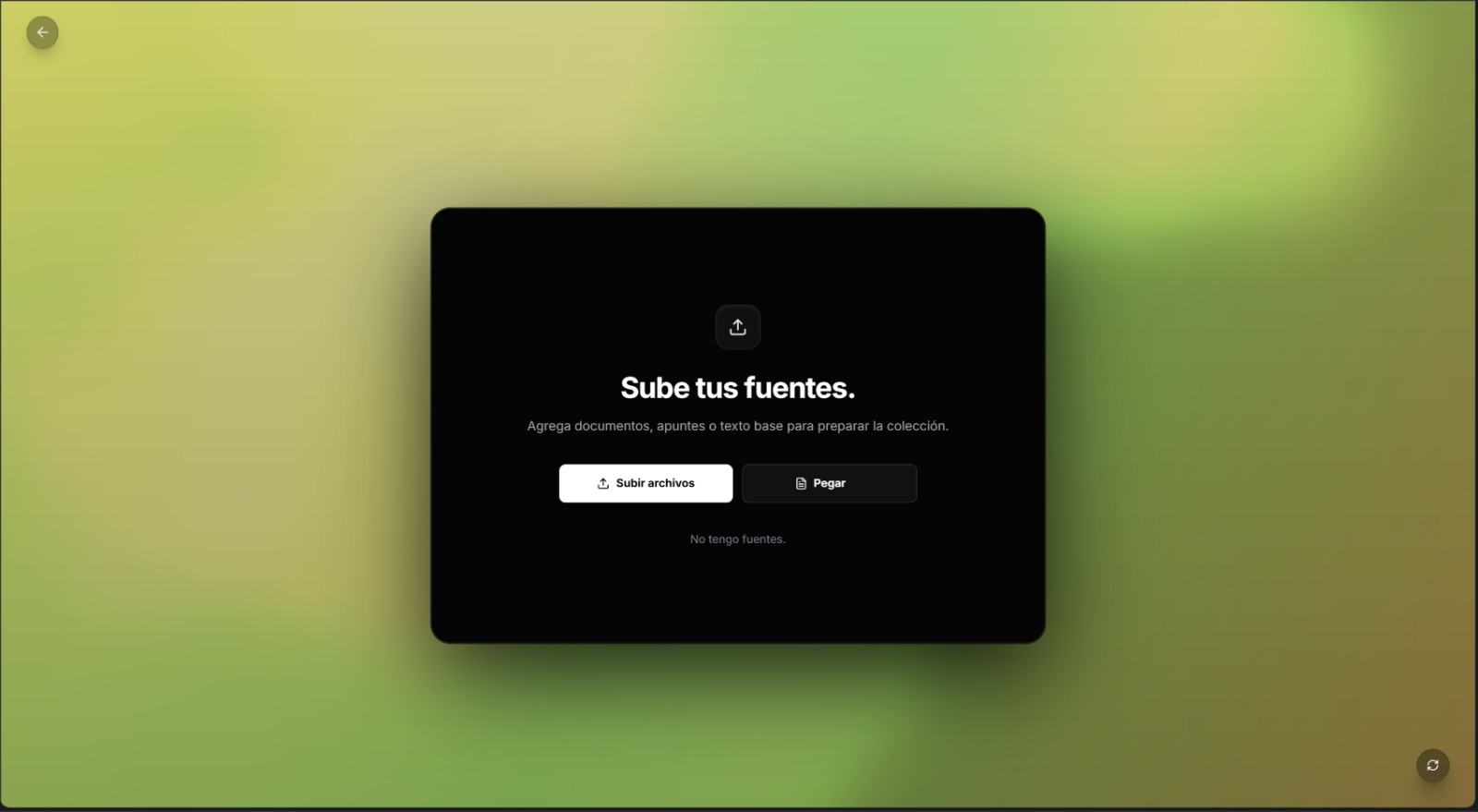
Upload sources and turn them into active practice.
Inspiration
Studying can demand hours of organizing notes, rereading documents, and creating practice material. Even after all that work, students may still be unsure about what they understand.
That friction can affect an exam, a scholarship, or a skill someone needs for their career.
We created Haiku to make effective studying easier and more accessible. Students provide their materials and learning goals. Haiku handles the preparation required to turn them into structured practice.
We believe more people should have access to a high quality learning system, regardless of their time, resources, or previous experience with study methods.
What it does
Haiku transforms learning materials into ready to use study collections.
A student can upload sources, explain what they want to learn, and let an AI agent build a collection around that objective. The collection can include questions, quizzes, flashcards, and contextual support.
Haiku grounds its output in the provided sources. This helps students practice using the material that matters for their course, exam, or project.
Collections can also be shared. A student may prepare one for classmates, while a professional team may organize the knowledge required for onboarding or an internal process.
Haiku reduces the work between receiving information and being ready to practice it.
How we built it
Haiku uses an AI agent architecture connected to a source processing and retrieval pipeline.
The application processes documents, divides their content into retrievable passages, and generates embeddings for semantic search. Specialized agents use validated tools to inspect sources, understand the user’s objective, and create learning activities.
The frontend is built with React, TypeScript, Vite, and Tailwind CSS. Supabase and PostgreSQL manage authentication and application data. Cloudflare Workers run the agent services, while Cloudflare Vectorize supports retrieval.
PDF processing and browser based OCR allow Haiku to work with digital documents and scanned pages.
During OpenAI Build Week, we completed the agentic collection creation pipeline and deployed it to production.
We also developed a research paper about lightweight descriptors for heterogeneous sources. These descriptors give an agent a compact and traceable view of the main topics and relationships inside a collection. This reduces dependence on large prompts and generated summaries.
Challenges we ran into
The first challenge was educational quality.
A question can be factually correct and still provide little learning value. Weak distractors, ambiguous wording, and superficial clues can make an activity easy to guess without understanding the material.
This becomes harder across different disciplines. Programming, medicine, mathematics, and history require different forms of reasoning.
The second challenge was context management. A collection may contain many documents and hundreds of questions. Sending all that information to the model for every request would increase latency and cost.
We combined semantic retrieval with structured navigation so the agent can access the context required for each task.
We also needed to control agent behavior. Haiku gives agents narrow tools with validated inputs. Each action can be inspected, which makes the system easier to debug and safer to operate.
Finally, academic documents are unpredictable. They may contain scanned text, formulas, code, tables, or complex layouts. Our ingestion pipeline needed several extraction paths while preserving the connection to the original source.
Accomplishments that we're proud of
During Build Week, we completed the full collection creation flow.
A user can provide a learning objective and a set of sources. The Haiku agent processes that material and creates a structured collection for practice.
We also integrated our work on lightweight source descriptors into the product architecture and completed a research paper documenting the method.
These improvements were launched to production before the end of the event.
Haiku can now turn heterogeneous academic materials into collections that students and teams can use or share.
What we learned
We learned that educational AI requires more than generating content.
The system must understand the learning objective, preserve evidence from the source, and produce activities that are useful without requiring the student to repair them.
We also learned that agents perform better when their available actions are precise. Validated tools and compact context made the workflow more predictable and easier to inspect.
Our research showed that lightweight descriptors can help an agent understand large collections without repeatedly generating expensive summaries.
The broader lesson was that study methods become more accessible when software handles their preparation. Students can spend more time practicing and less time building the system around that practice.
What's next for Haiku
Our next stage is to turn Haiku into a regional learning infrastructure company.
We plan to raise capital and build partnerships with universities across El Salvador. One of our main priorities is creating a free AI tier that remains accessible to students and economically sustainable for Haiku. From there, we want to develop an efficient expansion strategy for Central America and the rest of Latin America.
On the technical side, we will implement persistent memory and advanced knowledge management systems inspired by Karpathy’s LLM Wiki pattern and OpenClaw. Haiku should preserve learning history, source knowledge, decisions, and useful context across sessions.
We will continue improving our agentic systems, use MCP to connect Haiku with external tools and services, and deepen our integration with the OpenAI ecosystem. Our team has received valuable support through the OpenAI community spaces organized in El Salvador, and we want to transform that momentum into stronger products and broader access to AI powered education.
Haiku will also expand into the enterprise sector. Organizations will be able to transform large internal knowledge bases into guided training, onboarding, and continuously updated learning collections.
Our ambition is to build the most capable team in agentic AI systems in the region and use that expertise to make advanced learning infrastructure accessible at scale.
Built With
- ai-agents
- cloudflare-vectorize
- cloudflare-workers
- model-context-protocol
- openai-api
- paddleocr.js
- pdf.js
- postgresql
- progressive-web-app
- react
- retrieval-augmented-generation
- server-sent-events
- supabase
- tailwind-css
- tool-calling
- typescript
- vite


Log in or sign up for Devpost to join the conversation.