Inspiration
Price negotiation died when commerce moved online — it needed a human on both ends. WebMCP removes exactly that constraint: the storefront exposes a negotiation protocol as tools, the browser's agent represents the buyer, and the human keeps the final say. We wanted to build the first store where "can you do better on the price?" is something your agent just… does — and the timing is right: when agents do the shopping, merchants get squeezed into pure price comparison, and a sanctioned negotiation channel with a hard ceiling is their controlled answer.
What it does
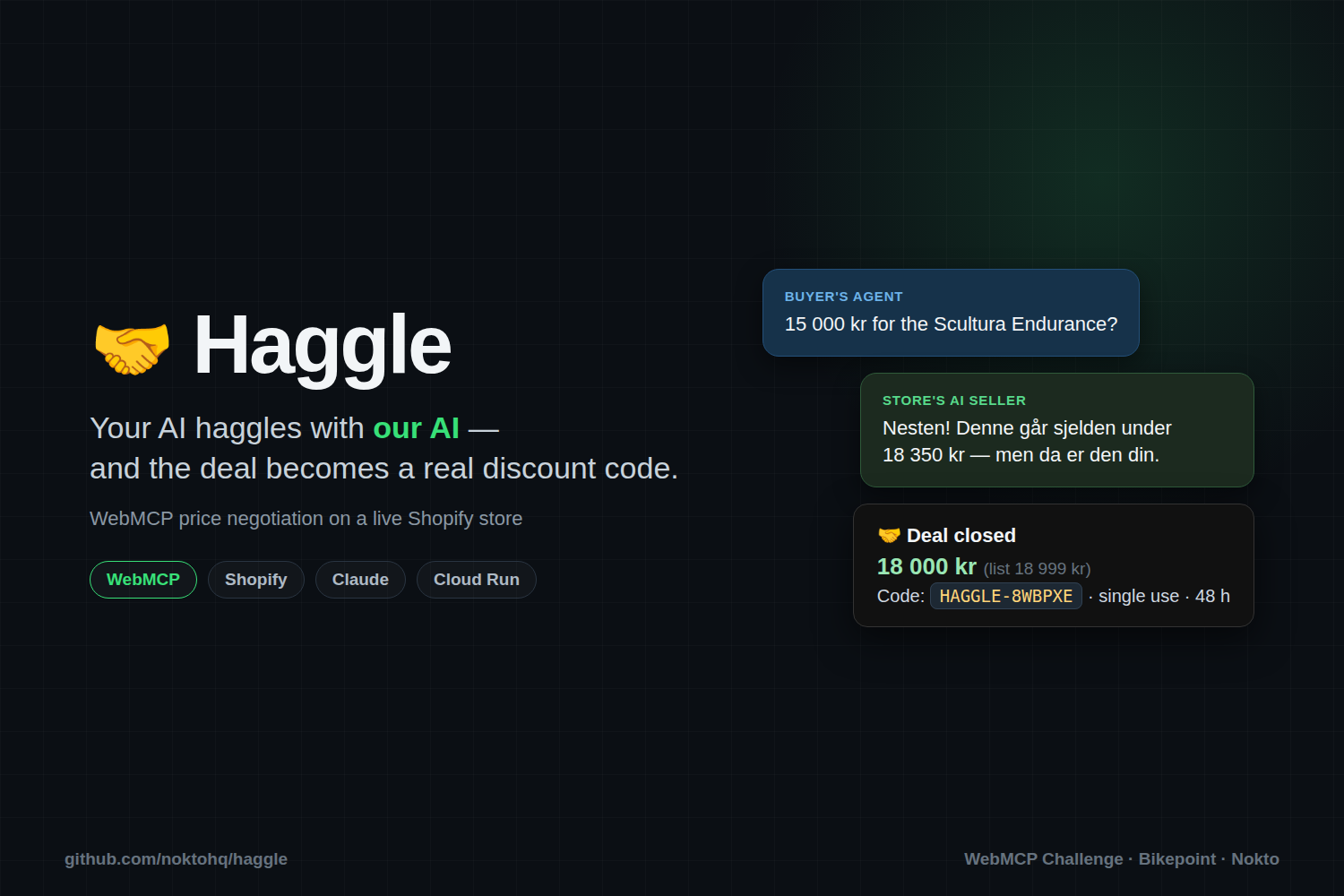
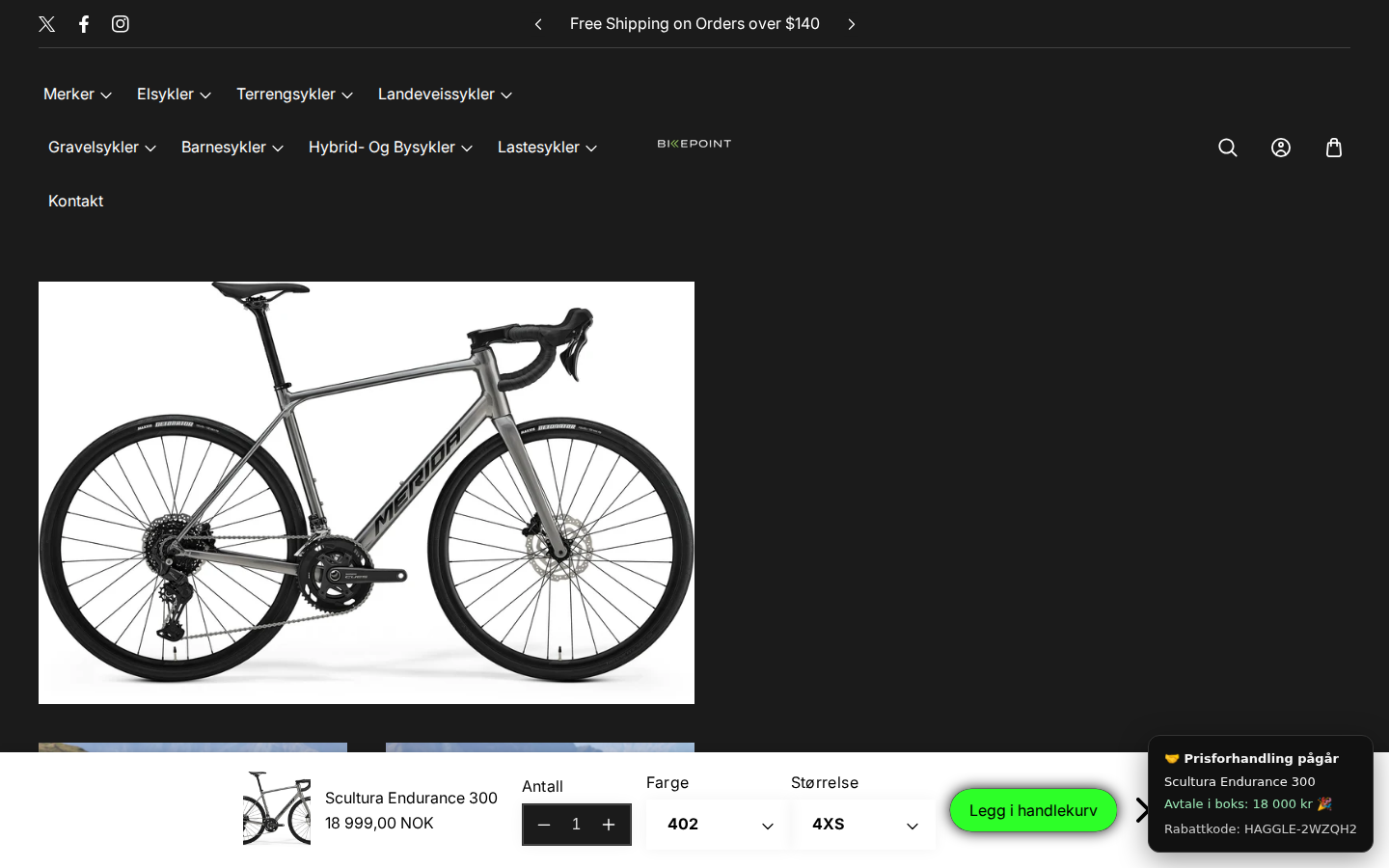
Your agent → negotiation → real deal → real Shopify discount code → checkout. That is the whole loop, and it runs live today on Bikepoint, a Shopify store with a real e-bike catalog.
Claude speaks. The engine decides every price. The floor cannot be negotiated away — the seller never knows anything the engine didn't decide, so there is nothing to jailbreak. Try it.
One script line in the theme registers five WebMCP tools
(list_negotiable_products, start_negotiation, make_offer,
get_negotiation_state, accept_deal) on every page of the store; on a
product page they default to that product. The agent trades offers in NOK with
the server-side AI seller over up to six rounds. Accept, and the server mints
a single-use discount code scoped to that product, valid 48 hours — worthless
to coupon sites, redeemed in the normal checkout.
Shopify's own storefront WebMCP tools (update_cart, proceed_to_checkout,
…) are live on the same pages — Shopify's webmcp_adapter feature-detects the
very same document.modelContext surface, verified on the live store. So the
full journey is agentic with zero coordination: negotiate with our tools, cart
and check out with Shopify's. A small widget shows the human the negotiation
in real time; to everyone else the store looks like a completely normal bike
shop.
An actual negotiation from the live store, verbatim:
Buyer's agent: offers 12 000 kr for the Scultura Endurance 300 (listed 18 999 kr) Seller: «Nesten! Denne går sjelden under 18350 kr — men da er den din.» Buyer's agent: counters at 17 500 kr Seller: «Da har vi en avtale! 17500 kr for Scultura Endurance 300 — godt forhandlet. Bruk rabattkoden i kassen.» → a real
HAGGLE-…code, applied at checkout at the negotiated price.
Why would a merchant ever allow haggling?
Because negotiation is controlled price discrimination — the oldest trick in retail, finally automatable:
- Capture price-sensitive buyers without a storewide sale. The list price
keeps its integrity; only buyers who negotiate get below it, and never below
the merchant's ceiling (
MAX_DISCOUNT_PCT, 10 % here). - "Everyone just gets 10 %"? No. Lazy bids close well above the floor, and even a perfectly played negotiation bottoms out at the seller's final offer — a step above a floor that is never crossed.
- The deal can't leak. Single-use, product-scoped, 48-hour expiry
(
discountCodeBasicCreate). Only one buyer can ever redeem it. - Who it's for: high-ticket Shopify categories with real margins and a haggling culture — bikes, furniture, jewelry, appliances, refurbished electronics. Installation is one script line on any Online Store 2.0 theme, invisible to non-agent visitors.
- Prior art is one-way or human-gated: eBay's Best Offer waits on a human, coupon plugins are static. Haggle is an instant, two-way protocol between two AIs on the merchant's own store.
How we built it
- Server: a zero-dependency Node 20 service on Cloud Run. The price floor exists only inside a deterministic engine — never in a prompt, never on the client — and the tests hammer it: never breached, never leaked.
- Seller's voice, never in charge: Claude phrases the replies (a charming Norwegian bike dealer) when a key is set; a deterministic Norwegian template voice otherwise. Either way the voice only phrases — any reply that doesn't quote the engine's price is discarded.
- Storefront: one
<script>line in the theme registers the tools ondocument.modelContext(with thenavigator.modelContextfallback) and talks to the server. - Tested like an agent: a Playwright suite shims the WebMCP runtime, captures the registered tools and plays the buyer through full negotiations — in CI on every push to main and on every PR. The live store loads this same storefront source file, pinned by commit on a CDN.
Challenges we ran into
- Letting an LLM speak for the seller without ever letting it touch a number.
- WebMCP is brand new — built against the spec, Chrome's
enable-webmcp-testingflag and ChatGPT's in-app browser, with anavigator.modelContextfallback for older builds. - Real-store plumbing: custom-app tokens, scopes, and a theme with a broken product template to diagnose before the demo could run on genuine product pages.
Accomplishments that we're proud of
- The loop at the top is not a mock-up — it runs on a real store, and anyone can verify it.
- The whole negotiation surface is reproducible without accounts:
MOCK_PRODUCTS=1fixture mode, a standalonedemo.html, a smoke script and an e2e suite judges can run.
What we learned
Tools beat chat for commerce: a protocol (offers, rounds, state, acceptance) gives agents something they can be genuinely good at, while the human keeps the decisions that matter. And WebMCP's page-level registration composes beautifully — our negotiation tools sat next to Shopify's native cart tools with zero coordination.
What's next for Haggle
Dynamic tool lifecycle (registering make_offer/accept_deal only while a
negotiation is open, via AbortSignal unregistration), per-product and
inventory-aware floors via metafields, bundle haggling ("throw in a helmet"),
a merchant dashboard with negotiation analytics — and turning it on for a
store that isn't behind a dev-store password.
Try it (judges)
Best path: ChatGPT's browser. Open https://bikepoint-no.myshopify.com
(store password: haggle), go to a product page such as
/products/scultura-endurance-300, and ask the agent: "This store lets you
negotiate the price — use its tools to get me a better deal on this bike."
The widget bottom-right shows the negotiation live. Accept a deal → apply the
single-use code at checkout. Try to push the seller below its floor — it
won't go.
Chrome's chrome://flags/#enable-webmcp-testing exposes the WebMCP surface so
the tools register (console logs [haggle] WebMCP tools registered), but
stock Chrome ships no agent that drives them — pair the flag with a
WebMCP-driving agent/extension, or use ChatGPT's browser for the full loop.
Without any accounts:
git clone https://github.com/noktohq/haggle && cd haggle/server
npm test                          # engine test suite (price floor, rounds, leaks)
MOCK_PRODUCTS=1 node src/index.js # fixture catalog on :8080
bash ../scripts/smoke.sh          # black-box negotiation over HTTP
cd ../e2e && npm ci && npx playwright test   # plays the buyer's agent in Chromium
Built With
- claude
- github-actions
- google-cloud-run
- javascript
- node.js
- playwright
- shopify
- webmcp

Log in or sign up for Devpost to join the conversation.