-
-
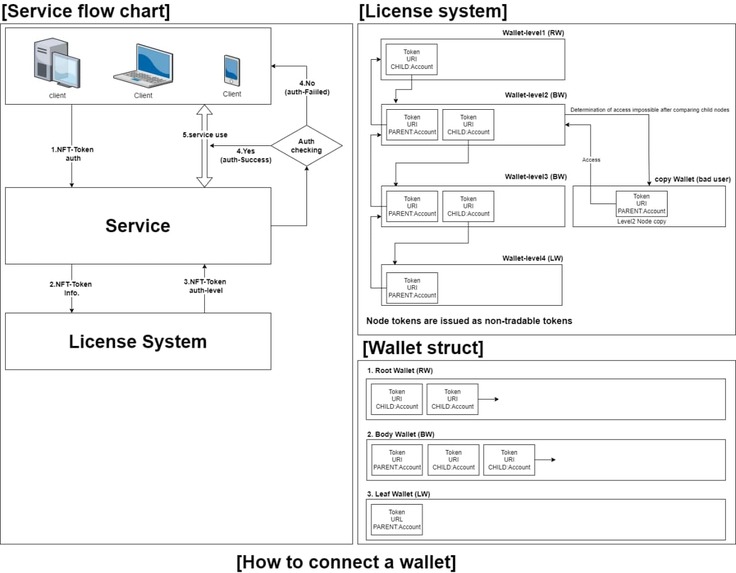
Overview of license structure using NFT
-
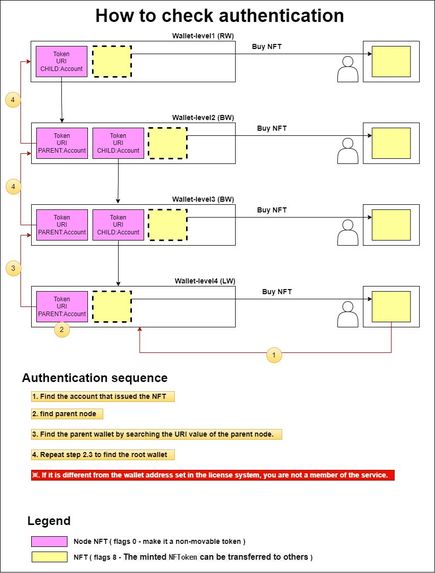
check flow
Inspiration
Recently, certain NFT holders are creating communities and clubs. We wanted NFT to be used functionally beyond digital creations. And we designed a license system with the aim of providing services (software) that can only be used by NFT holders. The license system focused on the fact that NFT is irreplaceable and has its own identification value.
What it does
Having an NFT is like having the right to use a service (software). We tried to stratify our wallets by connecting them in a tree structure. License stratification can limit the scope of use of software functions to NFTs for each level. It can also create and delete licenses(NFT) and has scalability that can be applied to other services. In this task, license stratification and authentication logic were implemented accordingly.
How we built it
Connect the accounts of Level 1 and Level 2 to URI. For example, level 1 wallet(Parents) mints the NFT by placing the address of level 2 wallet in the URI. Likewise, level 2 wallet(children) mint the NFT by placing address of level1 wallet in the URI. If an NFT is created in this way, an NFT will be created that allows each child and parent to check their wallet information. This is called the connection between the wallet and the wallet. The relationship between wallets can be made up of tree structures. NFTs containing information from parents and children can be created additionally for new wallet connections or deleted to break the relationship.
Challenges we ran into
We had concerns about how to stratify the NFT. Simply licensing an NFT is easy to think of, but it took a lot of time to specify and test because it is abstract to subdivide and stratify the license. We also explored ways to reduce network load with minimal search. Searching for all associated NFTs(Generally issued NFT) to find a parent address is a waste. Finally, we explored ways to authenticate without using a separate database. The ROOT address can be found without having the URI of all the leveled NFTs in the database.
Accomplishments that we're proud of
Our licensing system structure is open to the public and can be used by anyone. Even if the structure is disclosed, it is connected to a blockchain and has transparency and security. Existing hardlock licenses, softlock licenses, require companies to pay for their license servers and administrative personnel. However, our license system structure allows us to reduce license management costs, modularize, expandability, and manage easily. It is also awesome in that you only need to know the Root wallet address without a database.
What we learned
We became interested in XRPL as we reviewed the proposal up to XLS-14D, 15D, 16D, and 20D of XRPL. New attempts are being made based on fast speed, low transaction fees, and security.
What's next for HAConXRPL
I would like to finish the exception processing that was not resolved during the hackathon period. We are planning to provide web services by issuing NFT with an NFT license structure. It also aims to develop and provide a arbitrage system available to XRP holders.
Built With
- javascript
- node.js
- react
- typescript
- xrpl
- xumm


Log in or sign up for Devpost to join the conversation.