Inspiration
Hackathons give participants limited time to understand a challenge, identify its requirements, and build a working solution. However, competition pages can be long and contain important details scattered across descriptions, judging criteria, submission rules, and deadlines.
I built Hackwise to solve this problem. The goal is simple: help participants spend less time figuring out what a hackathon requires and more time building something that meets those requirements.
What it does
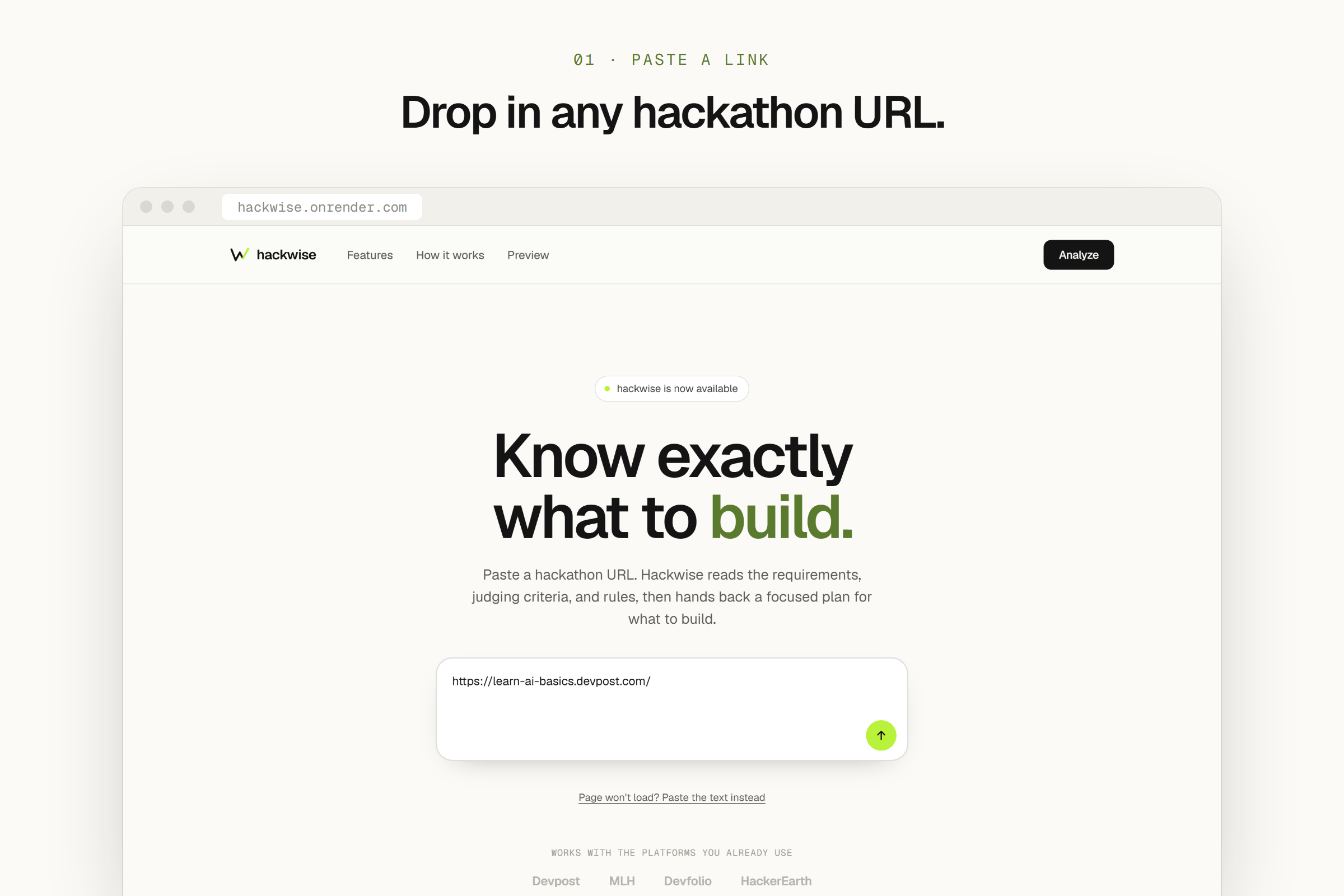
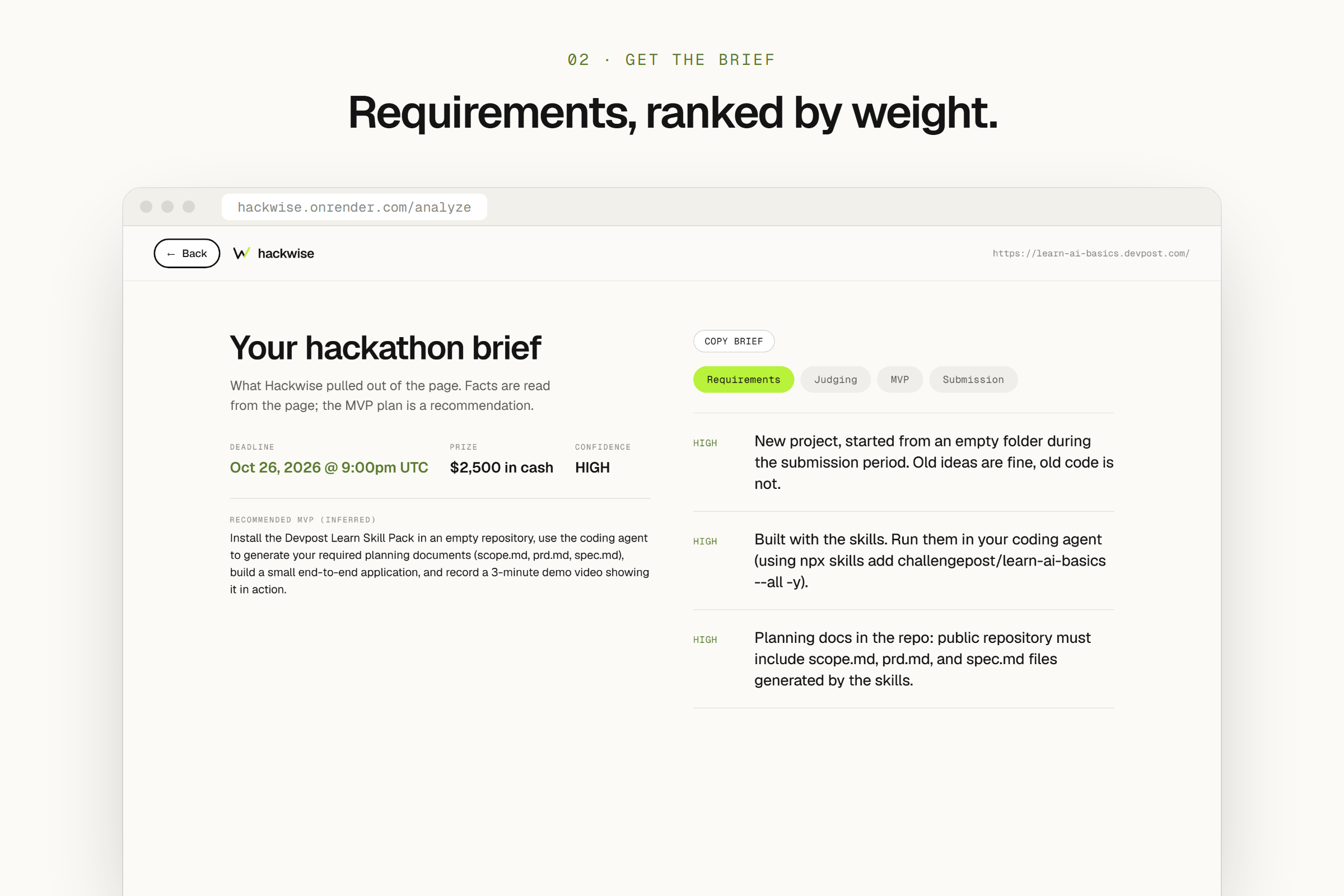
Hackwise transforms hackathon and competition briefs into structured, actionable information. Users submit a competition URL, and the application uses Google Gemini to generate a brief covering:
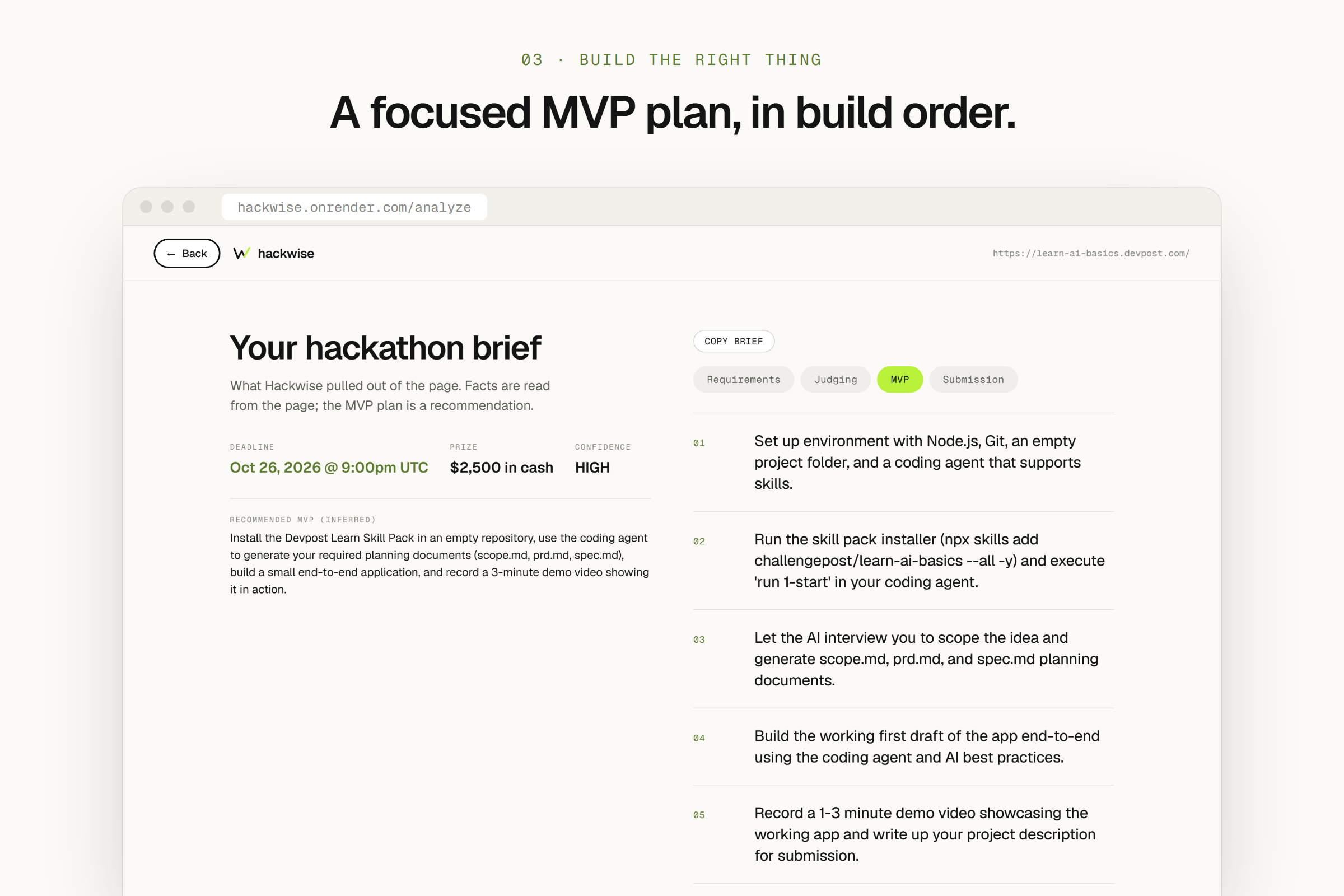
Requirements: What participants need to build or include. Judging criteria: What judges will evaluate. Submission rules: What must be submitted and how. Deadlines and prizes: Key competition information. MVP recommendation: A realistic starting point and suggested build direction.
Hackwise also provides a pasted-text fallback for pages that cannot be retrieved. It distinguishes source-based facts from inferred recommendations and avoids presenting unknown information as verified.
Live application: https://hackwise.onrender.com/
How we built it
We used a plan-first development workflow, defining the project scope, product requirements, and technical specification before implementing the application.
The core workflow combines a web interface, server-side processing, and the Google Gemini API. The application accepts a competition URL or pasted text, processes the available brief, and presents the result in organized sections so users can quickly identify what matters.
We deployed the application on Render and made the source code publicly available on GitHub.
Built with: Google Gemini, JavaScript, Node.js, and Render.
Source code: https://github.com/heyfegor/hackwise
Challenges we ran into
One major challenge was retrieving competition information from external websites. Some pages restrict automated access or fail to return their content in a usable format. We addressed this by providing a pasted-text fallback, allowing users to continue even when URL retrieval is unsuccessful.
Another challenge was making AI-generated guidance useful without confusing recommendations with official competition rules. We designed the output to distinguish extracted information from inferred MVP recommendations and to leave uncertain details unknown rather than inventing answers.
We also had to validate the complete workflow, from submitting a brief to receiving a structured result, while keeping the application practical for users working under tight hackathon deadlines.
Accomplishments that we're proud of
We're proud of taking Hackwise from an idea to a working, publicly accessible application within the hackathon timeline.
- A working end-to-end product: Users can submit a real hackathon URL and receive an AI-generated, structured competition brief.
- Live AI integration: We successfully integrated Google Gemini to analyze competition information and produce actionable results.
- A practical fallback: When a competition page cannot be retrieved, users can paste its text and still receive a structured analysis.
- Clear, actionable outputs: Hackwise organizes requirements, judging criteria, submission details, and MVP recommendations into dedicated sections.
- A deployed product and open-source code* We deployed Hackwise on Render and published the source code on GitHub so others can explore the implementation.
- A complete demo: We produced a 1-minute, 45-second demonstration showing the application, live AI analysis, results, and fallback workflow.
Our biggest accomplishment is making the core idea work in practice: turning lengthy competition information into a clearer starting point for building.
What we learned
Building Hackwise reinforced the importance of defining a clear scope before implementation, testing real end-to-end workflows, and designing for failure cases rather than only the ideal path.
We learned that a useful AI application needs more than a model call. It also needs reliable input handling, structured outputs, clear communication of uncertainty, and a fallback when external services or websites do not behave as expected.
Our main takeaway is that AI is most useful when it turns a complicated task into clear next steps that people can act on.
What's next for Hackwise
We want to improve extraction reliability across more competition platforms, make recommendations more adaptable to team size and available time, and help participants turn their competition brief into a practical, step-by-step build plan.
Built With
- gemini
- javascript
- node.js
- render

Log in or sign up for Devpost to join the conversation.