Inspiration
In shale oil production, extracting 1 barrel of oil yields up to 5 barrels of produced water. If disposal pumps fail, tanks reach "High-High" levels in minutes, triggering emergency shut-ins that cost \$20,000+/hr and permanently damage reservoir permeability. EOG mentors advised us that operators reject black-box AI—they need explainable, physics-grounded decision support with human authority. That inspired TIDEWATCH.
What it does
- Deterministic Deadlines & Cost of Waiting: Uses continuous mass-balance integration:
$$ \frac{dV}{dt} = Q_{in} - Q_{out} $$
to compute exact bisection deadlines ("Decide by 02:19 (12 min left)") and real-time waiting costs:
$$ \frac{dC}{dt} = \sum_{w \in W_{curtail}} P_{oil} \cdot q_{oil, w} $$
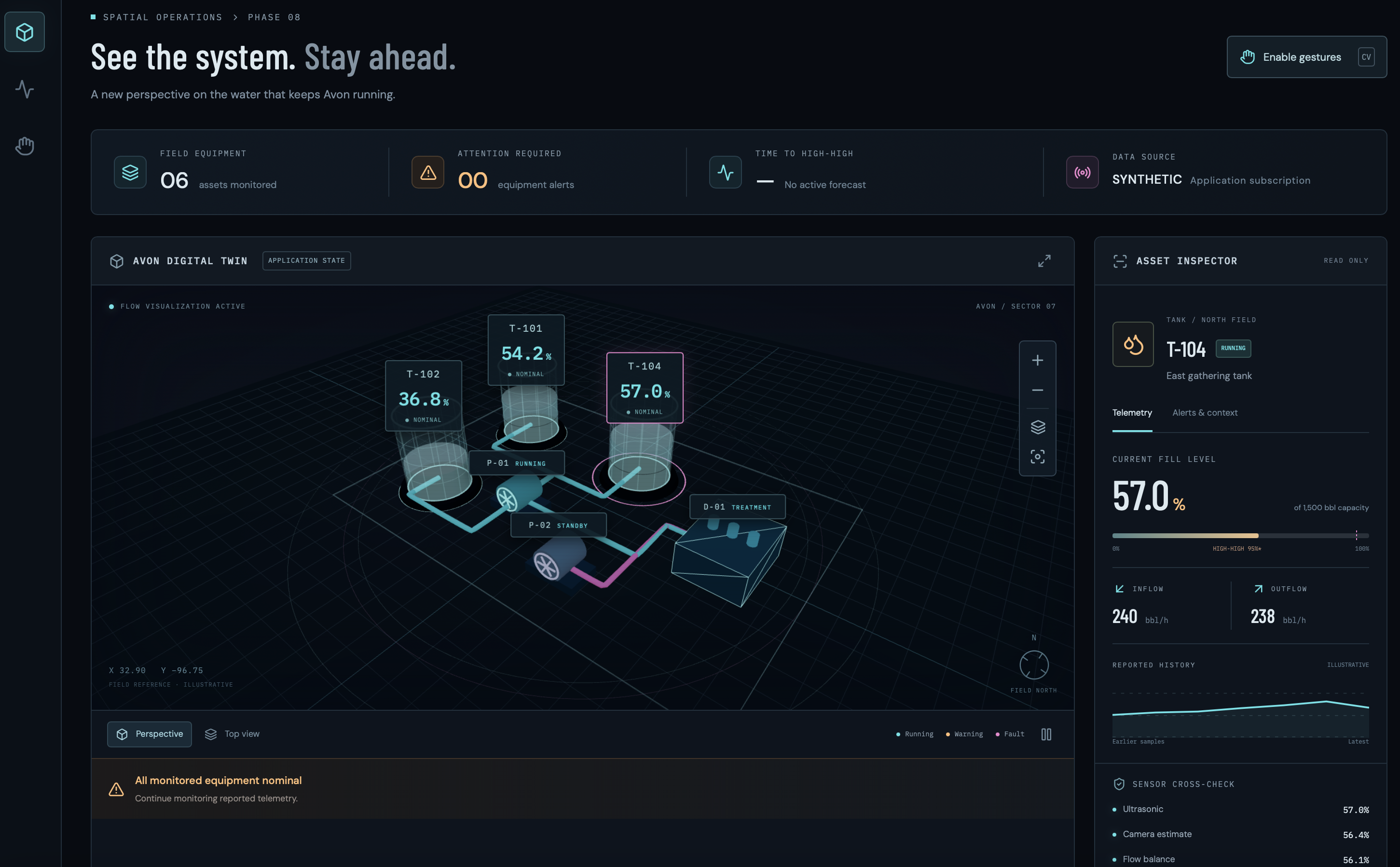
- 3-Way Sensor Trust Arbitration: Cross-checks Ultrasonic levels vs. Optical Camera levels vs. Flow Mass Balance:
$$ |L_{ultra} - L_{mass}| > \epsilon $$
Detects sensor drift and foam capping early, preventing false shutdowns.
- Value-Ranked Well Curtailment: Ranks wells by water-cut ratio:
$$ WC_w = \frac{q_{water, w}}{q_{water, w} + q_{oil, w}} $$
Curtails high water-cut wells (e.g., W-7 & W-12 at 92% water cut) first, slashing 120 bbl/hr of water while preserving 94% of oil cash flow.
- Real-Time State Sync (SpacetimeDB): Sub-millisecond multi-operator action claims between control rooms and field techs with zero duplicate dispatches.
- Tool-Grounded NVIDIA Nemotron AI: Streams incident briefings citing verified company SOPs (
SOP-PW-101) and data chips ([chip:...]). - Strict Human-in-the-Loop Gate: The AI cannot actuate equipment. All actions require a certified operator cryptographic approval token (
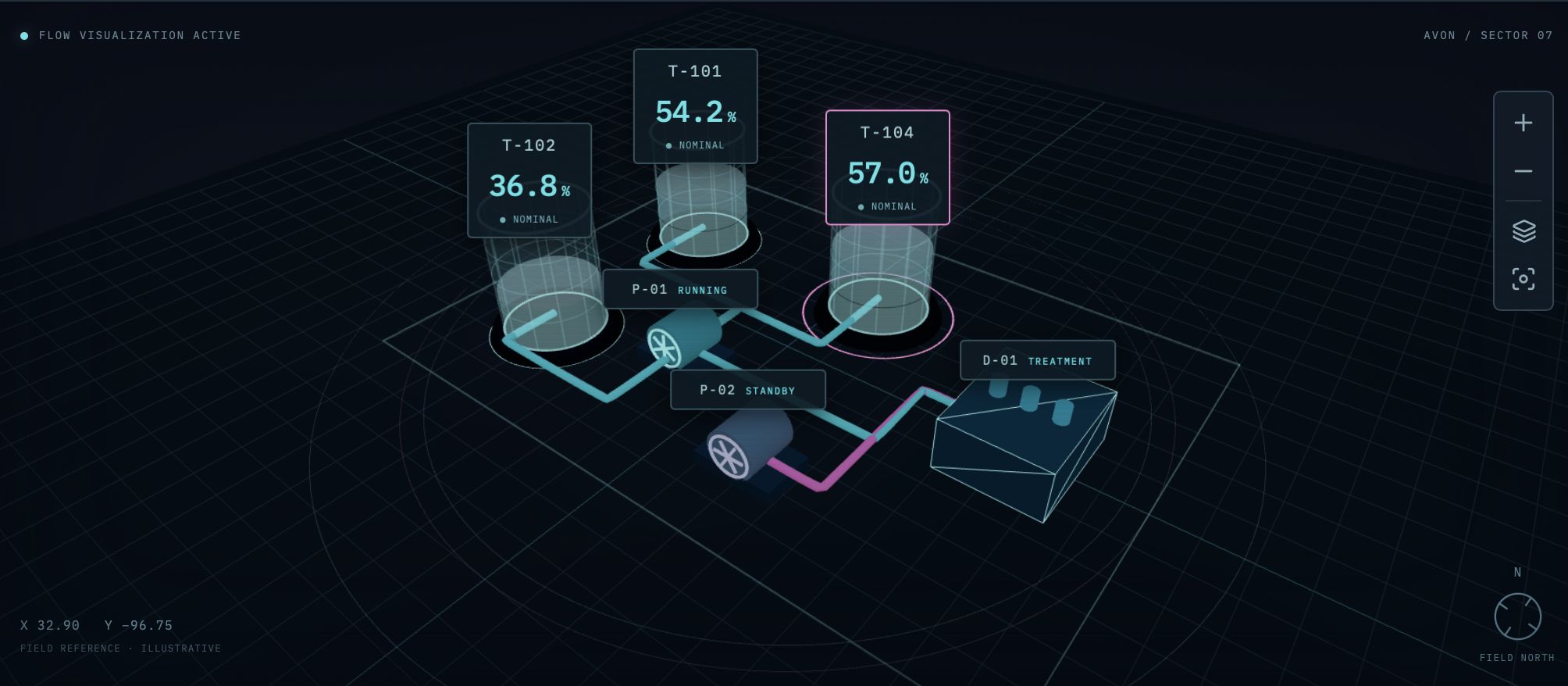
[ APPROVE PLAN ]). - 3D Digital Twin & Breach Simulation: WebGL 3D twin with CV hand gestures. When simulating leaks, the pipe turns red and actively sprays 52 animated fluid/data particles onto the pad ground.
How we built it
- Tiger Cloud (TimescaleDB): Hypertables continuously ingest 1-second hydraulic telemetry and compute sliding-window slope derivatives ( \frac{dQ}{dt} ).
- SpacetimeDB: Transactional serverless reducers manage real-time multi-operator state, incident claims, and persistent shift handoff logs.
- NVIDIA NIM: Powers grounded root-cause reasoning via
nvidia/nemotron-3.5-lightning-30b-a3bandmeta/llama-3.2-90b-vision-instruct. - MongoDB Atlas: Stores parameterized SOP runbooks (
SOP-PW-101–104) and incident histories for verifiable retrieval. - Frontend Console & 3D Twin: React, TypeScript, Vite, TailwindCSS, Three.js (@react-three/fiber), and MediaPipe CV hand tracking.
- Backend: FastAPI with asyncpg, WebSockets, and a first-principles hydraulic physics simulator.
Challenges we ran into
- Constraining LLMs to Strict Physics: Resolved hallucinations by enforcing a hard tool boundary—NVIDIA Nemotron can only cite deterministic backend calculation chips (
[chip:...]). - Multiplayer Race Conditions: Replaced standard WebSockets with SpacetimeDB atomic reducers to guarantee action claims lock instantly across all operator devices without collisions.
- 3D Hand Tracking Latency: Decoupled MediaPipe detection loops from Three.js render frames and added rotational momentum damping for smooth 60 FPS interaction.
Accomplishments that we're proud of
- \$20,488 Average Net Savings Per Incident: Validated across a 50-trial Monte Carlo benchmark against standard SCADA alerts, achieving 0 unintended shut-ins.
- 100% Explainable Architecture: Replaced black-box optimizers with deterministic mass balance, Bayesian sensor trust, and economic water-cut rankings.
- Dynamic Leak Particle Physics: Modeled pressurized line ruptures with real-time gravity arcs, fluid dispersal, and expanding ground pool ripples.
- Full Live Cloud Stack: Seamless live integration across Tiger Cloud, MongoDB Atlas, SpacetimeDB, and NVIDIA NIM.
What we learned
- Water logistics is the true operational bottleneck of unconventional oil production; preventing reservoir pressure shocks during shut-ins is critical.
- Language models are most valuable in mission-critical operations when strictly anchored to first-principles physics and company runbooks.
- Touchless CV gestures solve a real field ergonomics problem for operators wearing industrial work gloves.
What's next for TideWatch
- Field RTU Protocols: Direct telemetry ingestion via native industrial OPC-UA and MQTT Sparkplug B.
- Dynamic Truck Dispatch: Expanding SpacetimeDB reducers to coordinate third-party vacuum truck routing and disposal tickets.
- Basin-Scale Expansion: Scaling models from individual gathering batteries to interconnected pipeline networks across the Permian Basin.


