Play It First
Play your business before you pay for it.
Imagine finding the perfect space for your dream business. A restaurant, a bookstore, a boutique, a gym.
Now imagine walking inside, designing the interior, serving customers, managing finances, and testing your decisions before you've even signed the lease.
What if starting a business had a practice mode?
That's Play It First.
We turn real commercial properties into interactive multiplayer business simulations, where entrepreneurs can experiment, collaborate, and learn before putting real money on the line.
Our first playable experience is a café. But the vision is much bigger: any space, any business, and a chance to experience it before opening day.
Inspiration
Starting a business is one of the most consequential financial decisions an entrepreneur can make. Yet many of the most important decisions happen before the business has even opened its doors.
According to the U.S. Bureau of Labor Statistics, only 50.6% of private-sector business establishments that opened in March 2013 were still operating five years later.
The U.S. Small Business Administration recommends researching customer demand, estimating startup costs, and evaluating business locations before launching. But spreadsheets, floor plans, and business plans cannot fully capture what it feels like to operate a business.
We wanted to make those decisions interactive.
Inspired by the creativity of sandbox games and the practical value of flight simulators, we built a platform that turns real commercial spaces into playable business rehearsals.
Our vision is simple: whether you dream of opening a restaurant, bookstore, boutique, gym, or salon, you should be able to experience your business before risking your savings on it.
What it does
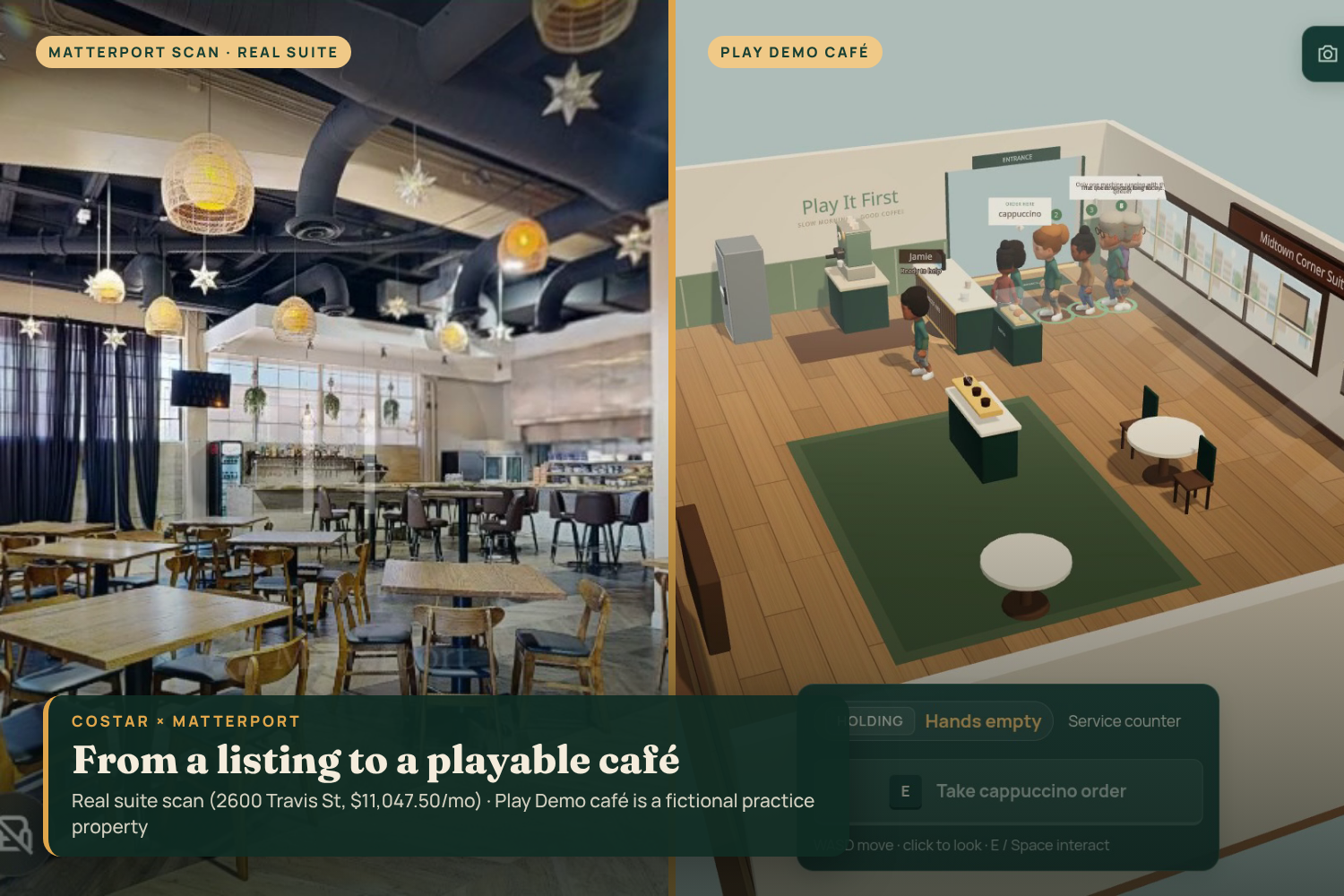
Play It First transforms real commercial properties into interactive, multiplayer 3D business simulations.
Our first playable business template is a café, demonstrating how a founder can move from discovering a property to rehearsing operations and developing a launch plan.
1. Find a real space. Turn it into your business.
Using CoStar commercial property data and matching Matterport scans, we reconstruct actual building layouts into playable 3D environments.
The simulation incorporates measured rooms, walls, doors, windows, and property dimensions. Actual asking rent influences the business's starting budget, while equipment, inventory, and operating expenses create simulated financial constraints.
Instead of imagining what a floor plan might feel like, you can walk through it.
We also built a property-import pipeline that validates matched listing and scan data, allowing the same approach to work across multiple commercial layouts.
2. Run the business together.
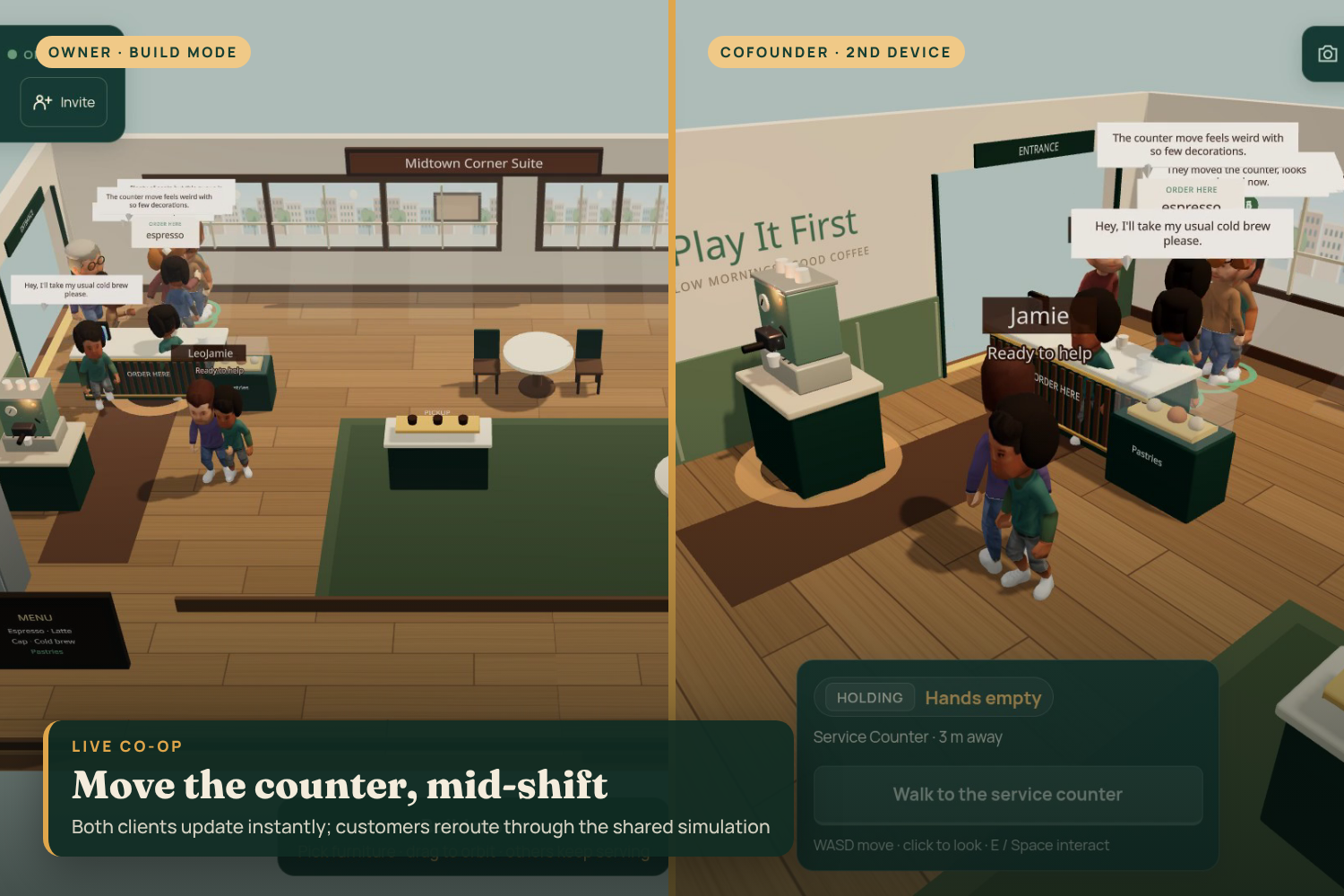
Invite your cofounder or friends through a room code or QR link and operate the same business in real time.
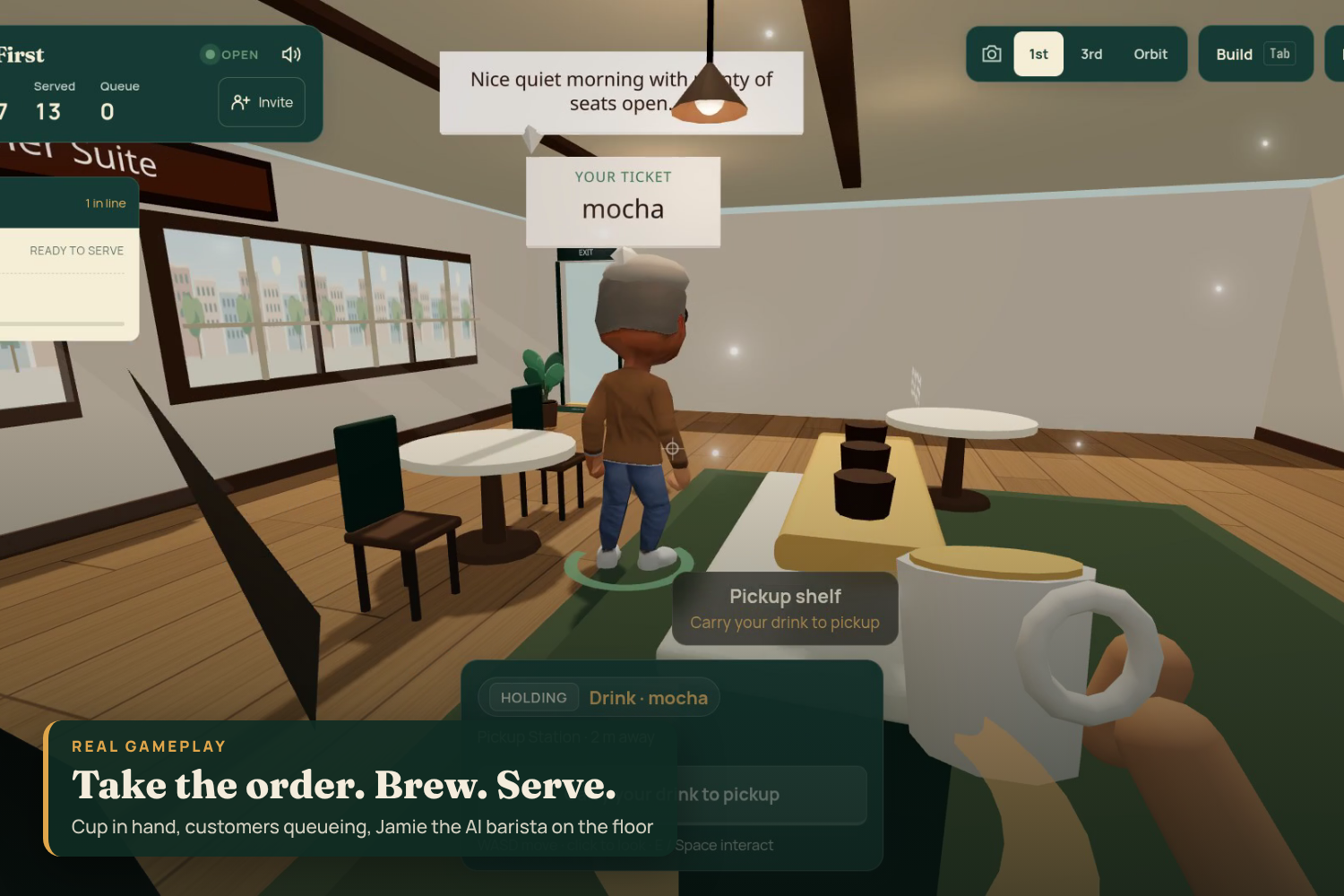
Take orders, walk to the kitchen, brew drinks, carry them to pickup, serve customers, purchase supplies, and manage your operating cash.
Players can take different roles and collaborate within a shared, authoritative simulation. Every completed sale updates inventory and finances for everyone.
We also built Jamie, an animated AI barista who physically navigates the café, takes orders, brews coffee, and serves customers using the same business rules as human players.
This is not a dashboard disguised as a game. It's a playable business.
3. Experiment with the layout and learn from the consequences.
Move furniture, rearrange service stations, add equipment, and change the way your business is organized.
Customers dynamically navigate the environment and respond to layout changes while other players continue working.
In our public multiplayer test, moving a service counter caused the same customer to calculate a new route, with both connected clients observing the change.
We also implemented a validated spatial recommendation system that can propose a different pickup location, compare modeled walking distances, and execute the relocation with owner approval.
Our goal is to let founders explore operational tradeoffs before committing to an expensive physical layout.
4. Meet Jamie, your AI business manager.
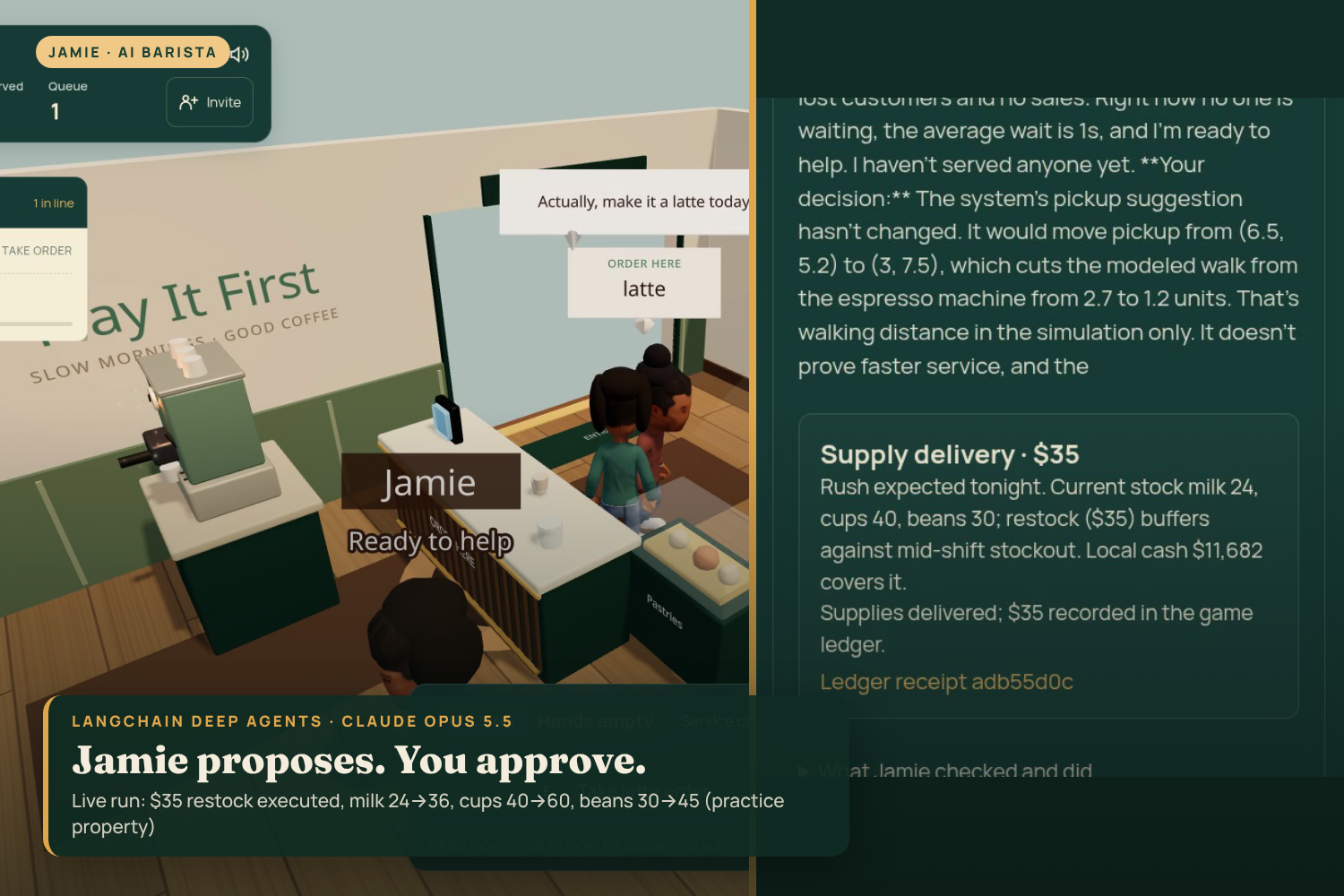
Jamie uses LangChain Deepagents to observe the running business, reason about its needs, recommend actions, and execute approved decisions.
Unlike a conventional chatbot, Jamie operates on actual simulation state and has tools that can make validated changes to the business.
For example, Jamie can:
- Inspect inventory, cash, customer queues, and business activity.
- Recommend a $35 supply delivery.
- Wait for explicit owner approval.
- Execute the purchase and replenish inventory.
- Read the resulting state and verify the transaction.
We implemented a provider-flexible architecture supporting Google Gemini, Anthropic Claude, and OpenAI models. Our latest live manager demonstrations use Claude Opus 5.5.
Both Gemini and Claude successfully completed our live Deepagents approval workflow during the hackathon.
Every execution is governed by server-side authorization, affordability checks, proposal expiration, and duplicate-transaction protection.
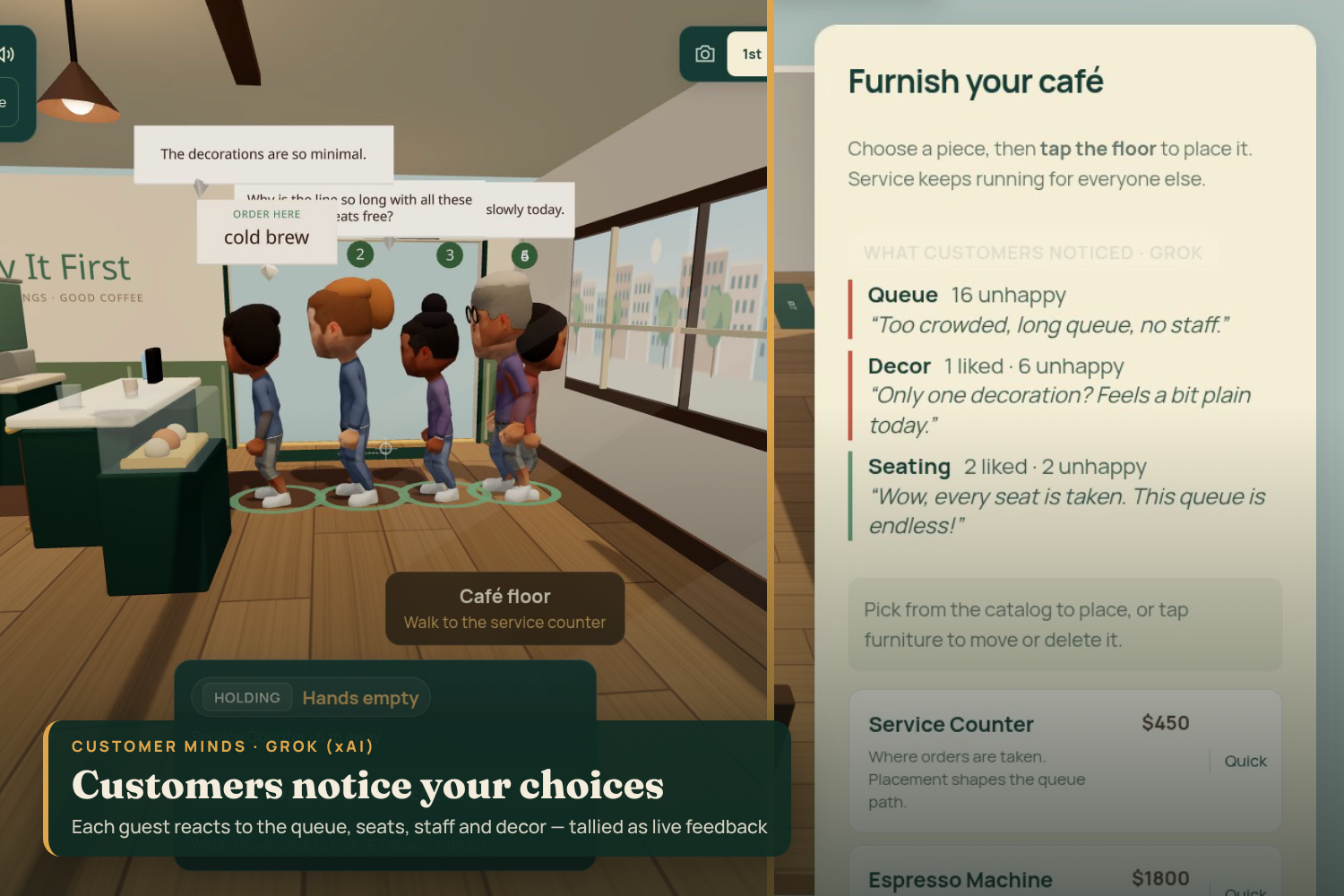
We also introduced an optional xAI Grok customer-persona system that gives simulated customers distinct preferences and reactions to seating, décor, queues, staffing, inventory, and layout changes. Their feedback can influence simulated patience and satisfaction, and is collected in the business recap.
Rather than treating customers as identical moving objects, we are exploring how AI can make a business rehearsal more dynamic and useful.
5. Understand the money before spending it.
Using Capital One's Nessie V2 API, we connect the simulation to mock business banking.
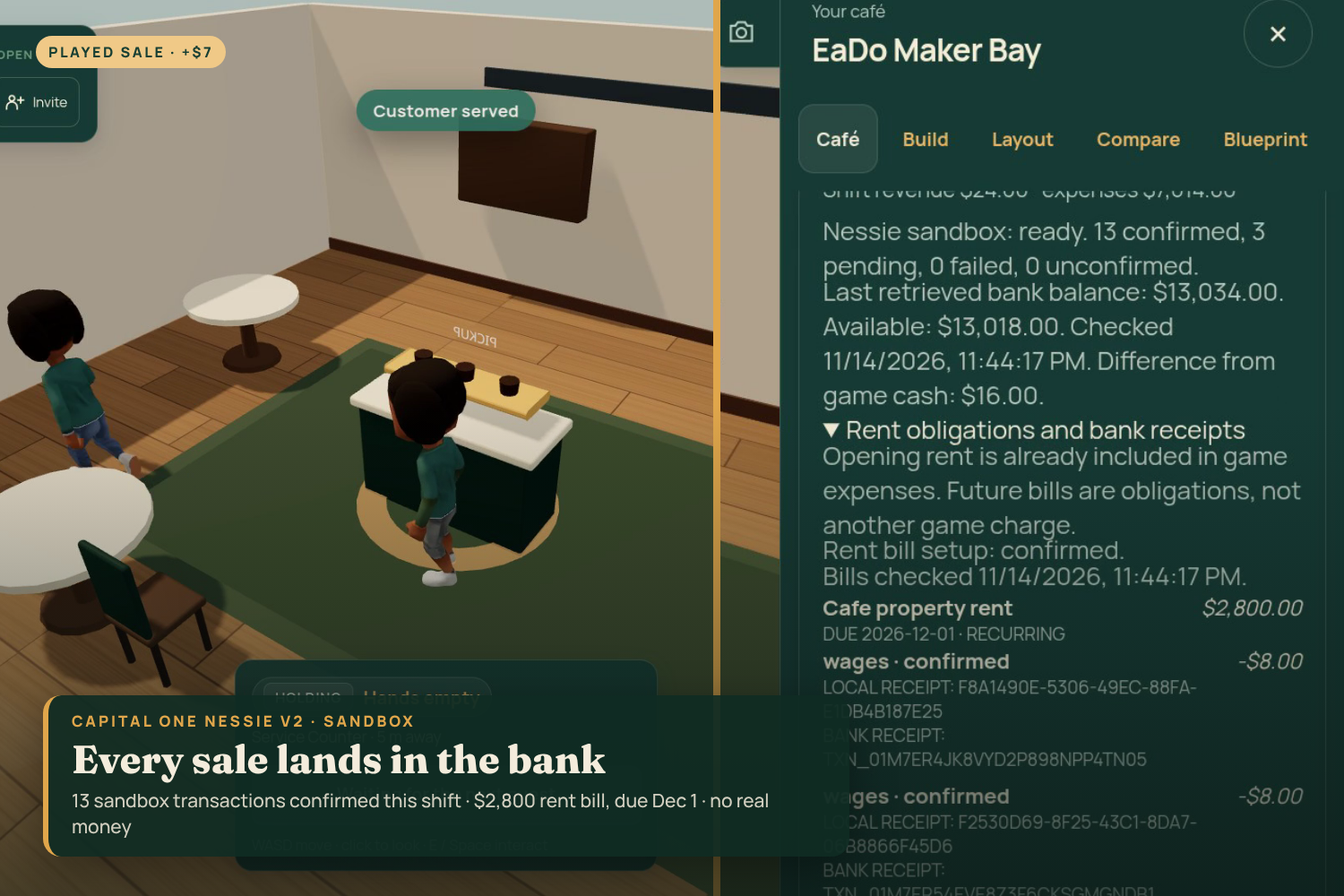
The integration supports sandbox accounts, sales deposits, supplier merchant purchases, recurring rent bills, transaction status, and balance reconciliation.
This allows a founder to explore an important distinction: having enough money to operate today does not necessarily mean having enough money to meet next month's obligations.
In a live public demonstration on a fictional practice property, Jamie inspected the sandbox financial context and proposed a $35 supply purchase. After owner approval, Nessie processed the merchant purchase, and the confirmed bank balance reconciled with the game's operating cash.
We also verified a separate live sandbox test that started with $1,000, processed a $9 deposit and a $35 merchant purchase, created a future $300 rent bill, and reconciled to $974 with no balance difference.
All funds and transactions are simulated. No real money is at risk.
6. Take your business manager beyond the game.
We integrated Photon 2.0 messaging infrastructure into the same Jamie manager.
The implementation supports connecting a phone to an authenticated café owner, receiving business questions, returning recommendations, and processing explicit proposal approvals through the same authoritative game tools.
We also implemented an authenticated voice-tool bridge designed to connect a provisioned Photon telephone number and external voice agent to Jamie.
This creates a path toward managing a simulated business through natural conversations rather than requiring the owner to remain inside the game.
External phone delivery and telephone provisioning are separate from the game's existing in-app manager and browser-based crew voice.
7. Leave with a plan, not just a high score.
At the end of a session, Play It First generates a business launch blueprint informed by the selected property, layout, startup expenses, operational results, inventory, and decisions made during the simulation.
The blueprint helps prospective founders reflect on what worked, what needs improvement, and which assumptions require real-world research.
Our intention is not to predict guaranteed profits or replace professional business planning. It is to give entrepreneurs a practical environment for experimenting, learning, and identifying better questions before making real commitments.
How we built it
We built Play It First as a full-stack, real-time simulation.
3D environment and interaction: React, TypeScript, Three.js, React Three Fiber, and Drei power the interactive environment, animated characters, lighting, cameras, building tools, and desktop/mobile controls.
Real property reconstruction: A Python import pipeline matches CoStar commercial listings with Matterport model data, validates measured geometry, and converts spatial information into game-ready floor plans. We use original game materials and furnishings rather than claiming to reproduce every scanned interior detail.
Multiplayer simulation: A Node.js server and WebSockets maintain authoritative game state, customer navigation, inventory, finances, player positions, and shared layout edits. Client-side movement prediction and server reconciliation improve responsiveness.
AI management: LangChain Deepagents integrates tool-capable models with our existing business rules. Agents inspect state, propose actions, receive explicit authorization, execute validated changes, and verify outcomes.
Customer simulation: xAI Grok integration supports individualized customer personas, situational reactions, and structured feedback, with scripted simulation behavior available when the provider is unavailable.
Financial integration: Nessie V2 connects the authoritative game ledger to sandbox accounts, deposits, merchant purchases, bills, and read-only reconciliation. Pending transactions are distinguished from confirmed settlements.
External communication: Photon 2.0 messaging transport and voice-tool infrastructure connect external communication channels to the existing manager without creating a separate business execution system.
Deployment: The entire application runs on a single Render service, serving the React client, backend APIs, and real-time multiplayer connections from the same origin. The application also supports a Progressive Web App experience for mobile devices.
We used open-source libraries and licensed assets, including Kenney's CC0 animated character models. Our team's contributions include the property-import pipeline, simulation, gameplay, multiplayer architecture, navigation, AI tools, banking integration, and complete product experience.
Challenges we ran into
One of our biggest challenges was converting actual commercial spaces into playable environments. Real buildings contain irregular rooms, narrow passages, complex wall boundaries, and door openings that cannot be handled correctly by a simple rectangular game map. We built collision validation, measured-floor navigation, and placement checks to keep the environment usable.
Multiplayer presented another challenge. Players need to move smoothly, interact with equipment, and modify the same layout without their local game state drifting apart. We addressed this through server-authoritative simulation, movement prediction, reconciliation, reconnect handling, and role-based permissions.
Integrating AI into a live simulation was also substantially more complex than building a chatbot. A model recommendation cannot be allowed to arbitrarily spend money or mutate game state. We implemented a proposal-and-approval workflow, fresh-state validation, stable receipts, and protection against duplicate execution.
Banking introduced its own distributed-systems problems. A Nessie transaction may remain pending even after the API accepts it. We built reconciliation and explicit transaction states so the interface does not falsely report that a payment has settled. When our initial live test encountered delayed settlement, we verified the existing records rather than blindly repeating financial requests.
Finally, we worked through provider quota limits, differences between model response formats, mobile viewport bugs, animated character movement, and the challenge of making a substantial technical system feel like an enjoyable game.
Accomplishments that we're proud of
- Turning an actual CoStar commercial property and its matching Matterport geometry into a playable multiplayer environment.
- Demonstrating real customer rerouting in a shared, running business.
- Building Jamie as both a visible working barista and a tool-using AI business manager.
- Successfully executing live, owner-approved Deepagents actions with Gemini and Claude.
- Connecting a live Claude-approved business purchase to an actual Nessie sandbox merchant transaction and reconciled balance.
- Creating a reusable architecture for importing additional real commercial spaces.
- Building a complete, playable product rather than a collection of disconnected API demonstrations.
Our favorite achievement is that we can walk into a reconstructed commercial building, operate a business with friends, change its layout, consult an AI manager, spend simulated funds, and see those decisions affect the same shared world.
What we learned
We learned that useful AI is not just about generating impressive responses. It is about connecting intelligence to reliable systems, meaningful decisions, and observable outcomes.
We also learned how much engineering goes into transforming physical spaces into interactive environments, synchronizing a multiplayer simulation, and maintaining consistent financial state across external services.
Most importantly, we learned that a serious real-world problem can be approached through play.
A game can be more than entertainment. It can be a tool for exploring decisions, communicating with a future business partner, and learning before the stakes become real.
What's next for Play It First
The café is only the beginning.
We want Play It First to support more business templates, including restaurants, bookstores, retail stores, gyms, and salons. Entrepreneurs could select a commercial space and choose the type of business they want to rehearse.
We want to expand our property-import pipeline, improve interior fidelity, introduce richer staffing and capacity models, and explore scenario testing across different layouts, budgets, and customer conditions.
We also want to expand external phone access, improve customer-agent behavior, and develop more useful comparisons between simulated business strategies.
Long term, we envision Play It First as a rehearsal platform for entrepreneurs, entrepreneurship programs, business advisors, commercial property professionals, and anyone who wants to understand the practical realities of opening a business.
We cannot eliminate the risks of entrepreneurship.
But we can help founders practice, discover problems, and make more informed decisions before taking them on.
Today, a café. Tomorrow, your business.
Make the mistakes here, not with your life savings. Play It First.
Built With
- anthropic-claude
- costar
- deepagents
- google-gemini
- langchain
- matterport
- nessie-api
- node.js
- photon-2.0
- progressive
- python
- react
- react-three-fiber
- render
- three.js
- typescript
- vite
- web
- websockets
- xai-grok
- zod
- zustand


