-
-
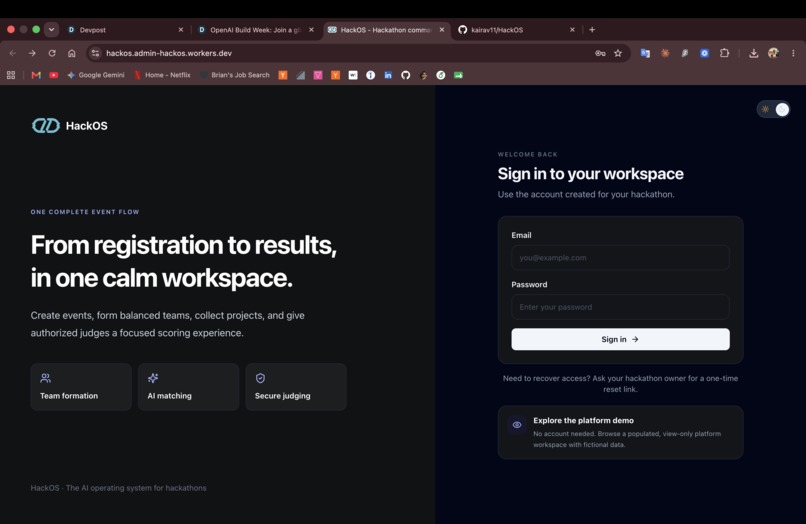
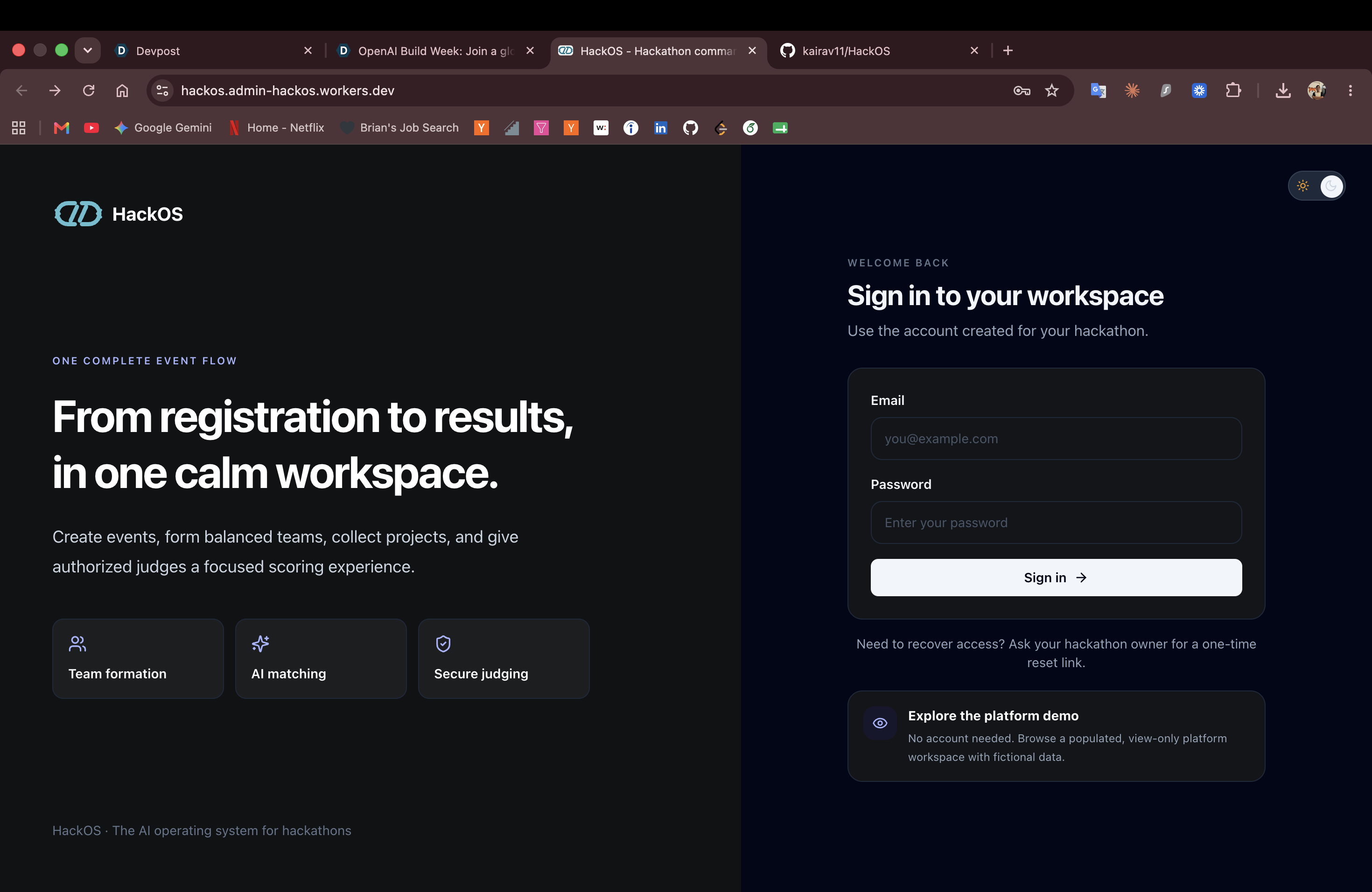
Login Page
-
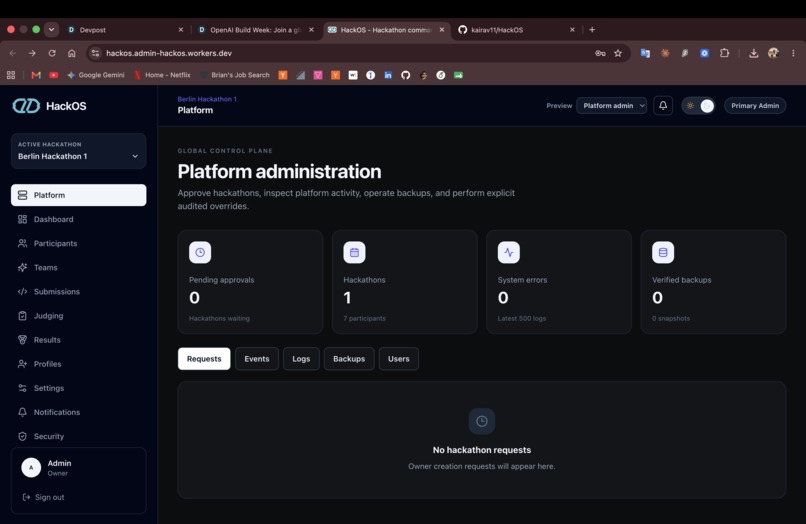
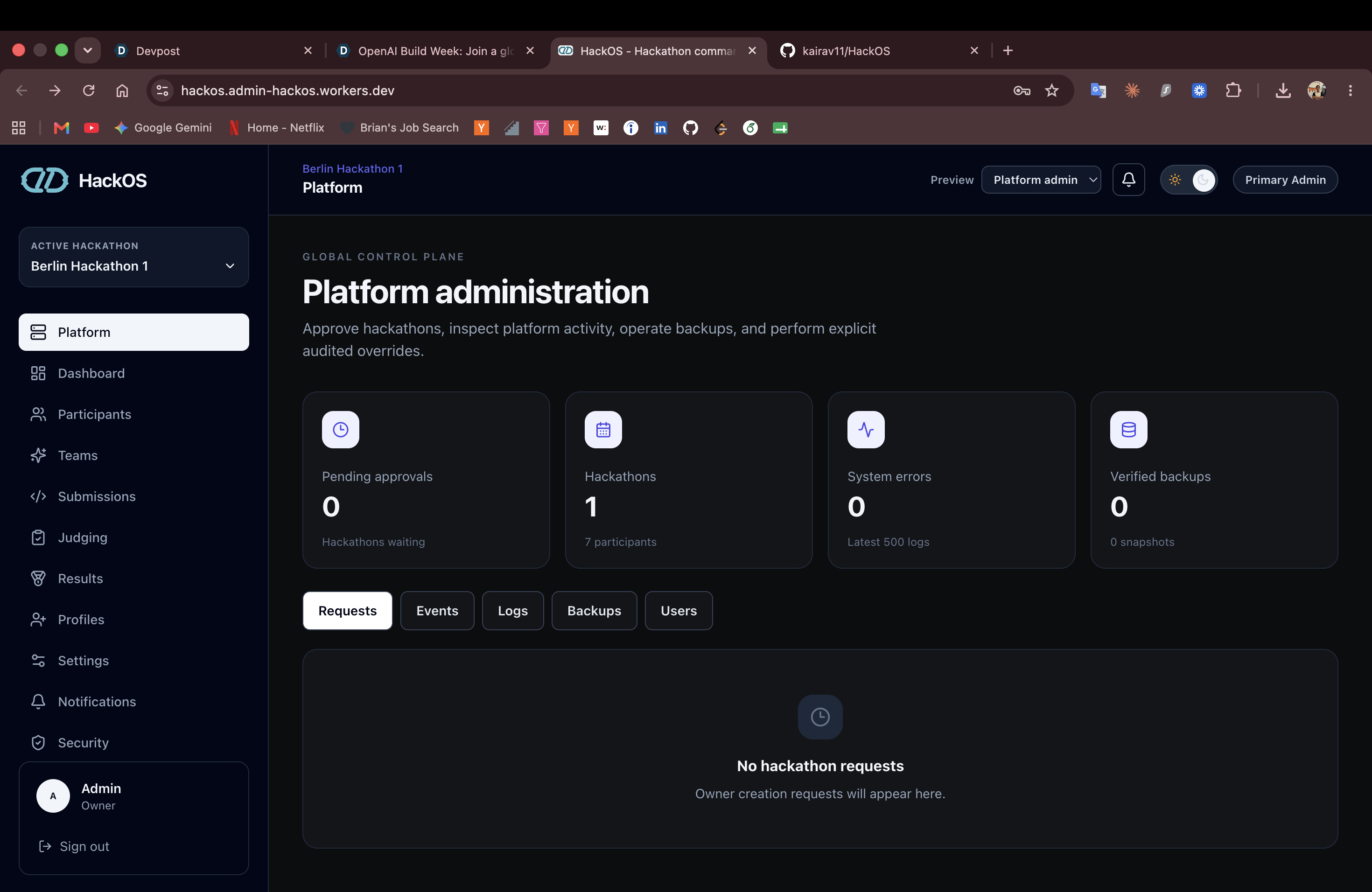
Admin Panel
-
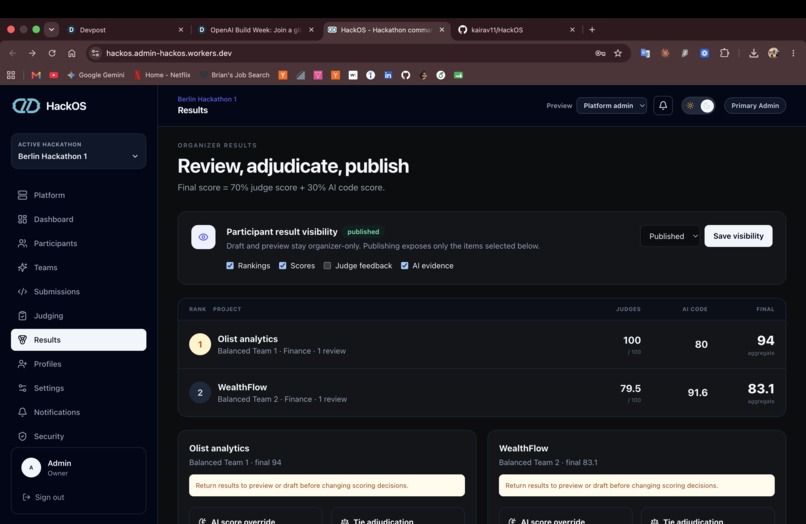
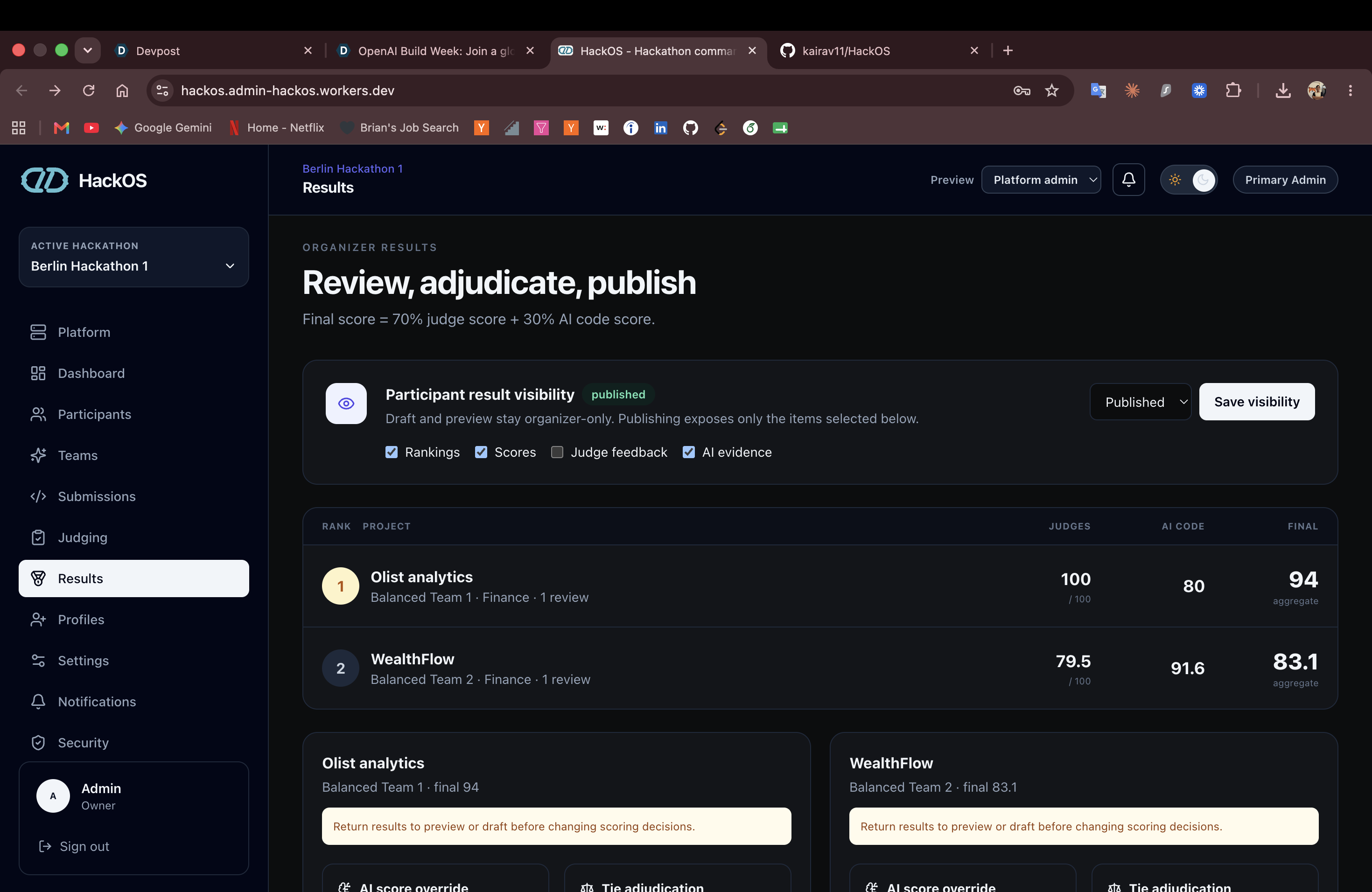
Results page
-
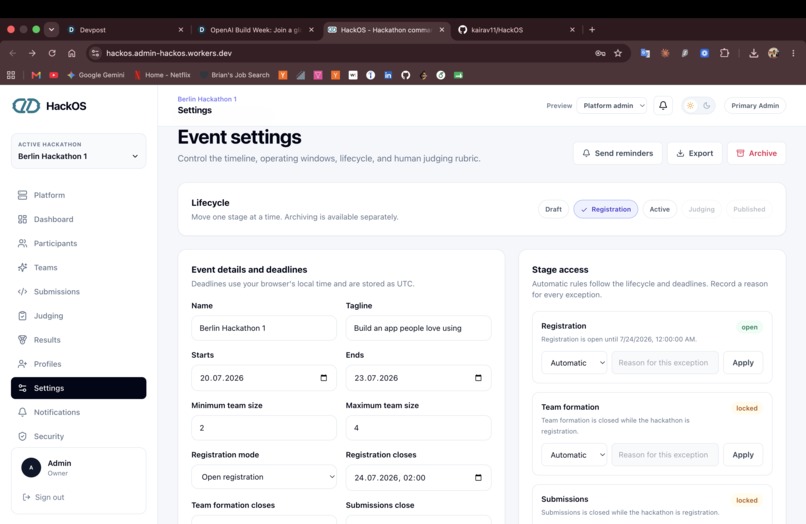
Hackathon settings

HackOS
Hackathons are exciting, but running one often means stitching together spreadsheets, forms, chat threads, GitHub links, and manual judging. HackOS brings that entire workflow into one focused workspace.
What inspired us
We wanted to make hackathon operations feel less chaotic for organizers and fairer for participants. Teams should be easy to form, judges should only see the work assigned to them, and organizers should not need to manually chase submissions, progress, or final rankings.
What it does
HackOS supports the full event journey:
- Create and manage multiple hackathons
- Invite or import participants through CSV
- Let participants join events, create teams, and submit projects
- Use AI to suggest balanced teams within the event's team-size rules
- Collect pitch deck, GitHub repository, and optional demo video links
- Give authorized judges secure, rubric-based project assignments
- Combine human judging with separate, evidence-backed AI code-review scores
- Track judging progress and publish controlled results to participants
Humans remain in control throughout. AI recommendations and code reviews are visibly separate from human judgment, stored with evidence, and can be reviewed or overridden by organizers.
How we built it
We built HackOS as a full-stack web application with Next.js, React, TypeScript, and Tailwind CSS. It uses SQLite locally and Cloudflare D1 in production, deployed on Cloudflare Workers.
The platform includes role-specific workspaces for platform admins, owners, organizers, judges, and participants. Access is scoped per hackathon, with invitations, password setup and recovery, session management, rate limiting, audit logs, and platform administration controls.
For AI features, HackOS uses OpenRouter with DeepSeek V4 Flash for team recommendations and DeepSeek V4 Pro for structured repository reviews. GitHub repositories are fetched through a bounded, security-conscious ingestion flow that records commit identity, files reviewed, evidence, confidence, metric configuration, and score.
We used Codex with GPT-5.6 throughout development to move quickly across product planning, database design, secure role flows, UI refinement, testing, deployment, and documentation. Codex helped us turn a broad product idea into a working end-to-end platform while we kept key product and security decisions intentional.
Challenges we faced
The hardest part was making AI useful without making it feel like an unaccountable black box. We addressed that by separating AI and human scores, requiring evidence for AI code reviews, storing versioned scoring configurations, and allowing organizers to override AI results with a documented reason.
Another challenge was keeping every role and every action correctly scoped to the right hackathon. We built event-specific memberships and server-side authorization checks so a judge, organizer, or participant only sees what they should.
Finally, we wanted the platform to feel polished without becoming visually noisy. We focused on a minimal interface, strong hierarchy, accessible dark mode, and role-specific navigation.
What we learned
We learned that operational AI products need clear boundaries. The best AI feature is not one that replaces people, but one that saves time while making its reasoning inspectable. We also learned how much a coherent workflow matters: secure onboarding, clear permissions, good defaults, and transparent progress can make a complex event feel calm.
Built With
- api
- cloudflare
- codex
- css
- d1
- deepseek
- flash
- github
- next.js
- openai
- openrouter
- playwright
- pro
- react
- resend
- sqlite
- tailwind
- typescript
- v4
- vitest
- workers
- zod


Log in or sign up for Devpost to join the conversation.