-
-
FINANCE
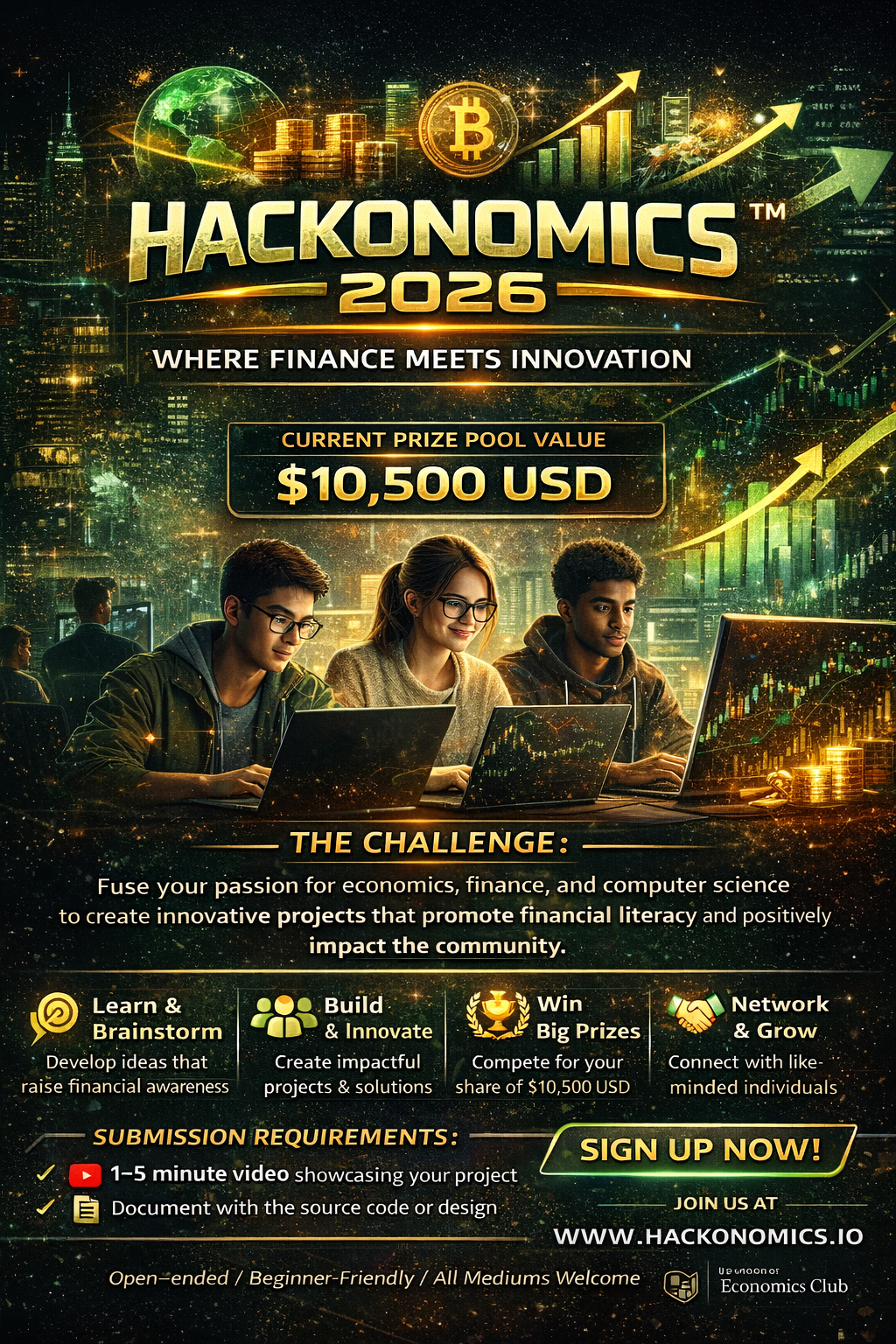
HACKONOMICS SERIES 2026: NEXUS PROTOCOL A Post-Mortem on Algorithmic Sovereignty and Financial Visualization Team: The Quant-Disruptors Project: NEXUS (Neural Economic X-change & Utility System) Theme: Hackonomics / FinTech Video Aesthetic: Disruptor (ColdFusion Style)
- THE INSPIRATION: Decoding the Invisible Hand The genesis of the NEXUS Protocol was not born in a vacuum, but rather from the chaotic frequency of the global markets observed during the volatile post-2024 economic corrections. We stood at a unique crossroads in history where the democratization of finance (via DeFi) collided violently with the opacity of institutional high-frequency trading (HFT).
Our inspiration was rooted in a fundamental question: Is the Efficient Market Hypothesis (EMH) dead?
The EMH posits that asset prices reflect all available information. However, looking at the "flash crashes" and the meme-stock rebellions of the 2020s, it became evident that markets are no longer driven solely by rational actors maximizing utility. They are driven by algorithmic sentiment, latency arbitrage, and systemic leverage. We were inspired by the works of Benoit Mandelbrot regarding the fractal nature of markets and the concept that financial time is relative to trading volume, not the clock.
We wanted to build a tool that didn't just trade but visualized the hidden liquidity flows that dictate market reality—a tool that fused the transparency of blockchain logic with the predictive power of machine learning. We wanted to peer inside the "Black Box" of Wall Street.
The ultimate goal was to create a system that could identify Market Microstructure inefficiencies—tiny fractures in the price of an asset across different exchanges—and exploit them while visualizing the data in real-time for the user. This is "Hackonomics" in its purest form: hacking the economic consensus to find the mathematical truth hidden in the noise.
- THE PRODUCTION CHOICE: The "Disruptor" Aesthetic For our submission video, we deliberately chose the "Disruptor / ColdFusion" aesthetic. This was not merely a stylistic preference; it was a narrative necessity.
The "ColdFusion" style, pioneered by creators like Dagogo Altraide, utilizes a specific visual and auditory language:
Downtempo, Synth-Heavy Soundtracks: To induce a state of focus and signify "future-tech." Cool Color Grading (Teals, Midnight Blues, Slate Greys): To convey sophistication, cold logic, and corporate intrigue. Slow Pans over High-Tech B-Roll: To suggest scale and global impact. Why this fits the soul of NEXUS: Our project deals with invisible forces—algorithms, data packets, and economic theory. These are abstract concepts. A standard "screen-recording" demo would fail to capture the gravity of what the code is doing. The "Disruptor" aesthetic allows us to frame the NEXUS Protocol not as a simple app, but as a historical shift.
This aesthetic treats technology with a sense of reverence and journalism. By framing our project through this lens, we are telling the audience: "This is not just a hackathon entry; this is a documentary about the moment finance changed." It aligns perfectly with the "Hackonomics" theme, which implies a deconstruction of established systems. The slow, methodical narration style allows us to explain complex LaTeX formulas and architectural decisions without overwhelming the viewer, effectively bridging the gap between a hype video and a technical whitepaper.
- THE LEARNING CURVE: From Syntax to Stochastic Calculus Building NEXUS required a bipolar skill set. We had to oscillate between the rigid determinism of software engineering and the probabilistic chaos of economics.
The Economic Awakening We had to move beyond basic supply and demand curves. We delved into Modern Portfolio Theory (MPT) and Behavioral Finance. We learned that risk is not just volatility; it is the probability of permanent loss of capital.
One of the most profound concepts we absorbed was the Kelly Criterion for position sizing, which became the heartbeat of our risk management engine. We realized that a trading bot with a 90% win rate could still go bankrupt if its position sizing was mathematically flawed.
$$ f^* = \frac{p(b + 1) - 1}{b} $$
Where:
$f^*$ is the fraction of the current bankroll to wager. $b$ is the net odds received on the wager. $p$ is the probability of winning. Understanding that money management is more important than prediction accuracy was a paradigm shift for our engineering mindset.
The Technical Crucible Technically, we learned that Python is excellent for prototyping but dangerous for low-latency execution. The Global Interpreter Lock (GIL) in Python became a massive bottleneck when processing WebSocket streams from five different exchanges simultaneously.
We learned to implement asynchronous concurrency using Rust for the execution layer (via PyO3 bindings). This hybrid approach taught us the intricacies of memory safety and the cost of context switching in CPU cycles. We also gained deep insight into Time-Series Databases (TSDB). Standard SQL databases could not handle the ingestion rate of tick-level data. We had to learn InfluxDB to store normalized financial data efficiently, allowing us to query millions of data points in milliseconds for our backtesting engine.
- THE ARCHITECTURE: Constructing the Machine The architecture of NEXUS is designed as a modular pipeline, ensuring separation of concerns between data ingestion, analysis, and execution.
Step 1: The Ingestion Layer (The Eyes) We built a multi-threaded websocket listener using Python (FastAPI) and websockets. This layer connects to public APIs (Binance, Coinbase, NASDAQ data feeds). It normalizes the incoming JSON payloads into a standardized Tick struct.
To handle the noise, we implemented a Kalman Filter. This is a recursive algorithm that estimates the state of a dynamic system from a series of incomplete and noisy measurements.
The state estimate update equation used in our pre-processing:
$$ \hat{x}{k|k} = \hat{x}{k|k-1} + K_k(z_k - H_k \hat{x}_{k|k-1}) $$
Where $K_k$ is the optimal Kalman gain. This allowed us to smooth out price spikes caused by API errors or illiquid order books before the AI ever saw the data.
Step 2: The Neural Core (The Brain) The cleaned data is fed into a Long Short-Term Memory (LSTM) neural network built with PyTorch. We chose LSTMs over standard RNNs because financial data has long-term dependencies (e.g., a trend started 4 hours ago still affects price momentum).
The model attempts to predict the $t+1$ price based on a lookback window of $t-60$ minutes. We utilized the Adam Optimizer for minimizing our loss function, which we defined as the Mean Squared Error (MSE) of the log-returns, rather than raw prices, to normalize volatility.
$$ L(\theta) = \frac{1}{N} \sum_{i=1}^{N} (y_i - \hat{y}_i)^2 $$
Step 3: The Execution Engine (The Hands) Once a signal is generated (Buy/Sell/Hold), it is passed to the Execution Engine written in Rust. This engine checks the signal against our Risk Management logic (Kelly Criterion + Stop Loss).
If the trade is valid, it signs the transaction payload using ECDSA (Elliptic Curve Digital Signature Algorithm) and broadcasts it to the exchange API.
Step 4: The Visualization Layer (The Face) The frontend is built with React.js and D3.js. It polls the backend for the current "Market Heatmap." We used WebGL for rendering to ensure that thousands of data points (particles representing liquidity) could flow across the screen at 60fps, maintaining the "ColdFusion" aesthetic of high-fidelity data visualization.
- THE CHALLENGES: Mathematical Hurdles and Race Conditions The road to NEXUS was paved with broken builds and mathematical paradoxes.
Challenge A: The Look-Ahead Bias During our initial backtesting, our model showed a Sharpe Ratio of 8.0, which is effectively impossible. We discovered we had inadvertently introduced Look-Ahead Bias. Our training data batches were not properly shuffled relative to time. The model was effectively "peeking" at the closing price of the candle it was supposed to be predicting.
Fixing this required a strict Walk-Forward Validation framework. We had to restructure our data pipeline to ensure that at time $t$, the model had strictly zero access to data from $t+1$.
Challenge B: Calculating Risk-Adjusted Returns We struggled to accurately quantify the performance of the bot. Raw ROI is misleading. We needed to implement the Sortino Ratio to differentiate between harmful volatility and upside volatility. Unlike the Sharpe Ratio, which penalizes all volatility, Sortino only penalizes downside risk.
Implementing this in code required complex vectorization of the returns array:
$$ S = \frac{R_p - R_f}{\sigma_d} $$
Where:
$R_p$ is the portfolio return. $R_f$ is the risk-free rate (we used the 10-year Treasury yield). $\sigma_d$ is the standard deviation of negative asset returns (downside deviation). $$ \sigma_d = \sqrt{\frac{1}{N} \sum_{i=1}^{N} (\min(0, R_i - T))^2} $$
Coding the downside deviation efficiently in Python using NumPy without loops was a significant optimization challenge to ensure our dashboard updated in real-time.
Challenge C: The API Rate Limit War When simulating HFT strategies, we hit the API rate limits of our data providers almost immediately. We were getting 429 (Too Many Requests) errors, which crashed our WebSocket listeners.
The Solution: We built a Leaky Bucket Algorithm for rate limiting our outgoing requests. We created a queue system in Redis that acted as a buffer. Even if the AI wanted to execute 50 trades a second, the Leaky Bucket would only release them at the rate allowed by the exchange (e.g., 10 per second), prioritizing "Sell" orders (risk reduction) over "Buy" orders (speculation).
Conclusion The NEXUS Protocol is more than a trading bot; it is a testament to the power of "Hackonomics." By applying the rigor of computer science to the fluidity of economics, we built a system that attempts to bring order to chaos. Through the "Disruptor" aesthetic, we hope to communicate not just the how, but the why—visualizing the invisible hand that moves the world.
We faced the limits of Python, the ruthlessness of market math, and the constraints of real-time data, emerging with a project that stands at the bleeding edge of FinTech.
HACKONOMICS 2026. The market is no longer a mystery. It is a dataset.
Built With
- css
- geminiapi
- html
- python
- react
- typescript

Log in or sign up for Devpost to join the conversation.