-
-
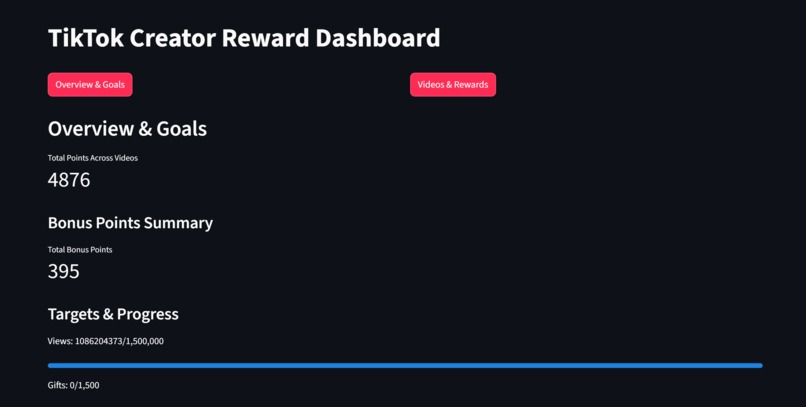
TikTok Creator Dashboard View 1
-
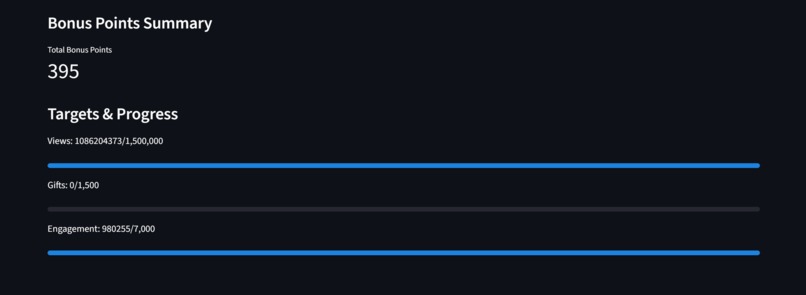
TikTok Creator Dashboard View 2
-
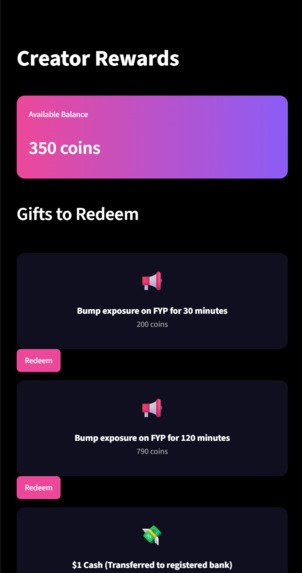
Creators Rewards Shop Mobile View 1
-
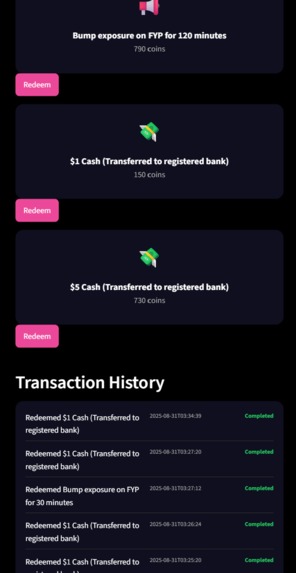
Creators Rewards Shop Mobile View 2
-
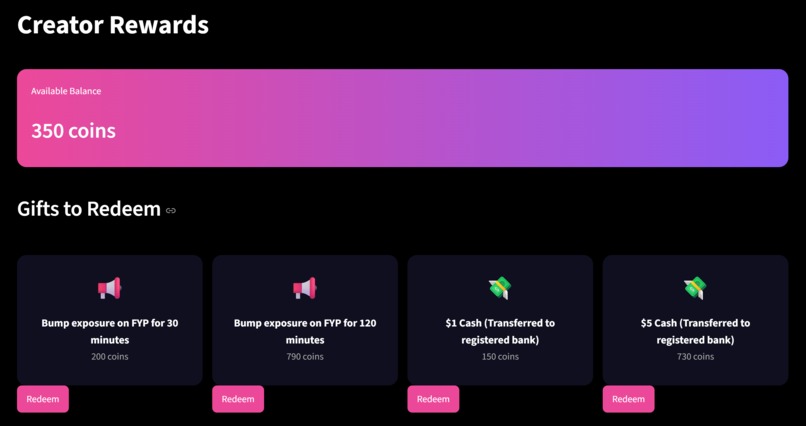
Creators Rewards Shop Web View 1
-
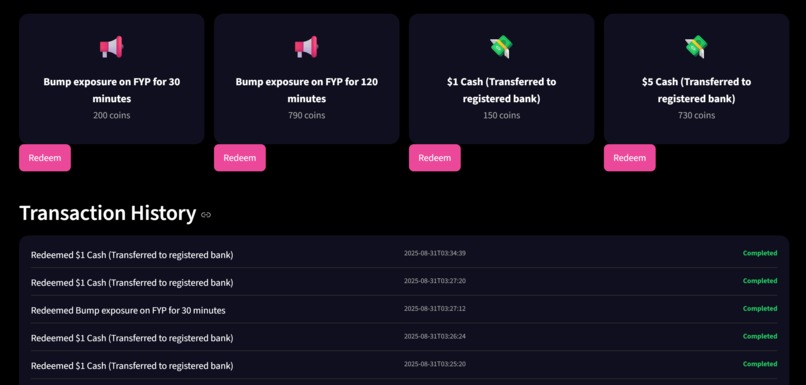
Creators Rewards Shop Web View 2


Inspiration
The Creator Rewards Shop is inspired by TikTok's own coin + gifting system, where users purchase coins in order to gift gifts to their favourite creators. This system works by having TikTok reward content creators with "coins" for their efforts in creating good content, which can then be used by creators in the Creator Rewards Shop in exchange for monetary rewards or a boost in their exposure on the platform.
What it does
- Content Scoring Mechanism – views, likes, shares, comments, bookmarks, engagement, sentiment are taken into account to generate "points" for each video posted.
- Bonus Points Mechanism – creators are rewarded for hitting certain milestones (e.g., hitting 100,000 followers, achieving 1M likes), which will then be added to their total points.
- Points are tallied every month and awarded to content creators in terms of "coins".
- Creators can use their "coins" to redeem either monetary rewards (sent via current method of bank transfer) or exposure (where their content is pushed by the algorithm for a certain period of time).
How we built it
We utilised Streamlit and Python to build our frontend UI and the point scoring mechanism.
To start the project, we first needed statistics from TikTok videos. We utilised a dataset from Kaggle trending.json as our starting point for viable TikToks, and then used extract_tiktok.py to extract video statistics (Views, Shares, Likes, Comments, Bookmarks) and other creator statistics. Videos were also stored in our Supabase storage buckets.
We then used sentiment_analysis.py, which utilised the Gemini API to process each TikTok video stored and provide a score from 0 to 1 indicating how much the platform would want the video, prioritising human-made content over AI-generated content.
Thereafter, we combined these statistics to generate a score using engagement_rate.py and points_calculation.py. Total points are inserted into our PostgreSQL table.
Challenges we ran into
- Prioritisation – There were numerous aspects to this project, such as whether to focus on calculation of content value, how to deliver that value to creators, and also prevent fraud/money-laundering. We chose to focus on calculation of content value and reimagining the way of delivering that value by creating the Creator Rewards Shop, where creators could 'shop' for their rewards.
- Lack of time – Difficulties in coordination due to the team having different schedules and being in different timezones.
Accomplishments that we're proud of
Despite the difficulties in communication and coordination (one of our team members is in Europe for their exchange semester), we are proud that we managed to deliver a prototype that showcases how our solution can be implemented, albeit with improvements.
What we learned
- Plan ahead – We could have made better use of the planning day and started coding earlier.
- Communicate – Schedule daily meetings to align on the project.
- Technical skills – We learned a new library (Streamlit), strengthened our knowledge in PostgreSQL (Supabase) databases, and improved our use of APIs.
What's next for Hackoclock - #6 Value-sharing Reimagined
- Implement fraud and anti-money laundering checks when processing each video.
- Improve prompt engineering – add more criteria for sentiment analysis of each video.
- Add more tasks and opportunities for creators to receive bonus points.
Built With
- buckets
- css
- gemini
- postgresql
- python
- streamlit
- supabase
- tiktokapi
- vite


Log in or sign up for Devpost to join the conversation.