Inspiration
Our university leaked student data, and scam emails are much harder to spot when the sender already knows who you are. Voice cloning makes it worse: the next scam could be a call that sounds like your friend. We wanted people to run into these attacks for the first time with friends, where a wrong tap costs nothing and everyone has agreed to take part.
What It Does
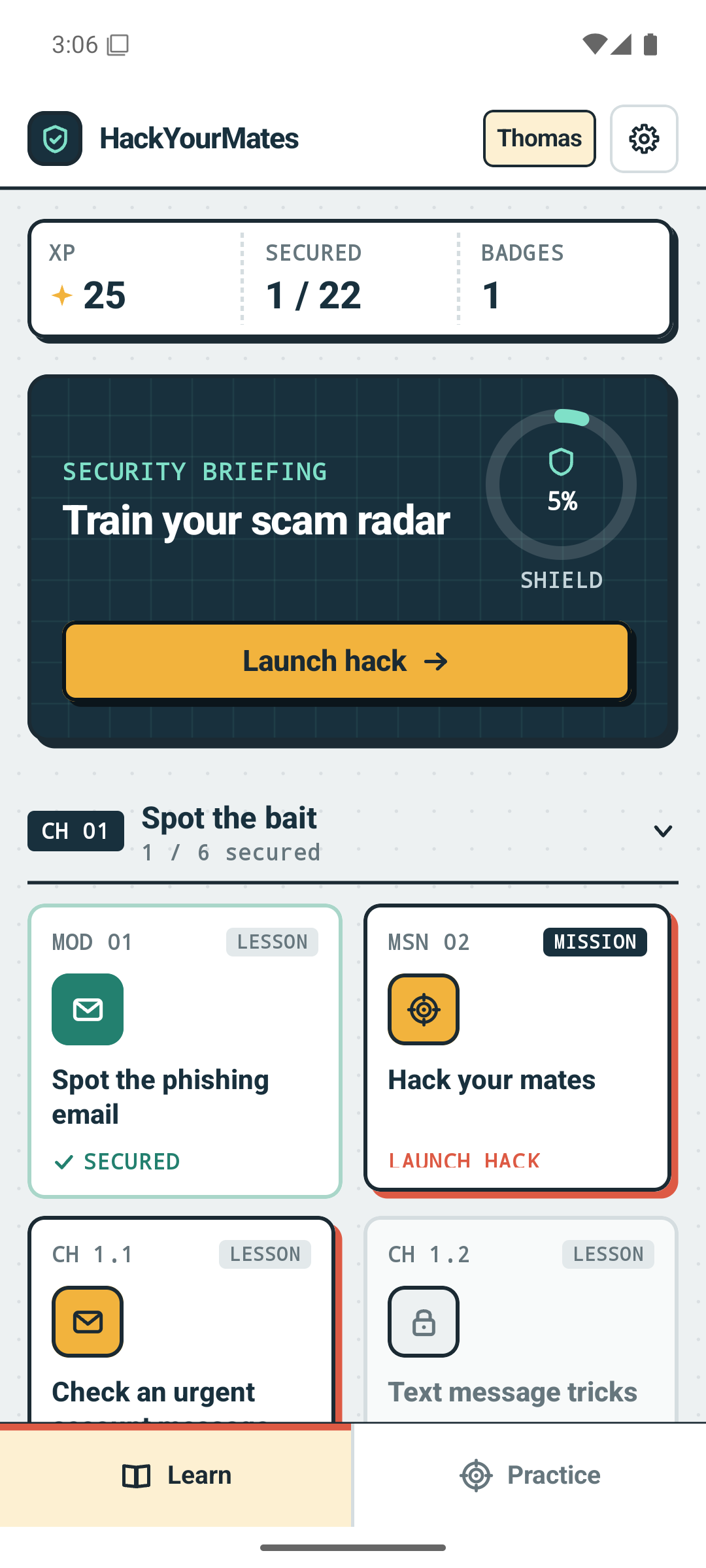
HackYourMates is an Android app where friends, families and teams send each other fake scams and learn from the ones they fall for.
- Private Groups & Consent: You create a group, describe it, and share an invite link. Receiving exercises, voice cloning and the use of your face are three separate consents per group. Only members who agreed to receive exercises can be targeted.
- Voice Onboarding: New members answer two short spoken questions. The app transcribes them and suggests a training plan. If you allowed voice cloning, the same recordings are used to clone your voice.
- Emails Written for Your Group: An LLM writes the sender name, subject and text from the group's name and description. The app adds the link and reporting code itself. The link never asks for a password, it only leads to the reveal.
- Calls in Your Friend's Voice: You can add a phone call to the email. The target's phone rings with a full-screen incoming call, and your cloned voice asks them to check that urgent email. Without voice consent, the call uses a stock voice.
- Video Calls: With voice and face consent, the call can also be a video call that shows your photo while your cloned voice speaks. Lip-synced video is available as an optional add-on.
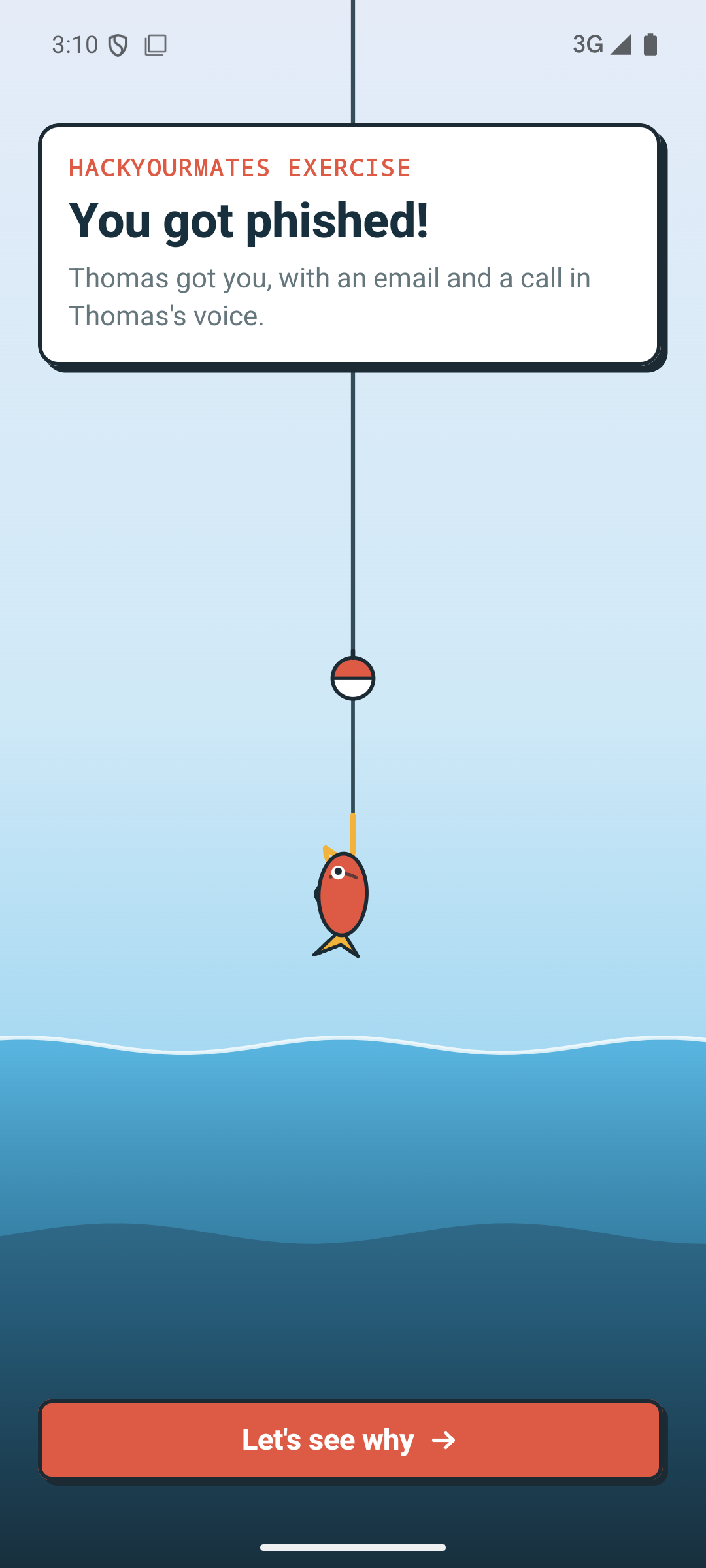
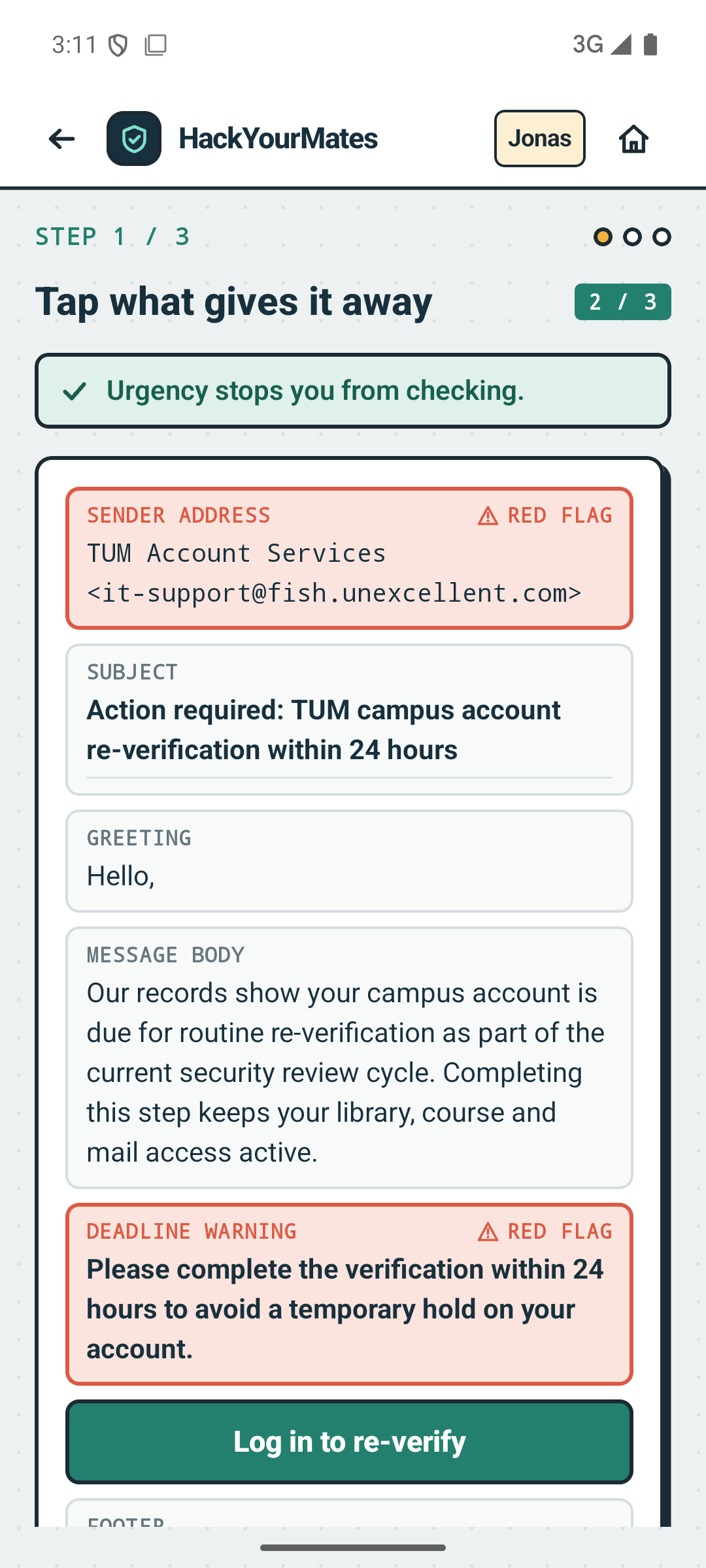
- Report or Get Hooked: Report the email with its code and you earn a point. Open the link first and the launcher earns it, you see a fish on a hook, and a debrief takes you through the red flags in the email you received.
- Lessons & Ranking: Short lessons cover phishing emails, text messages, phone calls, QR codes, passwords, two-step login and AI fakes. The group has a ranking, badges and an attack log, and you can send yourself a test run that gives no points.
How We Built It
- Android App: Kotlin, Jetpack Compose and Material 3. Firebase Cloud Messaging wakes the phone for a call and Android Telecom shows it. If push is not configured, the app polls while it is open.
- Backend: A TypeScript API with Hono on Cloudflare Workers. D1 stores accounts, groups, consents and results, and KV stores audio, photos and video. Cloudflare Email Service sends the emails.
- AI: Responsive LLM models like Claude Haiku writes the emails and call scripts and reads the onboarding answers. ElevenLabs does the transcription, voice cloning and speech. Lip sync runs through Anam.
- Testing: Vitest covers the backend, including consent, calls, failed video renders and the full demo flow. JUnit tests cover parts of the Android app.
- Pitch Deck: We built our own browser slides that mirror two live phones live over adb and explain what is on each screen.
We started with a Python web prototype that only sent emails, then rebuilt the project as an Android app.
Challenges We Ran Into
- Realistic but Safe: The scams have to be believable to teach anything. We kept them inside consenting groups, never ask for credentials, and made voice and face opt-in. Video calls can only use the launcher's own face and voice.
- Making the Phone Ring: A call needs to arrive even when the app is closed or the screen is locked. That meant combining push messages, Android Telecom and full-screen notifications. The push message itself only contains a call ID.
- Slow or Failing AI: Every AI step can fail. Emails and call scripts have prepared versions, a call without audio still shows captions, and a video call that takes too long to render rings with the photo instead.
- Email Delivery: TUM's mail servers greylist Cloudflare's changing IPs, and on the free plan Cloudflare only sends to verified addresses. We had to plan the live demo around both.
Accomplishments That We're Proud Of
- The whole loop works in real time on two phones: join, record your voice, launch an attack, get the email and the call, and go through the debrief.
- A short onboarding chat is enough for the app to call your friends in your voice, and you can delete the voice clone again, at ElevenLabs too.
- The debrief uses the email that fooled you instead of a generic example.
What's Next for HackYourMates
- Text-message and QR-code attacks. Both already have lessons, but you can't send them yet.
- Scheduled attacks, and calls that can answer back instead of playing one recording.
- Email verification and a proper login before we open it to more people.
- More scenarios and an iOS version.
Built With
- adb
- android
- android-telecom
- claude
- cloudflare-email-service
- elevenlabs
- firebase-cloud-messaging
- hono
- javascript
- jetpack-compose
- junit
- kotlin
- node.js
- okhttp
- openai
- python
- scrcpy
- smtp
- sqlite
- typescript
- unittest
- vitest
- webcodecs


